

Cloud Practitioner Pay vs. Solutions Architect at One Year
A data-driven comparison of entry-level AWS credentials to help you decide where to invest your study hours and exam budget.
You have $200 and roughly 80 hours of study time. Do you stop at the AWS Certified Cloud Practitioner, or push through to the Solutions Architect - Associate? The search data is clear: thousands of candidates agonize over this exact fork in their aws certification path every month. This comparison cuts through the marketing noise with salary ranges, typical job titles, employer requirements, and a one-year ROI model you can apply to your own situation.
What the Exams Actually Test
Before comparing paychecks, you need to understand what each credential signals to hiring managers. The gap in technical depth is substantial, and it directly shapes the roles you can credibly pursue.
The AWS Certified Cloud Practitioner validates foundational cloud literacy. Per the AWS Certification Exam guides, it covers basic cloud concepts, AWS core services at a high level, security fundamentals, and billing. You can pass with minimal hands-on experience. The exam is 65 questions, 90 minutes, and costs $100.
The Solutions Architect - Associate digs into designing distributed systems. You need to know VPC architecture, multi-tier applications, high availability patterns, and cost-optimization strategies across 65 questions in 130 minutes. The exam fee jumps to $150, and AWS recommends one to two years of hands-on experience. The [PDF] Plan your AWS Certification](https://d1.awsstatic.com/training-and-certification/docs/AWS_certification_paths.pdf) document positions this as the starting point for anyone with an IT or STEM background, while Cloud Practitioner is framed as optional for that same cohort.
This distinction matters because employers treat these credentials differently. Cloud Practitioner proves you can speak AWS terminology in a meeting. Solutions Architect - Associate proves you can sketch a three-tier web application on a whiteboard and defend the design.
Typical Job Titles and Responsibilities
Certifications do not exist in a vacuum. They qualify you for specific roles with specific expectations.
Cloud Practitioner holders typically land in positions where cloud knowledge is helpful but not the core technical requirement. Common titles include IT support specialist, technical sales associate, project coordinator, or junior business analyst. In these roles, you might explain AWS billing to a finance team, coordinate between developers and account managers, or support SaaS products that happen to run on AWS. The certification gets you noticed, but your daily work rarely involves touching the AWS Console.
Solutions Architect - Associate holders move into roles where cloud design is central. Titles include cloud support engineer, platform engineer, infrastructure analyst, or junior solutions architect. You are expected to design VPC subnets, select appropriate EC2 instance families, configure ALB routing rules, and justify cost decisions. The certification alone does not make you a senior architect, but it signals you can contribute to architecture discussions without constant supervision.
The responsibility gap translates directly to compensation. Employers budget differently for someone who translates cloud concepts versus someone who implements them.
Salary Ranges at the One-Year Mark
Salary data for certification holders is inherently noisy. Geographic location, prior experience, company size, and negotiation skill all swamp the credential effect. That said, aggregated market data from multiple sources reveals consistent patterns for U.S.-based professionals with roughly one year of post-certification experience.
Cloud Practitioner holders with one year in role typically earn between $52,000 and $71,000 annually. The median sits around $61,000. This range overlaps heavily with general IT support salaries, suggesting the credential provides a modest premium at best for pure technical roles. Where it adds clearer value is in non-technical positions—technical sales, customer success, or project coordination—where cloud fluency differentiates you from generic candidates.
Solutions Architect - Associate holders with comparable experience pull $78,000 to $112,000, with a median near $91,000. The floor is higher because the credential qualifies you for engineering roles with defined technical bars. The ceiling extends further because the associate-level knowledge base maps to measurable business outcomes: reduced infrastructure costs, improved availability, or faster deployment pipelines.
These figures assume you are leveraging the certification in a role that uses it. A Cloud Practitioner working as a cloud support engineer is an outlier, just as a Solutions Architect - Associate in pure sales is uncommon. The credential-to-role match drives the salary effect more than the credential alone.
The Hidden Cost of Stopping at Cloud Practitioner
The salary gap is only half the story. Career trajectory matters equally, and here the divergence becomes more pronounced.
Cloud Practitioner functions as a ceiling for many candidates. They earn the badge, list it on LinkedIn, and discover that technical interviews quickly expose the shallow depth. Without the associate-level credential, you are repeatedly screened out of roles that require hands-on design experience. The certification becomes a line item that generates interest but cannot close the deal.
Consider Maya, who earned Cloud Practitioner in March 2024 while working help desk. She applied to 34 cloud support roles over six months, received 12 first-round interviews, and advanced to final rounds twice. Both times, hiring managers asked her to whiteboard a multi-AZ deployment. She could describe availability zones conceptually but could not size instances or select storage classes. She eventually passed the Solutions Architect - Associate in November 2024, landed a cloud support engineer role by February 2025, and saw her salary jump from $58,000 to $87,000.
The Cloud Practitioner is not worthless. It is a stepping stone that becomes expensive if you treat it as a destination. The $100 exam fee and 20-30 study hours are trivial compared to the opportunity cost of delayed career progression.
Building the One-Year ROI Model
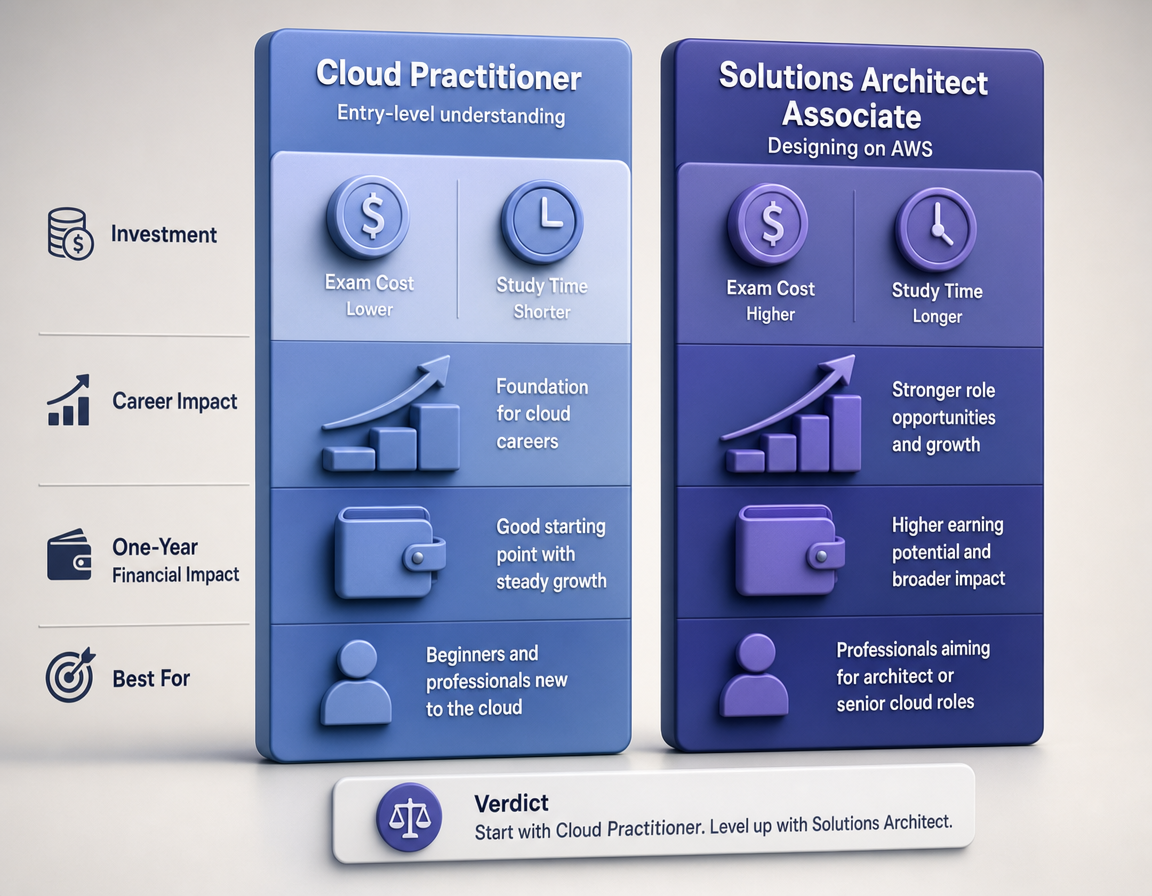
To compare these paths rigorously, you need to account for exam costs, study time, forgone earnings during study, and salary outcomes. Here is a conservative model for a U.S.-based candidate transitioning from a $55,000 general IT role.
| Cost Component | Cloud Practitioner Path | Solutions Architect - Associate Path |
|---|---|---|
| Exam fee | $100 | $150 |
| Study materials (practice tests, course) | $50-150 | $100-300 |
| Study hours | 25-35 | 60-80 |
| Estimated forgone earnings during study* | $660-920 | $1,580-2,110 |
| Total first-year investment | $810-1,170 | $1,830-2,560 |
| Typical first-year salary | $58,000-65,000 | $82,000-95,000 |
| Salary increase vs. baseline ($55K) | $3,000-10,000 | $27,000-40,000 |
| One-year ROI | 156-754% | 955-2,086% |
*Forgone earnings calculated at $26.44/hour ($55,000 annual ÷ 2,080 hours), assuming study replaces overtime or side work, not primary employment.
The model is deliberately conservative. It assumes you pay for quality practice materials rather than relying solely on free resources. It assigns monetary value to study time. It uses the lower bound of typical salaries. Even under these constraints, the Solutions Architect - Associate path generates roughly 3-10x the one-year return.
The Cloud Practitioner path can still make sense, but the financial case requires specific conditions: your employer reimburses the exam, you need cloud literacy for a non-technical role, or you are validating interest before committing to deeper study. For candidates already in IT, the associate path dominates on pure ROI.
When Cloud Practitioner Is the Smarter First Move
Despite the ROI data, blanket recommendations mislead. The AWS Certification Paths.Pdf explicitly recommends Cloud Practitioner for two profiles: candidates from non-IT backgrounds switching to cloud careers, and business professionals in sales or marketing roles who need stakeholder communication skills.
If you have zero IT experience, the associate exam is brutal. The questions assume familiarity with networking, Linux administration, and distributed systems. You can brute-force memorize services, but the scenario-based questions require intuition that only comes from hands-on work. Cloud Practitioner lets you validate your commitment, learn AWS terminology, and decide whether to invest the 6-12 months of foundational study needed for associate-level success.
Similarly, if your goal is technical sales or customer success at an AWS partner, Cloud Practitioner plus strong communication skills often outperforms Solutions Architect - Associate. Partners hire people who can translate between business requirements and technical capabilities, not necessarily people who design architectures.
The credential is also useful for team leads and managers who need to evaluate cloud proposals without implementing them. Understanding cost models, security shared responsibility, and service categories helps you ask better questions of your engineering team.
When Solutions Architect - Associate Should Be Your Starting Point
For candidates with 1-3 years of IT or STEM experience, AWS recommends skipping Cloud Practitioner entirely. The [PDF] Plan your AWS Certification](https://d1.awsstatic.com/training-and-certification/docs/AWS_certification_paths.pdf) document treats the associate level as the default entry point for this cohort, and the salary data supports that guidance.
If you have configured routers, managed Linux servers, or written infrastructure-as-code templates, the associate exam is challenging but achievable in 8-12 weeks of part-time study. The knowledge gaps are AWS-specific rather than foundational. You are learning how AWS implements load balancing, not what load balancing is.
The credential also unlocks faster advancement. With Solutions Architect - Associate and one year of cloud experience, you can credibly pursue the Professional level or specialty certifications. The Cloud Practitioner does not satisfy prerequisites for these advanced credentials, so stopping there creates a dead end in your certification trajectory.
Employer demand reinforces this path. Job postings for cloud engineer, DevOps engineer, and platform engineer roles frequently list Solutions Architect - Associate as preferred or required. Cloud Practitioner rarely appears in technical job requirements outside of entry-level support or sales roles.
How to Structure Your Study for Either Path
The study approach differs substantially between these credentials, and your choice of preparation materials affects both pass probability and knowledge retention.
For Cloud Practitioner, a two-week sprint is realistic. Focus on AWS core services (EC2, S3, RDS, Lambda), the Well-Architected Framework pillars, billing models, and basic security concepts. The AWS Certified Cloud Practitioner Practice Test at PlanetCert includes 830 questions across two versions, which is overkill for this level but builds confidence if you are anxious about test performance.
For Solutions Architect - Associate, plan 8-12 weeks with consistent hands-on practice. You need to build VPCs from scratch, configure auto scaling groups, implement multi-AZ deployments, and troubleshoot connectivity issues. The exam tests design decisions under constraints: cost, availability, performance, or security requirements. Memorizing service features is insufficient; you need to understand trade-offs.
The AWS Certified Solutions Architect - Associate Practice Exam provides 571 questions that mirror the exam's scenario-heavy format. More importantly, the explanations clarify why an answer is correct, not just which option to select. This distinction matters because the real exam often presents multiple valid architectures with subtle optimization differences.
Regardless of path, schedule your exam before you feel fully ready. The fixed deadline compresses study efficiency. Candidates with open-ended timelines often dilute their effort across months without improving outcomes.
The Verdict: A Decision Framework
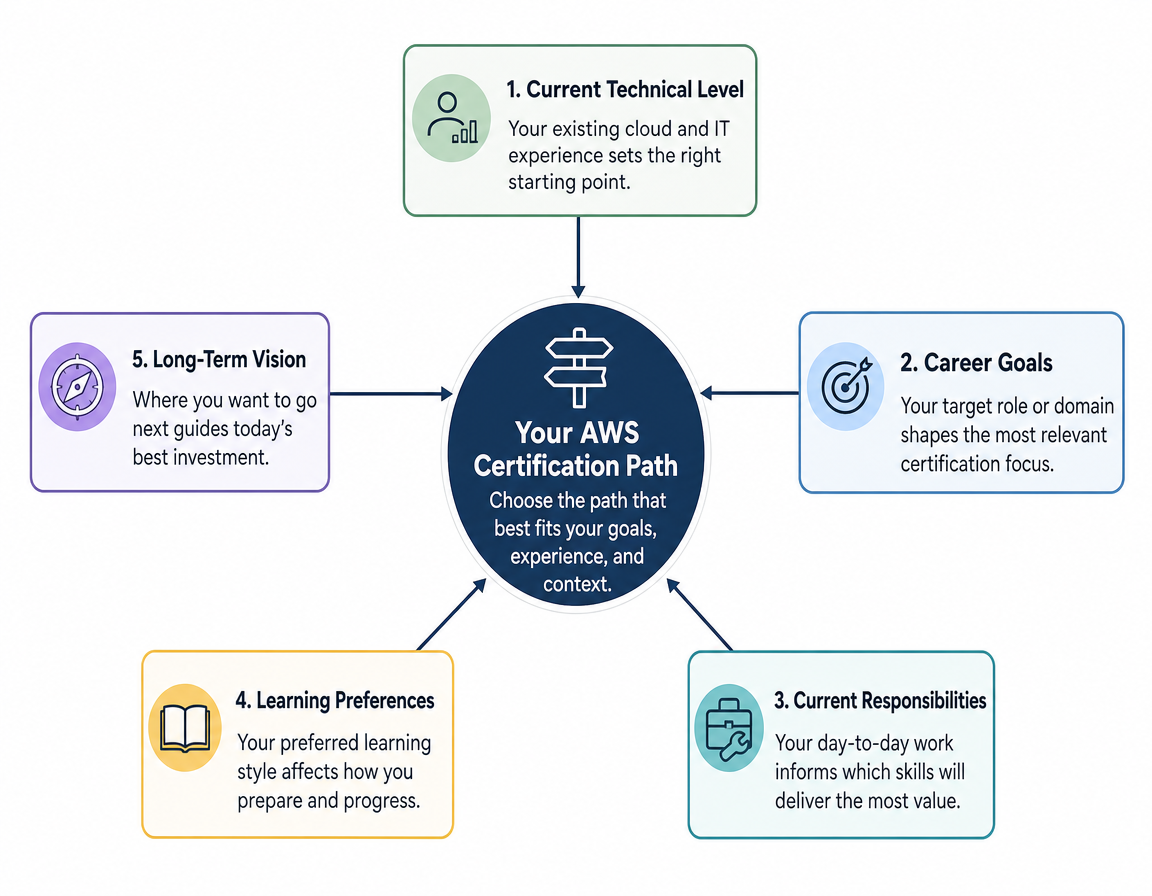
Your optimal path depends on three factors: your current technical depth, your target role, and your risk tolerance for study investment.
| Decision Factor | Choose Cloud Practitioner First | Go Direct to Solutions Architect - Associate |
|---|---|---|
| Current experience | Non-IT background; business/sales role | 1-3 years IT infrastructure, networking, or development |
| Target role | Technical sales, project coordination, management | Cloud engineer, platform engineer, solutions architect |
| Study risk tolerance | Prefer quick win; uncertain about cloud career | Comfortable with 2-3 month commitment; confident in technical abilities |
| Salary priority | Modest increase acceptable; value credential breadth | Maximize near-term earning potential |
| Long-term trajectory | May pursue advanced certs later; exploring options | Committed to cloud architecture or engineering path |
The framework is not rigid. A career switcher with strong self-study discipline can succeed at the associate level. An experienced sysadmin with limited time might grab Cloud Practitioner for a quick credential while planning associate study for later. The key is intentional choice rather than defaulting to the easier path.
What Comes After Each Credential
Your first AWS certification should fit into a larger plan, not exist in isolation.
Cloud Practitioner holders typically progress in one of three directions: deepening into an associate-level technical credential, adding a specialty badge in security or machine learning, or pivoting to role-specific training like AWS Partner accreditation. The credential itself does not unlock advanced exams, so the next step always requires significant additional study.
Solutions Architect - Associate holders have more branching options. The professional-level Solutions Architect exam becomes accessible with two or more years of design experience. Specialty certifications in security, networking, or databases build on the associate foundation. Alternatively, the DevOps Engineer - Professional path rewards candidates with operational experience.
The Premium Amazon Practice Tests collection covers the full progression from foundational through professional levels, which matters if you want consistent question quality across your certification journey rather than switching platforms at each tier.
Related Blog Posts
- Top 7 AWS Practice Tests for Success in 2026 — How to evaluate practice test quality across the major providers
- Best AWS Solutions Architect Associate Courses Are Wrong — A critical look at course marketing versus actual exam preparation needs
- AZ-900 Cloud Concepts vs AWS Cloud Practitioner Exam Scope — If you are cross-shopping cloud foundational credentials across vendors
- Learning Hub | Planet Cert
- Why Choose Aws Certified Solutions Architect
browse the relevant exam page and purchase a practice test
Get started
Discussion
Question Comments
0 comments·0 participantsSign in to leave a comment and access more free questions.