

Why AZ-900 Is the Best Cloud Cert for Beginners in 2026
If you are trying to break into cloud computing, the sheer number of entry-level certifications can paralyse your decision. AWS, Azure, and Google Cloud each offer a fundamentals credential, and every training site claims theirs is the smartest first step. The question is not which cloud is biggest. It is which exam gives a beginner the strongest foundation with the least friction.
AZ-900, the Microsoft Azure Fundamentals exam, wins on that combination in 2026. It costs less than its rivals, carries no prerequisites, never expires, and now covers AI fundamentals after Microsoft's January 2026 refresh. This article unpacks exactly why that matters, how the exam compares to AWS Certified Cloud Practitioner and Google Cloud Digital Leader, and what a realistic study path looks like if you are starting from zero.
What AZ-900 Actually Tests
Microsoft splits AZ-900 into three domains: cloud concepts, Azure architecture and services, and Azure management and governance. The 2026 refresh added generative-AI content, Microsoft Copilot, and Responsible AI principles, reflecting how Azure services now embed AI by default. You will not write code, deploy infrastructure from a CLI, or architect a multi-region solution. The exam checks whether you can describe compute, networking, storage, identity, and cost management in plain language.
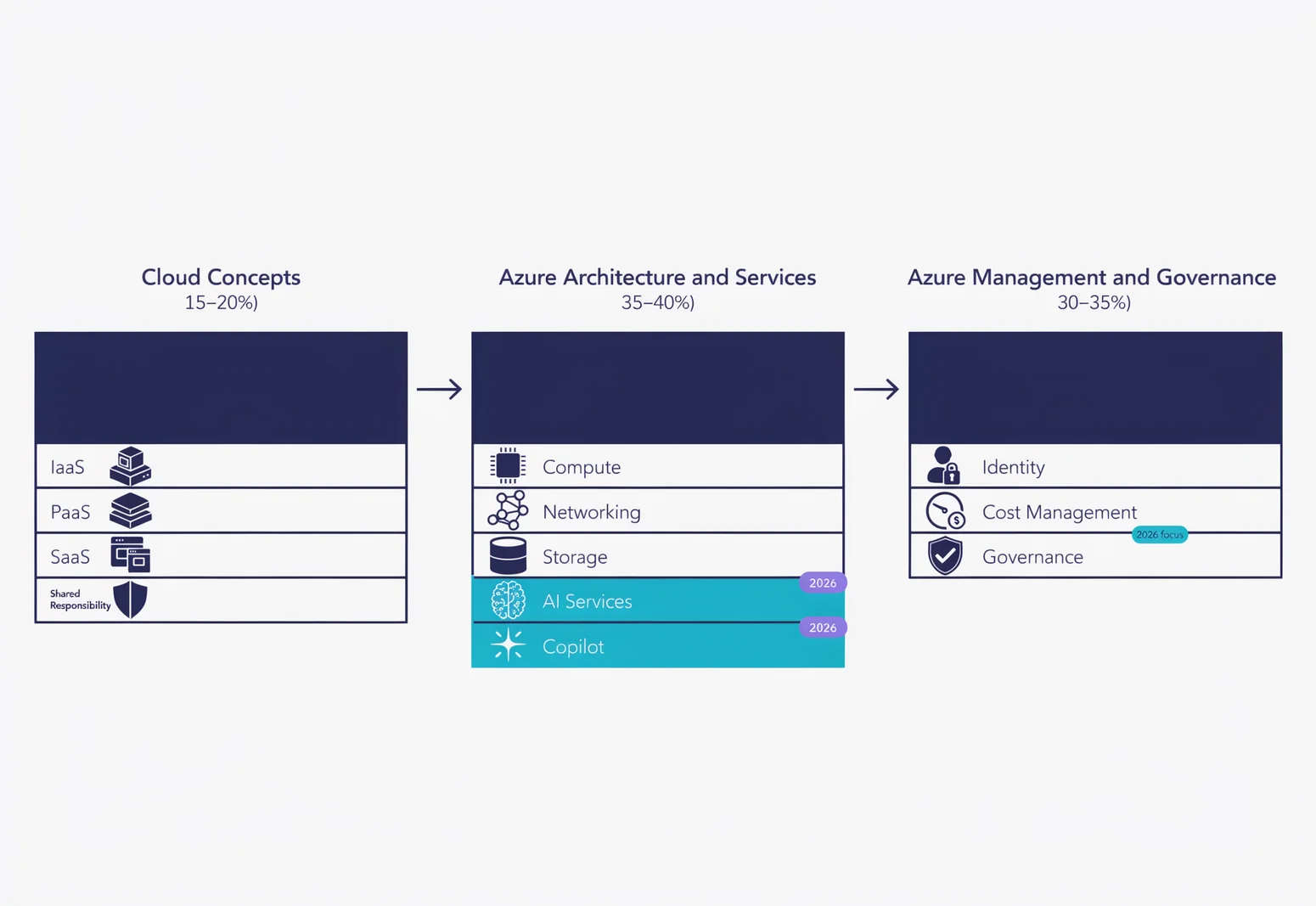
"This certification is a common starting point in a journey towards a career in Azure." — Microsoft guidance
That positioning matters. AZ-900 is explicitly designed as a gateway, not a filter. You can sit it with no IT background, pass in three to five weeks of part-time study, and walk away with a credential that does not expire. Role-based certifications like AZ-104 or AZ-305 require renewal every year; fundamentals certifications do not.
The AI additions are worth noting for beginners. Rather than forcing you to take a separate AI-900 exam, Microsoft folded foundational AI literacy into the core curriculum. If you work in a non-technical role—project management, sales support, finance operations—you now get exposure to how Azure AI services, Copilot, and responsible AI frameworks fit into business decisions without needing to train models or manage data pipelines.
Cost, Access, and Risk
AZ-900 costs $99 in the United States, with regional pricing that typically stays below equivalent AWS and Google exams. Microsoft also runs Virtual Training Days that often include free exam vouchers. With patience, your out-of-pocket cost can drop to zero. That is a meaningful difference when you are testing whether cloud is the right career direction.
The exam format is straightforward: 40–60 multiple-choice questions, either proctored online or at a test centre. No labs, no simulations, no waiting days for a practical assessment score. You know immediately whether you passed, and you can retake after a short cooling-off period if needed.
For career changers or students, that low-stakes structure reduces the anxiety that stops many beginners from scheduling their first cert. You are not gambling $300 and a weekend on a hands-on lab you might misconfigure. You are proving conceptual understanding, which is exactly what most entry-level cloud roles expect first.
How It Compares to AWS Cloud Practitioner
AWS Certified Cloud Practitioner (CLF-C02, with a C03 update scheduled for late 2026) is AZ-900's closest rival. Both are multiple-choice, both cost under $150, and both target non-technical audiences. The difference is in scope and tone.
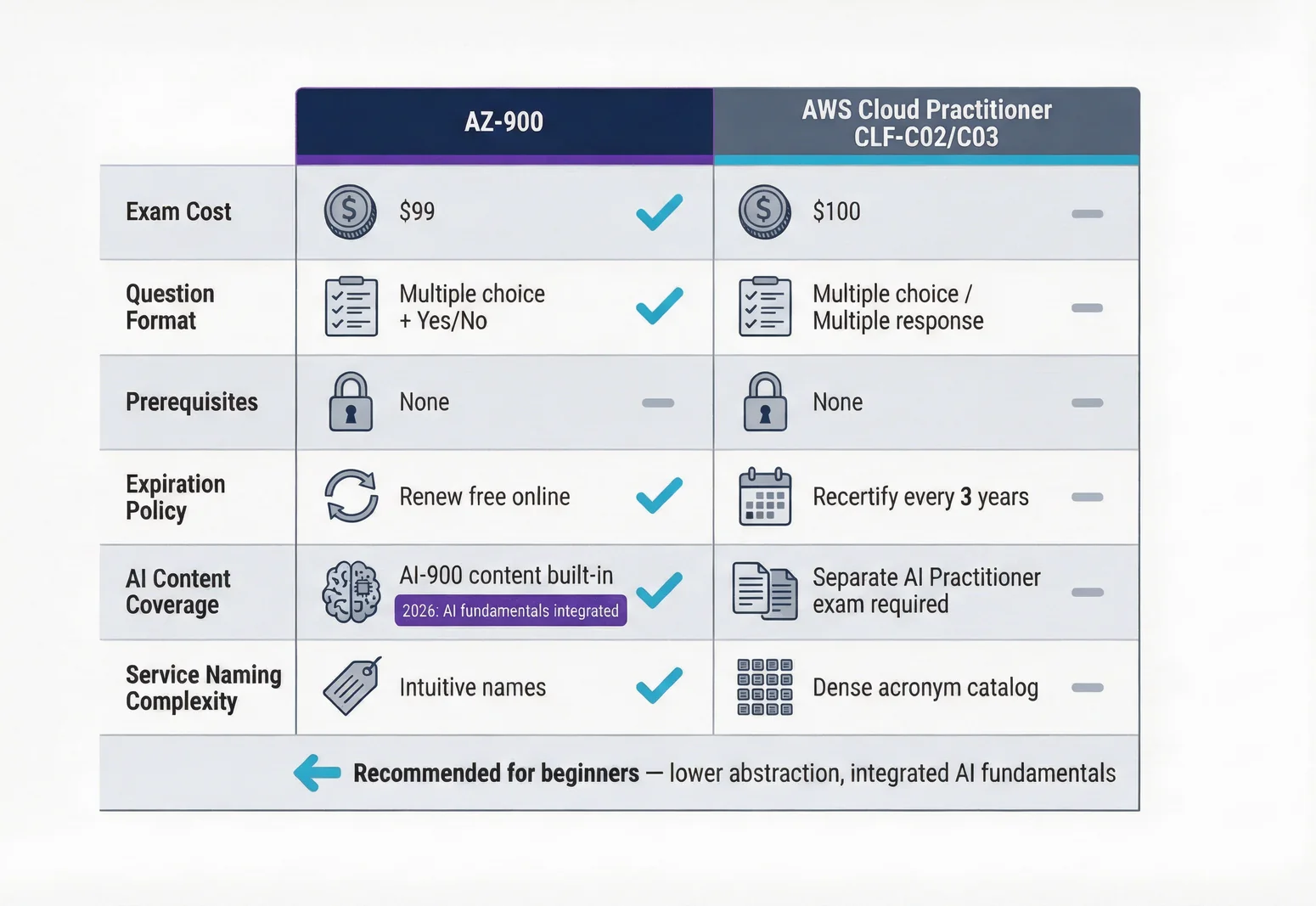
AWS spreads its fundamentals across a broader service catalogue. The exam touches compute, storage, networking, security, billing, and support plans, but it also expects familiarity with AWS's dense service naming and its shared responsibility model in more depth than AZ-900 demands. Many beginners find the AWS exam slightly more abstract because it assumes you are learning AWS's organisational logic at the same time you are learning cloud concepts.
AZ-900, by contrast, front-loads conceptual clarity. Microsoft's study guide structures learning around what a service does and why an organisation would choose it, not how to configure it. That pedagogical choice makes AZ-900 feel less like a product tutorial and more like a cloud literacy course.
"AZ-900 gives you foundational fluency rather than hands-on admin skills, and its real value is educational—preparing candidates for smarter cloud decisions and further study." — Windows News Team, July 2026
If your employer or target job market is Azure-heavy, AZ-900 is the obvious first step. If you need vendor-agnostic cloud literacy, either works, but AZ-900's tighter conceptual focus tends to build confidence faster for absolute beginners. You can explore the AZ-900 versus AWS CCP scope in more detail if you are genuinely undecided.
Google Cloud Digital Leader: A Different Animal
Google Cloud Digital Leader sits at a higher altitude. It targets business decision-makers and focuses on digital transformation strategy, data analytics, and Google Cloud's value proposition rather than technical fundamentals. The exam costs $99 plus tax, similar to AZ-900, but the content assumes you are already conversant with cloud concepts and want to align them with business outcomes.
That makes Google Cloud Digital Leader a poor first cert for someone with no IT exposure. It is better suited to product managers, consultants, or executives who need to evaluate cloud investments, not to someone who cannot yet explain the difference between IaaS and PaaS. If you are starting from zero, AZ-900 or AWS CCP will ground you first; Google Cloud Digital Leader becomes relevant later in your trajectory.
For a broader three-way comparison, see our Azure versus Google Cloud certifications breakdown.
The 2026 Refresh: What Changed and Why It Helps Beginners
Microsoft's January 2026 AZ-900 update introduced three significant shifts:
- AI services and Copilot: Candidates now need to describe what Azure OpenAI Service, Azure AI Foundry, and Microsoft Copilot do at a high level, and how organisations can use them responsibly.
- Responsible AI principles: Fairness, reliability, privacy, inclusiveness, transparency, and accountability are now explicit exam topics.
- Tightened governance focus: Cost management, resource tagging, and policy enforcement received greater weight, reflecting real-world operational concerns.
These changes do not make the exam harder. They make it more current. A beginner who passes AZ-900 in 2026 enters the job market with vocabulary that hiring managers actually use—Copilot, responsible AI, cost optimisation—not just theoretical cloud definitions.
The refresh also matters because Microsoft retired AI-900 (Azure AI Fundamentals) as a standalone entry point. AI-901 replaced it at a higher level, so AZ-900 is now the only Microsoft fundamentals cert that covers AI basics without requiring prior technical depth. That consolidation simplifies the certification roadmap rather than complicating it.
Who Should Start with AZ-900
AZ-900 fits several distinct profiles:
- Career changers with no IT background who need a credential that proves cloud literacy to recruiters.
- IT support staff who work alongside cloud teams and need to understand what those teams are building.
- Students and recent graduates who want a low-cost, low-risk cert before committing to a full Azure role-based path.
- Business professionals in sales, finance, or project management who interact with Azure workloads and need to speak the language.
It is less useful if you are already two years deep in Azure administration or you hold AZ-104. In that case, skip ahead to an associate-level credential. But for the audience this article addresses—people asking whether AZ-900 is worth it as a beginner—the answer is consistently yes, provided you treat it as a foundation, not a destination.
Building a Realistic Study Plan
Most beginners need three to five weeks of part-time study. A sustainable week looks like this:
- Week 1: Cloud concepts. IaaS, PaaS, SaaS, public/private/hybrid models, and the shared responsibility model. Microsoft's free Learn modules cover this well.
- Week 2: Core Azure services. Compute (VMs, App Service, container instances), networking (VNets, VPN Gateway, ExpressRoute), and storage (Blob, Disk, File, Archive tiers).
- Week 3: Identity, governance, and cost management. Microsoft Entra ID, RBAC, resource groups, subscriptions, and Azure Policy.
- Week 4: AI fundamentals and review. Copilot, Azure OpenAI Service, responsible AI principles, and a first pass through practice questions.
- Week 5: Timed practice exams and gap closure. Focus on questions you got wrong, not just your overall score.
Microsoft Learn remains the canonical free resource, but many candidates supplement with Microsoft certification practice tests to build exam rhythm and identify weak domains before the real sitting. The value of practice tests is not memorisation—it is learning how Microsoft phrases scenario questions and which distractors appear repeatedly.
If you want structured guidance on the 2026 exam cycle, our Azure certification tips 2026 article covers scheduling, voucher hunting, and objective-tracking tools.
Common Beginner Mistakes
Over-preparing is the most frequent error. AZ-900 is not AZ-104. You do not need to build a lab, script deployments, or master the Azure CLI. Candidates who treat it like an associate-level exam often burn out or over-schedule, delaying their first win unnecessarily.
Under-preparing for the AI content is the newer mistake. Because AI fundamentals were added in 2026, older study guides and video courses may skip them entirely. Verify that any material you use was updated after January 2026, or supplement with Microsoft's current Learn paths.
Finally, many beginners hesitate to schedule the exam until they feel "ready." With AZ-900, readiness is a diminishing threshold. If you are scoring consistently above 80% on timed practice tests, book the exam. The cost of a retake is lower than the cost of lost momentum.
What Comes After AZ-900
Passing AZ-900 gives you a credential that never expires, but it does not qualify you to build Azure infrastructure. The logical next steps depend on your target role:
- Cloud administrator: AZ-104 (Azure Administrator Associate).
- Cloud security engineer: AZ-500 (Azure Security Engineer Associate), though SC-900 is a gentler security fundamentals bridge.
- Data or AI path: DP-900 (Azure Data Fundamentals) or the new AI-901.
- DevOps or developer: AZ-204 or AZ-400, but only after you have hands-on experience.
AZ-900's real value is positioning you to choose intelligently among those paths. Without it, you are guessing which associate cert matches your skills. With it, you have a map.
Questions Beginners Actually Ask
Does AZ-900 expire? No. Microsoft fundamentals certifications, including AZ-900, do not require renewal. Role-based and specialty certifications do.
Can I pass AZ-900 with no IT experience? Yes. The exam is explicitly designed for technology professionals who want to demonstrate foundational knowledge, but "foundational" here means conceptual, not operational. Microsoft recommends some IT exposure, but it is not enforced as a prerequisite.
Is AZ-900 enough to get a cloud job? Rarely on its own. It signals cloud literacy and commitment, which helps entry-level applications stand out. Most hiring managers expect it to be paired with either hands-on experience, an associate cert, or a relevant project portfolio.
How does the 2026 AI content affect difficulty? The AI additions are descriptive, not technical. You need to know what Copilot and Azure OpenAI Service do, not how to implement them. Most candidates find this section intuitive if they have used any consumer AI tool.
Should I take AZ-900 or skip straight to AZ-104? Skip only if you already administer Azure daily and understand its core services. For everyone else, AZ-900 builds the conceptual vocabulary that makes AZ-104 study far more efficient.
From First Cert to First Cloud Role
AZ-900 succeeds as a beginner cert because it respects where beginners actually start. It does not demand coding, infrastructure experience, or a months-long study sabbatical. It teaches you to describe cloud concepts, recognise Azure services, and understand governance and AI fundamentals in business context. At $99—or often free with a training voucher—it is the lowest-risk entry point into a field that otherwise rewards specialisation.
The 2026 refresh keeps it current without inflating its complexity. By folding in AI literacy and tightening governance focus, Microsoft ensured that AZ-900 graduates speak the same language as the teams they hope to join.
If you are deciding whether to start your cloud journey here, the evidence points clearly toward yes. Schedule your exam, build a three-week study rhythm, and treat the credential as proof of concept—for yourself and for employers—that cloud is a field you can enter methodically, not just aspire toward.
References
- Why AZ — The AZ-900 Microsoft Azure Fundamentals is an ideal kickstarter as it is an entry-level certification offered by Microsoft for beginners who are freshers and who are looking to
Keep Building Your Certification Roadmap


Discussion
Question Comments
0 comments·0 participantsSign in to leave a comment and access more free questions.