
Microsoft Azure Certification Path: Role-Based Fundamentals to Expert 2026
Microsoft's credential program is built around four tiers: Fundamentals, Associate, Expert, and Specialty. Each maps to real job functions rather than broad product knowledge, so your azure certifications path should start with what you actually do—or want to do—day to day. In 2026, this structure matters more than ever. Three exams have refreshed this year alone, two more retire by August 31, and new AI-focused credentials have entered beta. Whether you're shifting from on-premises infrastructure, deepening a cloud specialty, or breaking into IT for the first time, the right sequence saves money, study time, and retake stress.
This guide walks you through selecting and scheduling your exams using the current numbering, pricing, and role mappings. It covers prerequisite realities (spoiler: Microsoft enforces almost none formally), realistic timelines, and how to avoid studying for a retiring test.
How the Four Tiers Actually Work
Microsoft organizes Azure credentials into Fundamentals, Associate, Expert, and Specialty levels. According to Microsoft guidance, this progression is "comprehensive, progressive, renewable, and shareable"—meaning each exam reflects job tasks, builds on previous tiers, renews annually through free online assessments, and ports to LinkedIn and other platforms.
Fundamentals exams cost $99, never expire, and require no prior certification. They cover concepts, not hands-on configuration. Associate and Expert exams run $165, remain valid for 12 months, and demand deeper technical execution. Specialty exams also cost $165 and last 12 months, but target narrow domains like SAP workloads or Azure Virtual Desktop.
The 2026 landscape includes one major shift: AI-900 retires June 30, replaced by AI-901 with a Microsoft Foundry focus. AZ-204 (Azure Developer Associate) retires July 31. AZ-500 (Azure Security Engineer Associate) retires August 31, with SC-500 launching as its replacement. If you're mid-preparation on any of these, timing your exam date is now urgent.
Mapping Exams to Your Current Role
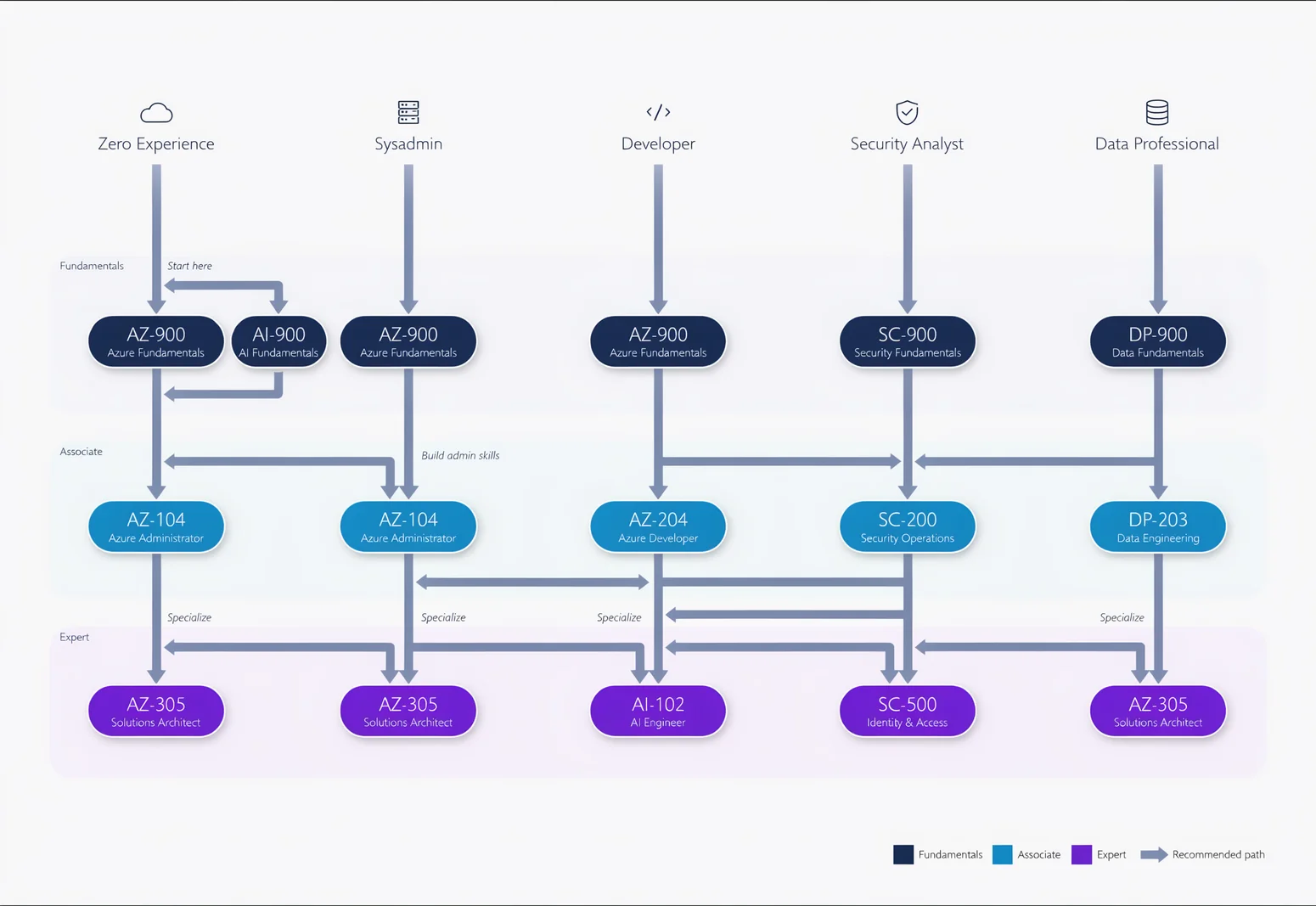
The most efficient azure certifications path starts with honest role assessment, not salary chasing. Here's how the tiers line up with common positions.
Starting from Zero: Fundamentals
AZ-900 (Azure Fundamentals) remains the standard entry point. It validates cloud concepts, core Azure services, pricing, and support—no labs, no PowerShell, no prior IT work required. AI-901 (replacing AI-900) adds Microsoft Foundry and generative AI concepts. DP-900 covers data fundamentals. SC-900 handles security, compliance, and identity basics. MS-900 is the Microsoft 365 parallel, less relevant for pure Azure tracks.
If you're completely new to cloud, AZ-900 is the safest first step. It costs $99, takes most candidates 2-3 weeks of part-time study, and confirms whether cloud work genuinely interests you before you spend on pricier Associate exams. Our AZ-900 beginner fundamentals guide breaks down the 2026 objective domains and how they compare to AWS's Cloud Practitioner.
Infrastructure and Operations: The AZ-104 Anchor
AZ-104 (Azure Administrator Associate) is effectively the gateway to every infrastructure and architecture track above it. It covers VMs, virtual networks, storage, Entra ID, backup, and monitoring—the operational backbone that AZ-305 (Solutions Architect Expert) assumes you already know.
Most administrators need 6-10 weeks of consistent study. Microsoft Learn's free modules help, but the exam tests applied knowledge, not memorization. You need hands-on lab time in a real Azure subscription. PlanetCert's practice tests for AZ-104 include scenario-based questions and explanations that map back to the official skills measured, which helps close gaps before you sit the live exam.
From AZ-104, typical progressions run:
- Cloud Administrator / Architect: AZ-104 → AZ-305
- DevOps Engineer: AZ-104 → AZ-400
- Security Engineer: SC-900 → SC-200 → SC-500 (from August 2026)
- Hybrid Specialist: AZ-800 + AZ-801 (Windows Server Hybrid Administrator Associate)
The AZ-800 hybrid infrastructure exam details how Microsoft now tests Windows Server 2025, Azure Arc, and hybrid join scenarios—critical for organizations not fully cloud-native.
Development and AI: The 2026 Restructure
The developer track saw the biggest 2026 shakeup. AZ-204 retires July 31, 2026. Its replacement, AI-103 (Azure AI Apps and Agents Developer Associate), entered general availability earlier this year. AI-200 (Azure AI Cloud Developer Associate) is currently in beta and becomes widely available later in 2026.
For developers choosing an azure certifications path now, the decision splits by interest:
- Traditional app development on Azure: Complete AZ-204 before July 31, or wait for Microsoft's announced replacement structure
- AI and generative development: Start with AI-901 fundamentals, then AI-103 for applied AI apps and agents
- Full-stack AI engineering: AI-901 → AI-103 → AI-200 when available
The AI track now carries explicit Microsoft Foundry and Copilot Studio components. This isn't surface-level "what is machine learning" content—it tests building, deploying, and securing AI applications on Azure infrastructure.
Security: From Engineering to Architecture
Security credentials have their own parallel track. SC-900 (Security, Compliance, and Identity Fundamentals) feeds into SC-200 (Security Operations Analyst) or SC-300 (Identity and Access Administrator). SC-100 (Cybersecurity Architect Expert) sits at the top.
The critical 2026 change: AZ-500 retires August 31, with SC-500 launching as its replacement. If you're currently studying AZ-500, you have a narrow window to test. The SC-401 security specialty changes article tracks how Sentinel KQL and threat hunting now replace older Log Analytics emphasis—part of Microsoft's broader security exam refresh.
Security architects often hold both AZ-104 and SC-200 before attempting SC-100. The cross-domain knowledge is deliberate: you can't architect security controls without understanding both infrastructure operations and threat detection workflows.
Data and Analytics
DP-900 (Data Fundamentals) leads to several Associate options: DP-203 (Data Engineer), AI-103 (which overlaps with data engineering for AI pipelines), or PL-300 (Power BI Data Analyst). The PL-300 data analyst exam format article details the case-study structure, PBIX lab requirements, and 700-point passing threshold—distinctly different from the multiple-choice-heavy Fundamentals exams.
For database specialists, DP-300 (Azure Database Administrator Associate) remains the target. Data scientists have a separate track through DP-100, though this sits outside the core Azure role-based structure.
Building a Realistic Study Timeline
Most professionals underestimate preparation time by focusing on video consumption rather than hands-on practice. Here's what actually works, based on exam tier and your weekly availability.
Fundamentals (AZ-900, AI-901, DP-900, SC-900): 20-30 hours total. Spread across 2-4 weeks at 7-10 hours weekly. Microsoft Learn paths are sufficient for concept coverage. Add practice tests in the final week to identify weak domains and build timing comfort.
Associate (AZ-104, AZ-204, SC-200, DP-203): 60-90 hours. Plan 6-10 weeks at 10-12 hours weekly. The first third covers concepts through structured learning. The middle third is hands-on lab work in Azure—building VMs, configuring VNets, deploying storage, scripting with Azure CLI or PowerShell. The final third combines practice exams with targeted review of missed objectives.
Expert (AZ-305, AZ-400, SC-100): 80-120 hours, often 10-14 weeks. These exams assume Associate-level operational fluency. AZ-305, for example, tests architectural decisions across compute, network, storage, security, and cost optimization—not how to create a VM, but whether to use VMs, containers, or serverless for a given workload, and how to secure and monitor the choice.
Specialty (AZ-120, AZ-140, AZ-220, AZ-700, and others): 40-60 hours, highly variable by domain overlap with your existing work. AZ-700 (Azure Network Engineer Associate) is technically Associate-tier but functions as a specialty for network-focused roles.
The 12-month validity on Associate, Expert, and Specialty credentials means you'll need annual renewal through Microsoft's free online assessments. These are shorter than the original exam and open-book, but they update to reflect current platform features. Budget 2-3 hours yearly per active credential.
Cost Planning and Exam Scheduling
Exam fees are straightforward: $99 for Fundamentals, $165 for all higher tiers. Retakes require full payment unless you purchased through a bundled program. Microsoft occasionally offers discounted exam vouchers through events or enterprise agreements, but standard pricing dominates for individual candidates.
The hidden cost is preparation material. Microsoft Learn is free and comprehensive, but many candidates need structured practice to build exam readiness. PlanetCert's simulator includes timed modes, flashcards, and explanations mapped to official objectives—useful for the final 2-3 weeks when you need to transition from learning to performance.
Scheduling strategy matters in 2026 specifically. With AZ-204 and AZ-500 retiring, Pearson VUE test centers and online proctoring slots fill near deadlines. Book at least 3-4 weeks ahead for your target date, with buffer time for a potential retake if you're cutting close to the retirement cutoff.
Common Progression Mistakes
Three errors derail most candidates:
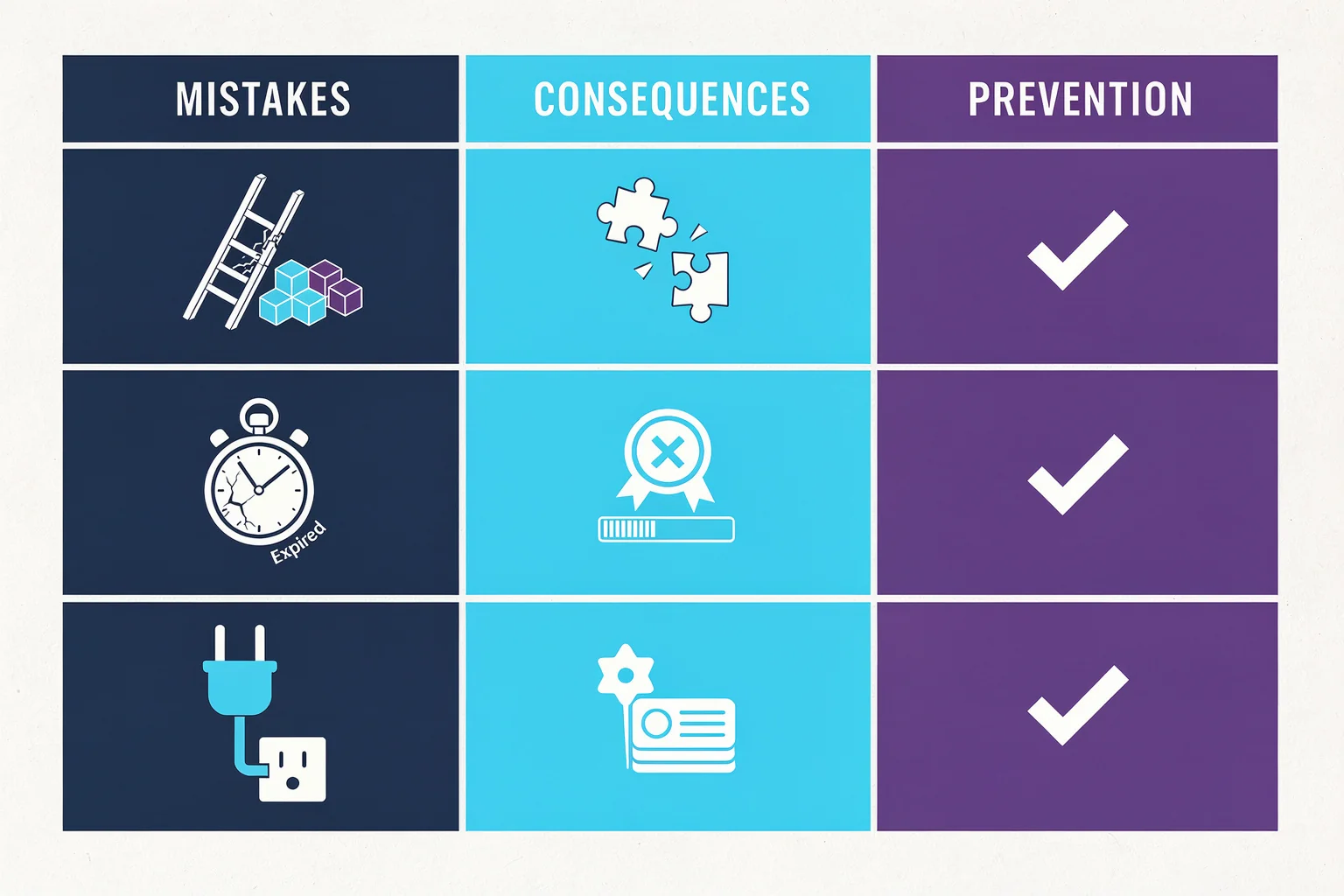
Skipping Fundamentals despite non-technical backgrounds. AZ-900 isn't mandatory, but AZ-104 assumes you understand regions, availability zones, and resource groups. Candidates who jump straight to Associate often fail not from lack of intelligence, but from missing conceptual scaffolding that Fundamentals provides in 20 hours.
Studying retired or retiring exams. AZ-204 and AZ-500 are the immediate concerns, but Microsoft has signaled ongoing restructuring. Verify exam status at Microsoft guidance before purchasing any practice materials or booking dates. A practice test for a retired exam is wasted money and study time.
Ignoring the hands-on requirement. Associate and Expert exams test applied skills. Watching videos or reading documentation without building resources in Azure is like studying driving theory without touching a car. The $165 exam fee becomes expensive when you pay it twice because you never configured a virtual network peering or deployed a Bicep template.
Choosing Your First Exam When You're Unsure
If you have no current Azure role and no clear target, follow this decision sequence:
- Assess your IT background. Database work points toward DP-900. Networking toward AZ-900 then AZ-700. Development toward AI-901. General IT support toward AZ-900.
- Take AZ-900 regardless if you're new to cloud. It costs $99, never expires, and validates whether cloud work fits your interests before larger investments.
- Pick one Associate exam based on job postings you actually want. Search roles in your market. If 80% list AZ-104, that's your next step. If security roles dominate, pivot to SC-900 → SC-200.
- Add Expert or Specialty only with project experience. AZ-305 without real architecture work is passable but not valuable to employers. The credential signals ability; the interview tests whether you can apply it.
For those comparing cloud platforms, our AZ-900 versus AWS Cloud Practitioner analysis maps how the entry-level exams differ in scope and career utility.
What Changed in 2026 and What's Next
This year marks the largest certification restructure since Microsoft moved to role-based credentials in 2019. Seventeen new certifications and exams entered beta or general availability by June 2026, per Microsoft's credentials roundup. The AI track expanded most aggressively, with AI-901, AI-103, AI-200, and AB-620 (AI Agent Builder Associate) launching across different availability windows.
The security track is consolidating. AZ-500's retirement and SC-500's launch signal Microsoft's intent to unify security credentials under the SC prefix, separating them from general administration. For candidates mid-study, this creates urgency but also opportunity—SC-500 will likely test current Sentinel, Defender, and Entra ID features rather than legacy configurations.
Zero trust architecture now appears across multiple exam objectives, not just security-specific tests. Even AZ-104 includes conditional access, network segmentation, and identity protection as standard administrative concerns. This reflects enterprise reality: every Azure role now touches security, and Microsoft's exams have adjusted accordingly.
Reader Questions
Do I need to pass Fundamentals before Associate?
No. Microsoft enforces no formal prerequisites. However, AZ-104 and other Associate exams assume the conceptual foundation that AZ-900 covers. Without it, you'll need to self-teach those basics while also learning operational skills.
How long do I have to pass AZ-204 or AZ-500 before retirement?
AZ-204 retires July 31, 2026, at 11:59 PM Central Time. AZ-500 retires August 31, 2026. You must schedule and complete the exam before these deadlines; partial progress or scheduled dates after retirement won't count.
Can I renew multiple credentials at once?
Each renewal assessment is separate and tied to one credential. However, Microsoft sometimes offers renewal content that overlaps—AZ-104 renewal touches concepts also relevant to AZ-305. The assessments are short enough that batching them in one study session is feasible.
What's the difference between Specialty and Expert?
Expert credentials (AZ-305, AZ-400, SC-100) span broad architectural or engineering leadership across a domain. Specialty credentials (AZ-120 for SAP, AZ-140 for Virtual Desktop, AZ-220 for IoT) target narrow, deep scenarios. Expert is generally more valuable for career advancement; Specialty pays off when you have existing deep experience in that niche.
Is the free Microsoft Learn path enough to pass?
For Fundamentals, usually yes with added practice tests. For Associate and Expert, most candidates need supplemental hands-on labs and exam-style practice. Microsoft Learn covers what to know; passing requires proving you can apply it under time pressure with scenario-based questions.
References
- Azure Certification Roadmap: Which Cert — | Tier | # Exams | Validity | Fee | Examples | | --- | --- | --- | --- | --- | | Fundamentals | 5 | Indefinite | 99 USD | AZ-900 / AI-901 / DP-900 / SC-900 / MS-900 | | Associate
Continue Your Certification Planning


Discussion
Question Comments
0 comments·0 participantsSign in to leave a comment and access more free questions.