
Short answer: usually not on its own. Searching for an AZ-104 practice test free of charge is a smart first move — free questions are the cheapest way to find out where you stand before you commit serious study hours. The problem is that most free sets cover a fraction of the exam blueprint, rarely simulate the real timing pressure, and often skip the scenario-based question styles that decide whether you pass. This article answers the sufficiency question directly: what Microsoft's own free assessment includes, which objective domains free resources tend to miss, and exactly where a timed simulator with explanations closes the readiness gap. If you have an exam date on the calendar, this will help you decide how far free material can take you and when to supplement it.
Is a free AZ-104 practice test enough to pass by itself?
For most candidates, no — but it's an excellent diagnostic tool. A free practice test tells you which domains you're weak in. It rarely gives you enough volume, variety, or exam-realistic pressure to fix those weaknesses.
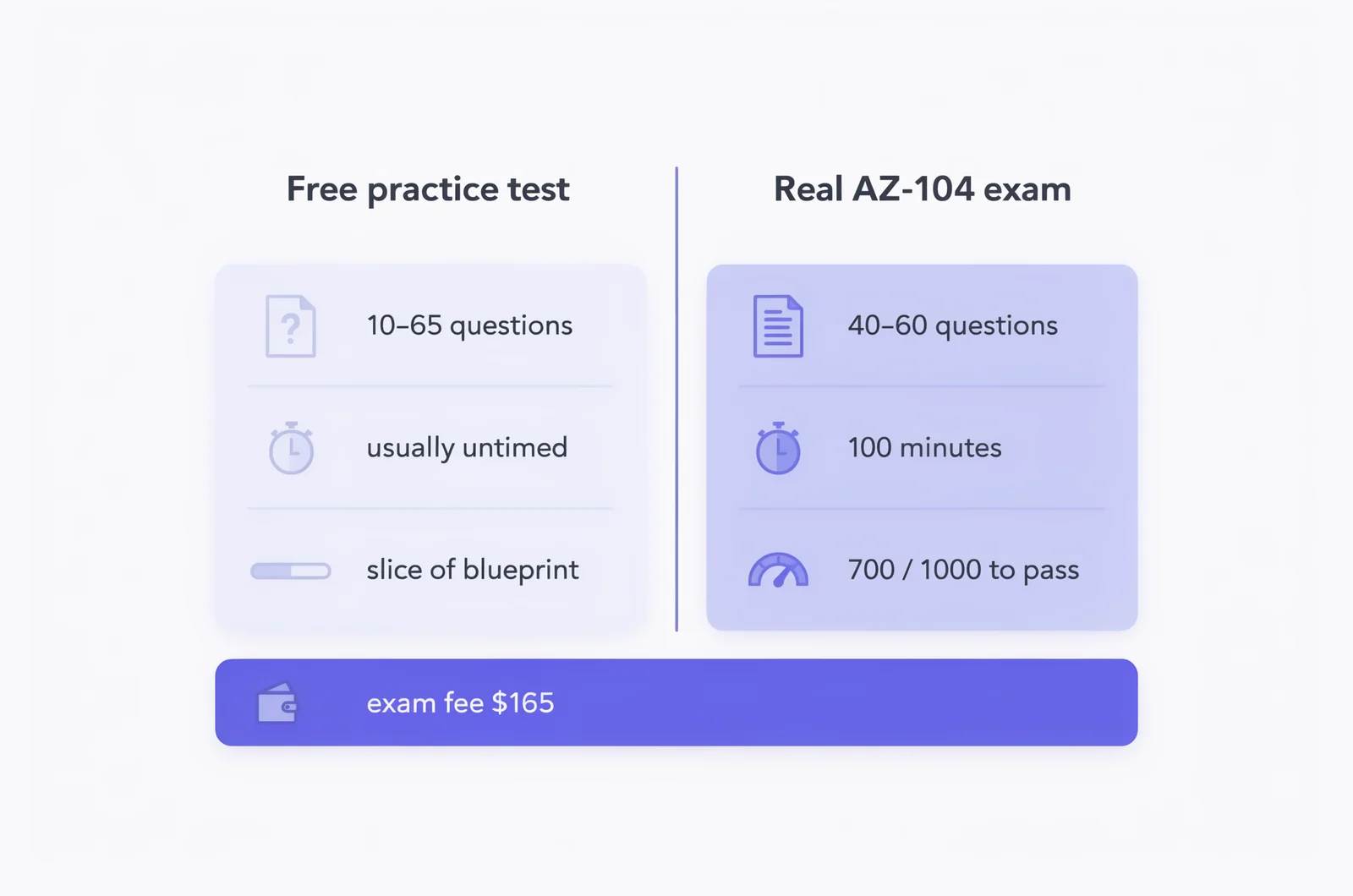
Consider the numbers. The AZ-104 exam costs $165, runs 100 minutes, contains 40–60 questions, and requires a scaled score of 700 out of 1,000 to pass, according to ExamCert's AZ-104 exam facts. A typical free test gives you somewhere between 10 and 65 questions. Even a strong performance on a 10-question sample tells you very little about how you'll handle 50 scenario-heavy questions across five weighted domains under a ticking clock.
There's also a scoring subtlety worth knowing. The 700 passing mark is a scaled score, not a flat 70% — question difficulty factors into the calculation — and there's no penalty for guessing, so unanswered questions are pure lost points, as EveryExamPrep's free AZ-104 test page explains. Free tests that don't teach you pacing and answer-everything strategy leave a real gap in your exam-day game plan.
So treat free practice tests as the entry point of your preparation, not the whole of it. They answer "where am I now?" brilliantly. They answer "am I ready to pass?" only partially.
What does Microsoft's own free practice assessment include?
Microsoft offers a genuinely useful free resource, and you should start there. Through Microsoft Learn, candidates can take a free Practice Assessment for AZ-104, attempt it as many times as they like, and receive a score report that shows the answer, the rationale, and links to additional documentation for every question. Microsoft's official AZ-104 study guide is the companion document — it lists the current skills measured, the domain weightings, and the last date the objectives were updated.
That combination is the most trustworthy free baseline available, for two reasons. First, the content aligns with the live exam blueprint, so you're practising against what Microsoft actually tests rather than a third party's interpretation of it. Second, the per-question rationale teaches you Microsoft's preferred answer logic, which matters on an exam where several options can look technically defensible.
But the Practice Assessment has limits. The question pool is smaller than the real exam's coverage, repeated attempts mean you start recognising questions rather than reasoning through them, and it doesn't fully replicate the timed, mixed-format experience of the live test — case studies, drag-and-drop items, and multi-part scenarios included. If you want a clearer picture of how those formats behave, our breakdown of the Microsoft exam format walks through how role-based tests are actually structured.
Use Microsoft's free assessment to establish your baseline and to review the official rationale style. Just don't mistake a good score there, after several retakes, for proven readiness.
Which exam domains do free practice tests usually skip or thin out?
The AZ-104 blueprint spans five domains: identity and governance, storage, compute, networking, and monitoring/backup. Free tests rarely weight them correctly, and they consistently under-serve the hardest material.
Identity and governance — Microsoft Entra ID, RBAC, subscriptions, Azure Policy — tends to get reasonable free coverage because the questions are easier to write. Storage and compute appear in most free banks too. The thin spots are almost always the same:
- Virtual networking depth. VNet peering, VPN gateways, ExpressRoute concepts, NSG rule priority, private endpoints, and DNS resolution across hybrid setups. Networking carries heavy weight on the real exam and produces the trickiest scenario questions, yet free sets often include only a handful of surface-level items.
- Scenario-based exhibits. The real exam shows you diagrams, Bicep snippets, diagnostic output, and configuration tables, then asks you to interpret them. Mastery Exam Prep's free AZ-104 set is one of the few free options that explicitly includes diagram and configuration-exhibit questions across all five blueprint domains — a sign of how rare that is.
- Monitoring and backup operations. Azure Monitor alerts, Log Analytics queries, Recovery Services vault configuration. These show up in free banks as one or two recall questions, not the operational decision-making the exam expects.
The pattern is simple: free questions cluster where they're cheap to produce. Your study plan needs to compensate by deliberately targeting the domains free material underweights, using the official study guide's skill list as your checklist.
Can you pass AZ-104 using only free resources?
It's possible, and people do it — but the honest answer depends on your background, and the risk math matters.
If you administer Azure daily — you deploy VMs, configure VNets, manage RBAC, troubleshoot storage — free resources plus Microsoft's documentation may genuinely be enough. Your job is your simulator; the free tests just confirm coverage and flag blind spots. Candidates in this position often pass with the free Practice Assessment, the study guide, and a few third-party question banks.
If you're newer to Azure administration, or you work in a narrow slice of it (say, mostly compute, little networking), free-only preparation gets risky. Here's the math: the exam costs $165 per attempt. Failing means paying again, waiting out the retake period, and losing weeks of momentum. Against that, the marginal cost of a paid, exam-realistic practice resource is small. Free question banks of 900+ questions exist — ExamCert advertises over 900 free AZ-104 questions — but raw volume without verified explanations and realistic timing doesn't reproduce exam conditions, and quality varies wildly across free sites.
One more caution: some "free" results ranking for this query are dump-adjacent sites republishing recalled exam content. Beyond the ethics, memorised answers fail you the moment Microsoft rotates the question pool, which happens regularly. Stick to original, explanation-backed questions — the kind you'll find in our AZ-104 sample questions set — and you build transferable understanding instead of fragile recall.
What does a timed simulator add that free tests don't?
Three things, and they're exactly the three things that fail unprepared candidates on exam day.
Pacing under pressure. You have 100 minutes for up to 60 questions, and case-study sections can eat 20 minutes alone. Free tests are almost never timed, so candidates arrive at the exam having never practised allocating time. A simulator forces the decision rhythm the real test demands — including the discipline to flag a hard question, answer everything (remember, no penalty for guessing), and circle back.
Explanation-driven gap closing. A free test tells you that you got a question wrong. A good simulator tells you why, with a worked explanation per question, and then lets you drill that weak domain until it stops being weak. This is the loop that actually raises your score: test, review, target, retest. Platforms like PlanetCert build their AZ-104 practice tests around exactly that cycle, pairing timed simulator sessions with expert-verified explanations and flashcards for the topics you keep missing.
Format familiarity. Case studies with multi-part questions, drag-and-drop ordering tasks, hot-area items on diagrams — encountering these for the first time in the exam room costs you minutes and composure. Simulators that mirror the delivery format remove that surprise. Candidates who've run two or three full timed mock exams before test day consistently report lower anxiety, and lower anxiety means fewer unforced errors on questions you actually knew.
How should you build a study plan around free AZ-104 practice tests?
Here's a pragmatic 3–4 week structure that uses free material where it's strongest and paid simulation where it counts.
Week 1 — baseline and blueprint. Download the official skills outline from Microsoft's study guide. Take the free Microsoft Practice Assessment cold, note your score per domain, and take a second free test from a different provider to cross-check. Every weak domain goes on a list. Don't study yet — diagnose first.
Weeks 2–3 — close the gaps. Work through Microsoft Learn's free AZ-104 learning path for your weak domains only; no point re-reading what you already scored well on. As you finish each domain, hit it with targeted practice questions and read every explanation, including the ones you answered correctly — the rationale often reveals a lucky guess. Keep a running error log of topics you miss twice.
Final week — simulate and verify. Run at least two full timed mock exams under real conditions: 100 minutes, no notes, no pausing. You're looking for consistent scores comfortably above the 700 pass line across multiple sittings, not one lucky result. Use your error log from weeks 2–3 for final flashcard review in the last two days. If your timed scores are still hovering near the pass mark, reschedule rather than gamble the $165.
A simple readiness checklist tool would fit naturally at this final stage — something that scores your last three timed results against the pass threshold and flags domains still below target before you commit to an exam date.
So what's the verdict on free AZ-104 practice tests?
Use them, absolutely — just use them for what they're good at. Free practice tests are the best zero-cost diagnostic in your preparation: they reveal weak domains, familiarise you with question style, and let you verify progress as you study. Microsoft's own Practice Assessment is the anchor resource because it tracks the live blueprint.
What free tests won't reliably do is prove you're ready to pass. The gap between "I scored well on 50 untimed questions" and "I can hold 700+ under 100 minutes of mixed-format pressure" is where most free-only candidates get caught out. Close that gap with timed simulation, per-question explanations, and deliberate work on the networking and scenario domains free banks underweight. PlanetCert's AZ-104 practice tests and exam simulator exist precisely for that final stage, with a money-back promise behind them. Do that, and your free practice tests will have done their real job: pointing you at exactly what to fix before exam day.
Keep your AZ-104 prep moving

Discussion
Question Comments
0 comments·0 participantsSign in to leave a comment and access more free questions.