

AD0-E208 Exam Objectives: What Sample Questions Really Test
If you're searching for AD0-E208 exam objectives, you probably have one of two problems. Either you've found the official Adobe guide but can't tell how the percentages translate into actual questions, or you've encountered practice material and aren't sure whether it matches the live test. This article bridges that gap. We'll walk through what the AD0-E208 Adobe Analytics Business Practitioner Expert exam really tests, how sample questions map to each domain, and how to read those items as signals about where your prep stands.
The AD0-E208 exam costs $225 USD globally, runs 100 minutes, and requires 31 correct answers out of 50 scored questions to pass. Adobe positions this at Expert level, though the entry bar sits closer to one-to-three years of hands-on analytics work with a marketing background. The 2026 update has shifted the framework toward applied workflows, scenario-driven interpretation, and data validation rather than pure feature memorization.
What Changed in the 2026 AD0-E208 Exam Update?
Adobe refreshed the AD0-E208 exam in 2026 with structural changes that directly affect what sample questions now look like. According to certification industry observers, the update places greater emphasis on applied Adobe Analytics workflows, scenario-driven business interpretation, data validation and troubleshooting, and deeper segmentation logic testing. Candidates can no longer rely solely on memorization; the new framework prioritizes implementation intelligence and real-world decision-making.
This matters when you evaluate practice material. Older question banks that drill toolbar locations or menu sequences may not prepare you for the current item style. If your sample set feels like a feature quiz, it is probably outdated.
The exam still covers five core domains, but the weighting and item construction have tightened around practical application. Let's look at how each domain shows up in actual question forms.
How Do the Five Exam Domains Appear in Sample Questions?
The AD0-E208 syllabus breaks into five weighted areas. Understanding these percentages helps you spot whether a practice set's balance matches the live test.
| Domain | Weight | What Sample Questions Actually Test |
|---|---|---|
| Reporting and Dashboarding | 30% | Building workspace projects, configuring visualizations, sharing reports, scheduling |
| Segmentation and Calculated Metrics | 22% | Container logic (hit/visit/visitor), sequential segments, metric formulas, attribution |
| Tool Knowledge and Troubleshooting | 12% | Data layer validation, implementation gaps, variable debugging, data quality checks |
| Adobe Experience Cloud Ecosystem | 10% | Identity services, audience sharing, integration patterns with AEP and Target |
| Administration | 10% | User permissions, report suite settings, classification rules, data governance |
The remaining 16% of exam content crosses these boundaries in integrated scenarios.
When you review AD0-E208 sample questions, check whether the distribution roughly tracks these weights. A practice set that is 40% administration and 10% reporting has its priorities reversed. That mismatch is a signal to supplement or replace the material.
What Do Reporting and Dashboarding Questions Look Like?
This is the heaviest domain at 30%, so it deserves disproportionate study time. Sample questions in this area rarely ask "which button creates a freeform table." Instead, they present a business requirement and ask you to select the right visualization, project structure, or sharing method.
A typical item might describe a marketing manager who needs weekly automated reports for regional stakeholders. The question asks which combination of scheduled delivery, breakdowns, and calculated metrics serves that need without manual rework. The wrong answers are plausible—each uses real Adobe Analytics features—but only one fits the constraints.
Another common pattern tests workspace configuration under pressure. You might see a scenario where a dashboard loads slowly because of excessive date ranges or uncapped row counts, then need to identify the most efficient fix.
When evaluating practice questions here, look for items that force trade-offs between completeness and performance. If your sample set only tests whether you can name visualization types, it is not deep enough for the current exam.
How Deep Does Segmentation Logic Go?
At 22%, segmentation and calculated metrics form the second-largest block. The 2026 update has pushed this area toward more complex container logic and sequential conditions. Sample questions now frequently test whether you understand when to use hit versus visit versus visitor containers, how AND/OR logic behaves across nested conditions, and how sequential segments handle entry and exit points.
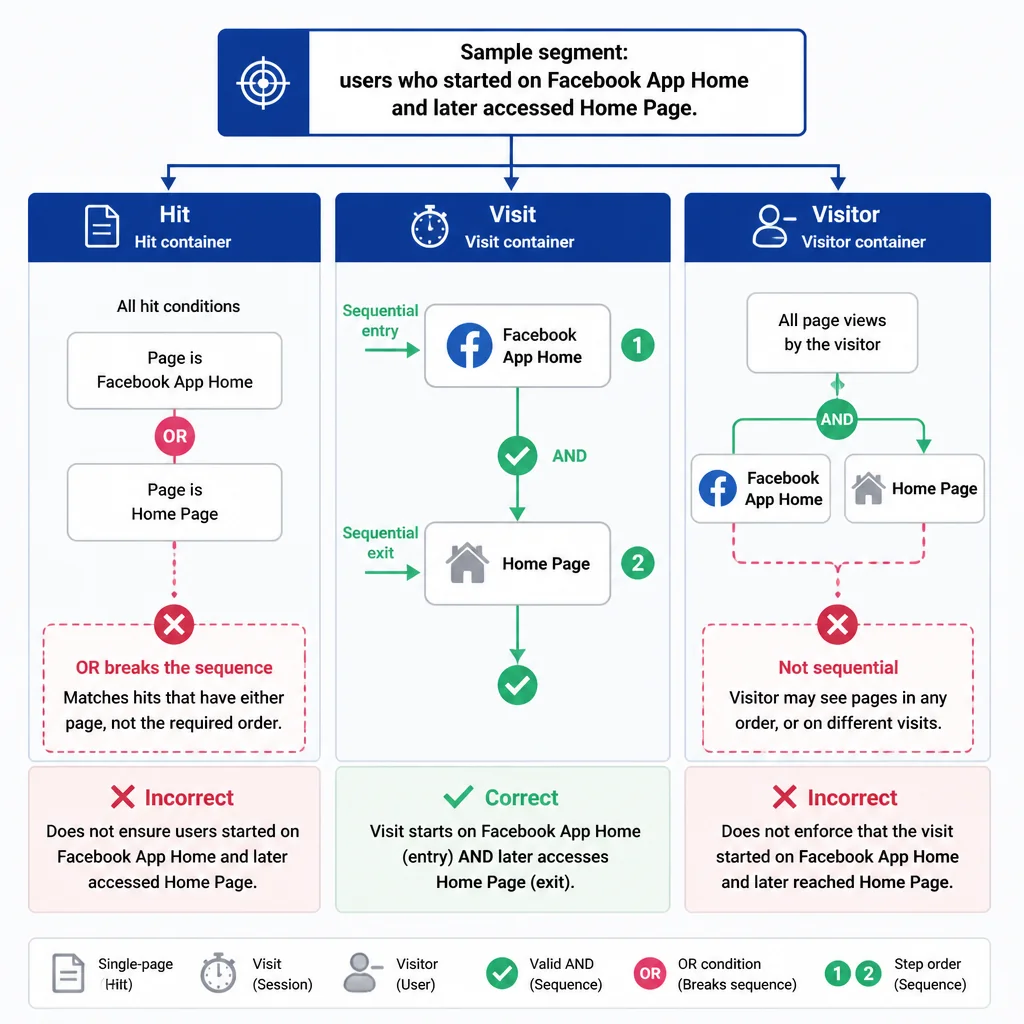
One verified discussion from exam prep communities illustrates this well. A candidate needed to build a segment for traffic that started on a "Facebook App Home" page and later accessed a "Home Page." The correct path required a visit container with an entry page condition combined with a separate page condition—not a simple hit-level match on both pages. The distractors included plausible but logically incorrect container choices.
This is exactly the kind of reasoning the live test now demands. When you work through AD0-E208 sample questions on segmentation, verify that explanations walk through why the container level matters, not just which answer is correct. If your practice material skips that reasoning, you will hit gaps on exam day.
Calculated metrics questions follow a similar pattern. You might need to build a custom metric that handles division-by-zero gracefully, or choose between different attribution models for a cross-channel campaign report. The math is rarely complex; the challenge is knowing which Adobe Analytics functions and settings implement the business rule correctly.
What Troubleshooting Scenarios Should You Expect?
Tool knowledge and troubleshooting sits at 12% officially, but its principles bleed into other domains. The 2026 update specifically added data validation emphasis. Sample questions here often describe a report where numbers look wrong—perhaps page views exceed visits, or a campaign shows zero conversions despite confirmed traffic.
Your task is to trace the most likely cause through implementation variables, processing rules, or classification gaps. The answer choices typically include real issues: a misconfigured eVar expiration, a missing campaign parameter, a timing race in the data layer, or an incorrect event serialization setting.
Good practice items in this area test diagnostic process, not just terminology. They should require you to eliminate possibilities based on symptoms. If your sample questions only define what a processing rule does, they are not preparing you for the scenario-based items Adobe now uses.
How Does the Experience Cloud Ecosystem Show Up?
At 10%, this domain can feel like a sideshow, but it carries outsized importance for candidates from pure analytics backgrounds. Questions here test whether you understand how Adobe Analytics connects to the broader stack—particularly Adobe Experience Platform, Real-Time CDP, and Target.
Sample items might ask when to use the Experience Cloud ID Service versus legacy Analytics visitor ID, how audience segments flow from Analytics to Target for personalization, or what data governance implications arise when sharing report suites across business units.
The depth is implementation-aware but not architect-level. You need to know the integration patterns, not build them from scratch. When reviewing practice material, check that ecosystem questions include realistic data-sharing constraints and governance considerations, not just feature lists.
What Administration Topics Appear on the Exam?
Administration also weighs 10% and tends to surprise candidates who expect purely analyst-level content. Questions cover report suite configuration, user group permissions, classification importer and rule builder setup, and data retention settings.
A common sample question pattern presents a governance scenario: a new market requires separate reporting, but leadership wants consolidated dashboards. Which combination of virtual report suites, permissions, and classification strategies balances both needs?
Another tests classification mechanics directly—when to use the importer versus rule builder, how to handle regex patterns for URL classification, or what happens when classification files conflict with existing rules.
If your practice set ignores administration entirely, or treats it as an afterthought, you are under-preparing for roughly one question in ten. That gap can matter on a 50-question exam where 31 correct answers separate pass from fail.
How Can You Tell If Sample Questions Match the Real Item Style?
Not all practice material labeled "AD0-E208 sample questions" reflects the current exam. Here are concrete checks you can apply before trusting a question bank.
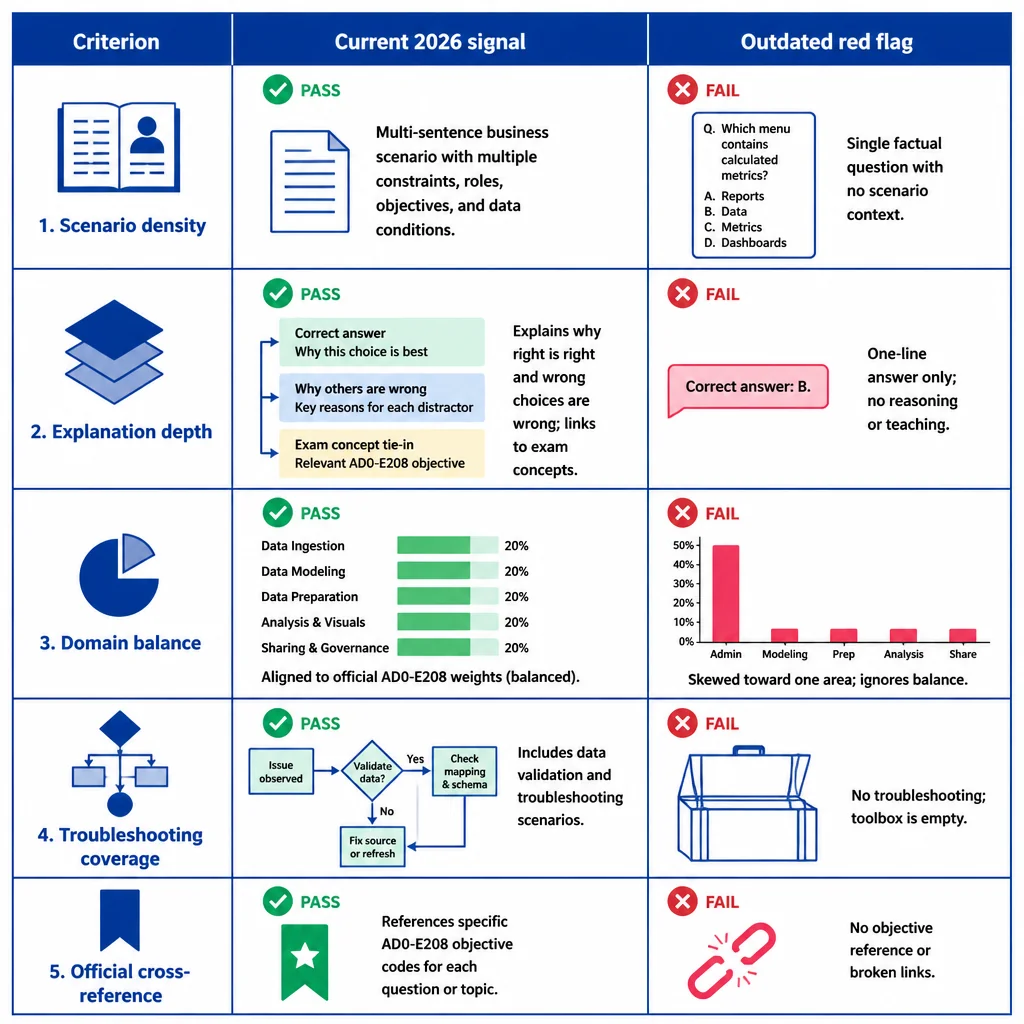
First, verify the scenario density. The 2026 exam uses business narratives as its primary vehicle. If your practice items are mostly standalone factual queries ("Which menu contains calculated metrics?"), the style is outdated. Look for paragraph-length setups with multiple constraints.
Second, check the explanation depth. Quality material explains why wrong answers are wrong, not just which choice is correct. This matters for learning; it also signals that the provider understands the exam's current reasoning demands.
Third, confirm the domain balance against the official weights. A practice set skewed toward memorization-heavy administration questions may feel productive but misdirects your limited study time.
Fourth, look for data quality and troubleshooting scenarios. These were amplified in the 2026 update. Their absence from a practice bank is a red flag.
Finally, cross-reference against the Adobe Digital Experience Certification Program official page for any objective changes since your material was published. Adobe does not always announce minor updates loudly, but the exam details page carries current timing, passing thresholds, and domain descriptions.
What Study Pattern Works Best With Sample Questions?
The most effective candidates use sample questions diagnostically, not just for repetition. A productive two-to-four week study window might look like this.
Week one: Work through a full practice set untimed. Flag every item where you were uncertain, even if you guessed correctly. Sort these by domain to expose your weakest area—often segmentation or troubleshooting for analytics generalists.
Week two: Deep-study flagged domains using Adobe's Experience League documentation and hands-on workspace practice. Return to sample questions only after you have closed specific knowledge gaps. This prevents reinforcing guesswork.
Week three: Run timed simulator sessions. The 100-minute limit sounds generous for 50 questions, but scenario-based items consume more reading time than factual ones. Build pacing discipline now, not on exam day.
Week four: Revisit weak topics using targeted question subsets. If administration remains shaky, drill those items specifically rather than running full exams that dilute your focus.
This cyclical approach—test, diagnose, study, retest—mirrors how candidates use mapping exam objectives to services for cloud certifications, and it applies equally well to Adobe's analytics track.
How Do You Avoid Outdated or Low-Quality Practice Material?
The certification prep market includes material that recycles old questions, misstates domain weights, or simply scrapes forum discussions without verification. Three warning signs help you spot problematic sources.
One, guarantees of specific question coverage. No legitimate provider can promise exact item matches; Adobe rotates its item bank. Claims of "real exam questions" often signal low-integrity content that may even violate Adobe's certification policies.
Two, missing 2026 update content. If a practice bank does not include data validation scenarios, sequential segment logic, or Experience Cloud integration questions, it predates the current exam framework.
Three, thin or absent explanations. A question bank that gives answers without reasoning helps you memorize, not understand. The current AD0-E208 exam tests application, not recall.
For guidance on evaluating practice exam quality before purchase, see how to vet a CCNA practice exam—the evaluation principles transfer across vendors.
What Should Your Final Week Look Like?
In the last seven days before your AD0-E208 exam, shift from learning to readiness verification. Run two full timed practice exams under conditions that match the live test: quiet space, no interruptions, and strict time enforcement. Review every incorrect or slow answer, but do not introduce major new study topics. Last-minute cramming on segmentation logic rarely sticks and can increase test anxiety.
Instead, use sample questions to rehearse your decision process. For each item, practice identifying the domain, the core constraint, and the most efficient elimination path. This meta-skill saves minutes per question and reduces second-guessing.
If your practice platform includes flashcards for key formulas, implementation variables, or governance thresholds, run through these in short bursts. The goal is fluent recall of foundational facts so your working memory stays free for scenario analysis.
Reader Questions
Do I need hands-on Adobe Analytics access to pass AD0-E208?
Adobe recommends two years of digital analytics experience with a marketing background. While you can memorize some content, the 2026 exam's scenario-heavy format strongly rewards actual workspace use. If you lack access, Adobe's Experience League sandbox environments and demo projects provide partial substitutes.
How many questions are experimental or unscored?
Adobe does not publish this detail for AD0-E208 specifically. Assume all 50 questions count toward your score and manage time accordingly. If you encounter an item that seems off-topic or unusually difficult, it may be experimental—but you cannot know which, so treat every question as scored.
Is the AD0-E208 exam proctored online or in person?
The exam delivers through online proctoring with camera access required. Schedule through Adobe's certification portal, which you can reach via the AD0-E208 course page for current availability and system requirements.
What score do I need to pass?
The passing threshold is 31 correct answers out of 50, or 62%. Adobe uses scaled scoring, so raw performance maps to this threshold. Do not aim for minimum accuracy; build margin through strong performance in your best domains.
How does AD0-E208 compare to the Analytics Architect Master exam?
AD0-E208 targets business practitioners who interpret data and build reports. The Architect Master level (AD0-E207) tests implementation design, data layer architecture, and enterprise governance at much greater technical depth. If your role involves code deployment or multi-suite strategy, you may need the architect track instead. PlanetCert offers an AD0-E207 practice test for candidates comparing paths.
Can I retake AD0-E208 if I fail?
Adobe allows retakes after a waiting period, though specific timing and fees are subject to policy changes. Check current retake rules through official certification channels before scheduling.
References
- Ad0 E208 Become An Adobe — The Adobe Analytics Business Practitioner Expert exam equips entry-level professionals with essential Adobe Analytics expertise, covering. ... - Real-world application of
Continue Your Exam Prep


Discussion
Question Comments
0 comments·0 participantsSign in to leave a comment and access more free questions.