

Is PRINCE2 Certification Worth It in 2026? Career ROI for IT Project Managers
You are staring at a £500–£1,000 certification path, a stack of study guides, and a calendar already full of sprint retrospectives. Before you commit evenings and weekends to PRINCE2 7, you want a straight answer: will this credential actually move your career forward, or just collect dust in your email inbox? The honest response depends on where you work, where you want to work, and what kind of projects you run.
PRINCE2 7 arrived in September 2023 through PeopleCert, replacing the 2017 sixth edition with sharper emphasis on people management, sustainability, and tailoring for digital delivery. In 2026, the methodology sits at an interesting crossroads. It remains the dominant project management framework in UK and European public-sector procurement, yet faces growing competition from Agile hybrids and the PMP credential in technology-focused environments. For IT project managers specifically, the certification's value hinges on whether your employer ecosystem treats it as a screening requirement or a nice-to-have.
What changed in PRINCE2 7 and why it matters now
PeopleCert's 2023 release was not a cosmetic refresh. The seventh edition restructured the method around seven practices, embedded people and sustainability as core themes, and explicitly addressed how PRINCE2 coexists with Agile ways of working. For IT professionals, the tailoring guidance is particularly relevant. Previous editions often felt rigid when applied to software delivery; Version 7 offers clearer language for adapting governance to iterative environments.
The certification naming evolved through early 2026. Certificates issued before mid-January 2026 carried the "PRINCE2 7" label. From 15 January 2026 onward, PeopleCert updated credentials to read "PRINCE2 Project Management [Foundation/Practitioner] VERSION 7," with official learning materials following to v7.2 by the week of 19 January 2026. If you are comparing training providers, verify which edition their materials cover. Outdated sixth-edition courses still circulate in secondary markets.
"PRINCE2 Project Management (Version 7) now includes a people element in the method, emphasising the importance of people in effective project outcomes." — PeopleCert, PRINCE2 Project Management Foundation (Version 7) exam description
The Practitioner level now requires proof that you can apply and tailor the method, not just recite process flows. This raises the bar meaningfully. Employers in 2026 increasingly distinguish between candidates who hold Foundation only versus those who completed both levels.
Where PRINCE2 still opens doors
Geography and sector remain the strongest predictors of certification value. In the United Kingdom, PRINCE2 appears explicitly in job specifications for project managers across central government, NHS digital programmes, local authority IT transformations, and defence contracting. The same pattern holds across Northern Europe, Australia, and parts of the Middle East where UK-style procurement frameworks were adopted.
For IT project managers specifically, this matters when you are:
- Bidding for public-sector digital transformation contracts where PRINCE2 is a mandated competency
- Moving from a technical specialist role (network engineering, cloud architecture, cybersecurity operations) into formal project leadership
- Working in regulated industries—healthcare IT, financial services infrastructure, utilities—where audit trails and stage-gate governance are non-negotiable
- Supporting programmes that must report through HM Treasury's Green Book or equivalent capital appraisal frameworks
CertNorth's 2026 analysis put this bluntly: PRINCE2 is "worth it if you work in (or are targeting) the UK, Europe, Australia, or government and public-sector projects, where it's frequently named in job postings." The inverse is equally true. In technology and software development where Agile frameworks dominate, PRINCE2 knowledge is rarely sought unless the role specifically bridges corporate governance and delivery teams.
When PMP or experience alone makes more sense
The Project Management Professional credential from PMI maintains stronger recognition in North American markets and among US-headquartered multinationals. SPOC Learn's 2026 US market analysis found that "PMP Certification continues to deliver the strongest overall career growth, salary advantage, and leadership opportunities across industries" in that geography. For IT project managers targeting Silicon Valley-style technology companies, Agile certifications (CSM, SAFe, PSM) or cloud-specific credentials often carry more weight than PRINCE2.
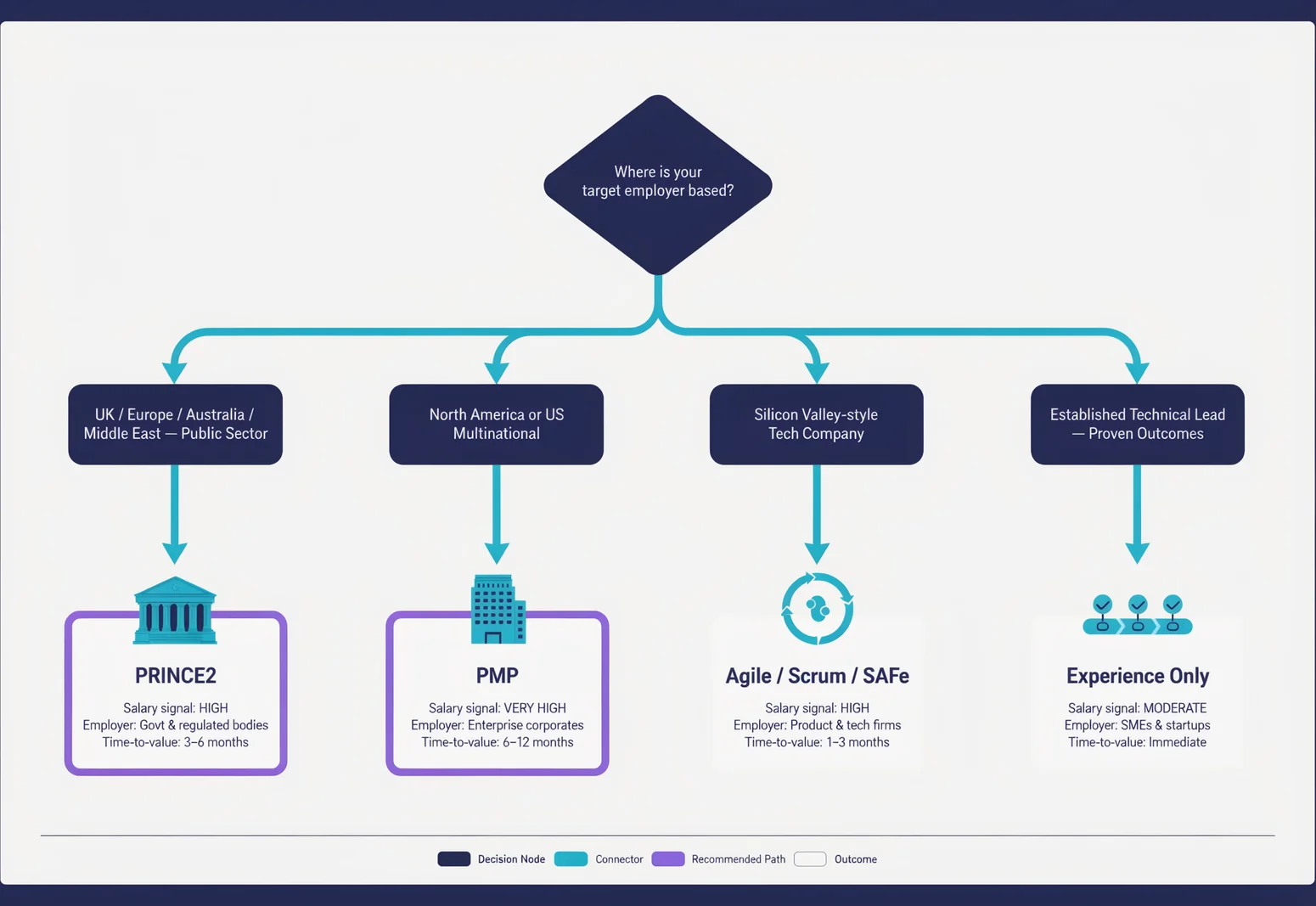
Experience without certification remains viable in certain trajectories. If you have already led multiple successful IT projects with demonstrable outcomes—on-time cloud migrations, zero-downtime infrastructure replacements, security compliance programmes—some employers value that track record over formal methodology training. The catch: automated HR screening systems and public-sector procurement frameworks still filter on certification keywords. Your experience helps after the interview is scheduled, not always before.
Alpha Learning Centre's 2026 guidance suggests PRINCE2 becomes "less compelling if you work primarily in technology or software, where Agile frameworks dominate and PRINCE2 knowledge is rarely sought; you are targeting roles with US-headquartered companies where PMP is the de facto standard; or you already have PMP and are looking for a complementary credential." In that last case, consider whether your time is better spent on cloud architecture or cybersecurity specialisations rather than a second project methodology.
The real costs and salary signals
PeopleCert's direct exam fees for PRINCE2 7 Foundation typically run £300–£400, with Practitioner adding roughly similar amounts. Training courses through accredited providers push total investment toward £800–£1,500 depending on format (self-paced, virtual classroom, or in-person intensive). The PRINCE2 Foundation exam cost UK varies by delivery channel, with exam-only vouchers offering savings for confident self-study candidates.
Rescheduling carries penalties. PeopleCert charges £60 for changes made between 8 and 4 hours before your slot, with stricter no-show policies. Factor this into your study timeline. Nothing erodes ROI faster than a rushed exam attempt and retake fee.
Salary data for 2026 shows PRINCE2 holders in UK IT project management roles typically starting around £45,000–£55,000, with senior practitioners in programme delivery or consultancy reaching £75,000–£95,000. Cert Demand's broader tracking cites "starting salary of $110,000 or more per year" for US-based roles, though this conflates multiple experience levels and geographies. The more precise signal is demand volume: they recorded 1,342 active US job postings requiring PRINCE2, up 33% over thirteen weeks—the highest demand level in their tracking dataset.
The certification does not directly inflate salary. What it does, as The Projex Academy noted, is "unlock access to roles that often pay more than non-project positions." The credential gets you past initial screening into interviews where your experience and delivery record can justify higher offers.
How employers actually evaluate PRINCE2 in 2026
A 2026 shift is worth noting. Employers increasingly treat the certificate as table stakes rather than differentiation. WowTechHub's industry analysis observed that "employers in 2026 are looking for evidence of application. A PRINCE2 certificate can help a candidate pass initial screening, but hiring managers increasingly ask how the person has used the method in difficult conditions: unclear sponsorship, changing scope, constrained resources."
For IT project managers, this means your interview preparation should include concrete examples of:
- Tailoring PRINCE2 stage boundaries to two-week Agile sprints
- Managing change control when business requirements shifted mid-cloud migration
- Escalating risks through project board structures without derailing technical delivery
- Applying the "people" practice from Version 7 to resolve team capacity conflicts
If you cannot speak to applied experience, consider whether you need the certification now or should first seek internal opportunities to lead governed projects.
PRINCE2 7 versus Agile: the false binary
Much online debate frames this as an either/or choice. In practice, 2026 IT project environments are hybrid. PRINCE2 7 explicitly accommodates Agile delivery through its tailoring guidance. The method governs project initiation, business justification, and stage boundaries; Scrum or Kanban handles daily execution within those boundaries.
This matters for your study approach. The PRINCE2 7 Practitioner exam tests your ability to adapt the method, not impose maximum process weight. Practitioners who pass can articulate when to lighten governance and when to enforce it—precisely the judgement call senior IT roles require.
If your current environment is purely Agile, PRINCE2 may feel foreign initially. The investment pays off when you move into programme management, portfolio governance, or client-facing consultancy where executives expect stage-gate reporting regardless of delivery methodology.
Study strategy for time-constrained IT professionals
Assuming you decide the credential supports your trajectory, efficient preparation matters. IT professionals typically underestimate the gap between understanding project management conceptually and passing PRINCE2's specific examination format.
Foundation level demands recognition of principles, practices, and process flows. Most candidates with project exposure need 20–30 focused hours. Practitioner level requires scenario analysis and application—closer to 40–50 hours for candidates without recent exam experience.
A practical study sequence:
- Diagnostic phase (2–3 hours): Attempt a full practice exam cold to identify knowledge gaps against the seven practices
- Structured learning (15–20 hours): Work through accredited materials, noting where your workplace experience aligns or diverges from PRINCE2's prescribed approach
- Gap closure (10–15 hours): Target weak areas with flashcards and explanation review, not re-reading entire chapters
- Simulation phase (8–10 hours): Timed practice exams under exam conditions, building pacing confidence for Practitioner scenario questions
PlanetCert's simulator includes PRINCE2 7-aligned question banks with explanation depth matching the exam's application focus. The timed mode proves particularly useful for Practitioner candidates who struggle with scenario length under pressure.
Validity, renewal, and ongoing commitment
PRINCE2 7 Foundation has no expiry. Practitioner, however, requires renewal through PeopleCert's Continuing Professional Development programme or re-examination every three years. The CPD path involves logging learning activities and paying an annual membership fee—factor this into your long-term cost model.
For IT project managers who certify once and then ignore the credential, renewal surprises create unnecessary friction. If your career path might pivot away from PRINCE2-heavy environments within three years, the Foundation-only route may suffice. If you are committing to public-sector or UK-centric programme delivery, Practitioner renewal is simply a cost of staying current.
Should you pursue PRINCE2 7 this year?
The decision framework is straightforward once you strip away marketing noise. PRINCE2 7 certification delivers clear career ROI when:
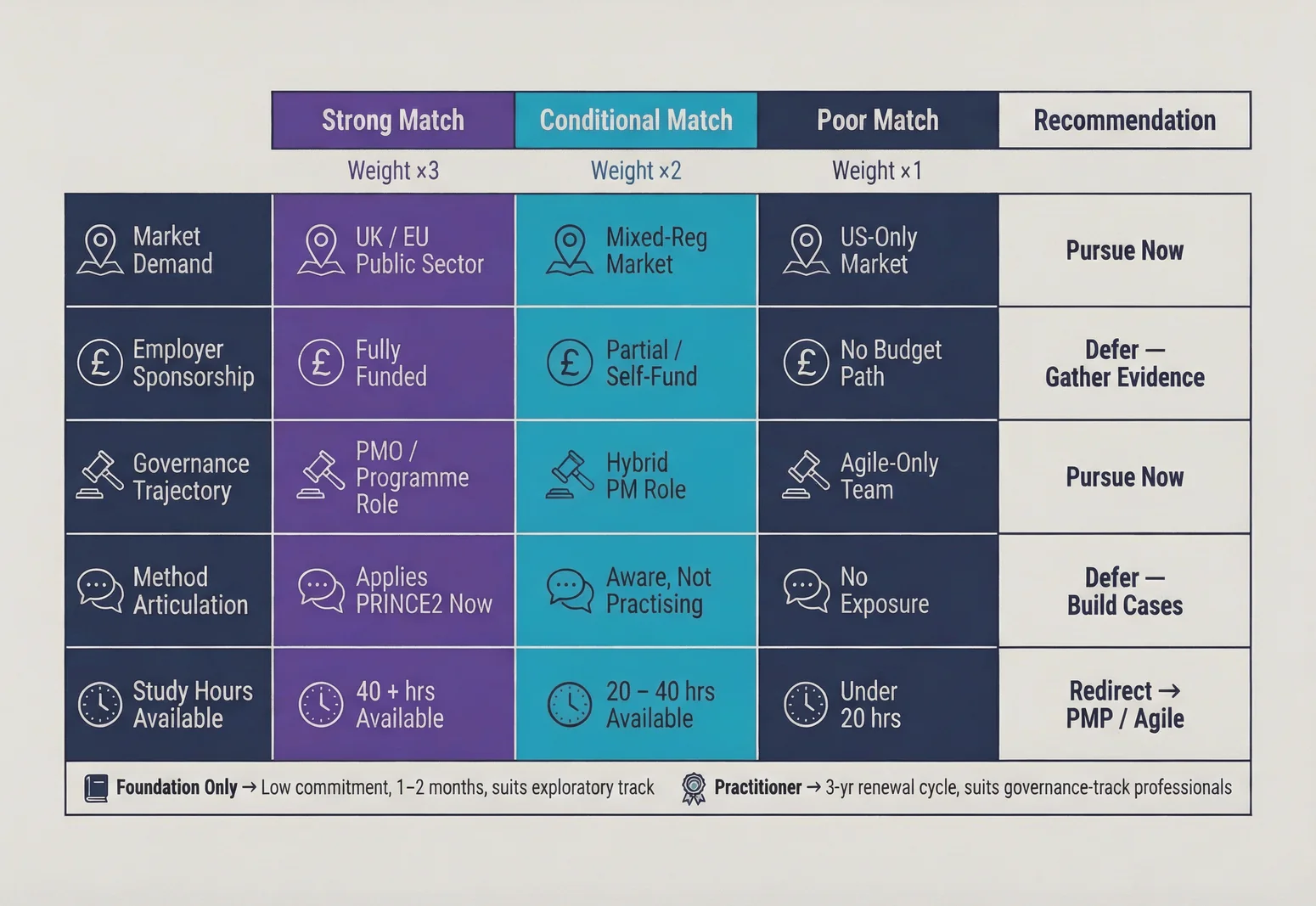
- Your target job market (UK, Europe, Australia, Middle East, or public sector anywhere) explicitly lists it
- You are transitioning from technical delivery into formal project governance and need a recognised credential to validate that shift
- Your current employer sponsors or reimburses certification, reducing personal financial risk
- You can articulate how you will apply the method, not just display the badge
It offers diminishing returns when:
- You are established in US technology markets where PMP or Agile credentials dominate
- Your role is deeply technical (cloud architecture, cybersecurity engineering, data platform development) with no near-term project leadership trajectory
- You already hold PMP and seek differentiation—consider domain specialisation instead
- You cannot commit the study time to pass Practitioner; Foundation alone carries limited weight in competitive hiring
The Projex Academy's 2026 assessment captures this nuance well: "PRINCE2 is not a trend-based certification. It functions more like a stable professional qualification." That stability is either an asset or a limitation depending on your career velocity and market position.
Questions IT project managers still ask
Does PRINCE2 7 replace my sixth-edition certification?
Existing sixth-edition credentials remain valid. PeopleCert's retirement schedule focuses on exam availability and material updates, not invalidating prior achievements. If you certified under the 2017 edition, you do not need to recertify unless your employer specifically requires Version 7.
Can I self-study effectively or must I use an accredited course?
PeopleCert permits direct exam registration for self-study candidates. The risk is gaps in understanding the examination's specific terminology and scenario logic. Many successful candidates combine self-paced learning with targeted practice exams rather than expensive classroom courses. The best PRINCE2 training providers UK offer varied formats worth comparing before committing.
How does PRINCE2 compare to Scrum or SAFe for IT work?
PRINCE2 governs project-level decisions: should we start, should we continue, what are the tolerances. Scrum governs team-level delivery: what we build this sprint, how we organise daily. They are complementary at different altitudes. SAFe attempts to scale both but introduces complexity that many organisations struggle to sustain.
Will AI tools make project management certifications obsolete?
AI assists scheduling, risk analysis, and reporting, but 2026 hiring data shows no decline in certification requirements. If anything, governance-heavy environments want credentialed humans who can interpret AI-generated insights and maintain accountability structures that automation cannot assume.
What if I fail the Practitioner exam?
PeopleCert allows retakes with standard waiting periods. More importantly, analyse your score report for practice-pattern gaps before rebooking. Practitioner failures typically stem from scenario misreading or time pressure, not knowledge deficiency—both correctable with simulation practice.
Certification paths that complement PRINCE2 for IT roles
For IT project managers building broader credibility, PRINCE2 pairs effectively with:
- Cloud platform certifications (AWS Solutions Architect, Azure Administrator, GCP Professional Cloud Architect): demonstrates technical fluency that pure project managers lack
- Cybersecurity credentials (CISSP, CISM, CompTIA Security+): increasingly relevant as IT projects embed security-by-design requirements
- Agile certifications (PMI-ACP, SAFe RTE, Professional Scrum Master): bridges the governance-delivery gap that PRINCE2 7 acknowledges but does not fully resolve
The cloud certification salary premium 2026 data suggests technical specialisations can outpace methodology credentials in pure compensation terms. Your optimal stack depends on whether you aim for programme director roles (methodology-heavy) or technical programme management (hybrid depth).
Making your study time count
Whatever you decide, treat certification study as a project itself. Define your business case, set tolerances for cost and schedule, and stage-gate your progress. The irony of poorly managed PRINCE2 preparation is not lost on examiners.
For candidates who commit, structured practice makes the difference between passing and retaking. The certification exam pass strategies that work for technical IT certifications—spaced repetition, scenario drilling, error log analysis—apply equally to PRINCE2's application-focused Practitioner level. The method may be governance-oriented, but your preparation should be execution-disciplined.
References
- Retirement updates — : December 2025 ... - PRINCE2 7 Certificate will remain the same until w/c 12 January 2026. From 15 January 2026, PRINCE2 Project Management certificates will be changed to
- PRINCE2 Project Management Practitioner (Version — PRINCE2 Project Management Practitioner (Version 7) | peoplecert.org ... PRINCE2 Project Management Practitioner (Version 7) Learn to apply and tailor the latest PRINCE2 Project
Explore more certification decisions


Discussion
Question Comments
0 comments·0 participantsSign in to leave a comment and access more free questions.