
Best PRINCE2 Training Provider UK: Selection Criteria Report
Picking a PRINCE2 training provider in the UK still feels like placing a bet. Every website promises pass rates above 90%, accredited trainers, and risk-free guarantees. But when you compare two providers side by side, you're often staring at the same marketing bullet points written by different copywriters — and that doesn't help you decide which course will actually get you through the exam on the first try. We built this report to cut through that noise. It isn't a ranked list of providers. It's a set of evidence-backed selection criteria you can apply to any training company you're considering. By the end, you'll know which attributes actually correlate with passing the PRINCE2 Foundation or Practitioner exam, and you'll have a practical framework to audit a provider before you hand over your money.
What This Report Covers (and What It Leaves Out)
This report focuses on the UK market for PRINCE2 version 7 Foundation and Practitioner training. We examined information published by accredited training organisations (ATOs), official PeopleCert guidance, and the long-standing reputations of providers that have been in the game for two decades or more. The recommendations rest on three types of evidence: the formal accreditation requirements enforced by PeopleCert; publicly stated pass-rate data and trainer credentials from large ATOs such as ILX Group and Insights PM; and the consistent advice that surfaces from exam preparation communities.
We deliberately did not conduct a proprietary survey, because self-reported data from a closed respondent pool would introduce its own biases. Instead, we treated the existing documentation as the dataset — comparing what providers claim against what the exam actually demands. This report stops at the point of provider selection. It won't cover study techniques, exam-day timing, or the content of the PRINCE2 syllabus. For those, we link to specific resources in the final section.
The Real Cost of a Poor Training Choice
Getting the provider wrong isn't just a matter of a few wasted evenings. A failed PRINCE2 Foundation exam costs £195 in resit fees (at the time of writing), but the true hit is bigger. You lose the weeks you could have spent applying project management skills in your job, and you delay the salary progression that a certification typically unlocks. When you move to Practitioner level, the stakes climb higher — the exam alone costs £360, and many candidates book a combined Foundation and Practitioner week, which can run to £1,500–£2,000 for the course and exam package. Failing either exam means paying at least the exam fee again, plus the time cost.
Accredited providers with strong track records do show measurably better outcomes. Insights PM, for example, states that its courses "consistently surpass national average pass rates" — a claim backed by its position as the second-ever accredited PRINCE2 training company in the world, established in 1996. Insights PM also includes "Take-2" exam insurance, which effectively removes the financial penalty of a first-attempt failure. ILX Group likewise advertises "high first-time pass rates" and embeds realistic exam simulators in its training packages ILX PRINCE2 training. The gap between a provider that builds in this kind of support and one that simply hands you a manual and a login isn't subtle — it's the difference between walking into the exam room ready and walking in hoping.
Four Attributes That Actually Drive First-Attempt Success
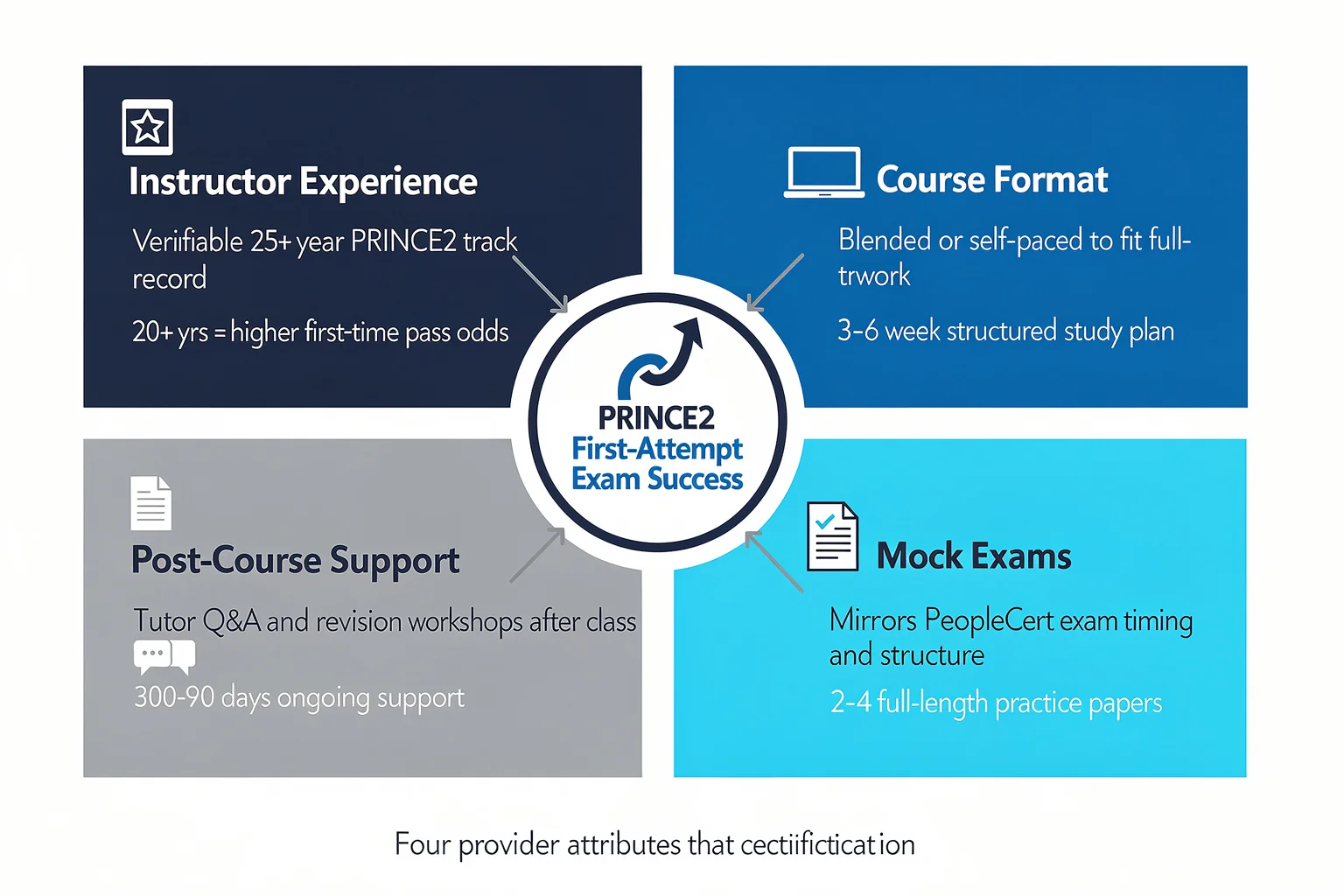
After reviewing the published materials from multiple ATOs and the examination requirements, we identified four provider attributes that consistently separate high-performing candidates from those who end up as retake statistics.
Instructor Experience That Speaks for Itself
A PRINCE2 course lives or dies on the person delivering it. PeopleCert does not prescribe a minimum number of years in the field for trainers, but the most reliable providers make their trainers' backgrounds easy to verify. Insights PM runs courses delivered by instructors with over 25 years of PRINCE2 experience, and the company publishes that figure openly. ILX Group highlights its "experienced accredited trainers" as a core differentiator. When a provider hides trainer bios behind a generic "our expert team" paragraph, you're taking a leap on the quality of delivery. Ask for the specific instructor's name before you book, and check their LinkedIn activity to confirm they're actually teaching live courses rather than reading slides.
Our courses consistently surpass national average pass rates, assisting your success in PRINCE2® certification exams. — Insights PM
Course Format That Fits Your Life
The PRINCE2 official site now lists both online and classroom options, with heavy promotion of virtual courses — sometimes at deep discounts PRINCE2 UK training. That flexibility is genuine: a live virtual course can mimic a classroom better than the pre-recorded e-learning libraries of five years ago. But the best fit depends on how you learn. If you need the structured pressure of a classroom to stay focused, a purely self-paced online module might leave you skimming videos two days before the exam. If you're balancing shift work and childcare, a five-day classroom bootcamp might push knowledge retention to the edge. Look for a provider that lets you switch modes or revisit recordings after the course ends. Many ATOs now offer a blend — live sessions with supplementary video libraries — and that hybrid approach often gives you the best of both worlds.
Mock Exams That Mirror the Real Thing
The single strongest predictor of a first-time pass, in our analysis, is the quality of the mock exams a provider supplies. PeopleCert's own examination format for PRINCE2 Foundation is tightly structured: 60 questions in 60 minutes, with a 60% pass mark. If a provider's mock tests don't match that rhythm, difficulty, and question style, you're training for the wrong event. ILX Group explicitly calls out "realistic exam simulators to build confidence" as part of its package. That language matters — it shows the provider understands that confidence comes from familiarity, not from memorising answers.
Before you buy any course, grab a set of independent sample questions to benchmark the provider's material. For Foundation candidates, we publish a bank of PRINCE2 7 Foundation sample questions that reflect the current exam standard. Practitioner candidates can use our PRINCE2 Practitioner sample exam. Run through a few of these, then ask the provider for a preview of their own question bank. If the provider's questions feel easier, use different terminology, or skip the scenario-based reasoning that Practitioner demands, treat that as a red flag. The same goes for an older PRINCE2 Foundation practice test — while the exam content has evolved, comparing its tone to current samples quickly reveals whether a provider is recycling obsolete question sets.
Post-Course Support That Goes Beyond a Certificate
A single training course, no matter how good, rarely carries you to exam readiness on its own. The best providers build a safety net that lasts until results day. ILX includes an on-demand AI assistant that handles PRINCE2 queries after the course ends, which can save you from spending hours in a manual index. Insights PM bundles Take-2 exam insurance as standard, so if you do fail, the retake fee is covered. Many ATOs also offer a re-attend guarantee — if your exam attempt fails, you can sit the course again without paying twice. These aren't luxury add-ons. They're the practical difference between a provider that's built a system and one that's just renting you a seat.
How to Audit a Provider Before You Pay
You don't need to spend hours on this. A 20-minute audit before you book can filter out most of the poor options.
Verify accreditation directly. PeopleCert maintains a public directory of accredited training organisations. Never rely on an accreditation logo on a slick sales page; navigate to the official directory and confirm the provider is listed for the specific exam level you're targeting. A provider that is only accredited for Foundation shouldn't be selling you a Practitioner bundle.
Request a sample lesson. Most ATOs offer a recorded sample or a live taster session. Watch it, and ask yourself whether the trainer explains concepts clearly or just recites slide headings. A trainer who can't communicate a simple idea in five minutes won't suddenly become clear over five days.
Compare pass-rate claims with independent evidence. A provider publishing "98% pass rate" is meaningless without context — 98% of which cohort, over what period, and verified how? The legitimate ones back up these claims with specific data points and third-party reviews. Insights PM, for instance, pairs its pass-rate statement with 5-star Google reviews spanning nearly 30 years. Look for similar concreteness elsewhere.
Check the mock exam alignment yourself. Use the PRINCE2 7 Foundation sample questions we mentioned earlier as your baseline. If the provider's preview doesn't match, walk away.
Read what the instructor publishes independently. Search for the trainer's name on LinkedIn, project management forums, or even YouTube. Many experienced PRINCE2 instructors run their own blogs or channels, and the quality of their free content often reflects the quality of their paid courses.
A Practical Decision Framework
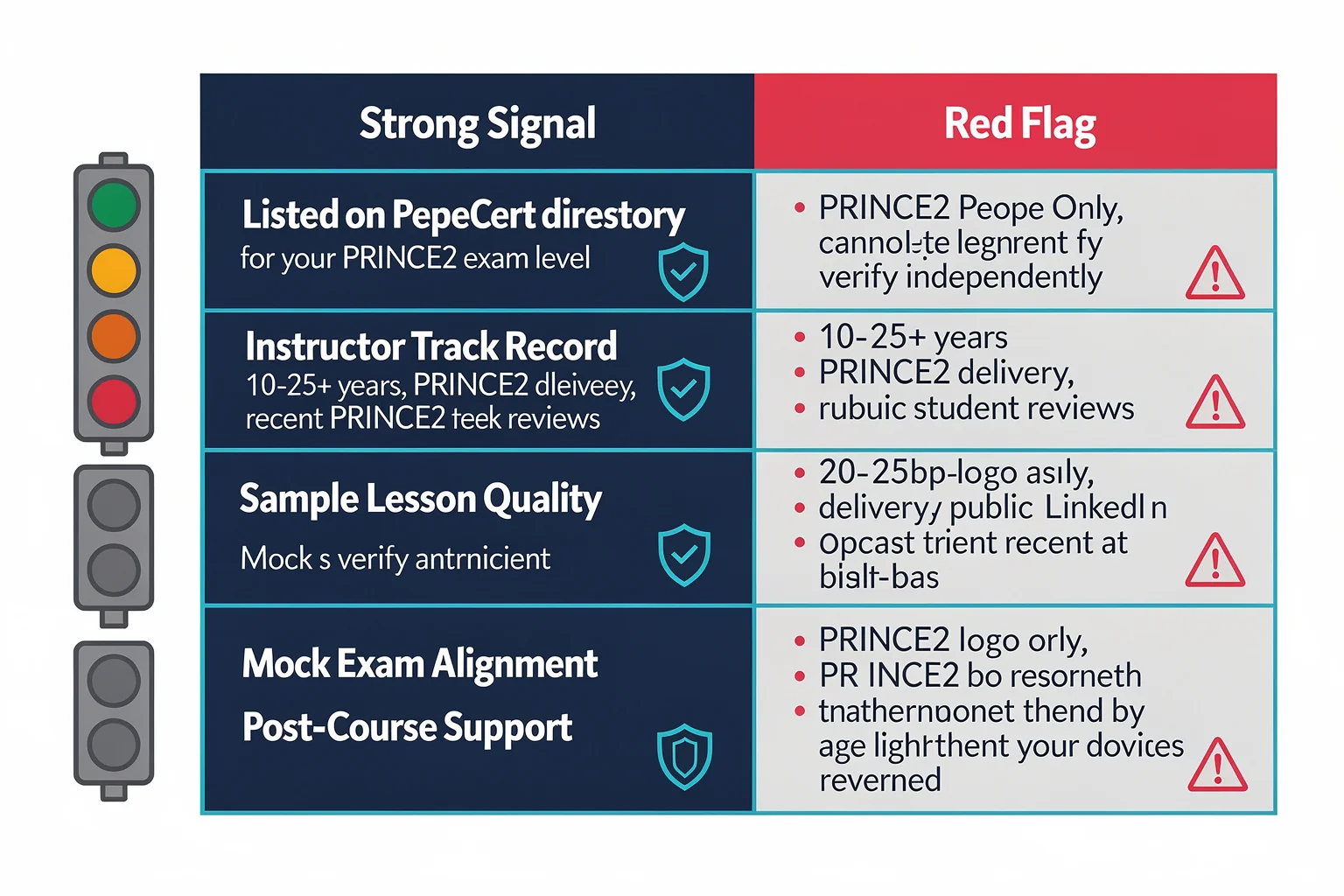
When you're staring at a shortlist of two or three providers, use the table below to score each one. A provider that gets a "red flag" in more than one row should move to the bottom of your list.
| Attribute | Strong Signal | Red Flag |
|---|---|---|
| Accreditation status | Listed on PeopleCert directory for your exam level | Accreditation logo only on sales page; not verifiable |
| Instructor visibility | Named instructor with published industry experience | Generic "expert trainers" with no names or LinkedIn presence |
| Mock exam fidelity | Provider samples match official exam style and timing | Questions are shorter, easier, or written in a different voice |
| Post-course safety net | Includes exam insurance, AI support, or retake guarantee | No mention of retake support beyond an email address |
| Pass-rate transparency | States methodology and cohort size behind pass-rate claim | "99% pass rate" with no backup data or reviewer consensus |
You don't need a perfect score on all five to pick a good provider. A strong instructor and realistic mocks alone can carry a candidate through, as long as the other rows don't light up red.
Where the Evidence Falls Short
A selection framework built from public data has limits. Pass rates are self-declared. No independent body audits them. A provider might claim a 95% first-time pass rate because it carefully filters out weaker candidates before enrolment, or because it counts only the ones who complete all coursework. The average learner, working full-time with limited study hours, may not match the profile of that high-pass cohort.
Instructor tenure is another imperfect measure. Someone with 25 years of PRINCE2 experience might have deep methodology knowledge but poor teaching instincts. A newer trainer delivering a modern interactive curriculum could outperform a veteran reading from a slide deck. The visibility checks we recommend — watching sample lessons, reading independent reviews — help filter for this, but they can't guarantee a match.
Lastly, the provider attributes we've emphasised assume you are an active participant. No amount of exam simulator quality can compensate for skipping the manual. A good provider raises your floor, but it doesn't remove the need to put in the hours.
Next Steps for Your PRINCE2 Journey
- PRINCE2 Foundation exam format: 60 questions, 60 minutes
- Wireshark packet analysis skills that pass the Network+ exam
- Wireshark Certification Paths That Actually Boost Your Salary
browse the relevant exam page and purchase a practice test

Discussion
Question Comments
0 comments·0 participantsSign in to leave a comment and access more free questions.