

PRINCE2 Foundation Exam Format: 60 Questions, 60 Minutes, 60% Pass Mark
PeopleCert’s PRINCE2 Foundation exam format stays consistent: 60 multiple-choice questions in 60 minutes, closed book, with a 60% pass mark. The number hasn’t shifted for the 7th edition, but the content behind those questions has — and a quiet policy change in early 2026 removed a study habit many candidates relied on. If you’re building a study plan right now, understanding the exam format isn’t about memorising a stat; it’s about designing your prep to match how the test actually works. To see how Foundation fits into the bigger picture, check the PRINCE2 certification path — it maps every level from Foundation through Practitioner and Agile.
What the Foundation Exam Looks Like
You face 60 one-best-answer multiple-choice questions. Each question offers four options, and only one is correct. There are no drag-and-drop, hot-area, or matching tasks at Foundation level — those belong to Practitioner. The clock starts as soon as the proctor releases the exam, and you work through the items one at a time. You cannot go back to review or change a previous answer once submitted.
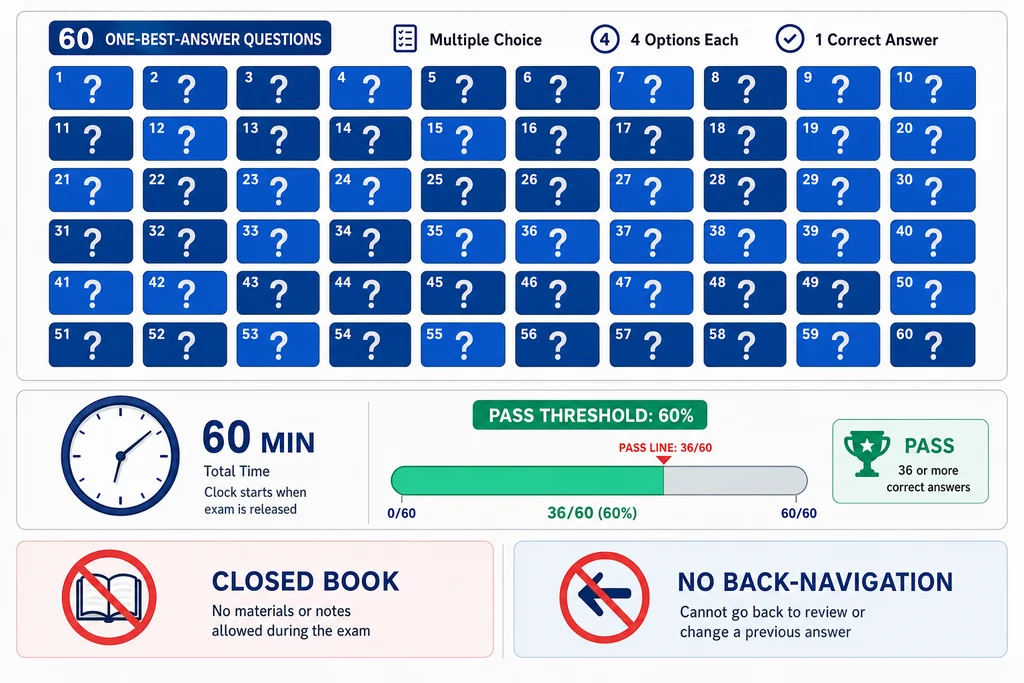
To pass, you need at least 36 correct answers out of 60. That 60% threshold — laid out clearly on the PRINCE2 exam format page — is fixed. There is no penalty for wrong answers, so guessing strategically always helps. The PRINCE2 Foundation exam specification confirms that the question pool is weighted across the syllabus, with a heavier spread on processes and practices. Even without a published percentage table from PeopleCert, the syllabus itself shows that Processes and Practices account for the largest chunk of marks, followed by Principles and People, with Project Context and the newer management approaches filling the remainder.
Most candidates now take the exam online through remote proctoring. The proctor will ask for a room scan before the exam starts — no physical books, wall charts, sticky notes, or second screens anywhere in sight. Tom, a colleague of mine, had a colour-coded wall planner completely unrelated to PRINCE2 flagged during his check-in because the proctor couldn’t read the text. He had to take it down and restart the scan, eating ten minutes of his settling-in time. Clear your workspace the night before.
For a detailed look at domain weightings, the PRINCE2 Foundation exam details page on PlanetCert breaks down the topic areas so you can budget study time where it matters most.
How the 7th Edition Reshapes the Question Pool
The 2017 edition tested candidates on principles, themes, and processes pulled from the Managing Successful Projects with PRINCE2 manual. The 7th edition reorganises everything around five integrated elements: Principles, People, Practices, Processes, and Project Context. It also introduced three new management approaches — Data & Digital Management, Commercial Management, and Sustainability — and added sustainability as a seventh performance target alongside time, cost, quality, scope, benefits, and risk.
In practice, this means the Foundation exam now asks fewer pure-definition questions. You’re more likely to encounter items that describe a partial project situation and ask which principle or practice is being applied, or which management approach should guide the team’s response. For example, a question might present a supplier price hike driven by new environmental regulations and ask which approach the project manager should consult. The answer isn’t a one-word recall; it requires connecting the scenario to the Commercial Management and Sustainability approaches, which sit in the 7th edition’s integrated framework.
The PeopleCert Foundation course page notes that the exam now tests application of principles across a broader project context. Candidates who memorised definitions from the 2017 manual often struggle because they can’t map those definitions to real project moves. The 7th edition rewards someone who can think inside the framework, not just recite it.
Why You Can’t Rely on Notes Anymore
From 23 January 2026, PeopleCert stopped allowing paper notes, handwritten summaries, sticky tabs, or any physical writing aid into Foundation and Practitioner exams. For years, many candidates leaned on colour-coded tabs and rapid-reference sheets to manage the cognitive load under time pressure. That safety net has been removed.
Lisa, a project coordinator I spoke with, had built her preparation around a one-page acronym sheet she planned to glance at during the exam. She discovered the new rule only during the proctoring check-in. She passed, but the mental recalibration right before the timer started cost her confidence. Another candidate, Amir, had spent weeks building a tabbed manual with chapter summaries. When the proctor told him to remove it, he felt suddenly exposed. He spent the final 48 hours running verbal drills with a study partner, and that pivot likely saved his score.
If you’re studying now, build knowledge that doesn’t need external prompts. Stop highlighting a physical book and start closing it to summarise aloud. Create short mental scripts for each principle or practice — a 30-second explanation linked to a concrete example — and run those drills during dead time (commutes, coffee queues, waiting for the kettle). The goal is recall that works when the only tools in the room are your brain and the screen.
Your Step-by-Step Foundation Exam Prep Plan
You can complete these steps alongside a training course or as a self-study path.
1. Map the syllabus to the 7th edition manual.
Walk through the five integrated elements from the official Managing Successful Projects with PRINCE2 7 publication. Mark which management approaches sit under each practice. Create a one-page matrix with the elements across the top and sub-topics below; tick off each when you can explain it without looking.
2. Allocate study time by topic weight.
Processes and Practices dominate the question pool. Spend roughly 40% of your study hours on those two, 30% on Principles and People, and the remaining 30% on Project Context and the newer management approaches. Write a weekly schedule with these ratios, and adjust as practice test results show where you’re leaking marks.
3. Build retrieval cards from scenario-based prompts.
For each principle, write a small scenario card: “The project board asks whether the project still makes sense after a supplier price spike. Which principle are they applying?” Answer on the back: “Continued business justification.” Add a follow-up: “What information would they request to make that decision?” This mirrors the exam style more closely than flat definition decks. A deck of 50–60 cards takes about 15 minutes per run.
4. Run a full simulator session every 48 hours.
Once you know the content, drop into a timed mock exam that copies the 60-minute, 60-question rhythm. After each round, don’t just check the score — log every wrong answer with a short note about what misdirected you. That mistake log becomes the study list you revisit in the final days.
5. Close gaps with focused micro-sessions.
After a simulator run, pick the one practice area where you dropped the most marks and spend 25 minutes drilling only that topic. Re-read the relevant manual section, answer ten targeted questions, and end with a self-test: can you explain the topic to a non-project-manager in under two minutes? If so, you’ve likely nailed it.
Using Simulated Exams to Build the Right Skills
Practice tests do more than measure knowledge. They teach clock management, guessing under uncertainty, and recovery from early mistakes — all crucial when you have exactly one minute per question.
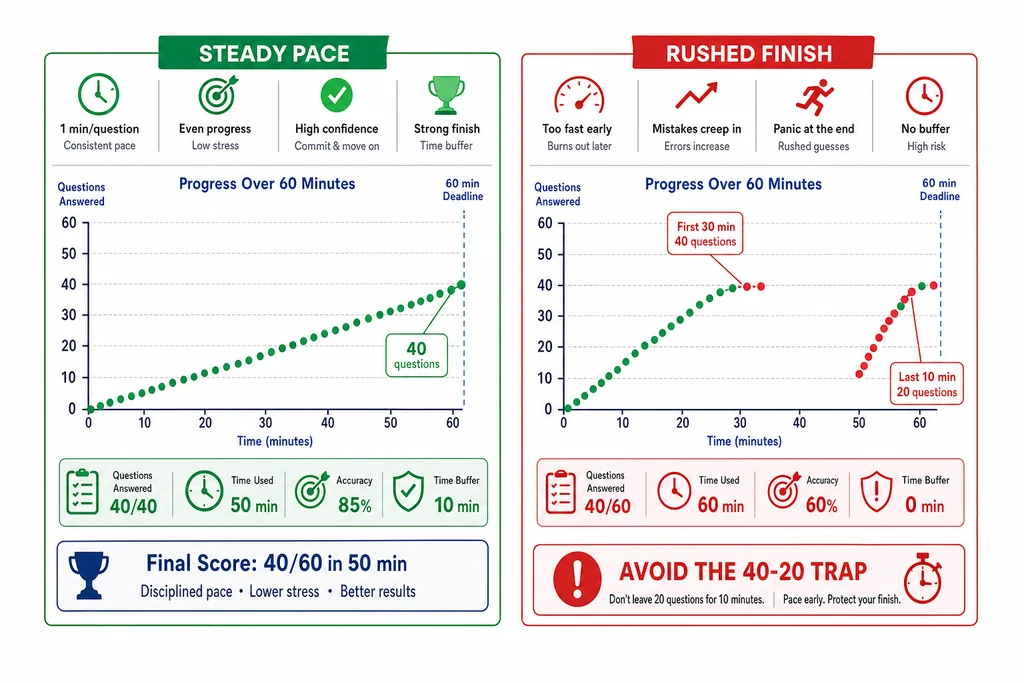
Because PeopleCert’s platform presents questions one at a time with no back-navigation, your practice must mirror that constraint. Train yourself to commit to an answer and move forward. I’ve seen candidates burn seven minutes on one ambiguous question, then scramble through the last 15 in ten minutes. A simulator that shows your pacing history will surface that habit quickly.
Try the “40-20 run”: take the first 40 questions at a steady one-per-minute pace, then use the remaining 20 minutes for the last 20 questions with a two-minute buffer. If you’ve practiced with real-style items — like the PRINCE2 Foundation sample questions — you’ll enter the exam already calibrated. Another drill: set a 60-minute timer and attempt only 45 questions, deliberately under-loading so you can focus on being deliberate. When you return to a full 60 in 60, the pace feels spacious.
What Happens on Exam Day
Log into the proctoring environment 15 minutes early to handle setup without eating into your exam time. Close every unrelated application, plug in your laptop, and test your webcam the day before. The proctor will guide you through a room scan; no phones, no notes, no second screen.
The timer starts when the exam is released. You see one question at a time with a counter and clock. No back-navigation. If you need a comfort break, assume you can’t pause the clock — few proctoring policies allow it. Your provisional result appears on screen immediately after you finish, and PeopleCert emails the official certificate within a few business days. A score of 36/60 or above makes you PRINCE2 Foundation certified.
Questions Candidates Ask Most Often
Does the Foundation exam test Practitioner-level processes?
No. Foundation tests recognition and overview of processes. Deep scenario application belongs to Practitioner. You won’t be asked to tailor processes to a specific project environment.
Can I use the 2017 manual to prepare?
I wouldn’t recommend it. The structure, terminology, and content coverage differ enough that you’d be studying material the exam no longer assesses. Get the 7th edition manual.
Is there a penalty for wrong answers?
No. You have a 25% chance on a blind guess. If you can eliminate two wrong options, your odds jump to 50% — worth the mental effort.
Does the Foundation certification expire?
No, PRINCE2 Foundation does not expire. However, if you later earn Practitioner, you’ll need to maintain it through CPD and a re-registration exam every three years.
Do I need formal training?
No prerequisite course is required. You can self-study and schedule the exam directly through PeopleCert. That said, many candidates find a structured course plus practice tests speeds up their grasp, especially on the updated 7th edition content.
Where Foundation Takes You Next
Passing Foundation unlocks the Practitioner exam: 70 questions, 150 minutes, open book, built around a single scenario. The contrast is sharp — Foundation asks “what is”; Practitioner asks “what should this project manager do next, and why.” The open-book element helps, but the 150-minute clock still punishes anyone who hasn’t internalised the scenario structure. The PRINCE2 Practitioner exam format page breaks down exactly what to expect.
Ready to build the recall that exam day demands? Learn more – browse the relevant exam page and purchase a practice test. No notes, no tabs, just the automatic responses you’ll need when the clock starts.
Study Resources to Keep on Your Radar
- Free PRINCE2 7 Foundation sample questions
- PRINCE2 Agile Foundation exam
- PRINCE2 Practitioner exam overview
browse the relevant exam page and purchase a practice test
Learn more
Discussion
Question Comments
0 comments·0 participantsSign in to leave a comment and access more free questions.