

IT Certifications with Highest ROI by Industry
Looking to boost your IT career? Here’s the bottom line: Certifications like AWS Certified Solutions Architect, CISSP, and Google Cloud Professional Cloud Architect can significantly increase your earning potential, with average salaries ranging from $145,000 to over $190,000 annually. These credentials deliver high returns on investment (ROI) by addressing critical industry needs in technology, healthcare, and finance.
Key Takeaways:
- AWS Certified Solutions Architect: Entry-level certification with a 374% ROI and salaries up to $180,000.
- CISSP: Cybersecurity gold standard with average salaries of $164,000 and a 3,000% ROI.
- Google Cloud Architect: High demand in multi-cloud strategies with average earnings of $190,204.
- CISM: Leadership-focused certification, offering salaries up to $250,000 for senior roles.
- Healthcare IT Certifications: Specialized credentials like CompTIA HIT-002 and CPHIMS are essential for regulated industries, with salaries reaching $208,000 for executive roles.
Quick Comparison:
| Certification | Cost | Avg. Salary (US) | Key Benefit |
|---|---|---|---|
| AWS Solutions Architect – Associate | $150 | $155,000 | Affordable with fast ROI |
| CISSP | $749 | $164,000 | Best for cybersecurity leadership |
| Google Cloud Architect | $200 | $190,204 | Growing demand in multi-cloud setups |
| CISM | $575–$760 | $191,653 | Ideal for management roles |
| CompTIA HIT-002 | $200–$300 | 10–15% salary bump | Bridges IT and healthcare expertise |
Certifications are a direct path to higher salaries, better roles, and industry recognition. Whether you're in cloud computing, cybersecurity, or healthcare IT, the right certification can be a game-changer.
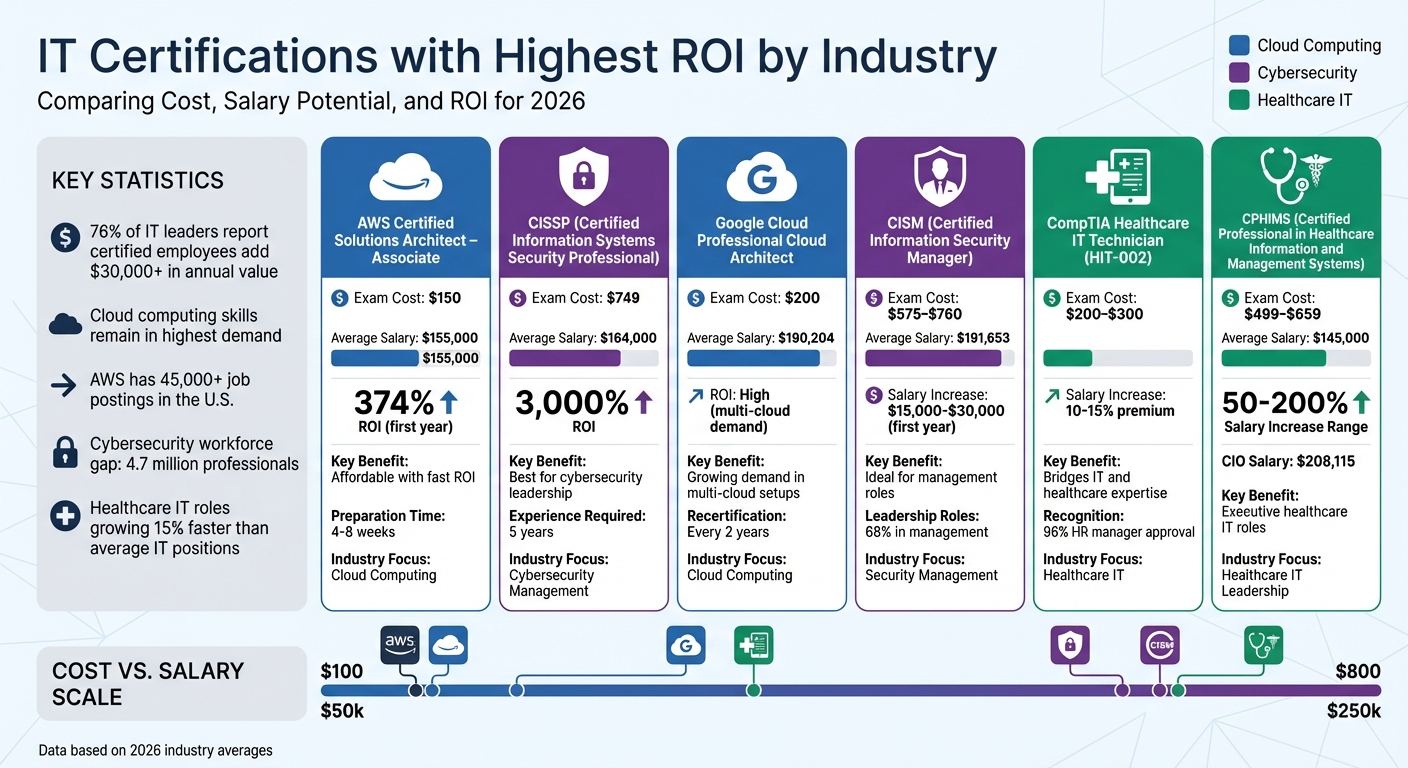
IT Certifications ROI Comparison: Costs, Salaries, and Benefits by Industry
Must-Have IT Certifications in 2025 (High-Paying and Best overall)
Success in these high-stakes exams often requires a proven certification prep strategy to ensure you pass on your first attempt.
1. AWS Certified Solutions Architect
The AWS Certified Solutions Architect certification continues to dominate as the most sought-after cloud certification across industries. With over 45,000 job postings in the U.S. alone, its demand has remained steady over the past five years, making it a solid choice for professionals looking to advance their careers.
Average Salary Increase
Earning this certification can significantly boost your income. Professionals with the Associate-level certification typically earn between $125,000 and $145,000 - up about 47% from the average baseline of $85,000. Those who achieve the Professional-level certification see even higher salaries, ranging from $155,000 to $180,000. Industry-specific averages show Finance and Fintech professionals earning around $155,000, while those in SaaS or software companies average $150,000.
Certification Cost
Getting certified is surprisingly affordable. The Associate exam costs $150, while the Professional exam is priced at $300. Many candidates begin with the $100 Cloud Practitioner exam, which provides a 50% discount on the Associate exam, reducing its cost to just $75. Adding $50–$100 for study materials, most professionals spend less than $500 in total to get certified. To ensure success on the first attempt, many candidates compare AWS practice tests to find the most effective study tools.
Return on Investment (ROI)
The return on investment for this certification can be staggering. For the Solutions Architect Associate path, the estimated first-year ROI is 374%. Real-world examples highlight even greater returns: In 2026, Sarah transitioned from a $55,000 job to an $85,000 Cloud Support Engineer role after investing just $300 in three months, resulting in a first-year ROI exceeding 10,000%. Similarly, Mike increased his salary from $95,000 to $125,000 in just six weeks with a $200 investment, achieving a 15,000% ROI.
Industry Demand Growth
The demand for Solutions Architects is rising, with job postings increasing by 15% year-over-year. Professional-level roles are growing even faster, at a rate of 20% annually. Additionally, 87% of IT hiring managers now view cloud certifications as a critical factor in candidate evaluation, and certified professionals are 73% more likely to land cloud-related roles. These statistics highlight the certification's potential to open doors and accelerate career growth.
2. CompTIA Healthcare IT Technician (HIT-002)
Healthcare IT certifications are becoming a game-changer for professionals in the tech world. Among them, the CompTIA Healthcare IT Technician certification stands out. It bridges the gap between healthcare and IT, making it a must-have for those looking to thrive in this rapidly evolving field. As hospitals and clinics embrace digital transformation, this certification is gaining traction as a key qualification for IT professionals aiming to make their mark in the healthcare industry.
Average Salary Increase
Certified professionals in entry-level healthcare IT roles often enjoy a 10–15% salary premium compared to their peers in general IT positions. This certification opens doors to specialized roles, highlighting its value in a field where expertise is in high demand. The salary bump reflects the growing need for IT professionals who not only understand technology but also grasp the unique regulatory and operational challenges of healthcare environments.
Industry Demand Growth
The demand for certified IT specialists in healthcare is on the rise. As the sector undergoes rapid changes, hospitals and health tech companies are actively seeking professionals with the right credentials. For example, cloud computing is becoming the backbone of clinical systems, creating opportunities for health informatics specialists. With 96% of HR managers recognizing the value of CompTIA certifications, roles such as Hospital IT Support, Medical Device Support, and Clinical Systems Support are increasingly being filled by certified experts.
This growing demand underscores the certification's relevance in a sector hungry for skilled professionals who can navigate both technical and healthcare-specific challenges.
3. Certified Information Systems Security Professional (CISSP)
The CISSP stands as a gold standard in cybersecurity certifications. Its vendor-neutral framework spans eight core domains, making it relevant across various industries. This certification is particularly sought after by professionals moving from technical roles into strategic leadership positions like Chief Information Security Officer or Security Architect. Below, we delve into the costs, salary benefits, and market demand that highlight the value of earning a CISSP.
Average Salary Increase
The financial benefits of earning a CISSP are hard to ignore. On average, professionals with this certification see a salary bump or promotion of nearly 20%. In the U.S., CISSP holders earn a median salary of approximately $164,000. The North American average sits around $147,757, though this varies by role and industry. For instance, Security Architects in Information Technology command a median salary of $308,000, while those in Pharma & Biotech earn around $246,000. Similarly, IT Managers in Financial Services average $153,762 compared to $177,181 in healthcare.
"If you have a CISSP, you won't be the one chasing jobs – jobs will be chasing you."
- Eric Reed, Cybersecurity Trainer
Certification Cost
The CISSP exam costs $749, with an additional annual maintenance fee of $135. When you include study materials, practice exams, and training courses, the total initial investment ranges between $1,000 and $3,000. While this may seem steep, the long-term financial benefits often far outweigh the upfront costs. Most candidates spend three to six months preparing, dedicating 10–15 hours per week to master the material. Additionally, candidates need five years of paid work experience in at least two of the eight CISSP domains. Those lacking the required experience can still take the exam and earn the Associate of (ISC)² designation until they meet the experience criteria.
For preparation, resources like Planet Cert offer exam simulators, practice tests, and detailed study guides to streamline the process.
Return on Investment (ROI)
The CISSP certification delivers a strong ROI, estimated at around 3,000%. Certified professionals typically earn about 30% more than their non-certified counterparts. Many CISSP holders transition directly into senior roles with salaries exceeding $200,000. Nearly 97% of CISSP-certified professionals are employed full-time, with over 47% in management or executive positions. The certification is also a common requirement for various U.S. government and Department of Defense roles, further boosting its value.
Industry Demand Growth
The demand for CISSP-certified professionals is on the rise. Employment for information security analysts is projected to grow by 32% through 2032, driven by a global cybersecurity workforce gap of approximately 4.7 million professionals. This growing demand highlights the CISSP’s importance as a pathway to senior roles in cybersecurity. Employers increasingly rely on the CISSP as a key qualification for leadership positions, even as specialized cloud certifications gain traction.
"The CISSP isn't just worth it, it's arguably the single most powerful investment you can make in your career."
- Joel Charlton, Certified Trainer and Author
4. Certified Professional in Healthcare Information and Management Systems (CPHIMS)
The CPHIMS certification is designed for senior professionals who combine expertise in healthcare delivery with IT systems. This credential demonstrates proficiency in managing the systems development lifecycle, organizational management, and leadership within healthcare IT settings. As hospitals and health systems ramp up their digital transformation efforts, the need for professionals skilled in overseeing clinical workflows and IT infrastructures continues to grow.
Average Salary Increase
This certification aligns with the increasing digitalization of healthcare, offering substantial salary benefits. On average, CPHIMS-certified professionals earn a base salary of $145,000 annually. Specific roles see even higher earnings: Chief Information Officers average $208,115, Consulting Managers around $161,086, and Directors of Information Systems approximately $137,639. Depending on the starting role and organization size, salary increases can range from 50% to as high as 200%.
"Holding a CPHIMS can often translate into the ability to command a better salary, reflecting the value you bring to an organization."
- CPHIMSPrep
Certification Cost
The exam fee for the CPHIMS certification is between $499 and $659. Additional expenses may include study materials. The certification is valid for three years, after which recertification is required through continuing education or retaking the exam. To qualify, candidates must hold a baccalaureate degree and have at least five years of experience in information and management systems, with three of those years specifically in healthcare. Resources like Planet Cert provide tailored exam simulators and practice tests for preparation.
Return on Investment (ROI)
The benefits of CPHIMS certification go beyond salary increases. Certified professionals are known to improve operational efficiency and accelerate project completion times. This translates into smoother electronic health record implementations, faster project resolutions, and enhanced credibility when collaborating with clinical teams. Additionally, the certification opens doors to executive roles, with nearly half (47.1%) of certified individuals being in the late stages of their careers.
Industry Demand Growth
Healthcare IT roles are expanding at a rate 15% faster than average IT positions. Organizations are actively seeking certified professionals to manage digital tools, AI-driven analytics, and electronic health records, all of which are crucial for improving patient care and operational efficiency. As healthcare IT evolves, the CPHIMS certification has become essential for professionals aiming to meet the sector's growing demands. It positions individuals at the critical intersection of healthcare and technology, a space where expertise is increasingly valued as health systems focus on digital solutions and data security.
sbb-itb-b03e171
5. Certified Information Security Manager (CISM)
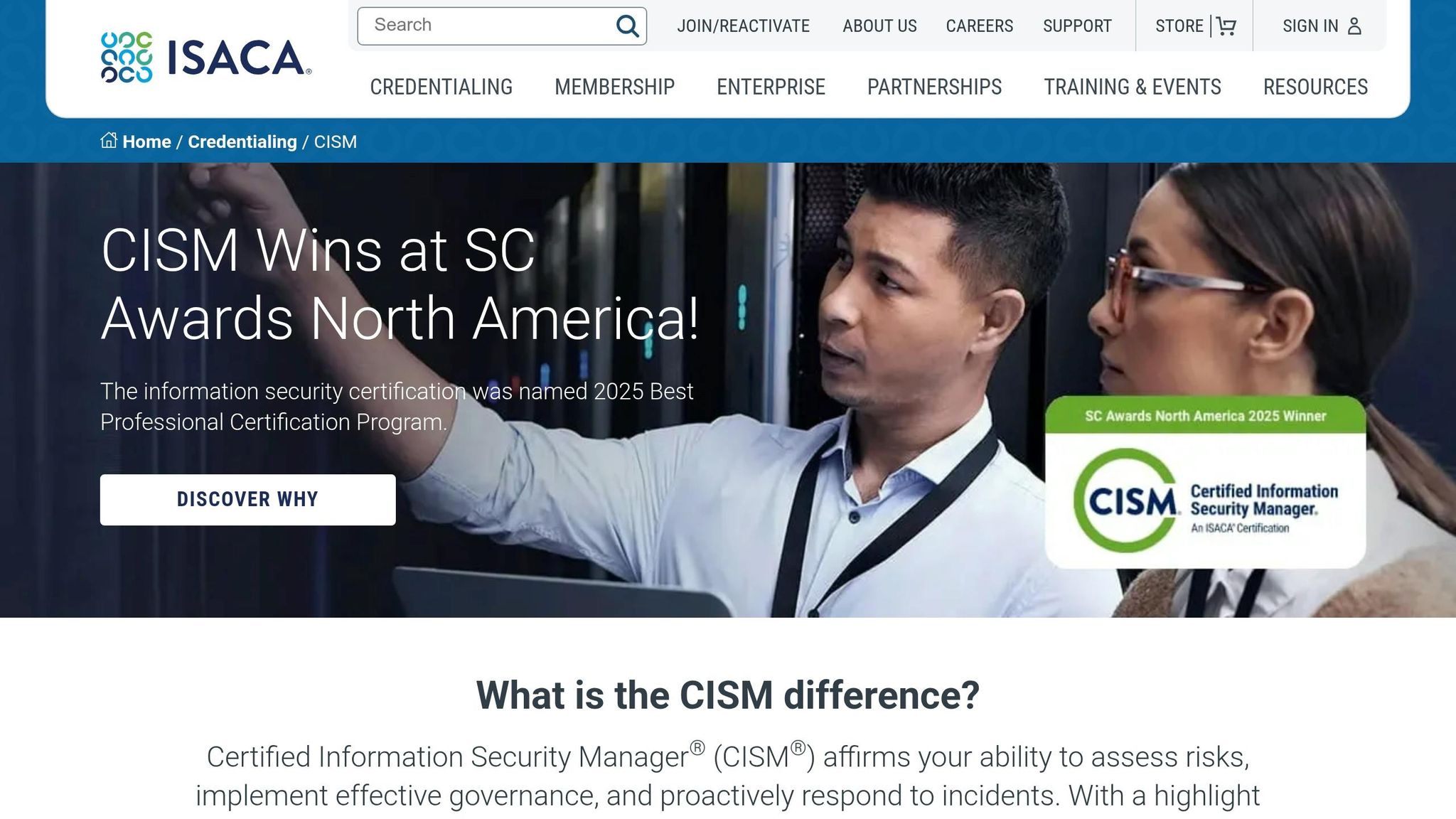
The CISM certification demonstrates the ability to transition from technical security roles to leadership positions by translating complex risks into actionable business strategies. This skill set is especially valued in industries like finance, healthcare, and government, where leaders must bridge technical expertise with executive decision-making.
Average Salary Increase
Earning a CISM certification often leads to a salary boost of $15,000 to $30,000 in the first year. On average, CISM holders earn $191,653 annually, which includes a base salary of $133,569 and an additional $58,084 from bonuses and profit-sharing.
Salaries vary depending on experience and location:
- Professionals with 5–8 years of experience typically earn $120,000–$160,000.
- Senior experts with 15+ years can command $200,000–$250,000 or more.
- West Coast professionals average around $200,000, compared to $151,000 in the Northeast.
Additionally, 37% of IT professionals reported receiving a salary increase immediately after earning a certification.
"CISM-certified professionals consistently earn significantly more than their non-certified counterparts... this credential is one of the most direct ways to move from mid-range security pay into leadership level compensation bands." - Rob Witcher, Founder, Destination Certification
Specializing in AI governance alongside a CISM certification can further boost base salaries by $20,000 to $40,000.
Certification Cost
The CISM exam costs $575 for ISACA members and $760 for non-members. Including training and study materials, the total investment generally falls between $1,900 and $3,800. Maintaining the certification requires an annual fee of $45 for members or $85 for non-members.
To qualify, candidates need five years of verified professional experience in information security management. Preparing for the 4-hour, 150-question exam typically requires about 150 hours of study. Resources like Planet Cert’s exam simulators and practice tests can help streamline preparation.
While the upfront cost may seem significant, the long-term career benefits make it worthwhile, as shown in the ROI breakdown below.
Return on Investment (ROI)
The CISM certification delivers a strong ROI, not just through salary increases but also by accelerating career progression. Certified professionals are often fast-tracked into leadership roles, reducing the time-to-hire for senior positions. Many see notable career and salary advancements within one to two years of earning the credential.
Strategic career moves amplify this ROI. Switching companies every 3–4 years often results in greater salary growth compared to waiting for internal promotions. Adding specializations, such as Governance, Risk, and Compliance (GRC), or platform-specific certifications can further increase earning potential, especially in regulated industries.
These factors explain why CISM-certified professionals remain highly sought after in today’s security-focused job market.
Industry Demand Growth
Demand for CISM-certified professionals continues to grow, particularly in regulated industries. As of March 2026, there are 661 active job postings in the U.S. specifically requiring CISM certification. This demand is fueled by regulatory frameworks like GDPR, HIPAA, SOX, and PCI-DSS, which require certified leaders to manage compliance challenges.
"CISM-certified professionals speak both the language of security and the language of business – a rare combination that drives demand and keeps salaries high." - IT Governance Editorial Team
The rise of AI systems has further increased the need for security leaders who understand AI governance and regulatory risks. A persistent shortage of cybersecurity professionals at the management level allows CISM holders to command premium compensation and negotiate remote work options. Many are also taking advantage of geographic arbitrage, earning metropolitan-level salaries while living in lower-cost areas through remote work.
6. Google Cloud Professional Cloud Architect
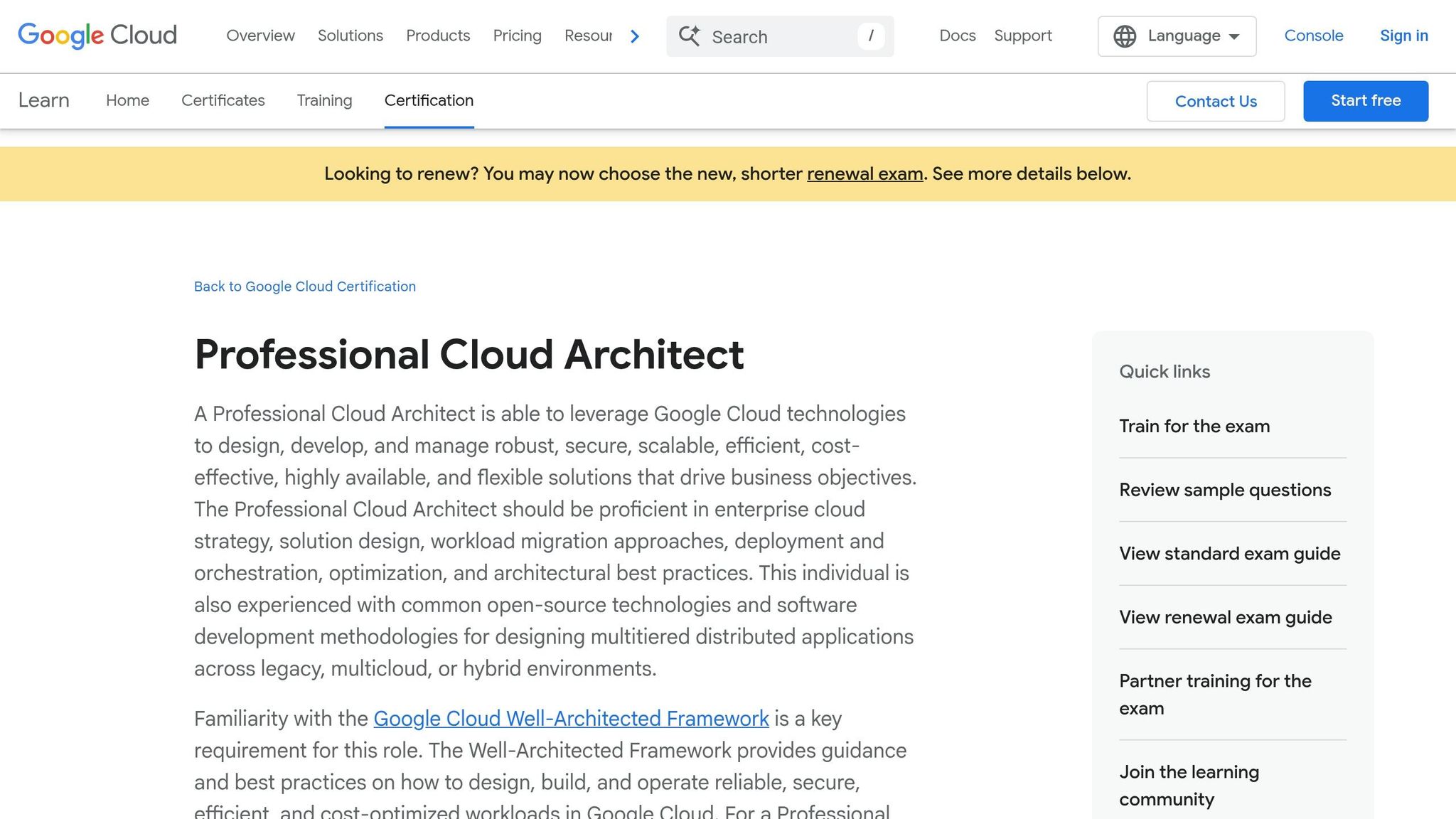
The Google Cloud Professional Cloud Architect certification validates skills in designing, building, and managing infrastructure on Google Cloud Platform (GCP). With GCP growing at an annual rate of 35% - the fastest among major cloud providers - this certification places professionals at the forefront of cloud technology advancements.
Average Salary Increase
Google Cloud architects earn an average of $190,204 annually, surpassing their non-certified counterparts by about $12,000. Additionally, certified architects often see yearly raises between 8% and 15% as they expand their expertise and take on more complex projects. Approximately 44% of certification holders also manage teams, reflecting the leadership opportunities tied to this credential.
"Everyone's looking for that multi-cloud approach, multi-cloud mindset. And Google Cloud is sitting there... as that alternative that a lot of organizations are moving to, just for redundancy." - Greg Fuller, VP of Codeacademy Enterprise at Skillsoft
Pairing this certification with others, like the AWS Certified Cloud Practitioner or security-focused credentials, can further boost your marketability, especially as multi-cloud strategies gain traction.
Certification Cost
The exam fee is $200. Preparation expenses range from $200 to $2,500, depending on the chosen study materials, though many employers provide financial support or training vouchers.
Google advises candidates to have at least three years of professional experience, including one year of direct experience designing and managing GCP solutions, before attempting the exam. The test, lasting 120 minutes, includes 50–60 multiple-choice and multiple-select questions, with two case studies making up as much as 30% of the score. Recertification is required every two years to maintain the credential.
Tools like Planet Cert's exam simulators and practice tests can help candidates prepare effectively by mimicking real exam conditions and providing detailed feedback.
Return on Investment (ROI)
With a $200 exam fee and earning potential exceeding $190,000 annually, this certification offers impressive ROI. IT leaders report that certified employees contribute over $30,000 in additional annual value to their organizations.
"IT leaders agree certified employees add more value to their organizations than non-certified employees - most often at $30,000 or more a year. Consider that figure against the cost of a prep course... and exam fees... The ROI becomes evident quickly." - Skillsoft
Specializing in AI tools like Vertex AI, Gemini, and Document AI can elevate earning potential even further as businesses increasingly integrate AI with their cloud systems.
Industry Demand Growth
Demand for Google Cloud architects is surging across industries like finance, technology, and professional services. Financial institutions rely on these professionals to create secure, compliant cloud infrastructures, while tech and service companies value their ability to scale operations and drive innovation. Given that cloud computing ranks as one of the most challenging areas for IT leaders to find qualified talent, certified professionals are in a strong position to negotiate perks like remote work and flexible locations.
The rise of multi-cloud strategies has also increased demand, as organizations turn to GCP alongside AWS and Azure to avoid single points of failure and enhance system redundancy. With this growing demand, the value of the Google Cloud Professional Cloud Architect certification is clear, setting the stage for further discussion of certification trade-offs in the next section.
Pros and Cons
Building on the ROI analysis earlier, here's a closer look at the advantages and drawbacks of each certification, helping you weigh the trade-offs.
The AWS Certified Solutions Architect – Associate offers an impressive return on investment, requiring only a $150 exam fee and a study period of 4–8 weeks. It’s a great choice for professionals aiming for quick career growth without a hefty initial expense. On the other hand, the CISSP certification, often regarded as the "gold standard" for cybersecurity management, comes with a higher price tag of $749 and demands 5 years of experience. This makes it ideal for those targeting leadership roles like Chief Information Security Officer (CISO).
Pairing certifications can be a smart move to maximize earning potential. For instance, combining cloud-specific credentials (like AWS or Azure) with vendor-neutral security certifications (such as CISSP or CompTIA Security+) can boost your value in the job market. However, there’s a diminishing return after earning three certifications, so focusing on strategic choices is more effective than simply accumulating them. Interestingly, certifications at the intersection of cloud computing and cybersecurity currently offer the highest salary premiums. For example, the AWS Certified Security – Specialty has an average annual salary of $203,597, reflecting a 22% year-over-year increase.
Industry-specific certifications also play a critical role in regulated sectors like healthcare and finance. Credentials such as CPHIMS and CISM are often required to ensure compliance and manage risk. Meanwhile, certifications like CISM and CISSP lean heavily toward management, with 68% and 58% of their holders occupying leadership roles, respectively.
"76% of IT leaders report that certified employees add more than $30,000 in annual value to their organizations." - Skillsoft IT Skills and Salary Survey
If you’re worried about the cost of certifications, check whether your employer offers training vouchers or prepaid exam credits. Many companies, particularly those partnered with vendors like Cisco, CompTIA, and Microsoft, provide financial support to offset these expenses.
Here’s a quick comparison of the certifications discussed:
| Certification | Exam Cost | Avg. Salary (U.S.) | Key Advantage | Primary Drawback |
|---|---|---|---|---|
| AWS Solutions Architect – Associate | $150 | $155,597 | Quick ROI; 4–8 weeks preparation | - |
| CISSP | $749 | $168,060 | "Gold standard"; 58% in management | Requires 5 years of experience |
| CISM | $575–$760 | $157,189 | 42% report pay increases | Primarily management-focused |
| AWS Certified Security – Specialty | $300 | $203,597 | 22% salary growth; 73% job demand rise | Requires 5 years in IT security plus 2 years on AWS |
| Google Cloud Professional Cloud Architect | $200 | $190,204 | Multi-cloud demand; 49% in management | Requires recertification every 2 years |
Conclusion
Drawing insights from healthcare, finance, and technology, this overview highlights certifications that align with various career aspirations and deliver measurable returns.
Choosing the right certification depends on your career focus and the clear return on investment seen across industries. For those specializing in cloud computing, certifications like the AWS Certified Security – Specialty and Google Cloud Professional Cloud Architect stand out, offering average salaries above $190,000. If your interests lie in financial security and risk management, the CISM certification delivers value with an average salary of $157,189 while addressing compliance needs. For a well-rounded cybersecurity career, the CISSP remains a top-tier choice, with professionals earning an average of $168,060.
Starting with vendor-neutral certifications such as CompTIA A+, Network+, or Security+ is a great way to establish a foundational skill set. From there, you can advance to vendor-specific certifications that often command higher earnings. Building your expertise step by step allows you to strategically stack certifications for maximum impact.
"This year's list shows that cloud computing skills remain in high demand and can be quite lucrative for tech professionals. Overall, the IT job market is characterized by a significant imbalance between supply and demand, which continues to drive salaries higher." - Greg Fuller, Vice President, Codecademy Enterprise
Look into training vouchers or Cisco Learning Credits that your employer might offer. Presenting the financial benefits of certifications - like the $30,000 annual boost noted in industry surveys - can help secure employer support for your certification goals.
Planet Cert offers a wide range of preparation tools for over 1,000 exams from 150+ vendors, including AWS, Google Cloud, CompTIA, ISACA, and ISC2. With resources like 1,000,000+ practice questions and multiple study modes (Exam Simulator, Study Mode, Flashcard Mode, and Review Mode), along with Brainy AI for deeper learning, you can gain a true understanding of the material instead of just memorizing answers. Track your progress, compare with peers, and prepare confidently at planetcert.com. These certifications not only sharpen your skills but also give you a competitive edge in the fast-paced IT world.
FAQs
Which certification is best for my industry (tech, healthcare, or finance)?
The right IT certification for you hinges on your career aspirations and the industry you're targeting. In the tech world, certifications such as Google Cloud Professional Cloud Architect, AWS Solutions Architect, and CISSP are highly regarded, especially in cloud computing and cybersecurity. If you're in healthcare, securing medical data is a priority, making certifications like CISSP, CISM, and CISA particularly relevant. Meanwhile, in the finance sector, credentials like CFA and CPA, along with certifications focused on security and data analysis, often deliver the strongest return on investment.
How can I calculate ROI for a certification based on my current salary?
To figure out ROI, you’ll need to weigh the total certification costs - this includes exam fees, study materials, and even opportunity costs - against the anticipated salary increase. The formula looks like this:
ROI = ((Salary Increase - Total Costs) ÷ Total Costs) × 100%
Keep in mind, certifications often lead to salary boosts ranging from 15% to 26%. This range can help you gauge whether pursuing the certification makes financial sense.
Can I earn CISSP or CISM without the required work experience?
No, you can’t earn CISSP or CISM without meeting the required work experience. For CISSP, you need at least five years of experience in at least two of its eight domains. On the other hand, CISM focuses specifically on cybersecurity management experience. These requirements are in place to ensure that candidates have the practical knowledge and skills needed to qualify for these certifications.
Related Blog Posts

Discussion
Question Comments
0 comments·0 participantsSign in to leave a comment and access more free questions.