

Top 12 IT Certifications for Career Growth in 2026
In 2026, staying competitive in IT means investing in certifications. With rapid advancements in AI, cloud computing, and cybersecurity, certifications validate your skills and boost your career prospects. Certified professionals earn 20–40% more than their uncertified peers, with many employers willing to pay a premium for verified expertise.
Here are the 12 top IT certifications to help you advance your career:
- CompTIA A+: Entry-level; covers hardware, troubleshooting, and OS. Ideal for IT support roles.
- CompTIA Network+: Focuses on networking concepts and troubleshooting. Prepares for roles like Network Administrator.
- CompTIA Security+: Validates foundational security skills. Great for SOC Analyst or Security Administrator roles.
- CompTIA Cloud+: Vendor-neutral cloud certification for Cloud Engineers and DevOps roles.
- Cisco CCNA: Networking certification for roles like Network Engineer, with skills in routing, switching, and automation.
- AWS Certified Solutions Architect – Associate: AWS cloud design and cost optimization skills.
- Microsoft Certified: Azure Solutions Architect Expert: Advanced certification for hybrid and cloud solutions.
- Google Cloud Professional Cloud Architect: GCP-focused certification for cloud architects and consultants.
- CISSP: Advanced cybersecurity certification for leadership roles like CISO or Security Architect.
- CCSP: Vendor-neutral cloud security certification for Cloud Security Engineers.
- PMP: Project management certification for IT Project Managers and PMO Directors.
- Certified Kubernetes Administrator (CKA): Hands-on Kubernetes skills for DevOps Engineers and SREs.
Key Takeaways:
- Certifications align with high-demand roles in cloud, security, and AI-driven environments.
- Salary increases range from 10–40%, depending on the certification and experience level.
- Advanced certifications like CISSP or Azure Architect are best for seasoned professionals, while CompTIA A+ and Network+ are ideal for beginners.
These certifications not only validate your skills but also position you for higher salaries and better opportunities in an evolving tech landscape.
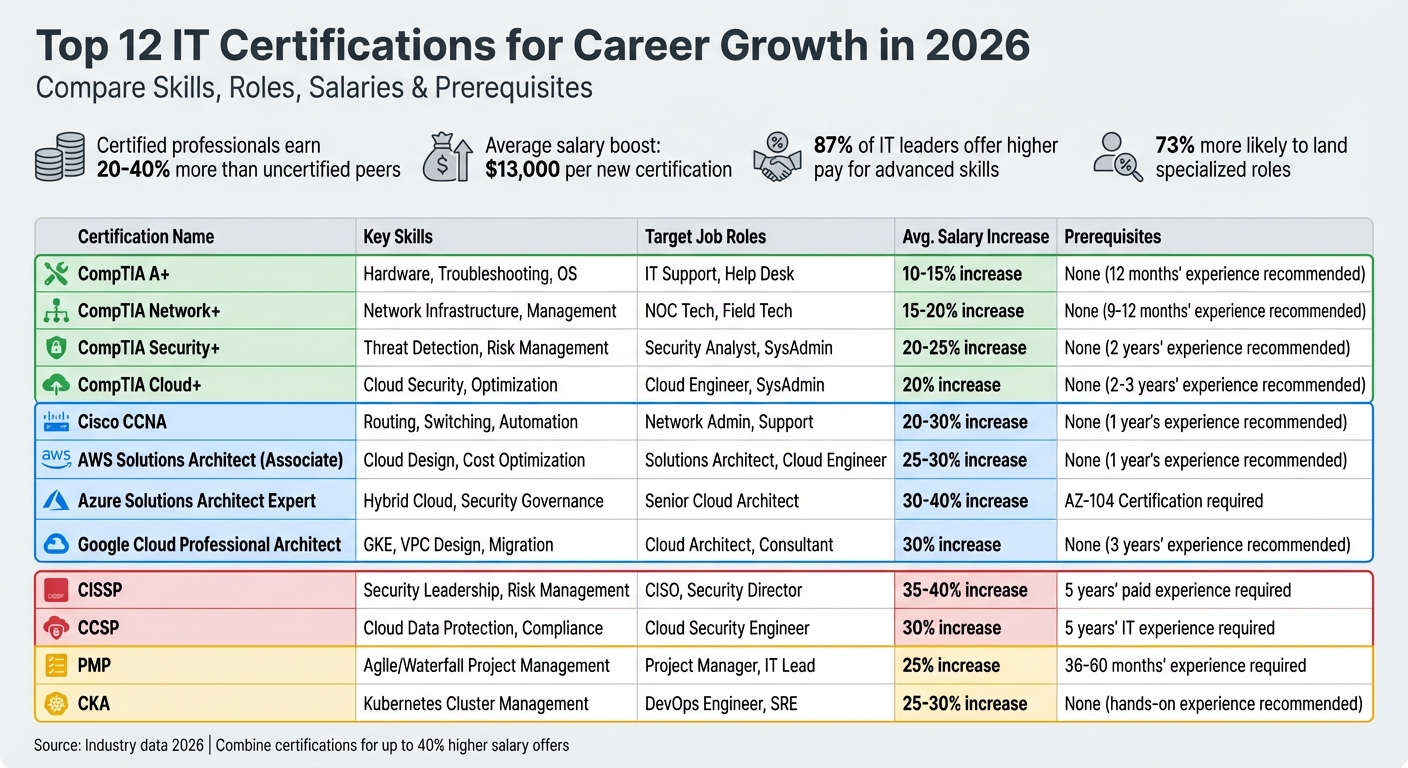
Top 12 IT Certifications Comparison: Skills, Salaries, and Career Paths 2026
1. CompTIA A+
What skills the certification validates
CompTIA A+ confirms core IT skills that are essential for modern tech environments. These include hardware troubleshooting, TCP/IP, 802.11ax wireless networking, and understanding cloud service models like IaaS, PaaS, and SaaS. Additionally, it covers operational procedures such as professional communication, safety practices, and documentation standards.
The certification, updated to version V15 as of March 25, 2026, requires passing two exams: 220-1201 (Core 1) and 220-1202 (Core 2). Core 1 emphasizes hardware, networking, mobile devices, virtualization, and cloud concepts, while Core 2 focuses on operating systems, security, software troubleshooting, and procedural tasks. Candidates also need hands-on experience with multiple operating systems, including Windows 11, macOS, Linux, Chrome OS, Android, and iOS, reflecting the diverse IT environments of 2026 workplaces. These skills prepare individuals for a range of entry-level IT support roles.
Which high-demand job roles it supports
This certification serves as a gateway to roles like IT Support Specialist, Help Desk Technician, Desktop Support Analyst, Field Service Technician, and Junior Systems Administrator. Companies such as Intel, Dell, HP, and Nissan actively seek A+ certified professionals to strengthen their technical support teams. As IT operations evolve in a world driven by multi-cloud setups and AI, these roles remain critical. By 2026, the U.S. tech workforce is expected to grow to about 6.1 million professionals, with demand for IT support specialists projected to reach nearly 818,000 positions by 2034.
Expected salary increase or career impact
In 2026, entry-level professionals with an A+ certification can expect salaries ranging from $50,000 to $65,000 annually. On average, certified IT workers earn about 16% more than their uncertified counterparts. Additionally, obtaining a new certification often results in a salary boost of around $13,000. The total cost for the certification includes $506 for the two exams, plus an estimated $100–$300 for study materials. Beyond validating technical expertise, this certification significantly enhances career opportunities and earning potential.
How it relates to emerging technologies
The 2026 curriculum incorporates advancements like AI-driven troubleshooting and automated diagnostics, which are becoming central to modern IT support. It also introduces proactive threat detection and securing IoT devices, alongside foundational knowledge of software-defined networking and Infrastructure as Code (IaC). Scott M. Graffius, CEO of Exceptional PPM and PMO Solutions, highlights its importance:
"CompTIA A+ is the industry-standard certification to launch a tech career"
This updated content ensures that certified professionals are equipped to handle the rapid changes and challenges of today’s tech landscape.
sbb-itb-b03e171
2. CompTIA Network+
What skills the certification validates
As IT infrastructures grow increasingly complex, proving your networking expertise is key for advancing your career in 2026. The CompTIA Network+ certification demonstrates your ability to design, configure, and troubleshoot both wired and wireless networks. The current N10-009 exam evaluates your knowledge across five key areas: Networking Concepts (23%), Network Implementation (20%), Network Operations (19%), Network Security (14%), and Network Troubleshooting (24%).
You'll need to show proficiency in tasks like IP addressing, configuring routers and switches, working with cloud models (SaaS, IaaS, PaaS), and executing disaster recovery plans. The exam combines multiple-choice questions with performance-based tasks, and you'll need a score of 720 out of 900 to pass. Priced at $390 for the standard exam voucher, the certification also validates your understanding of modern networking concepts like software-defined networking (SDN), zero-trust architecture, and Secure Access Service Edge (SASE). These skills are essential for a variety of networking roles.
Which high-demand job roles it supports
Earning the CompTIA Network+ certification can lead to roles such as Network Administrator, Systems Administrator, Network Support Specialist, Junior Systems Engineer, and Network Analyst. The certification equips you to manage networks in increasingly common multi-cloud environments, aligning with industry needs. For instance, the demand for systems engineers is expected to grow by 9% between 2023 and 2028.
CompTIA highlights the certification's practical importance:
"CompTIA Network+ validates the technical skills needed to securely establish, maintain, and troubleshoot the essential networks that businesses rely on." - CompTIA
Expected salary increase or career impact
The certification can significantly boost earning potential. Network Administrators earn a median salary of $90,000, with top professionals earning up to $150,000 annually. Systems Engineers average $130,000, while Network Support Specialists start around $68,000, with salaries climbing to $120,000 as experience grows. Additionally, this certification serves as a solid foundation for pursuing advanced credentials like the Cisco CCNA or CompTIA Security+. Most candidates find that 9 to 12 months of hands-on networking experience provides the ideal preparation for the exam.
The certification not only enhances earning potential but also keeps you aligned with the latest trends in technology.
How it relates to emerging technologies
The 2026 CompTIA Network+ curriculum incorporates cutting-edge technologies such as Network Functions Virtualization (NFV), Virtual Private Clouds (VPC), Internet of Things (IoT) (including IIoT, SCADA, and OT networks), and various cloud models like hybrid, public, and private. It also lays the groundwork for AI-driven network automation and intelligent systems.
With 14% of the exam focused on network security, you'll gain critical skills for identifying vulnerabilities, configuring firewalls, and mitigating threats like DDoS attacks. This comprehensive focus ensures you're prepared to navigate the increasingly interconnected worlds of networking and cybersecurity in 2026.
3. CompTIA Security+
What skills the certification validates
The CompTIA Security+ certification (SY0-701) proves your ability to secure systems and address threats across five key areas: General Security Concepts (12%), Threats, Vulnerabilities, and Mitigations (22%), Security Architecture (18%), Security Operations (28%), and Security Program Management and Oversight (20%). It highlights practical skills like working with SIEM and EDR/XDR tools, managing vulnerabilities, and executing incident response protocols. Additionally, it covers governance, risk, and compliance frameworks such as GDPR and PCI-DSS. To pass, you need a score of 750 out of 900 on up to 90 questions (including performance-based tasks) within 90 minutes. The exam voucher costs between $392 and $425, depending on your location. With this certification, you’ll be well-prepared for a range of sought-after cybersecurity roles.
Which high-demand job roles it supports
Earning the Security+ certification qualifies you for roles like SOC Analyst, Security Administrator, Systems Administrator, Security Engineer, and Cybersecurity Consultant. It’s particularly valuable for government and defense positions, as it meets U.S. Department of Defense 8140/8570.01-M standards for IAT Level II roles. This makes it a requirement for defense contractors working with companies such as Raytheon and Booz Allen Hamilton. Currently, there are over 65,000 U.S. job openings specifically requesting Security+, and the cybersecurity field is projected to grow by 32% through 2033. As CompTIA explains:
"Security+ isn't just a certification - it's a confidence booster. Whether you're new to IT or looking to specialize in cybersecurity, this certification ensures you're equipped to tackle real-world challenges." - CompTIA
Expected salary increase or career impact
The financial rewards of Security+ certification are notable. Certified professionals earn about 25% more than those with only CompTIA A+. Median salaries for early-career roles range from $85,221 to $101,130. SOC Analysts typically earn $45,000 to $78,000, Security Analysts bring in $75,000 to $95,000, and Cybersecurity Consultants can make between $95,000 and over $140,000 annually. Holding a security clearance can boost earnings by 25-40%, and government jobs often pay 15-20% more than private-sector roles. The certification is valid for three years and can be renewed by earning 50 Continuing Education Units (CEUs).
How it relates to emerging technologies
CompTIA Security+ stays current with the evolving IT landscape by addressing new threats and technologies. The 2026 curriculum includes Zero Trust architecture, AI-driven threat detection, and cloud-native ecosystems, preparing professionals to handle challenges like ransomware and supply chain attacks. The certification also equips you to secure hybrid environments, including cloud platforms, mobile devices, IoT, and operational technology (OT). With an emphasis on automation and scripting, it aligns with the industry’s growing reliance on security analytics and automated response systems.
The Only IT Certifications Worth Getting in 2026 (Based on Real Jobs)
4. CompTIA Cloud+
As the IT world increasingly leans on specialized cloud expertise, the CompTIA Cloud+ certification is becoming a go-to credential for professionals looking to stay ahead in 2026.
What skills the certification validates
The CompTIA Cloud+ (CV0-004) certification focuses on managing cloud infrastructure across various platforms. The exam dives into Cloud Architecture (23%), covering public, private, hybrid, and multi-cloud environments, along with virtualization and resource optimization. It also tests deployment skills (19%), like workload migrations and Infrastructure as Code, and operations (17%), including lifecycle management, scaling, and backup processes. Security is another key area (19%), focusing on IAM, vulnerability management, and compliance with standards such as PCI DSS and ISO 27001. Additionally, it introduces DevOps fundamentals (10%) with CI/CD pipelines and tools like Kubernetes, Ansible, and Jenkins, and troubleshooting (12%) for connectivity and security challenges. The exam features up to 90 multiple-choice and performance-based questions, to be completed in 90 minutes, with 2–3 years of hands-on experience recommended.
Which high-demand job roles it supports
Cloud+ opens doors to roles like Cloud Engineer, Systems Administrator, DevOps Engineer, Network Administrator, and IoT Engineer. The certification aligns with industry frameworks like NICE and DCWF, supporting positions such as network operations specialist, enterprise architect, and security architect. With cloud and DevOps roles surging in demand, projections show the U.S. will need 355,000 network administrators, 108,000 DevOps engineers, and 40,000 IoT engineers by 2030. Salaries are competitive - DevOps engineers earn a median of $136,000 annually, with advanced roles reaching over $182,000. IoT engineers average $115,000, while network administrators bring in around $97,000 per year. The certification’s vendor-neutral approach is particularly beneficial for multi-cloud strategies.
Expected salary increase or career impact
IT professionals with certifications often earn 25–40% more than their non-certified counterparts. On average, earning a new certification boosts salaries by $13,000, with 87% of IT leaders offering higher pay for advanced cloud computing skills. Certified professionals are also 73% more likely to land specialized roles. For even greater career impact, consider pairing Cloud+ with platform-specific certifications like AWS or Azure, or a security-focused credential like Security+, which can boost salary offers by up to 40%. With cloud roles growing at a rate of 30% year-over-year, the demand for these skills shows no sign of slowing.
How it relates to emerging technologies
The Cloud+ certification builds on core IT and security knowledge, addressing the growing importance of cloud-native solutions. It aligns with the "cloud-first" approach, where businesses prioritize cloud-based architectures and automated pipelines. The certification emphasizes automated, CI/CD-driven, infrastructure-as-code environments, while ensuring security is integrated at every stage of cloud operations. It also highlights the role of cloud infrastructure in supporting IoT systems, where engineers must bridge hardware with cloud-based data exchange. This certification serves as a solid foundation for professionals aiming to specialize in advanced cloud roles.
5. Cisco CCNA
What skills the certification validates
The Cisco CCNA (200-301) exam measures your ability to configure and troubleshoot network infrastructure across six main domains. The IP Connectivity domain, which accounts for 25% of the exam, focuses on routing protocols like OSPF and IPv4/IPv6 routing, as well as troubleshooting methods. Network Fundamentals (20%) covers the OSI and TCP/IP models, subnetting, and wireless basics. The Network Access domain (20%) highlights VLANs, Spanning Tree Protocol, and EtherChannel configurations. Meanwhile, Security Fundamentals (15%) ensures you understand ACLs, device hardening, VPN basics, and AAA protocols. Smaller portions of the exam include IP Services (10%), which touches on NAT, DHCP, DNS, and QoS, and Automation and Programmability (10%), which introduces REST APIs, JSON data formats, and software-defined networking concepts.
The exam includes 95–105 questions to be completed in 120 minutes, with simulation labs included. Subnetting is a key focus, making up 20–30% of the score, so mastering quick calculations (around 30 seconds per problem) is essential. These skills prepare candidates for a variety of networking roles.
Which high-demand job roles it supports
The CCNA certification builds on foundational networking knowledge, unlocking opportunities for specialized roles. As of early 2026, there are approximately 7,234 active job postings in the U.S. seeking CCNA-certified professionals. Entry-level roles like Network Technician and NOC Technician typically pay between $45,000 and $65,000 annually. For mid-level positions such as Network Administrator or Network Engineer, salaries range from $72,000 to $95,000. More advanced roles, like Network Security Analyst or Cloud Network Engineer, can earn between $92,000 and $108,000, with some Cloud Network Engineers exceeding $105,000.
The certification is also valuable in emerging fields like AI-driven networking and SD-WAN management. With AI-based enterprise networks projected to grow by 32% by 2026, CCNA-certified professionals are well-positioned for these advancements. Cisco's dominance in the global enterprise networking market (holding 53.6% as of late 2024) further strengthens the certification's relevance, especially in an industry where 87% of organizations report IT talent shortages.
Expected salary increase or career impact
Earning a CCNA certification can boost your average salary to $82,000 - about $8,000 more than non-certified peers. Over half (56%) of certification holders report receiving a pay raise within three months of earning their credential. First-year salary increases often range from $10,000 to $30,000. Professionals who pair their CCNA knowledge with automation tools like Python or Ansible can see earnings rise by 20–30% compared to traditional roles. In tech hubs like San Francisco, New York, and Seattle, CCNA-certified roles often pay 20–40% above the national average.
The CCNA also serves as a stepping stone to higher certifications like the CCNP, which can raise your salary potential by an additional $20,000 to $40,000. As CloudOps Engineer Elvin Arias Soto explained:
"Passing that CCNA exam triggered a chain of events I could never have predicted. First, I was a student, then a teacher, then a Cisco instructor, and I eventually became a Cisco VIP".
How it relates to emerging technologies
The CCNA reflects the industry's shift toward programmable and software-defined networking. Its Automation and Programmability domain (10% of the exam) introduces API-based management and centralized controller architectures, key for modern networks. By 2026, automation skills are expected to be required for 60% of networking roles. The certification also covers modern wireless standards like Wi-Fi 6E and Wi-Fi 7, which are crucial for supporting hybrid work models.
Security concepts have evolved as well, with greater emphasis on Zero Trust frameworks. By 2026, 74% of enterprises are expected to fully implement Zero Trust. Additionally, the CCNA lays the groundwork for advanced networking technologies, including AI-assisted troubleshooting and tools like Ansible for configuration management. These updates ensure the certification remains relevant in a rapidly changing tech environment.
6. AWS Certified Solutions Architect – Associate
What Skills the Certification Validates
This certification confirms your ability to design secure, scalable, and cost-efficient cloud systems on AWS. It tests your expertise across four primary areas:
- Resilient Architectures (30%) – Focuses on creating fault-tolerant systems.
- High-Performing Architectures (28%) – Covers optimizing performance for compute, storage, and databases.
- Secure Applications and Architectures (24%) – Evaluates your understanding of identity management with IAM, encryption techniques, and security best practices.
- Cost-Optimized Architectures (18%) – Tests your ability to manage cloud spending, a critical skill as businesses aim to control rising cloud costs in 2026.
To prepare, you’ll need hands-on experience with AWS services like EC2 and Lambda for compute, S3 and EBS for storage, RDS and DynamoDB for databases, VPC for networking, and IAM for access control. The exam includes 65 questions (multiple choice or multiple response) and takes 130 minutes. AWS recommends at least one year of practical experience designing cloud solutions before attempting the test. These skills are foundational for many cloud-focused roles and are in high demand across industries.
Which High-Demand Job Roles It Supports
This certification is a frequent requirement in U.S. job postings, with over 45,000 listings as of early 2026 - a 15% jump from the previous year. It’s particularly relevant for roles like Cloud Architect, Cloud Engineer, Security Engineer, Data Engineer, DevOps Engineer, and Solutions Consultant. Industries such as technology, financial services, healthcare, and retail/e-commerce are actively hiring professionals with this credential. These roles often lead to measurable career advancements.
Expected Salary Increase and Career Impact
AWS Certified Solutions Architects earned an average salary of $175,847 in 2026. Entry-level professionals (0–2 years of experience) typically see a 30.7% salary boost, earning around $85,000 compared to $65,000 without certification. Mid-level (3–5 years) and senior-level (6–10 years) professionals also experience notable pay increases. About 73% of AWS-certified individuals reported receiving a raise after certification, with the average bump being 27%. In major tech hubs, salaries can reach $175,000 in San Francisco, $160,000 in New York, and $155,000 in Seattle. The exam costs $150, and passing it grants a 50% discount on your next AWS certification.
How It Relates to Emerging Technologies
This certification keeps pace with rapid technological advancements, emphasizing areas like serverless architectures and automated cost management. As businesses incorporate AI into their operations, cloud architects are increasingly tasked with designing infrastructures to support generative AI and machine learning workloads.
Rajat Sachdeva, Author of CoPrep AI, highlights the value of this skill set:
"The professional-level architect is the person who can look at a sprawling, inefficient system and redesign it to be faster, more resilient, and 30% cheaper. That skill is worth its weight in gold."
The certification serves as a cornerstone for cloud expertise, even as companies adopt multi-cloud strategies. Pairing this credential with specialties in Security or Machine Learning can significantly improve career prospects in specialized cloud roles.
7. Microsoft Certified: Azure Solutions Architect Expert
What Skills the Certification Validates
This certification proves your ability to design comprehensive cloud and hybrid solutions on Microsoft Azure. To pursue it, you must first earn the Azure Administrator Associate (AZ-104) credential. The required exam, AZ-305, tests your expertise across four key areas:
- Identity, Governance, and Monitoring (25–30%): Includes Azure Active Directory, role-based access control, and logging solutions.
- Data Storage (20–25%): Covers relational and non-relational databases like Azure SQL and Cosmos DB.
- Business Continuity (15–20%): Focuses on strategies for high availability, backups, and disaster recovery.
- Infrastructure (30–35%): Evaluates skills in designing compute, networking, and application architectures.
The exam takes 120 minutes, includes roughly 60 questions, and requires a minimum score of 700 to pass. Candidates are typically expected to have 3–5 years of hands-on cloud experience. These skills complement advanced cloud concepts discussed earlier in this guide.
Which High-Demand Job Roles It Supports
This certification opens doors to senior roles like Cloud Solutions Architect, Enterprise Architect, Azure Infrastructure Architect, Cloud Consultant, and Technical Cloud Lead. Azure Architects are projected to remain among the top five most sought-after cloud professionals through 2026. Highlighting their importance, Mark Malloy, Content Manager at PassITExams, states:
"Solutions Architects translate business requirements into technical cloud architectures, making them indispensable to any organization's cloud strategy."
Expected Salary Increase and Career Impact
Azure Solutions Architects are well-compensated, with average salaries around $155,000 in 2026. Entry-level positions typically range from $130,000 to $165,000, while senior architects in enterprise or consulting roles can earn between $180,000 and $200,000. Multi-cloud architects see even higher figures, ranging from $180,000 to $250,000. The certification exam costs $165, and 63% of certified professionals report receiving or expecting a promotion after earning it. Beyond salary boosts, this credential accelerates career growth in competitive roles. To stay up-to-date, certification holders must complete an annual free online assessment on Microsoft Learn, ensuring they remain proficient with Azure’s evolving features.
How It Relates to Emerging Technologies
As enterprises increasingly adopt Azure, this certification positions professionals to lead the shift from on-premises setups to hybrid and cloud-native solutions. Architects are now integrating AI and automation into Azure ecosystems, including machine learning workloads. There’s also a growing emphasis on Zero Trust security models, requiring advanced identity and access management strategies. With expanding cloud budgets, architects are tasked with cost optimization and governance, often through tools like Azure Policies and tagging standards (commonly referred to as FinOps). The rising trend of hybrid environments - combining Azure with on-premises systems - further elevates the demand for professionals skilled in designing these complex solutions. This combination of hybrid, AI-driven, and cost-efficient architecture ensures Azure Solutions Architects remain vital in the tech landscape of 2026.
8. Google Cloud Professional Cloud Architect
What Skills the Certification Validates
This certification confirms your ability to design and manage cloud solutions that align with business goals. The exam evaluates expertise across six key areas: designing architecture (25%), managing infrastructure (17.5–20%), security and compliance (17.5–20%), process optimization (15–20%), implementation (11–12.5%), and operational reliability (12.5–15%). It’s a 2-hour test with 50–60 questions.
You’ll need to demonstrate skills in workload migration techniques like lift-and-shift, replatforming, and refactoring. Proficiency in deploying applications using tools such as GKE, Cloud Run, and App Engine is also crucial. Additionally, the certification tests your understanding of Google’s Well-Architected Framework, which focuses on operational excellence, security, reliability, performance, cost efficiency, and sustainability. Google suggests having at least three years of industry experience, including one year of designing solutions on Google Cloud Platform (GCP), before attempting the exam. The exam costs $200, and case studies make up 20–30% of the content.
Which High-Demand Job Roles It Supports
These skills open doors to advanced roles in the cloud computing world. Certified professionals often step into positions like Cloud Solutions Architect, Cloud Infrastructure Architect, Enterprise Architect, DevOps Cloud Architect, and Cloud Security Architect. Other opportunities include roles such as Enterprise IT Strategist, Cloud Consultant, and Solutions Engineer, as well as operational leadership positions like SRE Lead and CloudOps Lead. Career paths can progress from Solutions Architect to Senior and Principal Architect, with potential to move into executive roles over time.
For example, in February 2026, a global retailer leveraged a GKE solution with Multi-Cluster Ingress, designed by a Professional Cloud Architect, to achieve 99.99% uptime during record-breaking peak sales. This was accomplished through global load balancing and horizontal pod autoscaling. Similarly, a major financial institution revamped its fraud detection system in early 2026 with a real-time pipeline using Google Cloud Dataflow and BigQuery ML. This reduced fraud detection times from minutes to milliseconds while adhering to strict encryption standards.
Expected Salary Increase and Career Impact
Certified professionals typically earn between $175,000 and $220,000 annually, with an average premium of $8,500 to $12,000 compared to non-certified peers. Senior architects with over five years of experience can earn $200,000 to $280,000, while principal architects with eight or more years of experience may see salaries ranging from $250,000 to $350,000 or more. The certification remains valid for two years, after which a renewal exam, costing $100, is required. This renewal focuses heavily on addressing business challenges with generative AI. Organizations that invest in expert-level cloud training report a 32% faster time-to-market for digital products.
How It Relates to Emerging Technologies
This certification reflects the rapid evolution of cloud technologies, with a growing focus on AI and data management. The 2026 standards emphasize expertise in generative AI, advanced autonomous AI, and data governance. Mark Malloy, Content Manager at PassITExams, highlights the certification’s value:
"The Professional Cloud Architect certification is the most powerful way to prove your expertise in architecting secure, scalable, and business-aligned solutions on Google Cloud."
The exam tests your ability to integrate tools like Vertex AI and BigQuery ML for production-grade MLOps and real-time data processing. With Google Cloud growing at 35% annually and holding about 11% of the global cloud market share, this certification positions you to lead in data-driven architectures. It validates skills in Kubernetes-based solutions (via GKE), serverless-first strategies (Cloud Run), and Zero Trust security models tailored for AI and data-heavy workloads.
9. Certified Information Systems Security Professional (CISSP)
What Skills the Certification Validates
The CISSP certification proves expertise across eight key areas of enterprise security: Security and Risk Management (16%), Security Architecture and Engineering (13%), Communication and Network Security (13%), Identity and Access Management (13%), Security Operations (13%), Security Assessment and Testing (12%), Asset Security (10%), and Software Development Security (10%). The exam is a 3-hour adaptive test with 100–150 questions, requiring a minimum score of 700 out of 1,000 to pass.
What sets CISSP apart is its focus on both technical and strategic skills. It equips professionals to handle risk management at an organizational level, including setting risk tolerances and prioritizing vulnerabilities. Additionally, it validates proficiency in managing AI governance, ensuring data accountability, and navigating complex risk decisions. To qualify, candidates need five years of relevant experience in at least two of the eight domains. However, a four-year college degree or an approved credential like Security+ can waive one year of this requirement. These skills make CISSP holders well-suited for senior cybersecurity roles.
Which High-Demand Job Roles It Supports
Widely regarded as the "gold standard" for cybersecurity leadership, the CISSP opens doors to senior-level roles in large organizations. As of early 2026, there are 15,597 job openings in the U.S. specifically seeking CISSP-certified professionals. This certification is ideal for roles like Chief Information Security Officer (CISO), with salaries ranging from $217,127 to $319,000, and Security Architect, earning between $156,094 and $227,000. Other roles include Chief Information Officer (CIO) ($146,907–$273,000), Cybersecurity Manager ($164,496), Security Systems Engineer ($103,018–$177,000), and IT Manager ($108,606–$129,000).
The CISSP also supports roles such as Information Systems Security Officer, Security Consultant, Security Auditor, and Information Assurance Analyst. For government positions, combining CISSP certification with a Top Secret clearance in areas like Washington D.C. can result in salaries ranging from $200,000 to $250,000 or more.
Expected Salary Increase and Career Impact
CISSP-certified professionals enjoy significant salary and career benefits. In the U.S., the median salary for CISSP holders is $164,000 - roughly 30% higher than their non-certified counterparts. Additionally, 64% of IT leaders report that these professionals add over $10,000 in value to their organizations.
The certification does come with costs: the exam fee is $749, and an annual maintenance fee of $125 applies. To keep the certification active, professionals need to earn 120 Continuing Professional Education (CPE) credits every three years, with at least 40 credits reported annually. With a pass rate of about 20%, candidates typically dedicate 100–150 hours of study time. The demand for information security analysts is expected to grow by 29% between 2024 and 2034, further highlighting the career potential for CISSP holders.
How It Relates to Emerging Technologies
By 2026, the CISSP certification will be essential for tackling advanced cybersecurity challenges like AI-driven phishing, sophisticated ransomware, and securing AI workloads in cloud environments. This certification has evolved from a technical credential to a strategic asset, influencing how organizations build resilience.
Rajat Sachdeva, Author at CoPrep AI, puts it this way:
"A CISSP certification tells executives you're the person who can think strategically about risk, not just reactively about threats."
CISSP bridges the gap between technical skills and executive strategy, making it indispensable for managing multi-cloud environments and proactively hunting threats. As cybersecurity threats grow more complex, this certification ensures professionals are ready to address challenges in an AI-powered, multi-cloud world.
10. Certified Cloud Security Professional (CCSP)
What Skills the Certification Validates
The CCSP certification hones your ability to secure modern cloud environments, focusing on designing, managing, and protecting cloud data, applications, and infrastructure. It emphasizes global best practices and covers six key areas: Cloud Concepts, Architecture and Design; Cloud Data Security; Cloud Platform & Infrastructure Security; Cloud Application Security; Cloud Security Operations; and Legal, Risk and Compliance.
Unlike traditional server security, CCSP takes a vendor-neutral approach, addressing the unique challenges of virtualized environments and cloud-specific risks. To qualify, candidates must have at least five years of paid IT work experience, including three in information security and one in one or more of the six CCSP domains. The certification exam, a 3-hour Computerized Adaptive Test with 100–150 questions, costs $599 and requires an annual maintenance fee of $135.
Which High-Demand Job Roles It Supports
The CCSP opens doors to senior roles such as Cloud Security Architect, Enterprise Architect, Security Administrator, Systems Engineer, Compliance Specialist, and Information System Security Manager (ISSM). As of early 2026, there are around 489 job openings in the U.S. specifically seeking CCSP-certified professionals. This certification signals advanced technical expertise, making it a key asset for securing enterprise-level positions.
Expected Salary Increase and Career Impact
Professionals with a CCSP certification enjoy competitive salaries, starting at $142,000, with averages ranging from $120,000 to $180,000. Certified individuals typically earn 25%–40% more than their non-certified peers, and 87% of IT leaders report offering higher pay to candidates with advanced cloud and cybersecurity skills. Combining the CCSP with a cloud-specific certification, like AWS or Azure, can boost earning potential by up to 40%. To maintain the certification, professionals must earn 90 Continuing Professional Education (CPE) credits every three years. This credential underscores the growing importance of advanced IT certifications in today's cloud-centric world.
How It Relates to Emerging Technologies
By 2026, the CCSP will address new challenges like multicloud environments, serverless computing, and AI-driven data security. As companies shift away from single-vendor reliance, the demand for vendor-neutral certifications that demonstrate expertise across AWS, Azure, and Google Cloud is rising. MeasureUp highlights this trend:
"CCSP offers a vendor-neutral validation of cloud security mastery. By 2026, companies will demand professionals who can secure not one, but several cloud ecosystems."
With global cloud computing spending expected to surpass $2 trillion by 2030, and stricter international privacy and audit requirements making CCSP-certified professionals indispensable in industries like finance and healthcare, this certification positions IT experts to handle the transition from physical systems to automated, virtualized cloud infrastructures. A revised CCSP exam outline will take effect on August 1, 2026.
11. Project Management Professional (PMP)
What Skills the Certification Validates
The PMP certification demonstrates your expertise in managing projects using predictive (Waterfall), Agile, and hybrid methodologies - key approaches for overseeing digital projects. The exam is divided into three domains: Process (50%), People (42%), and Business Environment (8%). Notably, about half of the exam content focuses on Agile and hybrid methodologies. This shift highlights the transition from just managing tasks to taking on a strategic leadership role. PMP-certified professionals are equipped to align technology projects with business objectives, handle risks proactively, and deliver measurable outcomes. While AI may handle repetitive tasks, the PMP emphasizes essential human skills like conflict resolution, stakeholder alignment, and emotional intelligence - qualities that are critical for leadership roles in project management.
Which High-Demand Job Roles It Supports
The PMP equips professionals with the skills needed for senior-level roles such as IT Project Manager, Program Manager, PMO Director, Portfolio Manager, VP of Operations, and Project Management Consultant. In early 2026, the U.S. had around 9,622 active job postings requiring PMP certification. According to Sean O'Connor from monday.com:
"PMP-certified professionals are trained to manage cross-functional work, control risk at scale, and connect execution directly to business strategy."
PMP holders are often seen as internal consultants who bridge the gap between executive strategies and actionable team execution, especially during digital transformations. Their ability to navigate complex projects makes them highly sought after across industries.
Expected Salary Increase and Career Impact
In the U.S., PMP-certified professionals earn a median salary of $135,000, which is 24% higher than their non-certified peers. Surveys show that certified professionals enjoy salary premiums ranging from 20% to 35%, with typical earnings between $100,000 and $150,000 in fields like IT and engineering. In some regions, such as Switzerland, the premium can reach 44%. The California Institute of Applied Technology highlights the value of the certification:
"When hiring managers see PMP on a resume, they're not just seeing someone who passed an exam, they're seeing proven project leadership in action."
The exam costs $405 for PMI members and $555 for non-members, with certification maintenance requiring 60 Professional Development Units (PDUs) every three years. With demand for project-oriented roles expected to grow through 2030, the PMP remains a strong career investment.
How It Relates to Emerging Technologies
Modern PMP-certified professionals are using tools powered by AI for tasks like risk detection, automated resource allocation, and predictive analytics to handle large-scale projects. While AI manages routine operations, PMP holders are valued for their strategic thinking and ability to negotiate with stakeholders. As the job market in 2026 becomes more competitive, the PMP certification acts as a "machine-readable signal" in AI-driven hiring systems like applicant tracking tools. Combining the PMP with skills in analytics or GenAI can further boost career opportunities.
12. Certified Kubernetes Administrator (CKA)
What Skills the Certification Validates
The Certified Kubernetes Administrator (CKA) certification is tailor-made for infrastructure professionals looking to prove their expertise in managing Kubernetes environments. Unlike exams with multiple-choice questions, the CKA is entirely hands-on. You’ll face 15–20 live command-line tasks over two hours, requiring you to use kubectl to troubleshoot clusters, fix networking issues, and handle production-level configurations. The exam focuses on five key areas:
- Troubleshooting (30%)
- Cluster Architecture, Installation & Configuration (25%)
- Services & Networking (20%)
- Workloads & Scheduling (15%)
- Storage (10%)
Expect to tackle real-world issues like resolving "CrashLoopBackOff" errors or addressing "NotReady" nodes - all while working under tight time constraints. The skills you’ll demonstrate are vendor-neutral, making them applicable across major platforms like AWS, Azure, Google Cloud, and even on-premises setups. This hands-on approach reflects the industry’s shift toward performance-based certifications that highlight practical expertise.
Which High-Demand Job Roles It Supports
The CKA certification is highly relevant for professionals in roles such as DevOps Engineers, Site Reliability Engineers (SREs), Cloud Architects, and System or Infrastructure Engineers. With Kubernetes powering production environments in 95% of Fortune 500 companies, it’s no surprise that the certification appears in over half of all Kubernetes-related job listings.
Pinaki Nandan Hota from ITJobNotify explains the certification’s value to employers:
"The certification signals three things to employers: hands-on operational capability, production-grade experience, and reduced training risk."
As companies prioritize hiring professionals who can handle real-world outages and optimize Kubernetes environments, the CKA stands out as a key credential in the hiring process.
Expected Salary Increase and Career Impact
Earning the CKA can significantly boost your earning potential, with certified professionals in the U.S. typically earning between $120,000 and $150,000 annually. On average, certification holders enjoy a salary bump of over $15,000. The exam costs $445, which includes one free retake and access to practice simulators. Training bundles, priced between $595 and $645, are also available to help candidates prepare. The certification is valid for two years, reflecting Kubernetes' rapid evolution and frequent updates. Additionally, research shows that 69% of employers are more likely to hire candidates with technical certifications, further enhancing its value.
How It Relates to Emerging Technologies
Kubernetes has become the backbone of modern application infrastructure, acting as the control layer for multi-cloud and hybrid cloud environments. As AI workloads grow in prominence, there’s increasing demand for Kubernetes administrators skilled in GPU scheduling and resource management to support AI pipelines. While tools like AI-driven YAML generators and GitOps automation simplify some tasks, manual troubleshooting remains a critical skill.
Many CKA-certified professionals also pursue the Certified Kubernetes Security Specialist (CKS) to deepen their understanding of platform governance and security. With the global Kubernetes market projected to grow from $2.6 billion in 2025 to $14.6 billion by 2033, the long-term career benefits of the CKA are hard to ignore.
Quick Comparison of All 12 Certifications
Here’s a quick snapshot of how the 12 certifications stack up, helping you decide which aligns best with your career goals and current expertise.
CompTIA certifications like A+, Network+, and Security+ are beginner-friendly, with no prior credentials required. These are great for those just starting in IT. On the flip side, certifications like CISSP and CCSP demand five years of paid experience, making them ideal for seasoned professionals targeting leadership roles. Interestingly, the Azure Solutions Architect Expert stands out as the only certification here requiring a prerequisite: the AZ-104 Azure Administrator Associate certification.
When it comes to salary, entry-level certifications typically boost earnings by 10–15%, while advanced ones can lead to a 35–40% increase. Certified IT professionals generally earn 25–40% more than their non-certified counterparts, with new certifications adding an average of $13,000 to annual salaries.
| Certification | Key Skills | Target Job Roles | Avg. Salary Increase (USD) | Prerequisites |
|---|---|---|---|---|
| CompTIA A+ | Hardware, Troubleshooting, OS | IT Support, Help Desk | 10–15% | None (12 months' experience recommended) |
| CompTIA Network+ | Network Infrastructure, Management | NOC Tech, Field Tech | 15–20% | None (9–12 months' experience recommended) |
| CompTIA Security+ | Threat Detection, Risk Mgmt | Security Analyst, SysAdmin | 20–25% | None (2 years' experience recommended) |
| CompTIA Cloud+ | Cloud Security, Optimization | Cloud Engineer, SysAdmin | 20% | None (2–3 years' experience recommended) |
| Cisco CCNA | Routing, Switching, Automation | Network Admin, Support | 20–30% | None (1 year's experience recommended) |
| AWS Solutions Architect (Assoc.) | Cloud Design, Cost Optimization | Solutions Architect, Cloud Eng | 25–30% | None (1 year's experience recommended) |
| Azure Solutions Architect Expert | Hybrid Cloud, Security Governance | Senior Cloud Architect | 30–40% | AZ-104 Certification |
| Google Cloud Prof. Architect | GKE, VPC Design, Migration | Cloud Architect, Consultant | 30% | None (3 years' experience recommended) |
| CISSP | Security Leadership, Risk Mgmt | CISO, Security Director | 35–40% | 5 years' paid experience |
| CCSP | Cloud Data Protection, Compliance | Cloud Security Engineer | 30% | 5 years' IT experience |
| PMP | Agile/Waterfall Project Mgmt | Project Manager, IT Lead | 25% | 36–60 months' experience |
| CKA | Kubernetes Cluster Mgmt | DevOps Engineer, SRE | 25–30% | None (hands-on experience recommended) |
Pairing certifications can also make a big difference. For example, combining a platform-specific certification like AWS or Azure with a governance or security-focused credential like CISSP can increase salary offers by up to 40%. Use this comparison to zero in on the certifications that align with your career ambitions and experience level.
Conclusion
Selecting the right certification depends on where you are in your career and where you want to go. If you're just starting, foundational certifications like CompTIA A+ or other entry-level options can help you build the core skills employers look for. For those further along in their careers, certifications such as AWS Solutions Architect – Associate, Cisco CCNA, or CompTIA Security+ can lead to better opportunities and higher salaries. Meanwhile, senior professionals aiming for leadership roles often turn to credentials like CISSP or Microsoft Certified: Azure Solutions Architect Expert, which are highly regarded and often come with compensation exceeding $150,000.
In 2026, IT professionals who view certifications as strategic career investments will be better positioned for success. Skills in cloud computing, cybersecurity, and AI are in high demand, with 87% of technology leaders offering higher salaries to qualified candidates. With 92% of businesses now operating in multi-cloud environments, combining certifications in AWS and Azure can greatly boost your appeal in the job market. The key is not just earning certifications but ensuring you're thoroughly prepared to apply what you've learned.
At any stage of your career, building a strong foundation is essential. Understanding the material and applying it effectively is far more valuable than simply memorizing answers. Hands-on practice through labs and real-world projects helps you develop the skills employers value most.
To make your certification journey smoother, using practical preparation tools is a smart move. Planet Cert offers resources to help you succeed, including over 1,000,000 practice questions across 1,000+ exams from 150+ vendors. Features like the Exam Simulator for realistic testing, Study Mode with detailed explanations, and Brainy AI for deeper topic exploration are all accessible on any device without extra software.
Choose a certification that aligns with your career goals, stick to a structured study plan, and take advantage of reliable preparation tools. Certified professionals not only earn higher salaries but are also 73% more likely to land specialized roles. By aligning your certifications with in-demand skills and thorough preparation, you'll be ready to excel in the competitive IT landscape of 2026. The next step in your career starts with the right certification.
FAQs
Which certification should I start with if I’m new to IT?
For those just stepping into the IT world, the CompTIA A+ certification is an excellent place to begin. It covers key skills such as hardware, software, troubleshooting, and basic networking, making it particularly useful for landing entry-level positions. As you gain hands-on experience, you can aim for more advanced certifications like AWS Solutions Architect or Microsoft Certified: Azure Administrator, depending on your career aspirations. CompTIA A+ serves as a strong starting point for anyone looking to build a thriving IT career.
How do I choose between AWS, Azure, and Google Cloud certifications?
To decide between AWS, Azure, and Google Cloud certifications, think about your career aspirations, the current industry demand, and the unique strengths of each platform.
- AWS dominates in cloud adoption, making it a top choice for roles in cloud architecture and infrastructure management.
- Azure specializes in hybrid cloud solutions and integrates seamlessly with Microsoft environments, which is ideal if you work with Microsoft-heavy enterprises.
- Google Cloud shines in areas like data engineering and artificial intelligence, making it a strong contender for those focused on cutting-edge data solutions.
A smart approach is to start with the platform most relevant to your current workplace or career path. Once you've gained expertise, you can explore certifications from other platforms to broaden your skill set and increase your versatility.
What’s the best certification path for moving into cybersecurity?
If you're aiming to break into cybersecurity by 2026, prioritize earning certifications such as CISSP, CISM, OSCP, CEH, and PenTest+. These certifications demonstrate your expertise in critical areas like threat defense and align with the skills employers are actively seeking. They can significantly boost your chances of landing a role in this rapidly expanding field.
Related Blog Posts

Discussion
Question Comments
0 comments·0 participantsSign in to leave a comment and access more free questions.