

How to Overcome Exam Anxiety: 8 Proven Techniques for Test Takers
Exam anxiety can feel overwhelming, but the good news is that it's manageable. Whether you're preparing for IT certifications or any other exam, these eight techniques can help you stay calm, focused, and confident:
- Practice with real exam questions: Familiarity with exam formats reduces anxiety by up to 60%.
- Control stress with breathing exercises: Techniques like box breathing calm your nervous system in just 90 seconds.
- Reframe negative thoughts: Replace "I’m going to fail" with "I’ve prepared well and can succeed."
- Visualize success: Mentally rehearse exam day to build confidence and reduce stress.
- Use smart test-taking strategies: Tackle easy questions first, flag tough ones, and manage your time wisely.
- Prioritize physical health: Sleep well, eat balanced meals, and exercise to boost mental clarity.
- Leverage study tools: Platforms like Planet Cert pinpoint weak areas, helping you focus on improvement.
- Schedule worry time: Write down your fears, then shift focus to post-exam rewards.
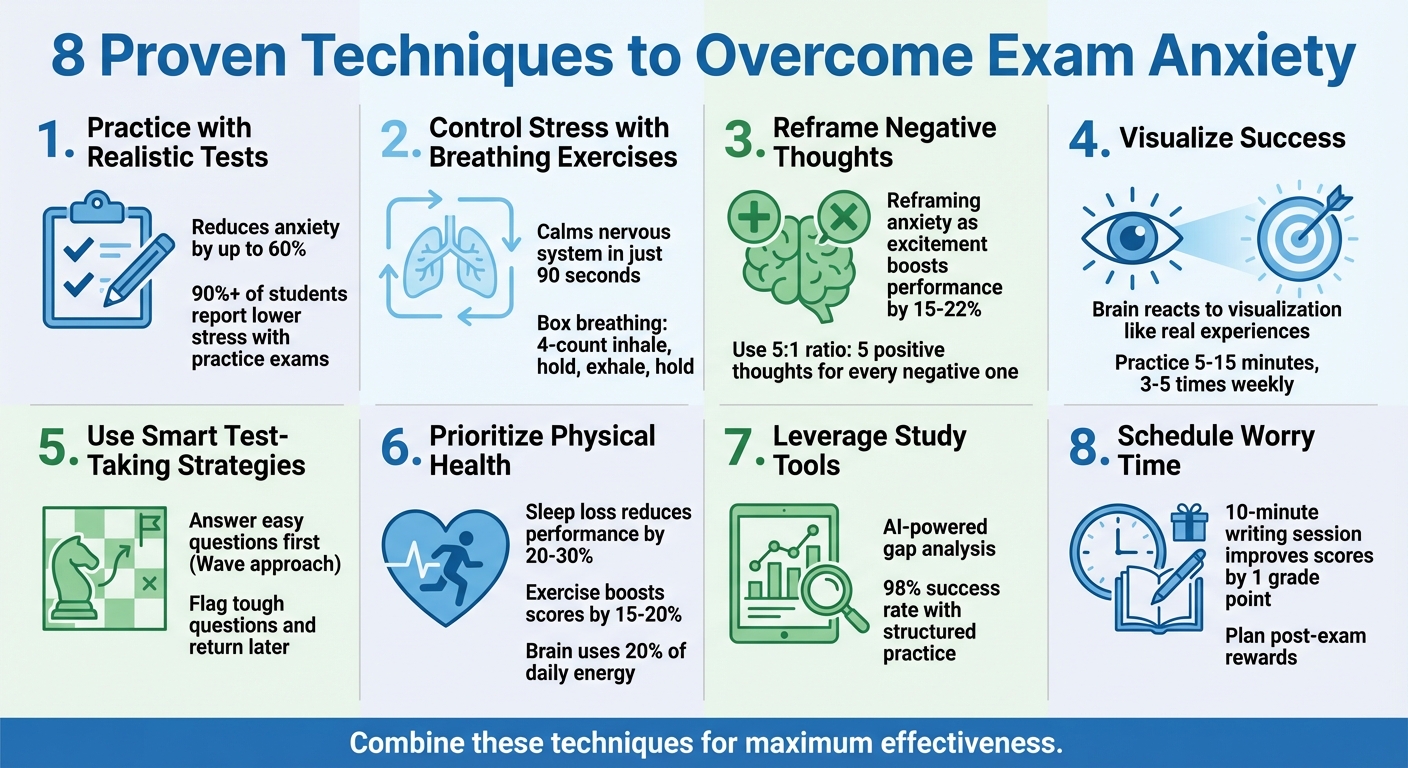
8 Proven Techniques to Overcome Exam Anxiety
How to overcome test anxiety | Ryan Lee | TEDxBIS Wuxi Youth
sbb-itb-b03e171
Technique 1: Use Realistic Practice Tests to Prepare
Walking into an exam unprepared is a recipe for anxiety. Facing an unfamiliar format can leave your mind blank, as stress triggers a fight-or-flight response. The fix? Familiarity. Repeated exposure through practice tests can help you feel at ease when it matters most.
The statistics are clear: candidates who tackle 500+ practice questions can reduce their test-day anxiety by up to 60%. It's not just about mastering the material; it's about making the exam environment feel second nature. Over 90% of students say that retaking practice exams significantly lowers their stress levels. Each practice session chips away at the novelty of the test, turning it into a routine task. This allows you to focus entirely on the technical content instead of the format.
Planet Cert's Exam Simulator is designed to mirror real testing conditions. It offers timed modes that replicate the pressure of the actual exam, along with questions aligned with official syllabi and detailed answer explanations. With over 1,000 practice tests for providers like AWS, Microsoft, Cisco, and CompTIA, you’ll get hands-on experience with the exact formats you’ll encounter. Plus, it’s web-based and mobile-friendly, meaning you can practice wherever you are - no downloads required.
"Practice with realistic certification questions, clear explanations, and a clean exam simulator so you know what to expect on test day and can focus on passing." - Planet Cert
Here’s how to make the most of it: take timed, uninterrupted practice tests and carefully review your mistakes to identify weak areas. Planet Cert reports a 98% success rate among students who follow their preparation method. Additionally, professional exam retake rates drop by 35% when structured practice is paired with anxiety-reduction strategies. Watching your practice scores improve gives you tangible proof of your readiness, replacing self-doubt with confidence. Incorporating realistic practice tests into your study plan is a game-changer, setting the stage for the anxiety-management techniques covered next.
Technique 2: Practice Breathing Exercises to Control Stress
When exam anxiety takes over, it can feel like everything is spiraling out of control - your heart races, your palms sweat, and your mind goes blank. But there's a quick and effective way to regain your composure: controlled breathing exercises. These techniques can calm your nervous system in as little as 90 seconds, helping you lower your heart rate and regain focus when stress threatens to derail you.
Breathing exercises work by activating your parasympathetic nervous system, which helps your body shift out of fight-or-flight mode. Slowing and controlling your breath stimulates the vagus nerve, sending a reassuring "all clear" message to your brain. This process reduces your heart rate, lowers blood pressure, and improves oxygen flow to your brain - restoring the clarity you need to face tough questions.
"The extended exhale is the key. It triggers your vagus nerve and sends a direct signal to your brain that the threat has passed - even if your conscious mind still feels panicked." - Athenify
To make these breathing techniques second nature, practice them daily for at least two weeks. Use them during study sessions, before starting a new exam section, or whenever a difficult question triggers panic. For longer exams with scheduled breaks, like the PMP exam’s two 10-minute intervals, take advantage of that time to reset your nervous system completely. One particularly effective technique is known as box breathing.
Box Breathing Method
Box breathing, or square breathing, is a straightforward and powerful technique used by U.S. Navy SEALs to stay calm under pressure. It involves a four-step cycle: inhale through your nose for four counts, hold your breath for four counts, exhale through your mouth for four counts, and hold again for four counts. Repeat this sequence four times in one sitting.
To enhance the calming effect, picture a square in your mind, associating each side with one phase of the breathing cycle. This visualization helps distract your mind from anxiety while the controlled breathing reduces the brain fog caused by stress hormones like cortisol. If the four-second count feels challenging at first, start with two or three seconds and gradually increase the duration as you get more comfortable.
Technique 3: Replace Negative Thoughts with Positive Ones
Just like controlled breathing or practice tests, adjusting your mindset is crucial for exam success. The way you think during exams directly affects your performance. Unfortunately, negative self-talk can sabotage even the most prepared students. Around 55% of students struggle with test anxiety, which often leads to harmful thought patterns like catastrophizing (assuming the worst will happen), all-or-nothing thinking (believing anything less than perfect is failure), and overgeneralization (thinking one bad score defines all future outcomes).
The solution? Challenge and reframe these thoughts with logic and evidence. For example, if you catch yourself thinking, "Everyone else is smarter than me", ask yourself: Is this based on fact, or is it just a feeling? Replace it with a more constructive thought, such as, "My only competition is with myself and my past performance." This mental shift frees up your energy for problem-solving instead of letting it spiral into unproductive worry. In fact, research shows that reframing anxiety as excitement can boost exam performance by 15-22%.
Here’s how you can turn anxious thoughts into rational ones:
| Anxious Thought | Rational Reframe |
|---|---|
| "I'm going to fail this exam." | "I’ve prepared well and succeeded in similar challenges before." |
| "I don't know anything." | "I may not know everything, but I’ve mastered the key concepts." |
| "If I fail, my career is over." | "This exam is just one step in a longer journey. I can retake it if needed." |
Another effective strategy is expressive writing. Spend 10 minutes jotting down all your fears and worst-case scenarios, then physically throw the paper away. This simple act helps clear your mind, freeing up mental space. Studies show this technique can improve your exam scores by an average of half a letter grade.
You can also try the 5:1 ratio during study sessions: for every negative thought, counter it with five positive or neutral ones, such as "I’m improving every day" or "I’ve already mastered several key areas".
Write Affirmations to Stay Focused
Affirmations are another way to reshape your mindset. These are short, positive statements that help replace automatic negative thoughts. For them to work, affirmations must be specific, realistic, and written in the present tense. Instead of saying, "I will do well", try something more grounded, like "I am prepared" or "I trust my preparation".
"Positive affirmations are short, powerful statements that help reframe your thoughts and support a healthier mindset, especially during stressful times like exams, transitions, or tough days." - University Health Services, UW–Madison
Write these affirmations on sticky notes and place them where you’ll see them often - on your mirror, laptop, or even your front door. Repeat them 10 times, 2-3 times a day, for at least 30 days. If an affirmation feels insincere, use a bridge statement like "I am learning to trust my preparation" or "I am open to the possibility of doing well".
Finally, for the day of the exam, create short cue phrases like "Breathe and proceed" or "One question at a time" to calm yourself in moments of panic.
Up next, explore how visualization can further help manage exam anxiety.
Technique 4: Visualize a Successful Exam Experience
Did you know that your brain reacts to vivid visualization almost the same way it does to real-life experiences? When you mentally rehearse an exam, the same neural pathways light up as if you're actually sitting in the testing room. This means visualization isn't just daydreaming - it's a powerful tool to prepare your mind for exam day.
"Visualization works because your brain cannot fully distinguish between a vividly imagined experience and a real one. Neural pathways activate in both scenarios." - Open Exam Prep
To get started, find a quiet space and begin with a simple breathing exercise - inhale for 4 seconds and exhale for 6. Once you're relaxed, imagine your exam day step by step. Picture yourself waking up feeling steady, eating a familiar breakfast, and heading to the testing center with a sense of calm. Visualize entering the exam room, greeting the proctor, and settling into your seat [28,31]. Engage all your senses - imagine the sounds, sights, and even the feel of the desk under your hands.
What makes visualization particularly effective is practicing how you'll handle challenges. Imagine facing a tough question. See yourself pausing, taking a deep breath, and confidently moving on to the next one. This mental rehearsal helps train your brain to keep panic at bay during the actual test. Finally, picture yourself clicking "submit" with a sense of relief and imagining a positive outcome [28,33].
For the best results, practice visualization for 5–15 minutes, 3–5 times a week, starting 4–8 weeks before your exam. You can also do quick "micro-rehearsals" by spending 60–90 seconds visualizing a calm start before a practice test. The goal isn't to imagine perfection but to train your brain to stay calm and focused, no matter what. When combined with other techniques, visualization can help you feel more in control and ready to tackle anything that comes your way.
Technique 5: Use Smart Test-Taking Strategies
Walking into an exam without a plan can drain your energy and waste precious time. Once you've calmed your nerves and built up your confidence, it's time to focus on a smart approach to tackling the test. Using effective test-taking strategies helps you stay composed, manage your time wisely, and handle tough questions without getting stuck.
Start by understanding the exam's structure so you can pace yourself properly [37,38]. For instance, the PMP exam has 180 questions to be answered in 230 minutes, giving you about 1.27 minutes per question. Knowing this lets you set mental checkpoints to stay on track. A great method to try is the "Wave" approach: go through the test in multiple passes. On your first pass, answer the easiest questions - the ones you can solve in 10 seconds or less - to build momentum and boost your confidence [41,42].
When you encounter a tough question, don’t let it derail you. Flag it and move on. Just like pacing your breathing, managing your time is key. As Tracy Wallace, a Microsoft Azure instructor at Global Knowledge, explains:
"I treat every question as a potential trick question. This makes me pay attention."
Pay close attention to every word in the question. Watch for qualifiers like "always", "never", or "except" - these can completely change the meaning. For multiple-choice questions, use the process of elimination. If two options are direct opposites, one of them is often correct. This logical, step-by-step approach ensures you're solving problems methodically, complementing the mindset you've already built.
Save the last 10–15 minutes of your exam to revisit flagged questions and double-check your work. Remember, many professional exams, such as the CompTIA Security+ or FINRA, don’t penalize wrong answers. So, it’s better to make an educated guess than to leave a question blank [4,41]. Trust your instincts - your first answer is often the right one unless you’re certain it’s wrong.
At the start of the exam, carefully review the instructions. Proctors often share key tips or grading details that might influence how you approach the test. If there’s a tutorial screen before the timer begins, use that time to do a quick breathing exercise - like the 4-7-8 technique - to calm your nerves. Combine these strategies with relaxation and visualization techniques to stay fully in control throughout the exam.
Technique 6: Take Care of Your Physical Health
Once you've nailed down the mental strategies and test-taking techniques, there's one more crucial piece of the puzzle: your physical health. How you treat your body directly impacts how well your brain performs. If you're physically drained, your mental sharpness takes a hit. For example, losing sleep the night before an exam can reduce your cognitive performance by as much as 20–30%, which is on par with having a blood alcohol level of 0.05%. Clearly, taking care of your physical well-being isn't just helpful - it’s essential.
Sleep is your brain’s recharge mode. Deep sleep is when your brain processes and stores everything you've studied, transferring it from short-term memory into long-term recall. Without enough sleep, your ability to think clearly, remember details, and solve problems takes a nosedive. Rosie Osmun, a Certified Sleep Coach at Amerisleep, explains it perfectly:
"Your brain works like a high-performance engine, and sleep acts as the premium fuel it needs to run at full power during exams."
What you eat powers your performance. Did you know your brain uses about 20% of your daily energy? That means your diet matters - a lot. Stick to balanced meals that include protein, healthy fats, and complex carbs. Think scrambled eggs on whole-grain toast with avocado or a plate of baked salmon with brown rice and veggies. These options give you steady energy without the crashes you might get from sugary snacks or heavy, greasy foods. And on exam day, avoid trying new foods. Stick with what your body already knows and handles well.
Exercise helps keep stress in check. Regular movement lowers stress hormones like cortisol and boosts feel-good endorphins. Studies even show that students who stay active with aerobic exercise during their study period score 15–20% higher on practice exams compared to those who don’t. You don’t have to hit the gym hard - something as simple as a 20-minute walk on exam morning can help clear your mind and reduce stress. Just avoid intense workouts within three hours of your test, as a high heart rate can mimic anxiety symptoms.
Prepare Your Body the Day Before
The night before your exam is critical for setting yourself up for success. Stop studying 2–3 hours before bed to give your brain time to wind down. Create a sleep-friendly environment by keeping your room cool (65–68°F), dark, and quiet. If worries about the test are keeping you up, jot them down before bed to help put your mind at ease. For extra peace of mind, set two alarms to avoid the fear of oversleeping.
Dinner the night before should be balanced but not too heavy, spicy, or greasy - anything that could disrupt your sleep or upset your stomach. On exam morning, eat a familiar breakfast about 2–3 hours before the test. Stick to your usual caffeine routine; suddenly doubling your coffee intake can increase your heart rate and make you feel jittery, which can mimic anxiety symptoms. When your body is rested, nourished, and ready, you'll be able to give your full attention to the exam.
Technique 7: Use Planet Cert's Study Tools to Close Knowledge Gaps
Once you've prepped your body, it's time to tackle the uncertainty that can come from not knowing your weak spots. Even if you've studied hard, not having a clear sense of where you struggle can let doubt creep in. That’s where Planet Cert's study tools can make all the difference. With AI-powered insights, the platform pinpoints and targets your weak areas automatically, helping you focus your efforts where they matter most.
Study Mode lets you learn at your own pace with expert explanations that break down the concepts behind each answer. These detailed rationales provide more than just the "what" - they explain the "why", helping you build the confidence you need for exam day. As Emily Johnson, a DevOps Engineer, put it:
"The detailed explanations helped me understand not just the answers, but the concepts behind them".
To reinforce what you've learned, try Flashcard Mode, which offers a fast and effective way to review. Using spaced repetition and active recall techniques, this mode strengthens your memory by as much as 200–400% compared to last-minute cramming.
If you want to focus on learning from your mistakes, Review Mode is perfect. It allows you to revisit missed questions and dive into detailed explanations to better understand where you went wrong. Plus, the platform tracks your progress over time, giving you a clear picture of your improvement. This not only helps you close knowledge gaps but also reduces the uncertainty that can fuel anxiety. With a success rate of over 98% among more than 5,000 students, Planet Cert's tools provide a structured way to tackle your weak areas.
Technique 8: Set Aside Time to Worry and Plan Post-Exam Activities
Managing exam stress isn't just about preparation - it’s also about giving your mind the space to process worries and look forward to something rewarding. Instead of letting anxious thoughts linger all day, try setting aside just 10 minutes to focus on them. Research suggests that a brief writing session about exam fears can actually improve test performance by nearly a full grade point. How? Writing helps unload those racing thoughts from your working memory, leaving you better equipped to tackle complex questions.
Here’s how to do it: set a timer for 10 minutes and jot down every fear you have about the exam - no filters. What if you fail? What if you blank out? What if time runs out? Once the timer stops, throw that paper away. This simple act can help clear your mind and break the cycle of constant worry.
"Writing, it turns out, helps unload anxieties and frees up cognitive resources normally occupied by worry loops." - reviewNprep
Once you've cleared your head, shift gears and focus on something positive: plan a reward for yourself after the exam. Whether it’s grabbing dinner at your favorite spot, catching a movie, or spending time with friends, having something fun to look forward to can help redirect your focus from the stress of the test to the celebration afterward.
And don’t forget, many IT certification exams allow retakes. Knowing there’s a backup plan can ease the pressure of getting everything right on the first try, giving you the confidence to approach test day with a calmer mindset.
Conclusion
Managing exam anxiety takes a well-rounded approach. It doesn't have to derail your journey toward IT certification success. The eight techniques outlined here work together to address the mental, physical, and behavioral aspects of test stress - whether it's calming racing thoughts, managing physical symptoms, or building confidence through preparation. The aim isn’t to eliminate anxiety entirely but to keep it at a level where it sharpens focus and enhances recall.
Using structured techniques to manage anxiety can lower exam retake rates and ease stress on test day.
"The best way to reduce anxiety is preparation." - Open Exam Prep
Planet Cert’s study tools are designed to support your preparation. With realistic exam simulators, detailed explanations for each question, and multiple study modes, the platform helps you develop procedural fluency. Through consistent practice, you can make question formats feel second nature - transforming the actual exam into just another practice session and reducing the novelty that often triggers anxiety. Plus, the Brainy AI feature allows you to tackle tough topics, create new practice questions, and address knowledge gaps that might otherwise lead to self-doubt.
FAQs
How do I know if my anxiety is normal or too much?
Anxiety can be a natural response, especially if it pushes you to prepare or stay alert without interfering with your ability to focus or perform. But when it begins to trigger physical symptoms like nausea or a racing heartbeat, or if it starts to chip away at your confidence, concentration, or daily routines, it might be crossing the line into something more disruptive. Experiencing panic attacks, intense worry, or avoiding situations altogether are clear signs that it’s time to explore strategies or seek professional help to manage it effectively.
What should I do if I blank out during the exam?
If your mind goes blank, take a pause and give yourself a moment to regroup. Try a deep breathing technique, like the 4-7-8 method, to steady your nerves and refocus. Keep a positive mindset - sometimes, reframing anxiety as excitement can improve how you perform under pressure. A quick mental reset can make a big difference, helping you regain composure and continue with confidence.
How early should I start practice tests before my exam?
Starting practice tests a few weeks before your exam is a smart move. It gives you time to go over the material, pinpoint areas where you might need extra work, and fine-tune your strategies. Regularly working through sample questions and simulations not only boosts your confidence but also helps you get comfortable with the exam format. This preparation can ease nerves and set you up for a stronger performance when the big day arrives.
Related Blog Posts

Discussion
Question Comments
0 comments·0 participantsSign in to leave a comment and access more free questions.