

PMI rarely rewards “textbook recall” on the PMP exam. Most items are scenario-based and written to test whether you can choose the best next action under real-world constraints, not whether you can define an input, tool, or output.
If your current prep feels like you keep missing questions you “know,” you probably are not failing knowledge, you are failing interpretation. Below you will find PMP exam sample questions (original, exam-style) plus a decoding framework to spot what PMI is really asking.
What PMI is really testing (so you stop studying the wrong way)
The PMP exam is aligned to the PMP Exam Content Outline (ECO), which organizes tasks across People, Process, and Business Environment. It also blends predictive and agile or hybrid delivery. You can confirm the current outline on PMI’s site in the PMP Exam Content Outline.
In practice, that means many questions are built to evaluate whether you can:
- Protect outcomes (value, benefits, risk posture), not just follow a plan.
- Lead through ambiguity (conflict, unclear requirements, shifting priorities).
- Use the right governance (change control when needed, tailoring when allowed).
- Communicate with intent (stakeholder engagement, escalation paths, transparency).
- Choose delivery tactics that fit the context (predictive vs agile vs hybrid).
A helpful mental model is: PMI asks “What should a competent project manager do now to reduce risk and increase value, while staying ethical and aligned to governance?”
How to decode PMP question wording like a PMI item writer
Most “trickiness” on the PMP is not vocabulary. It is signal words and hidden constraints.
Step 1: Identify the situation in one sentence
Before looking at options, summarize the stem:
- Phase: initiating, planning, executing, monitoring/controlling, closing
- Delivery approach: predictive, agile, hybrid
- Primary issue: people (conflict), process (change), business (value)
Step 2: Circle the command word (it changes the correct answer)
| Command word in the question | What PMI is actually asking you to do | What to watch out for |
|---|---|---|
| What should the PM do first? | Pick the immediate next step that prevents waste and reduces risk | Jumping to solutions before understanding root cause |
| What should the PM do next? | Pick the next action after the situation is understood | “First” actions like gather data might be too early |
| What is the best course of action? | Choose the most PMI-aligned option, not just a possible one | Two answers can be “okay,” only one is best |
| What should the PM do? | Choose the most appropriate response given governance and context | Watch for missing constraints like contracts or compliance |
Step 3: Extract constraints (the exam hides them in plain sight)
Common constraints that change the answer:
- “Regulatory,” “contract,” “audit,” “safety” usually means stronger governance.
- “Pilot,” “prototype,” “discovery,” “backlog,” “sprint” suggests agile behaviors.
- “Senior stakeholder,” “sponsor,” “steering committee” changes escalation etiquette.
- “Vendor,” “procurement,” “SOW” shifts you toward contract management.
Step 4: Eliminate options that violate PMI’s preferred sequence
A lot of answers are wrong because they skip order. Examples:
- Implementing change before assessing impact or following the change process.
- Escalating before attempting direct resolution (unless it is urgent, unsafe, or unethical).
- Replanning everything instead of addressing the immediate blocker.
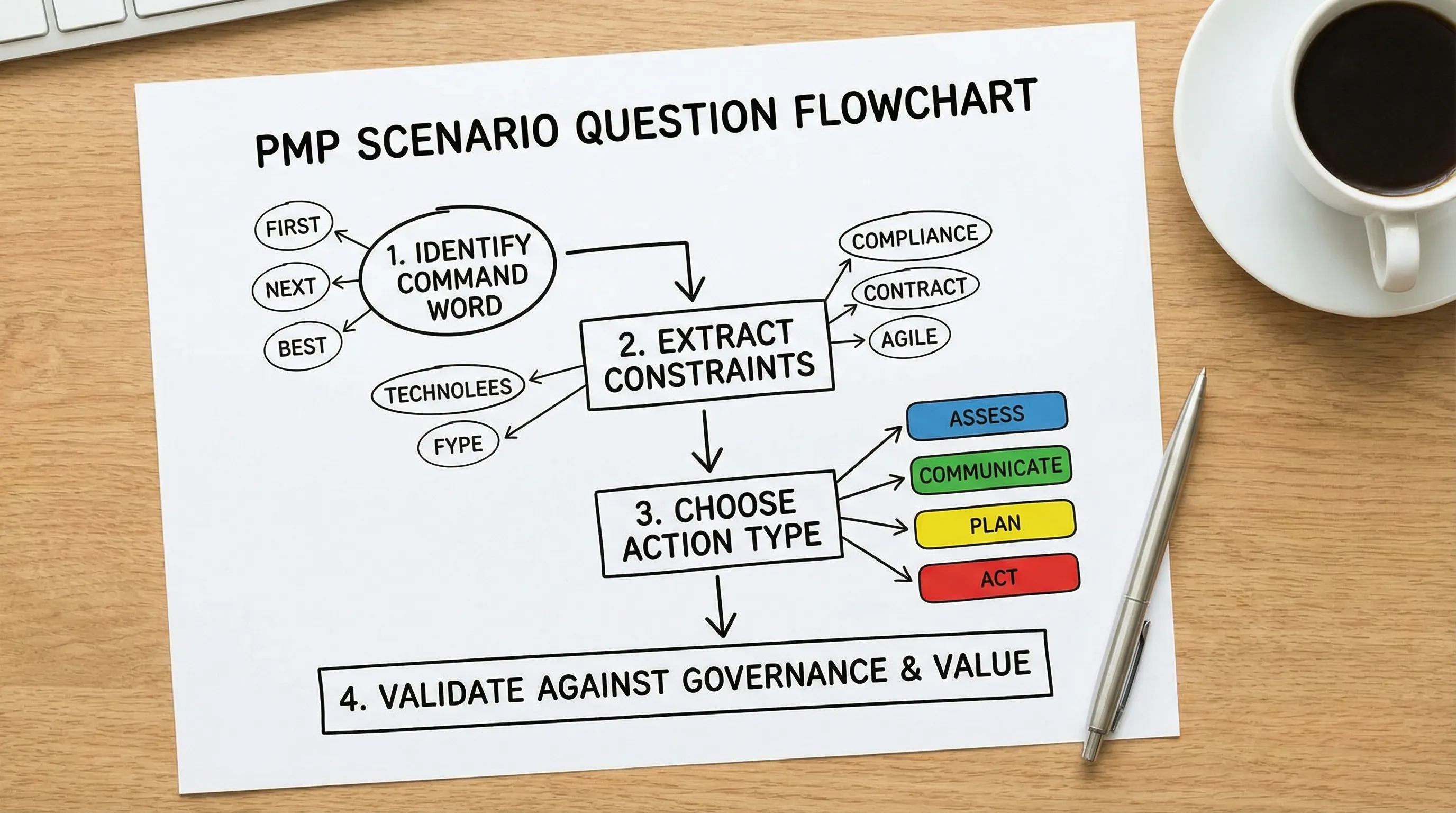
PMP exam sample questions (with “what PMI is really asking”)
These are original, exam-style items designed to mirror the decision logic of the PMP. Use them to practice decoding the stem, then compare your reasoning to the explanation.
Sample Question 1: Change request in the middle of execution
A stakeholder asks for a new feature that would significantly improve user adoption. The request was not included in the approved scope baseline. The team is halfway through execution and currently meeting schedule targets.
What should the project manager do first?
| Option | Choice |
|---|---|
| A | Ask the team to estimate the effort and start the work immediately to capture the market opportunity. |
| B | Submit a change request and perform an impact analysis with schedule, cost, and risk implications. |
| C | Inform the stakeholder that the request cannot be accepted because scope is already approved. |
| D | Ask the sponsor to decide whether to include the feature to avoid delays. |
Correct answer: B
What PMI is really asking: Do you follow the right governance sequence for scope change? Even if the request is valuable, PMI expects you to analyze impact and use integrated change control (or the agreed change process) before committing.
Sample Question 2: Team conflict that is hurting delivery
Two senior engineers are in ongoing conflict about technical direction. Their disagreements are now delaying work and creating tension in daily collaboration.
What is the best action for the project manager?
| Option | Choice |
|---|---|
| A | Escalate the conflict to the functional managers immediately. |
| B | Replace one engineer to protect team performance. |
| C | Facilitate a structured discussion to identify root causes, align on goals, and agree on a path forward. |
| D | Wait for the next status meeting and raise the issue with all stakeholders present. |
Correct answer: C
What PMI is really asking: Can you lead people problems directly before escalating? Facilitation and conflict resolution are preferred unless there is a policy, safety, or ethics reason to escalate right away.
Sample Question 3: Agile team, unclear requirements
A product owner provides a high-level requirement, but the team says the acceptance criteria are unclear. The next sprint starts tomorrow.
What should the project manager (or agile lead) do next?
| Option | Choice |
|---|---|
| A | Start the sprint and clarify requirements as issues arise to maintain velocity. |
| B | Run a refinement session to clarify acceptance criteria and confirm shared understanding before committing work. |
| C | Ask the sponsor to approve the requirement to avoid rework later. |
| D | Move the item to “done” if it is high priority and can be improved later. |
Correct answer: B
What PMI is really asking: Do you protect flow by reducing ambiguity before commitment? Agile does not mean “start without clarity.” It means collaborate, refine, and then commit.
Sample Question 4: Vendor delay and contract boundaries
A vendor informs you that a critical component will be delivered three weeks late due to supply issues. The component is on the critical path. Your contract includes schedule-related terms.
What should the project manager do first?
| Option | Choice |
|---|---|
| A | Threaten contract termination to force faster delivery. |
| B | Review the contract terms and meet with procurement to determine options and obligations. |
| C | Immediately crash the schedule by adding resources to downstream tasks. |
| D | Inform the team that the delay is unavoidable and update the schedule baseline later. |
Correct answer: B
What PMI is really asking: Do you respect procurement governance? Before reacting, you validate contractual levers and obligations, then choose mitigation.
Sample Question 5: Risk response versus issue response
During testing, you discover a defect type that could cause significant rework if it appears in production. Similar defects were documented as a risk earlier, with a planned response.
What should the project manager do?
| Option | Choice |
|---|---|
| A | Implement the planned risk response and update the risk register and issue log as appropriate. |
| B | Remove the risk from the register because it has already occurred. |
| C | Ignore the defect since it was already anticipated in risk planning. |
| D | Escalate to the steering committee because all defects require escalation. |
Correct answer: A
What PMI is really asking: Do you understand the difference between risk planning and issue management? When a risk triggers, you execute the response and update both artifacts appropriately.
Sample Question 6: Stakeholder engagement drop
A key stakeholder who previously supported the project has stopped attending meetings and is no longer responding to requests for input. Their area owns an important dependency.
What is the best action?
| Option | Choice |
|---|---|
| A | Document the stakeholder as “uncooperative” and proceed without them. |
| B | Ask the sponsor to instruct the stakeholder to participate. |
| C | Meet with the stakeholder to understand concerns, reassess engagement strategy, and update the stakeholder engagement plan. |
| D | Replace the stakeholder with someone more supportive. |
Correct answer: C
What PMI is really asking: Do you treat disengagement as a problem to diagnose, not a label? PMI typically prefers direct engagement and plan updates before escalation.
Sample Question 7: Benefits and value conversation
A project is on track for scope and schedule, but a business leader questions whether the expected benefits still justify continued investment due to market changes.
What should the project manager do next?
| Option | Choice |
|---|---|
| A | Explain that the project must continue because the charter was approved. |
| B | Review the benefits management approach with the sponsor and reassess expected value, then recommend options (continue, pivot, or terminate). |
| C | Reduce quality to cut costs and preserve benefits. |
| D | Hide the concern to avoid alarming the team and stakeholders. |
Correct answer: B
What PMI is really asking: Can you manage for value, not just triple constraint? When benefits are challenged, you revisit value assumptions with the right governance.
Sample Question 8: Hybrid delivery and misaligned governance
Your organization uses a hybrid approach. Delivery work is iterative, but leadership expects predictive-style monthly scope sign-offs. The team reports that sign-offs are slowing down feedback and causing rework.
What is the best action?
| Option | Choice |
|---|---|
| A | Eliminate sign-offs because agile teams do not need approvals. |
| B | Continue the current process because leadership prefers it. |
| C | Propose tailoring the governance to align with iterative delivery, while ensuring required controls and transparency remain in place. |
| D | Ask the team to work overtime to compensate for the sign-off delays. |
Correct answer: C
What PMI is really asking: Do you understand tailoring? PMI supports adapting processes to context, as long as you maintain appropriate controls and stakeholder alignment.
The fastest way to improve: train your “question decoding” muscle
Doing more questions helps, but only if your review teaches you how PMI thinks. After each missed (or guessed) question, run a short loop:
- Restate the scenario in one sentence (who, what happened, what is at risk).
- Identify the command word (first, next, best).
- List the constraints you missed (contract, compliance, stakeholder role, delivery approach).
- Write a one-line rule you can reuse (example: “Scope change requires impact analysis and the change process before committing work.”)
This is the same reason step-by-step visual guides work so well when learning practical skills. If you have ever patched a wall, you know you do not skip straight to painting. You prep, fill, sand, then finish. That is why simple resources like step-by-step visual guides can feel easier than guessing your way through a repair, and the same logic applies to PMP practice.
Common PMP traps (and what PMI generally prefers)
| Trap you fall into | Why it is tempting | What PMI generally prefers |
|---|---|---|
| Escalate immediately | It feels decisive | Try direct resolution first, escalate when needed |
| Start executing without clarity | You want to move fast | Clarify requirements and acceptance criteria before committing |
| Treat the plan as unchangeable | Baselines feel “official” | Use change control and tailoring appropriately |
| Optimize only schedule/cost | Those are measurable | Optimize value, risk, and stakeholder outcomes too |
| Pick the most “technical” option | It sounds expert | Pick the option that best manages the project system (people, process, governance) |
Where high-quality practice questions make the biggest difference
PMP readiness is less about reading more pages and more about seeing enough scenarios to recognize patterns:
- Change control patterns (scope, schedule, cost, quality tradeoffs)
- Stakeholder patterns (power, influence, engagement)
- Agile and hybrid patterns (refinement, feedback loops, transparency)
- Risk patterns (risk register vs issue log, response strategies)
A realistic simulator helps because it forces you to make decisions under time pressure, then review your reasoning.
Frequently Asked Questions
Are PMP exam sample questions enough to pass the PMP? Sample questions are essential, but only if you review them deeply. The exam rewards judgment and sequence, not memorization.
How many PMP exam sample questions should I do before test day? There is no universal number, but you should do enough mixed sets to stabilize your accuracy and, more importantly, to consistently explain why the correct option is best.
Why do I miss questions even when I know the material? Most misses come from command words (first vs next vs best) and hidden constraints (contract, compliance, stakeholder role, agile context).
Is the PMP exam mostly agile now? The PMP blends predictive and agile or hybrid concepts. Expect to switch mindsets based on the scenario.
What is the best way to review PMP practice questions? Re-solve missed questions cold, extract the constraint you missed, and write a reusable rule for future scenarios.
Practice the way PMI tests with Planet Cert practice tests
If you want to turn decoding skill into consistent scores, use a question bank that mirrors real exam pressure and provides clear explanations.
PlanetCert offers planet cert practice tests, exam questions, and a web-based exam simulator (mobile-friendly, no additional software required) across a wide catalog of IT and professional exams. You can start your PMP prep workflow by training with timed sets, tracking your misses, and retesting until your decision-making becomes automatic.
Explore PlanetCert here: Planet Cert practice tests

Discussion
Question Comments
0 comments·0 participantsSign in to leave a comment and access more free questions.