
T-Cert Alabama Cost Rises for 2026: Will IT Certification Fees Follow?
Every time a certification body touches its fee schedule, the question that hits the forums isn’t really about the policy. It’s about whether your own next exam voucher is about to get pricier. In mid-2026 the Alabama State Department of Education added transaction charges to its T-CERT teacher certification portal, and the first reports were from educators staring at a fresh line-item they hadn’t budgeted for. If you’re studying for a Cisco, CompTIA, or AWS exam, your reflex was probably the same: is this the start of a broader price push? Let’s walk through what changed in Alabama, see how other state credential systems handle their costs, and then lay out the real numbers on IT certification fees so you can decide whether to lock in a voucher now or keep preparing at your current pace.
What Alabama Changed in 2026
Alabama’s teacher certification process runs through the T-CERT web portal, managed by the State Department of Education. For years the fee structure was relatively simple—pay an application fee and, if your submission was clean, move on. That changed earlier this year.
The state now applies a flat transaction fee on every application, regardless of whether the application is refundable. The fee varies by submission type, so the exact figure depends on whether you’re applying for a first certificate, renewing, adding an endorsement, or submitting a late renewal. A late submission triggers an additional $50 non‑refundable charge, a detail flagged by the University of North Alabama’s certification office. All application fees remain non‑refundable, so once you click submit, the cost is sunk.
One detail that caught a lot of applicants off guard: there was no blanket announcement or press release. The fee schedule updated inside the T-CERT portal, and most users discovered the new costs when they reached the payment screen. That pattern—quiet, operational adjustments instead of headline‑grabbers—matters. The State Department’s certification page now notes the transaction fee and the non‑refundable policy, but you only see the specific pound‑level cost once you’re deep into the application flow.
What’s driving the change? The short answer is cost recovery. Running a secure, modern certification portal isn’t cheap. Staff time, platform maintenance, and periodic security updates all cost money, and the transaction‑fee model suggests the department is moving toward pricing each interaction closer to its direct servicing cost. For a first‑time applicant, the combined outlay in 2026 is noticeably higher than what the same candidate would have paid in 2025. That’s the headline, even if the state hasn’t published the percentage increase.
How Other Teacher Certification Systems Price Their Exams
Alabama isn’t alone in rethinking how much teachers pay for the paperwork between them and the classroom. Texas, for example, uses a per‑test fee model: every TExES exam carries its own registration charge, and adding endorsements or pursuing multiple certifications pulls in separate administrative fees. A candidate chasing bilingual or special education endorsements can easily cross $350 in registration and testing fees before factoring in any programme tuition, fingerprinting, or background checks. Our look at the TExES exam cost shows just how quickly those line items stack up.
The contrast between Alabama’s transaction‑fee model and Texas’s per‑test approach points to a wider pattern: certification authorities are getting more granular about what they charge for. Where a single flat fee used to cover most of the pipeline, we’re now seeing itemised charges for submissions, for late handling, for additional score reports, even for digital‑badge delivery in some systems. The authority gains smoother revenue; the applicant faces harder‑to‑predict costs unless they map every required step before they start the process.
This attention to fee unbundling is exactly what makes the Alabama T-CERT update worth watching beyond education circles. If you recognise the pattern in a state‑run portal, you’ll spot it faster when your next IT vendor exam adds a separate processing fee or restructures recertification charges.
The IT Certification Fee Landscape in 2026
When you switch the lens from teacher credentials to IT certifications, the picture isn’t a single sweeping price hike. It’s a mixed bag, driven by each vendor’s strategy and market position.
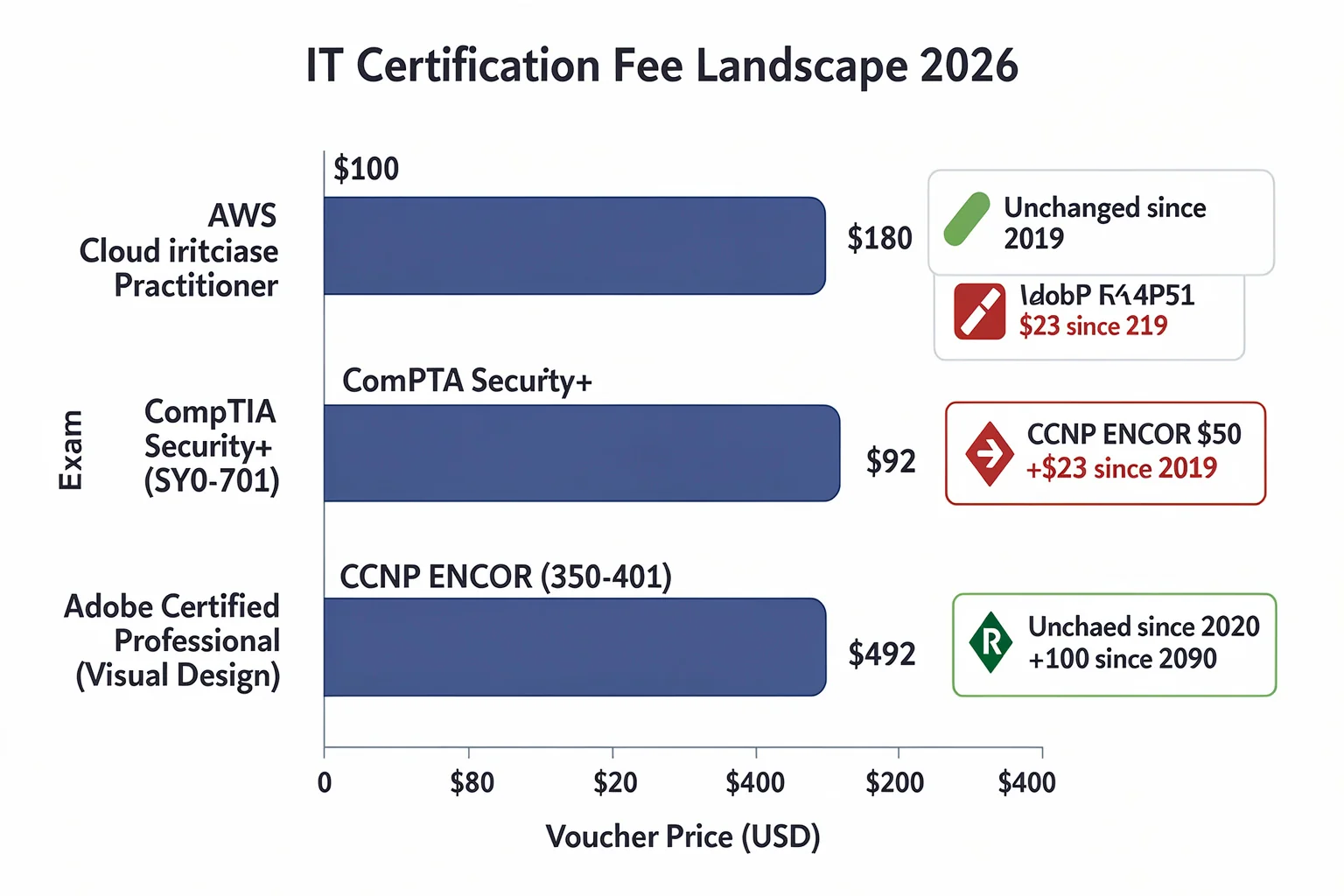
AWS has held its ground. The foundational AWS Cloud Practitioner exam fee still sits at $100 in 2026, unchanged since the exam launched. Associate‑level exams remain at $150, and professional and specialty exams at $300. AWS treats these certifications as ecosystem‑builders—the real revenue comes later, through platform adoption, training, and conference attendance. Even if underlying delivery costs have risen, AWS appears to be absorbing the difference.
Cisco has moved upward. The professional‑level CCNP ENCOR cost 2026 now reaches $400. In 2019 you’d have paid $300 for the same‑level exam. The associate CCNA moved from $300 to $325 in early 2023. These increases align with blueprint refreshes and investments in secure, psychometrically‑validated item pools. Cisco’s approach seems to treat certification as a revenue centre where incremental price bumps keep the programme sustainable as exam‑delivery costs climb.
Adobe kept the sticker price flat but changed the path. The typical Adobe Certified Professional exam costs about $180 globally, and that number hasn’t shifted in several years. But Adobe has been shrinking the number of exams that earn the Professional label, nudging more candidates toward the pricier Expert and Master tiers. The headline price didn’t move—the total cost to achieve a meaningful credential did climb for many people. We broke that down in the Adobe exam price breakdown.
CompTIA follows a slow, predictable cadence. The SY0‑701 Security+ voucher is $392 if you buy directly from CompTIA, though academic and business‑channel pricing can bring it lower. Digging into the Security+ exam real price reveals that when you add study materials, a practice‑test bundle, and the financial cushion for one potential retake, the real outlay often nudges $700. That’s not because the voucher suddenly jumped, but because cost is now distributed across several decisions you can’t avoid—a dynamic that mirrors the Alabama T‑CERT shift.
Enterprise‑focused paths like HPE follow a similar logic. A single exam voucher might look moderate, but the full certification track involves required training courses, recertification events, and sometimes membership fees. When we mapped HPE certification costs, the exam line‑item was only the visible tip of a larger spend. As the specialisation level rises, so does the per‑exam price.
Across these vendors, the core takeaway is that no single narrative fits. Some leaders treat certification as a marketing investment and keep fees flat. Others treat it as a product and raise prices alongside their refresh cycles. If you’re planning to test in the next 12 months, knowing which camp your target vendor sits in helps you decide whether to rush a booking or stick to your study plan.
The Forces That Move Exam Prices
Three pressures tend to push certification fees up, and occasionally one pressure keeps them from budging.
Platform and delivery costs. Secure proctoring, testing‑centre maintenance, item development, psychometric analysis, and the regular blueprint refreshes all cost real money. When a vendor revises an exam—think CompTIA’s move from N10‑008 to N10‑009 or Cisco’s adoption of the 200‑301—the investment in new question pools and updated delivery infrastructure often coincides with a price adjustment. The candidate pays a portion of that refresh through a higher voucher fee.
Vendor strategy. AWS treats its certifications as a loss‑leader that deepens cloud adoption; CompTIA treats Security+ as a revenue‑generating product. Both approaches are rational, but they produce very different price trajectories. If your target vendor is fighting for market share in a crowded space—entry‑level cloud, for example—expect more price stability. If the certification is mature and heavily required by employers, the vendor has more latitude to raise prices.
Unbundling. The Alabama T‑CERT transaction fee is unbundling in action. In IT we’re seeing the same: separate charges for exam delivery, e‑text access, retake insurance, digital‑badge maintenance, and late registration. The sticker price on the voucher hasn’t always changed, but the total take‑out for a full certification has grown because there are more mandatory line items.
When prices stay put. Massive competition can freeze fees. Microsoft’s AZ‑900 and DP‑900 fundamentals exams have been $99 for years, largely because AWS and Google Cloud offer comparable credentials at similar price points. And if a vendor is trying to build a new certification path, early adopters often get beta‑exam pricing well below the eventual retail cost. Microsoft has run beta programmes where a $165 associate‑level exam was offered for $50—or even free—for a limited window. Keep an eye on the vendor’s certification blog for beta announcements; those slots fill in hours, but a $300 exam taken for $50 changes the economics completely.
Budgeting for Your IT Exam: Beyond the Voucher Price
If the Alabama T‑CERT change teaches us anything, it’s that the line-item price on a sign‑up page rarely captures the full cost. Here’s what a realistic IT exam budget should include.
- Voucher cost. This ranges from $99 for entry‑level AWS or Azure fundamentals to $400 for CCNP ENCOR, and climbs into four figures for certain expert‑level vendor exams.
- Retake risk. A single fail on a $300 exam pushes your planned one‑time spend to $600. That’s the most common budget‑blow‑up. A good set of practice tests that simulates the timing and covers detailed answer explanations can meaningfully lower the chance of a retake. Spending $100–$150 on quality prep isn’t an extra cost—it’s insurance.
- Study materials. Books, video courses, virtual labs, and bootcamps can run from $50 to several thousand. Many successful candidates skip the full bootcamp and instead pair an official study guide with a question bank that includes thorough, exam‑board‑style explanations. That combination frequently gets them exam‑ready for a fraction of the premium‑course price.
- Recertification fees. If your certification expires every three years, the combination of continuing‑education credits, submission fees, and renewal vouchers can add 20–30% to the annualised cost. Before you book, check the recertification policy. Some bodies also charge an annual maintenance fee that you’ll pay regardless of whether you’re actively testing.
- Time. A candidate who stretches preparation over six months because life gets in the way often ends up paying more—for subscription‑based lab access, for peak‑price exam slots, and for the simple cost of staying on the treadmill longer. When you can, schedule your exam for a quieter quarter and front‑load the study hours.
Here’s a concrete example. Someone targeting the 350‑401 ENCOR pays a $400 voucher. A six‑week practice‑test regimen, an official cert guide, and perhaps a video course might cost $150 more. Pass on the first attempt and you’re at roughly $550. Fail once, and you’re at $950 plus another six weeks of lost momentum. That failure surcharge is why experienced exam‑takers rarely treat the voucher price as the final number. They build the retake possibility into the budget from day one.
What IT Pros Can Learn from the Education Sector’s Fee Shifts
Teacher certification and IT certification don’t look like siblings, but they share a surprising amount of DNA. Both rely on standardised assessments to verify competence. Both require periodic renewal. Both have started unbundling costs, and both are wrestling with the overhead of secure, remote‑friendly delivery systems.
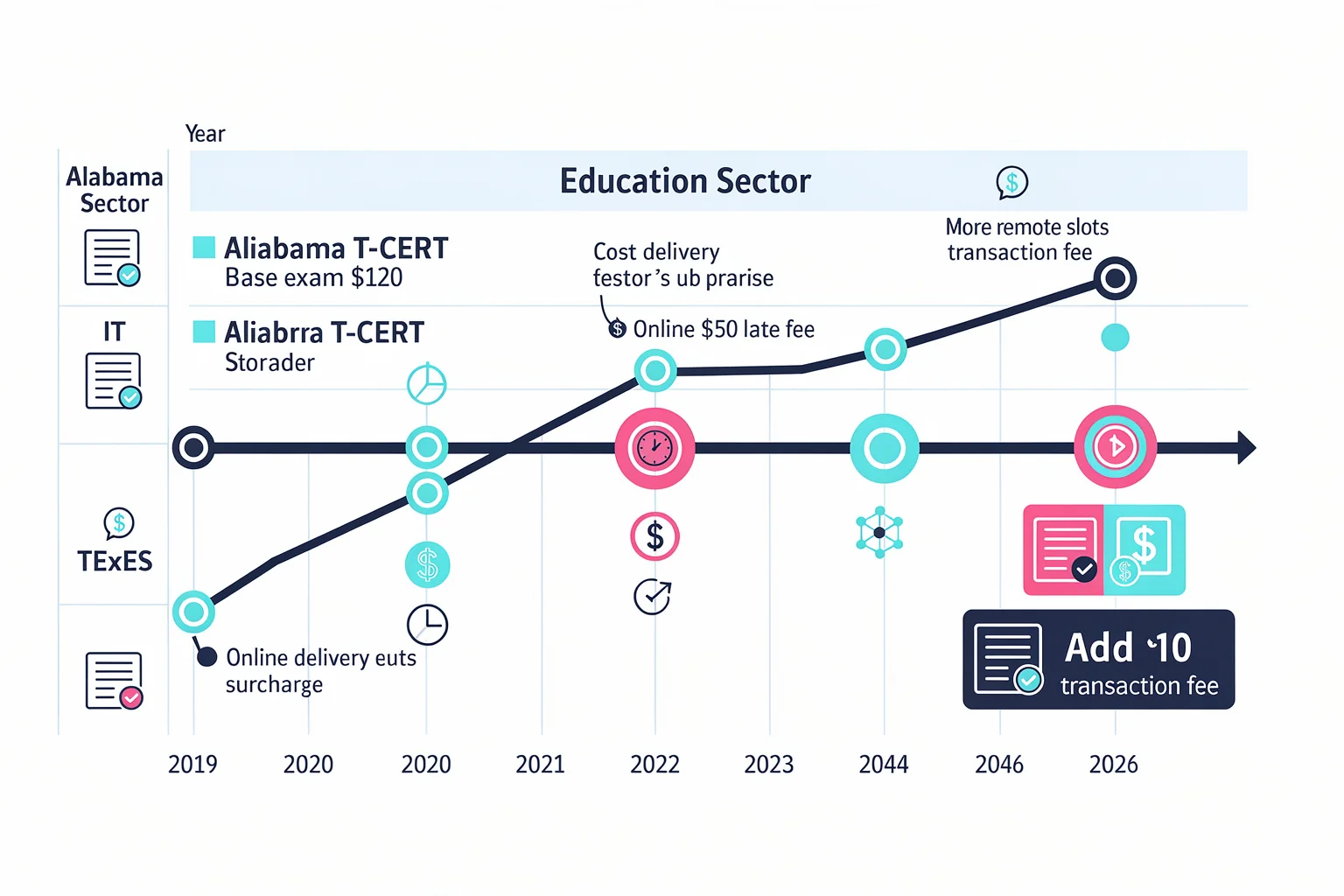
Alabama’s move to transaction fees is a signal that certification authorities of all stripes are re‑evaluating their funding models. When a state department—which isn’t a profit‑seeking entity—starts attaching a per‑step charge, it tells you that the old “pay once and forget” pricing is straining under the weight of modern platform requirements. In the IT world, testing providers like Pearson VUE have raised their own service charges, and those increases eventually appear either directly on a candidate’s invoice or baked into higher vendor voucher prices.
The practical takeaway for someone aiming at a certification in the next year isn’t to panic and buy everything today. The smarter move is to map the full per‑certification cost, including the likely need for one retake, and then lock in a voucher for any exam whose vendor hasn’t raised prices recently. Vendors tend to announce changes at the start of a fiscal quarter; watching for blueprint updates around July or January often gives you a few weeks of notice.
Quick Answers to Your Certification Fee Questions
Does the Alabama T‑CERT fee increase affect my IT exam? No, each state controls its own educator certification fees, and there is no direct link to CompTIA, Cisco, or AWS pricing. The change is relevant because it illustrates the broader shift toward unbundled, per‑step charges—something IT vendors are adopting in their own way.
Which IT exam has held its price the longest? AWS Cloud Practitioner has stayed at $100 since launch, and Microsoft’s AZ‑900 and DP‑900 fundamentals exams have been $99 for years. Both are anomalies driven by intense competitive pressure and vendor strategy, not by static delivery costs.
Should I buy my voucher early to avoid a price hike? If your target exam hasn’t been repriced in two or more years, and if the vendor tends to raise prices alongside blueprint refreshes, buying a voucher up to 12 months in advance can lock in the current rate. Most vouchers remain valid for a year, so early purchase rarely creates pressure if you’re already in a study plan.
How much should I budget for a retake? At a minimum, budget the full voucher cost again. For a $300 exam, that means treating the real price as $600 until you have a passing result. A solid practice‑test bundle can reduce the probability of needing that retake, but it’s wise to have the fallback funded from the start.
Do I really need a practice test bundle, or can I just use the official study guide? Practice tests do something a guide alone cannot: they simulate the pressure of a timed exam and surface the specific domain areas where your knowledge is thin. When a practice platform includes detailed explanations and links back to the exam objectives, it can shorten your study timeline by helping you focus on the gaps. Compared to the cost of a single retake, the bundle usually pays for itself on the first pass.
More Exam Cost Resources
- AWS Cloud Practitioner Training Costs in 2026 Explained
browse the relevant exam page and purchase a practice test

Discussion
Question Comments
0 comments·0 participantsSign in to leave a comment and access more free questions.