Clinical Practice: Head and Neck · 1.A.1 Traumatic brain injuries
A 28-year-old patient with severe traumatic brain injury has an intracranial pressure (ICP) of 20 mm Hg. The patient's arterial blood pressure is 112/64 mm Hg (mean arterial pressure of 80 mm Hg). What is the patient's cerebral perfusion pressure (CPP), and what is the appropriate management?
Answer and explanation
Correct answer: A
CPP equals MAP minus ICP (80 - 20 = 60 mm Hg). The guideline-directed target is 60-70 mm Hg. Pushing CPP above 70 mm Hg increases the risk of acute respiratory distress syndrome from excessive fluids and pressors.
Q2Question 2
Beginner
Clinical Practice: Head and Neck · 1.A.1 Traumatic brain injuries
In a mechanically ventilated patient with an isolated severe traumatic brain injury who does not demonstrate acute cerebral herniation, what are the target ventilatory parameters?
Answer and explanation
Correct answer: B
Normal ventilation (PaCO2 35-45 mm Hg) prevents cerebral vasoconstriction and ischemia. Target PaO2 is 80-100 mm Hg; hyperoxia (>100 mm Hg) increases oxidative tissue injury.
Q3Question 3
Advanced
Clinical Practice: Head and Neck · 1.A.1 Traumatic brain injuries
A 34-year-old unrestrained driver involved in a high-speed rollover collision sustains a severe traumatic brain injury with a baseline Glasgow Coma Scale (GCS) score of 5. Following emergent endotracheal intubation, the patient is admitted to the neurotrauma intensive care unit with a multimodal intracranial monitoring catheter capable of measuring intracranial pressure (ICP) and brain tissue oxygen tension (PbtO2).
Initial post-placement telemetry demonstrates an ICP of 24 mm Hg, a mean arterial pressure of 86 mm Hg (CPP 62 mm Hg), an arterial oxygen saturation of 97%, and a PbtO2 of 11 mm Hg. The patient is sedated and mechanically ventilated with a PaCO2 of 38 mm Hg and core temperature of 37.1 °C. Serum sodium is 140 mEq/L.
According to tiered severe traumatic brain injury consensus algorithms (such as SIBICC), which tier-1 intervention should the trauma nurse anticipate next to address the patient's compromised cerebral oxygenation?
Answer and explanation
Correct answer: B
The target PbtO2 is at least 15 mm Hg. When compromised despite normal ICP/CPP, first-tier measures optimize FiO2 and CPP. Barbiturates and decompressive craniectomy are higher-tier rescue therapies.
Q4Question 4
Intermediate
Clinical Practice: Head and Neck · 1.A.2 Spinal cord injuries
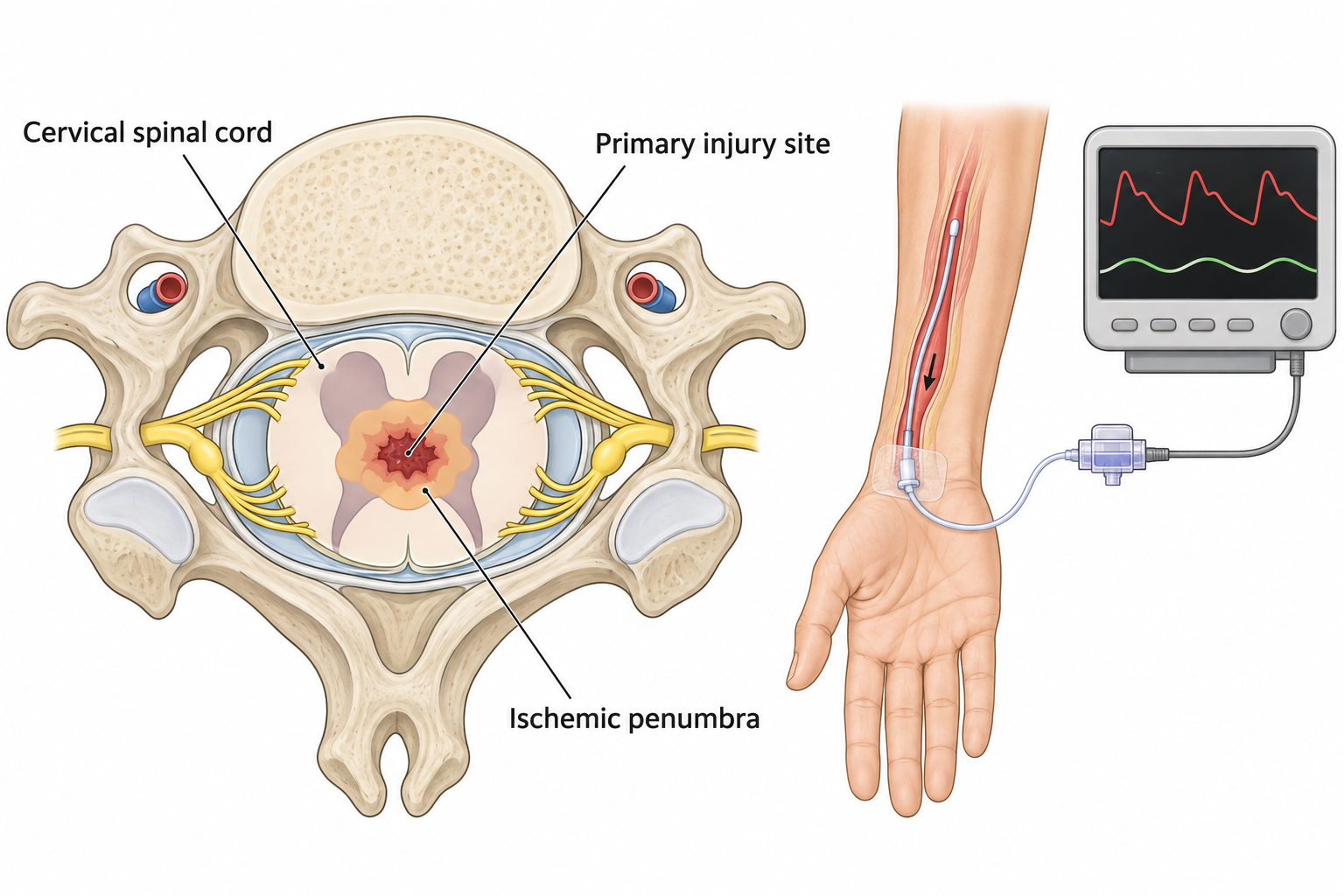
Following acute traumatic cervical spinal cord injury, clinical practice guidelines recommend maintaining a mean arterial pressure (MAP) target of _____ for 7 days to prevent secondary ischemic injury to the spinal cord.
Answer and explanation
Correct answer: D
ACS TQP guidelines recommend maintaining MAP between 85 and 90 mm Hg for 7 days after acute spinal cord injury to sustain spinal cord perfusion pressure and limit secondary cord ischemia.
Q5Question 5
Intermediate
Clinical Practice: Head and Neck · 1.A.2 Spinal cord injuries
A 24-year-old patient arrives following a diving accident resulting in a complete C5 spinal cord injury. Vital signs are: blood pressure 82/46 mm Hg, heart rate 48 beats/min, respiratory rate 12 breaths/min, and temperature 36.4 °C. The skin of the extremities is warm and dry. After receiving an initial 1,000 mL intravenous crystalloid fluid bolus without hemodynamic improvement, which intervention is most appropriate?
flowchart TD
A[C5 Spinal Cord Injury] --> B[Loss of Sympathetic Tone]
B --> C[Vasodilation: Hypotension]
B --> D[Unopposed Vagal Tone: Bradycardia]
C & D --> E[Neurogenic Shock]
E --> F[Fluid Resuscitation]
F -->|Inadequate Response| G[Pressor with Alpha + Beta Activity]
Answer and explanation
Correct answer: B
Neurogenic shock causes loss of sympathetic tone, producing hypotension and bradycardia. After initial fluids, pressors with both alpha and beta activity treat vasodilation and bradycardia while avoiding pulmonary edema.
Q6Question 6
Advanced
Clinical Practice: Trunk and Pelvis · 2.A.4 Great vessel injuries
A 29-year-old patient presents with a stab wound within the "cardiac box" of the anterior chest. The patient is hypotensive (blood pressure 84/50 mm Hg) with tachypnea. A Focused Assessment with Sonography in Trauma (FAST) examination of the subxiphoid view shows no pericardial fluid, but the left thoracic view reveals a massive left hemothorax. What is the most likely physiological explanation for the negative pericardial FAST?
Answer and explanation
Correct answer: A
FAST can yield a false-negative for hemopericardium if a pericardial laceration decompresses pericardial blood into the pleural cavity, manifesting instead as a large hemothorax.
Register free for 6 more questions
Or unlock all 161 TCRN questions with explanations, timed mode and flashcards.