

If you’re checking 010 111 exam passing score requirements, start by matching the code to the exam’s full title, awarding organisation and current version. This guide does not confirm an official numerical pass mark, scoring scale or current booking availability for 010-111. Those details need confirmation before you use a percentage to make a booking decision.
That distinction matters when you’ve spent evenings studying and want a clear answer about readiness. A practice percentage, an official passing score and a qualification’s award requirements measure different things. Treating them as interchangeable can give you confidence that the evidence doesn’t support.
I’d check the following six points in this order: the official threshold, its scoring method, the treatment of unscored questions, result delivery, validity and score-report detail. The first two determine what a passing score means. The remaining checks explain how to approach the sitting, interpret the result and plan around it.
1. Confirm the pass mark for the exact 010-111 exam
The first requirement to establish for 010-111 is the official passing threshold attached to the correct examination. Every later calculation depends on that match.
Before accepting a number, locate the full exam title and awarding organisation. Then check whether the policy applies to the version you intend to book. An exam code on a preparation page is insufficient evidence of either current availability or current scoring rules.
This check deserves first place for anyone choosing materials, buying a voucher or setting a study target. Its limitation is simple: confirming the threshold tells you the required result, but it doesn’t explain how answers produce that result.
Record the threshold with its context
Keep the passing score beside the details that make it meaningful:
- The full exam title and code.
- The awarding organisation.
- The applicable version or objectives.
- The score range and passing threshold.
- The policy’s effective date, where stated.
Check the wording carefully. A requirement to achieve at least a stated score has a precise boundary. If the policy leaves rounding unclear, ask for clarification rather than assuming a score just below the threshold will qualify.
If official documents appear to conflict, identify which applies to your intended sitting. A publication date alone may not settle that question; look for an effective date or an explicit version reference.
An unanswered question about the awarding body or current booking status should come before any readiness calculation. Ask the exam owner or its authorised booking provider to confirm the correct examination and applicable scoring policy.
Save the answer with your booking information so you can trace the pass mark back to the exam you actually intend to take.
2. Establish whether the score is raw, weighted or scaled
For 010-111, the next check is how the reported score relates to your answers. A threshold without its scoring method can be easy to misread.
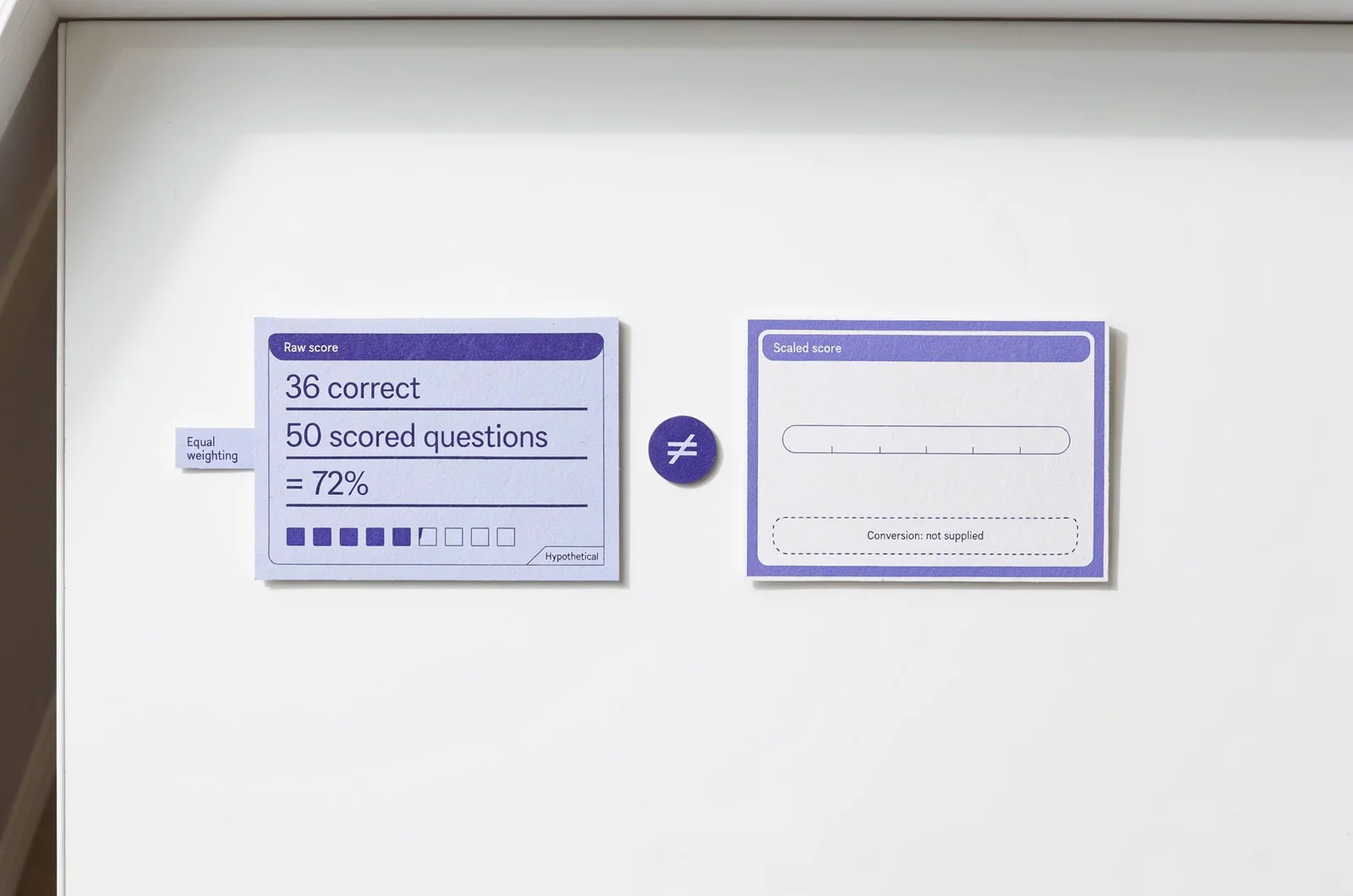
A raw percentage describes the proportion of available marks earned. A scaled score expresses performance on a reporting scale. A weighted system gives some questions or components more influence than others. These descriptions explain possible methods; they do not establish which method 010-111 uses.
This check is especially useful if you’re comparing a practice-test percentage with a published passing score. Its limitation is that the exam owner may explain the reporting scale without publishing the full conversion method.
Avoid calculating a percentage from the scale alone
As a hypothetical example, answering 36 of 50 equally weighted, scored questions correctly produces a raw result of 72%. That arithmetic assumes every included question contributes equally and that each response receives a simple correct-or-incorrect mark.
It cannot establish the equivalent result on an undisclosed scaled system. Dividing a passing score by the maximum reported score is also insufficient to prove the required percentage of correct answers.
Look for explicit rules about partial credit, multiple-response questions, weighting and penalties for incorrect answers. If those rules aren’t stated, leave them unresolved.
Once the exam identity and objectives match, PlanetCert’s 010-111 sample questions are an optional preparation resource. Use them to examine your reasoning, and check their coverage against the applicable objectives.
The distinction between practice and exam scores also matters when setting a study target. Record your practice percentage as a preparation measure, alongside the scoring method used by that particular question set. Keep the official passing threshold in a separate field.
3. Check whether every question contributes to the result
The treatment of unscored questions is another point to confirm for 010-111. This guide does not establish whether the examination contains any.
If the exam owner states that some questions are unscored, check what that means for the published question count and exam duration. You need to know whether the stated total includes those questions and whether they sit within the same time allowance.
This check is most useful when planning your pace. Its limitation is that knowing unscored questions exist may still tell you nothing about which questions they are.
Build your approach around the instructions
Avoid treating an unusually difficult or unfamiliar question as evidence that it carries no marks. Difficulty and wording do not establish a question’s scoring status.
Instead, prepare an approach that works without identifying unscored material. Read the response instructions, attempt each required item and use the available review controls as permitted.
The same care applies to unanswered questions. Establish the official rules before deciding whether to guess, skip or return later. If incorrect responses carry a penalty, that affects the decision. If the policy says nothing about penalties, don’t import a rule from another examination.
Unscored items can also make an unofficial “number of mistakes allowed” calculation unreliable. Such a calculation needs a known scored-item count, item values and passing rule.
For your study notes, write down only what the applicable policy confirms. If the number of scored questions is unknown, mark it as unknown and plan your timing around the confirmed total and duration.
4. Confirm when the result becomes available and final
For 010-111, establish both when you receive a result and what status that result has. These are separate questions.
A result displayed after submission, a downloadable score report and a qualification appearing in an account could represent different administrative stages. This guide does not confirm which stages apply to this examination or how long they take.
This check moves higher in priority if you have an employment, course or application deadline. Its limitation is that an expected reporting time may still depend on conditions stated in the exam owner’s policy.
Work backwards from the evidence you need
First, identify what your deadline actually requires. An employer might ask for a pass result, while another organisation might require an awarded qualification or a verification record. Ask the receiving organisation which document it will accept.
Then confirm the relevant details with the exam owner:
- Whether any result is available immediately after submission.
- Whether an initial result is provisional.
- Where the official score report is delivered.
- Whether a separate award or verification step applies.
- How to raise a missing-result query.
Keep result timing separate from the examination’s duration. A timed appointment tells you how long you have to complete the assessment; it doesn’t establish when evidence of the outcome will be usable.
For preparation, timed practice sessions can help you assess whether your pace holds under a time limit. They provide no confirmation of the official reporting schedule.
Before choosing an appointment, record the result stage your deadline requires and the applicable delivery guidance. Allow for any stated processing period rather than assuming the appointment date will also be the date you can submit proof.
5. Separate exam availability, result validity and qualification expiry
For 010-111, “validity” needs a precise meaning before it can guide your booking. The availability of an exam version, the use of a passing result and the duration of a qualification are separate matters.
This guide does not establish a validity period for a 010-111 result or any resulting credential. Avoid assigning one without an applicable official policy.
This check is particularly useful if you’re completing a qualification in stages, using a voucher or studying across a version change. Its limitation is that different dates may govern different parts of the process.
Attach each date to the thing it controls
An exam retirement date, where applicable, concerns the availability of a particular examination. A voucher expiry concerns the conditions for using that voucher. A result-acceptance window concerns how a pass can be used. A credential expiry concerns the awarded qualification.
Keep those labels attached to the dates in your notes. A voucher’s deadline does not establish how long a qualification remains valid.
If other assessments or eligibility conditions apply, check whether they must be completed within a stated period. Also establish whether the exam version you plan to take satisfies the qualification route you intend to follow.
Anyone with an earlier 010-111 result should ask a narrower question than “Is it still valid?” Specify the result date, exam version and intended use. That gives the exam owner enough context to explain the applicable rule.
Before paying, list every confirmed deadline relevant to your route. Leave unspecified dates blank, and request clarification where an unanswered validity question could prevent you from using the result as intended.
6. Find out what the score report can actually tell you
The final check for 010-111 is the information available after the examination. Understanding the report’s scope helps you plan how to use a pass or respond to an unsuccessful attempt.
This guide does not confirm the report’s layout or whether it includes an overall score, topic indicators or other feedback. Check the exam owner’s description before expecting a particular breakdown.
This point matters most if you want to use the result to direct further study. Its limitation is that a report can provide useful feedback without revealing individual questions, exact errors or the full scoring calculation.
Use feedback at the level it supports
If the report includes topic indicators, follow the accompanying explanation. A bar, category or descriptive label needs its legend before you can interpret it.
Avoid turning a topic indicator into an exact question count unless the report explicitly supports that calculation. Equally, a small difference between two indicators may be insufficient evidence for a detailed comparison of your abilities.
For preparation, exam simulator analytics provide a separate way to organise revision. Compare available practice feedback with the applicable objectives, then identify the concepts behind your mistakes.
Keep your revision notes specific. Record the misunderstood concept, why your chosen response failed and what evidence supports the correct response. Revisit the concept with a fresh question rather than relying only on recognition of an earlier answer.
A useful interactive booking checklist could store the confirmed exam identity, pass mark, scoring method, reporting arrangements and relevant deadlines. Missing fields should remain blank and prompt a follow-up question; the checklist should not estimate an official pass probability.
Before booking, resolve uncertainties that affect exam eligibility, score interpretation or the deadline for usable results. Use your practice record to judge preparation separately.
Questions that affect a 010-111 booking decision
The remaining 010-111 questions concern what you can safely conclude from the information you have. Use them to identify the specific answer still needed before you commit to an appointment.
What numerical score do I need to pass?
An official numerical threshold is not confirmed in this guide. Obtain the passing score and reporting scale for the exact exam title and version.
If you have found a number elsewhere, check its origin and applicability. A percentage on a preparation page does not establish the exam owner’s passing requirement.
Can I calculate how many questions I’m allowed to miss?
Only if the confirmed scoring rules provide enough information. You would need the scored-item count, item values, treatment of partial credit and relationship between marks and the passing threshold.
Without those details, a precise mistake allowance would depend on assumptions. Base your preparation on coverage and reasoning rather than an invented error budget.
Does a strong practice result mean I should book?
It can contribute to the decision, but it cannot establish official scoring equivalence. Check whether your performance holds with fresh questions, the applicable objectives and the confirmed time limit.
Repeated success on a familiar set needs careful interpretation. Examine whether you can explain the answer and apply the concept when the wording changes.
Can I assume 010-111 is currently available?
Current availability is not confirmed here. Establish that the exam owner or its authorised booking provider accepts appointments for the exact examination you intend to take.
If a preparation page exists but you cannot locate a matching official booking route, resolve that mismatch before purchasing materials or arranging an exam date.
Practice scores, question quality and exam timing


Discussion
Question Comments
0 comments·0 participantsSign in to leave a comment and access more free questions.