

The timed vs untimed practice exams question tends to surface about a week into studying, when you have a question bank open and no idea whether the clock should be running. Get it wrong in either direction and you waste your most valuable resource: realistic attempts. Run everything untimed and you can walk into the test centre answering accurately but far too slowly. Run everything against a clock too early and you rehearse rushed mistakes instead of fixing the gaps underneath them.
Here is the short version. Untimed practice teaches content and reasoning method. Timed practice teaches pacing, judgement, and composure. You need both, in that order, and the switch point is something you can measure rather than guess. What follows is a sequence of tasks you can run in a simulator this week: diagnose your bottleneck, work untimed blocks with written explanations, add a clock, read your score report by domain, and finish with spaced full simulations.
Diagnose Whether the Clock or the Content Is Beating You
Before you split your study time, get one piece of data. Take 30 to 40 mixed questions from your exam's bank and work through them with no timer. Answer every question, then write a one-line justification for each answer, right or wrong. This is the logic behind blind review, the method the 7Sage Blog describes as re-attempting questions without a time restriction to work out whether your obstacle is the clock or your grasp of the content.
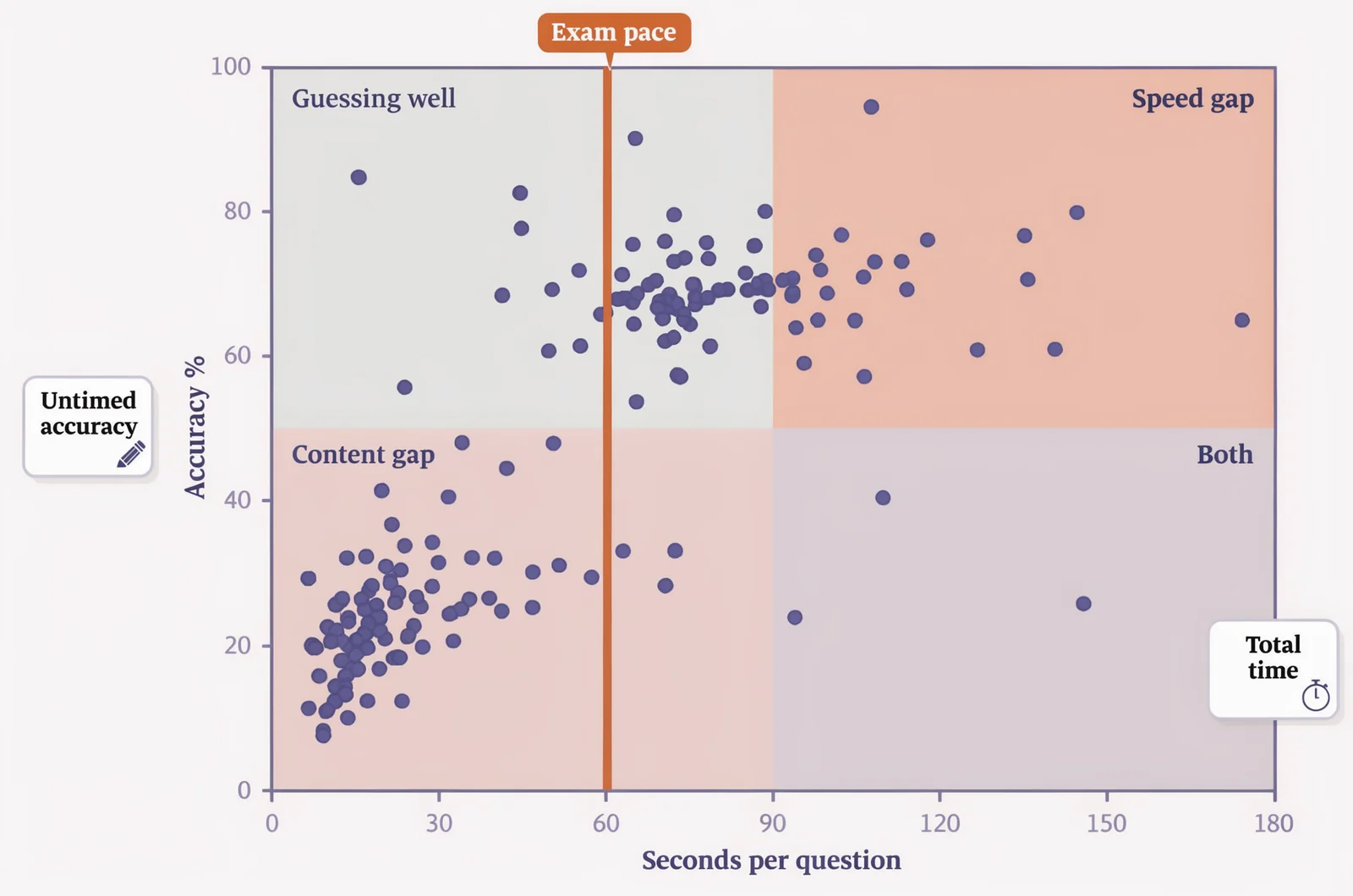
Then record two numbers: your untimed accuracy across the set, and the total time taken, converted to seconds per question.
Compare that pace against the real exam. CompTIA Security+ allows 90 minutes for up to 90 questions, so roughly a minute each. Cisco's CCNA gives 120 minutes for 100 to 120 questions, a similar or slightly tighter budget. Those published limits are the benchmark your untimed pace has to clear.
The gap between your untimed and timed accuracy tells you what to do next:
| What you observe | What it means | Next move |
|---|---|---|
| High untimed accuracy, slow pace | Content is fine, speed is the problem | Move to timed blocks quickly |
| Low untimed accuracy, reasonable pace | Content gaps are the problem | Stay untimed another week or two |
| Low accuracy and slow pace | Both need work | Untimed first, then layer in timing |
| High accuracy and fast pace | You may be guessing well | Add harder items and full simulations |
If you score far higher untimed than timed, you are more comfortable with the content than with finding answers under pressure. If your untimed score barely improves on your timed score, the problem is knowledge, not the clock, and more timed tests will just rehearse the same errors.
Run Untimed Blocks So They Actually Teach You Something
Untimed practice has a bad reputation because most people do it badly. Answering slowly without reviewing is just slower guessing. Removing the clock gives you room to explain, in writing, why the right answer is right and why each distractor fails.
Work in blocks of 20 to 30 questions from a single exam domain. One domain at a time matters, because scattered questions hide which objective is weak. Microsoft's role-based exams, for instance, are built around job-task domains rather than isolated facts, so a block drawn from one domain maps onto something you can study. If you are heading toward a Microsoft certification, it helps to understand how the Microsoft exam format structures those domains before you build your blocks.
For each question in an untimed block, do three things:
- Answer it, then write one sentence on why your choice is correct.
- Write one sentence on why the most tempting wrong answer is wrong.
- Tag the question with the objective it tests, using the vendor's own numbering.
That third step builds the weak-topic log you will use later. Keep it in a spreadsheet with three columns: objective code, times missed, and the reason you missed it. Reasons matter more than counts. "Didn't know the difference between two similar services" is a study task. "Misread the question" is an attention task, and it belongs in a different column.
Untimed work is also where you should be honest about time spent. If a single question takes ten minutes, you have found a topic you do not understand, not a topic you are slow at. Write that distinction down.
Close gaps with explanations and flashcards
The review is the study session. After each untimed block, spend at least as long reviewing as you did answering. Where an explanation is thin, or you still cannot see why an answer is right, drop the objective into a flashcard deck and drill it over the next few days. Flashcards handle recall; explanations handle reasoning. They are separate jobs.
A useful test of whether you have learned an objective: explain it out loud in under 60 seconds without notes. If you cannot, it goes back in the deck.
Set an exit condition for untimed work
Use a concrete threshold rather than a feeling. A workable one is 85% or better accuracy on two consecutive untimed blocks drawn from different domains, with your written justifications matching the official explanations. Once you clear that, further untimed work has diminishing returns. Time to add the clock.
Add a Clock Without Rehearsing Panic
The first timed sessions should not be full-length exams. Start with single-domain timed blocks at real exam pace, then widen. If your exam allows 90 minutes for 90 questions, run 20 questions in 20 minutes. That is short enough to stay sharp and long enough to feel pressure.
Two rules make early timed practice useful rather than demoralising. No pausing: if you pause the timer, you are back to untimed practice with extra steps. No going back after the block ends: score it, log it, move on, and review afterwards untimed.
Introduce timing gradually because pressure changes what you are measuring. A time limit that forces nearly everyone to rush turns a knowledge test into a speed test, which is a different skill from the one most certification exams intend to assess. The UK government's analysis of time limits and speed of working in assessments draws the line plainly: where a limit is generous enough for nearly all candidates to attempt every question without undue haste, the test measures knowledge and skill; where speed and accuracy trade off, the test is speeded. Most vendor certification exams sit closer to the first category. Your goal is not to become fast, but to become fast enough that the clock stops being a factor.
Pacing checkpoints you can actually use
Rather than watching the clock continuously, set three or four checkpoints across a block and check your position against them. For a 60-question, 60-minute block: question 15 at 15 minutes, question 30 at 30 minutes, question 45 at 45 minutes.
If you are behind at a checkpoint, you have a decision to make: flag and move on, or accept a slower finish. Practising that decision is the real value of timed blocks. Knowing when to abandon a question is a skill, and you only learn it by abandoning questions under pressure.
Flagging, guessing, and questions worth skipping
Certification exams rarely penalise wrong answers more than blank ones, so an unanswered question at the end of a block is a pure loss. Build a rule now: if a question has taken more than roughly twice your per-question budget and you are no closer to an answer, flag it, pick your best option, and move. Come back if time allows.
Track how often you flag. A rising flag count with a stable score usually means you are being more honest about uncertainty, which is progress. A rising flag count with a falling score means you are running out of time earlier than you think.
Read Your Score Report to Find the Real Weak Spots
A percentage tells you almost nothing. What you want from each timed block is a per-domain breakdown sitting next to your untimed numbers.
| Domain | Untimed accuracy | Timed accuracy | Gap | Action |
|---|---|---|---|---|
| Domain 1 | 90% | 85% | 5 pts | Maintain, light review |
| Domain 2 | 80% | 55% | 25 pts | Timed drills on this domain |
| Domain 3 | 60% | 55% | 5 pts | Untimed study, content gap |
A large gap between untimed and timed accuracy in one domain points at pacing or question-format friction. A small gap with low accuracy in both points at missing knowledge. Those two problems need opposite responses, and a single overall score hides both.
This is where wrong-answer review pays off. Working through an ADM-201 practice exam review is a good model: take each wrong answer, decide whether it was a knowledge miss or a timing miss, and route it to the right kind of practice. Do that consistently and your log becomes a study plan rather than a list of regrets.
Turn the log into a two-week schedule
With a log in hand, the schedule writes itself. A workable split for the final fortnight:
- Days 1–3: untimed blocks on your two weakest domains, full written review
- Days 4–5: timed single-domain blocks on those same domains
- Days 6–7: one full-length timed simulation, then a full untimed review of every miss
- Days 8–10: flashcards on remaining gaps, plus short timed drills on strong domains
- Days 11–13: two more full simulations, spaced apart, each followed by review
- Day 14: light review only, no new material
Spacing matters more than volume. Research on practice test timing found that test anxiety dropped more for candidates who took practice tests early in their study period than for those who took them later, and that retrieval practice tends to pay off more when there is a delay between practice and the real test. In practical terms: do not cram your simulations into the last 48 hours.
Run Full Simulations That Match the Real Thing
A full simulation is not just a longer timed block. It is a rehearsal of the whole day, and the details are what make it useful.
Set it up properly:
- Book a fixed slot, ideally matching your real exam's start time.
- Use the real exam's section structure and time limits, including any breaks.
- Sit at a desk with the setup you will have on test day. No second monitor, no notes, no phone within reach.
- Use a simulator that presents questions in the real format, not a PDF.
- Score it immediately, then stop. Review the next day.
That last point is deliberate. Reviewing while tired produces shallow notes. Sleeping on it and reviewing fresh produces better ones.
If your exam includes performance-based or lab-style items, your simulation has to include them. A Power BI exam with case studies and PBIX labs behaves very differently from a straight multiple-choice test, and the PL-300 exam format shows how much a lab section can change your pacing plan. Budget time around the heaviest item type, not the average.
Build stamina for a long sitting
Endurance is a real variable and it is trainable. If your exam runs two hours or more, at least one simulation should run the full length without a mid-session break longer than the real exam allows. The first time you do this will feel worse than the second. That is the point.
Two or three full-length simulations in the final stretch is usually enough. More than that and you start burning study days on measurement rather than improvement.
What to do in the last 48 hours
Stop taking new full simulations. Review your weak-topic log, re-read explanations for the objectives you missed most often, and run one short timed block per domain to stay sharp. Then close the laptop. Arriving rested beats arriving with one more practice test behind you.
Mistakes That Cost Points in Both Modes
Most of the damage in practice comes from a handful of predictable errors.
Running everything timed from day one. You rehearse rushed mistakes and never diagnose the underlying gap. Timed practice is a performance tool, not a learning tool.
Running everything untimed forever. You build accuracy you cannot reproduce under a clock, and the first real simulation is a shock.
Reviewing only the questions you got wrong. Questions you got right for the wrong reason are landmines. They will fail you on a differently worded version of the same objective.
Treating a percentage as a diagnosis. A 70% overall score could be 90% on four domains and 40% on one. Those need completely different responses.
Ignoring the format. Practising multiple-choice items when your exam includes labs, drag-and-drop, or case studies leaves a whole skill untested. If you are preparing for a cloud exam, reviewing AZ-104 exam mistakes is a quick way to see how often time management and format surprises, rather than missing knowledge, decide the outcome.
Cramming simulations at the end. Spacing timed attempts across the final two weeks gives you time to act on what they reveal.
Questions Candidates Ask Before Switching Modes
How many untimed questions should I do before adding a clock?
Enough to hit roughly 85% accuracy on two consecutive untimed blocks from different domains, with your written reasoning matching the official explanations. For most people studying two to four weeks, that lands in the first week to ten days.
Should I ever take a full practice exam untimed?
Once, early, as a diagnostic. After that, full-length attempts should be timed, because an untimed full exam inflates your score and gives you data you cannot use to predict real performance.
My untimed score is much higher than my timed score. What does that mean?
Your content knowledge is ahead of your pacing. Shift the balance toward timed single-domain blocks and full simulations, and keep untimed work for reviewing misses only.
My timed and untimed scores are about the same, and both are low. What now?
That points at content gaps rather than the clock. Go back to untimed blocks with full written explanations and flashcards, and hold off on more full simulations until your untimed accuracy moves.
Is it worth practising with a per-question timer?
It can help early on to calibrate your sense of pace, but it changes how you read questions and can make you rush easy items. Use it for a few short drills, then switch to checkpoint-based timing.
How do I stop test anxiety from wrecking my timed attempts?
Take practice tests earlier in your study period rather than saving them for the final days, and space them out. Practice test timing has a measurable effect on anxiety, and early, spaced attempts tend to reduce it more than late cramming.
Choosing a Practice Platform That Supports Both Modes
The mode matters less than the quality of the questions and explanations behind it. A timed simulator built on weak questions teaches you to answer weak questions quickly. What you want is a bank of exam-style items written against the current published objectives, with explanations that tell you why each distractor fails, plus a mode switch so you can move between untimed study and timed simulation without changing tools.
PlanetCert's practice tests and exam simulator are built around that split, with timed practice modes for pacing work and explanations and flashcards for closing gaps between attempts. If you are working toward a specific vendor exam, it is worth checking the timed AZ-900 practice tests as an example of how a timed mode with explanations behaves in practice, or looking at how ADM-211 sample questions map onto the real format before you commit to a study plan.
One practical tool idea if you are building your own schedule: a pacing estimator. Enter your exam's question count and time limit, your current untimed accuracy, and your average seconds per question, and it returns a suggested split of untimed versus timed blocks for the weeks you have left. Even a rough version in a spreadsheet keeps you from guessing.
Where to Take This Next
The sequence is short: diagnose with one untimed set, learn in untimed blocks with written explanations, add a clock once your untimed accuracy clears 85%, read score reports by domain, and finish with two or three spaced full simulations. The candidates who pass comfortably are rarely the ones who did the most questions. They are the ones who knew which mode they were in and why.
References
The Effect of Practice Test — Participant groups received online practice tests either early in the semester (before the midterm) or later (before the final exam). Results indicated a significant effect of


Discussion
Question Comments
0 comments·0 participantsSign in to leave a comment and access more free questions.