
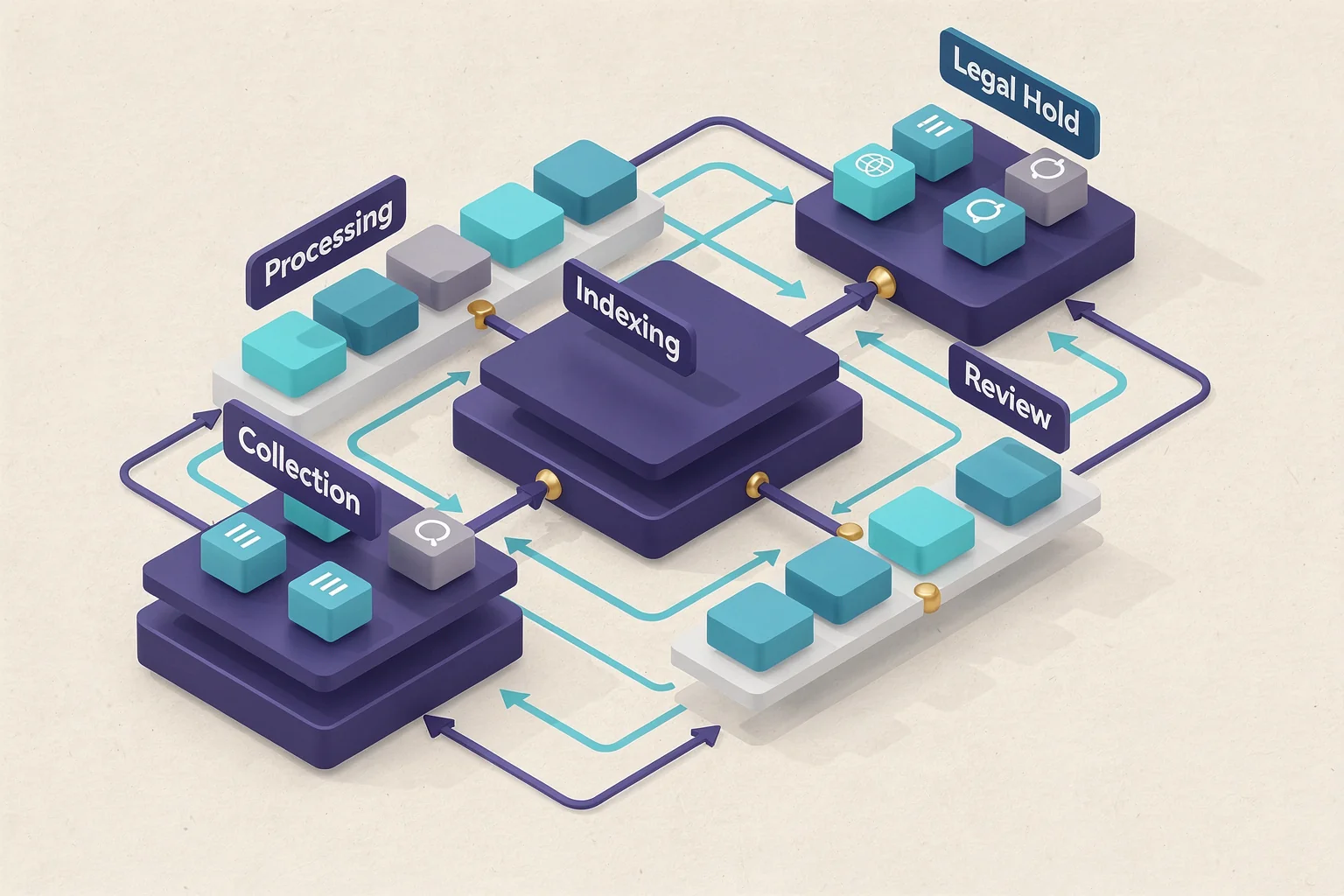
VCS-261 Sample Questions: What Veritas Tests on eDiscovery 8.2
Most candidates searching for VCS-261 sample questions want more than a question list. They need to know what the exam actually measures, how administration tasks translate into testable scenarios, and where to focus limited study time. This whitepaper analyzes the exam's question design based on Veritas eDiscovery Platform 8.2 documentation and available practice materials, mapping technical domains to the scenario-based problems you'll face in the test room.
The VCS-261 exam—formally titled Administration of Veritas InfoScale Storage 7.3 for UNIX/Linux—sits at an interesting intersection. Despite its name referencing InfoScale Storage 7.3, the certification path connects to broader Veritas data management competencies including eDiscovery Platform 8.2 administration. Veritas structures its certification tiers so that product-specific expertise (VCS) feeds into solution-level credentials (VCP), making this exam a gatekeeper for storage management and high-availability specializations.
Exam Scope and What 75-85 Questions Actually Cover
Veritas publishes that the exam contains 75-85 questions across 105 minutes. The VCS-261 exam page tracks this as a mid-density test where time management matters less than precise technical recall. You have roughly 74 seconds per question, which sounds generous until you encounter the multi-select scenarios with nested command syntax.
The question pool draws from five major syllabus areas:
- Configure Veritas InfoScale Storage
- Administer Veritas InfoScale Storage
- Configure Veritas InfoScale Storage for high availability
- Implement Veritas InfoScale Storage features
- Troubleshoot Veritas InfoScale Storage
Each area breaks further into specific object types: disk groups, volumes, file systems, cluster service groups, replication agents, and snapshot mechanisms. The exam does not test eDiscovery Platform 8.2 directly by name, but the underlying storage architecture, legal hold data management, and processing workflow resilience all depend on the InfoScale competencies this exam validates.
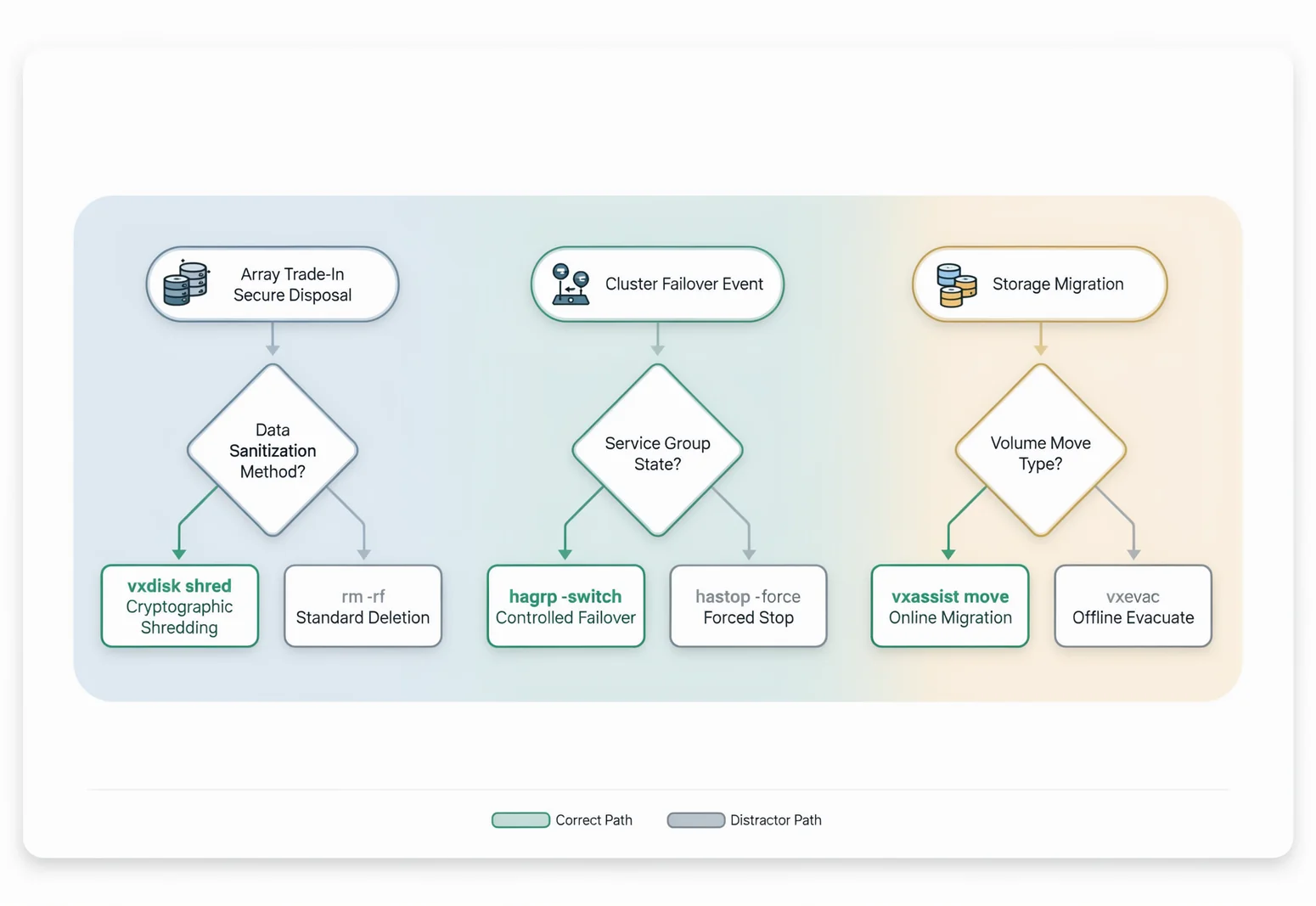
Sample questions from verified practice sources reveal a consistent pattern. Single-choice items test command recognition and default behavior. Multiple-select items force you to identify all valid approaches to a task, with distractors that are syntactically plausible but operationally wrong. Scenario stems describe a business condition—an array trade-in, a cluster failover requirement, a storage tier migration—and ask which command sequence or configuration choice resolves it.
How Administration Tasks Become Test Scenarios
The most reliable way to predict what VCS-261 sample questions will ask is to study how Veritas frames administrative work as decision trees. Three scenario types dominate the available practice material.
Data Lifecycle and Secure Disposal
When organizations decommission storage, administrators must sanitize data before hardware leaves the facility. One free practice set poses this exact condition: an organization trading in an array needs to securely clean file system data. The question tests whether you know the specific Veritas command for cryptographic shredding versus standard deletion.
This maps to real eDiscovery 8.2 workflows where legal hold data must be defensibly destroyed after retention periods expire. The underlying storage command competency—knowing shred behavior, volume removal sequences, and disk group cleanup—becomes testable because mishandling it creates spoliation risk in litigation contexts.
Cluster File System Creation and Mounting
Another common scenario asks how to create and mount a Veritas cluster file system. The distractors play on subtle option differences: -o cluster versus -o shared, mkfs with or without cluster-aware flags. The correct path requires understanding that cluster file systems need shared volume creation followed by cluster-aware mounting, not just standard local file system procedures.
For eDiscovery administrators, this directly affects processing node availability. When review platforms need concurrent access to evidence stores, the cluster file system configuration determines whether multiple hosts can operate on the same data set without corruption or locking conflicts.
Snapshot Synchronization and Recovery
Snapshot mechanics appear repeatedly in practice materials. One question describes adding snapshot mirrors with vxsnap addmir, then asks which plex state indicates full synchronization. Others probe Data Change Object (DCO) purpose, FastResync map management, and thin reclamation daemon behavior.
These aren't academic exercises. eDiscovery 8.2 processing workflows use snapshot-based preservation to maintain defensible copies of source data. An administrator who cannot verify snapshot integrity or interpret plex states risks producing incomplete or challenged evidence sets.
Command Reference Depth: What the Exam Assumes You Know
VCS-261 sample questions reward hands-on familiarity over manual memorization. You need to recognize command output, interpret log files, and select flags from context rather than recite syntax verbatim.
Key command families that appear across practice sources include:
| Command Family | Typical Test Focus |
|---|---|
vxdisk, vxdg |
Disk initialization, disk group import/export, portability between OS platforms |
vxassist, vxsnap |
Volume creation, snapshot management, mirror addition and synchronization |
mkfs, mount (VxFS options) |
Cluster-aware file system creation, mount option selection for shared access |
fsadm, sfcache |
File system administration, SmartIO caching control |
vxstat, vxtrace |
Performance monitoring, command history logging |
The exam particularly tests option discrimination. For SmartIO caching control, one practice source confirms two valid methods: the smartiomode mount option and the sfcache command. Distractors include mincache, vxcache, and fsadm—all real Veritas commands, but not the correct caching control mechanisms.
Log file interpretation also appears. One question asks which log reveals executed InfoScale Storage commands, testing whether you know vxtrace output location versus general system logs. For audit and compliance scenarios in eDiscovery work, this log awareness supports defensible process documentation.
Cluster and High Availability: The Integration Layer
The VCS-261 syllabus explicitly includes cluster configuration, and sample questions reflect this with service group management, failover behavior, and global cluster setup scenarios.
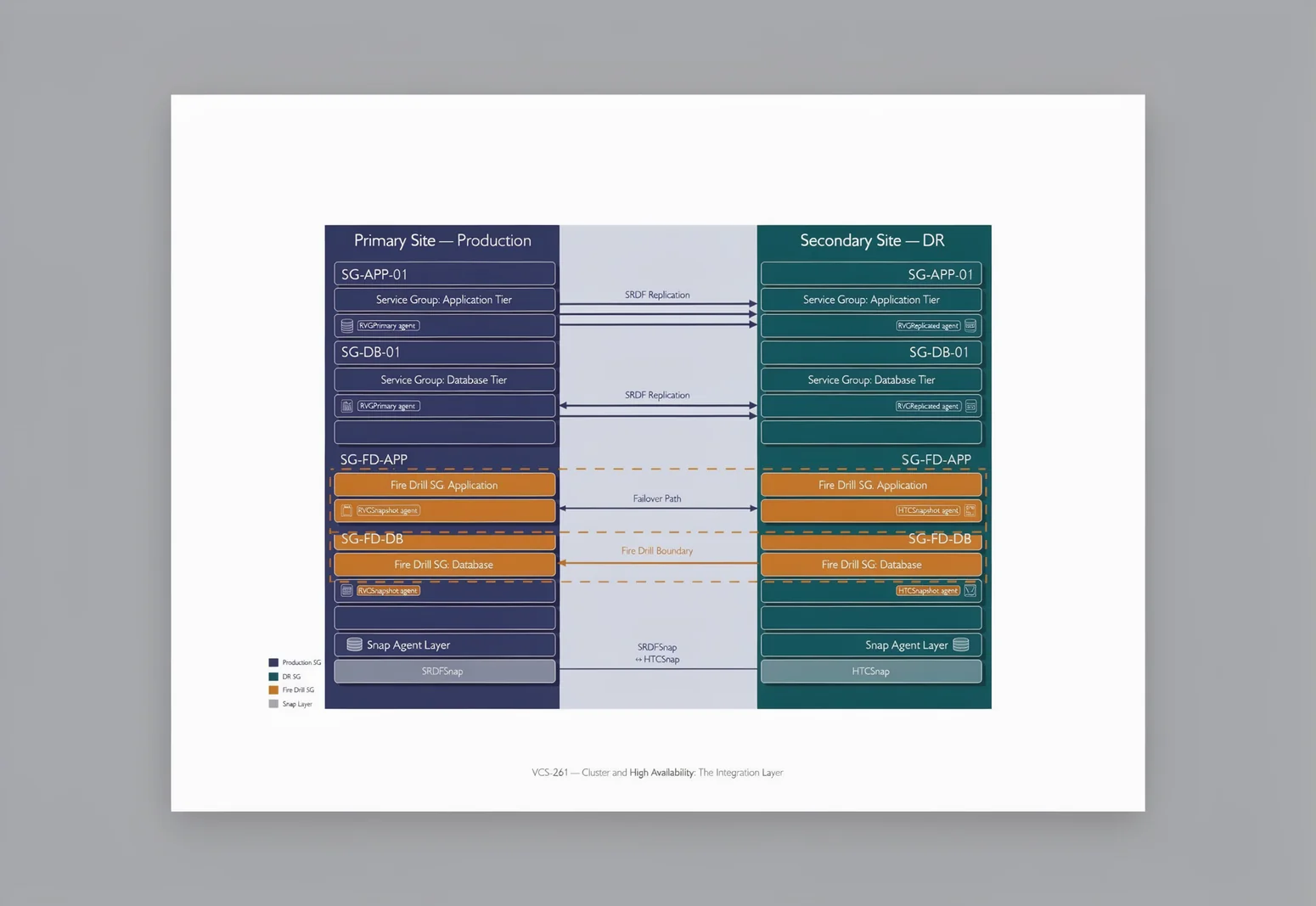
A Veritas technical guide on fire drills in global clusters illustrates how deep this goes. Fire drills test disaster recovery readiness at secondary sites without disrupting production access. The procedure uses special service groups with fire drill resources replacing replication agents, and corresponding snap agents (SRDFSnap, HTCSnap) handle storage array snapshot import.
This matters for eDiscovery 8.2 because litigation support environments require continuous availability. If a primary processing site fails, counsel needs confidence that secondary environments can resume review without data loss or integrity compromise. The exam tests whether administrators understand the mechanics that make this promise defensible.
Sample questions in this domain tend toward scenario complexity. You might see a stem describing a two-site cluster with replication, then need to identify correct service group modification sequences, resource dependency changes, or fire drill verification steps.
Study Strategy: From Sample Questions to Exam Readiness
Collecting VCS-261 sample questions is only the starting point. The exam's scenario density means you need to practice extracting technical requirements from business context, then mapping to precise command or configuration choices.
A productive study sequence runs like this:
Baseline with objectives — Download the current Veritas exam objectives and mark domains by self-assessed confidence. The 75-85 question pool distributes across all objectives; weak areas become disproportionate failure risks.
Practice with explanation review — Work through timed question sets, but spend equal time on wrong answers. Understand why the correct choice works and why each distractor fails. Many practice providers now include command reference links in explanations; follow them.
Build command fluency — Set up a lab environment or cloud instance with Veritas InfoScale Storage. Execute the commands that appear in sample questions. The exam tests recognition, but muscle memory from actual operation improves recall speed and accuracy.
Simulate exam conditions — Use a timed simulator for full-length practice. The 105-minute window feels different when you're question 60 and uncertain about cluster mount options.
Review error patterns — Track mistake types. Option confusion (choosing
-o clusterwhen-o sharedis correct) suggests conceptual gaps. Timing failures on long stems indicate need for faster scenario parsing.
PlanetCert's approach to exam preparation emphasizes this evidence-based cycle: diagnose, practice with explanations, simulate, repeat. The platform's question explanations include reference citations where applicable, helping candidates build mental models rather than memorize isolated facts.
What Practice Quality Looks Like
Not all VCS-261 sample questions carry equal value. The market includes outdated material, questions misaligned with current objectives, and explanations that state answers without reasoning.
Quality indicators to evaluate:
Date alignment — Veritas updated exam content through 2026. Questions referencing InfoScale Storage 7.3 specifically, rather than generic Veritas Storage Foundation, reflect current scope.
Explanation depth — Good practice material explains why wrong answers are wrong, not just which choice is correct. This builds adaptable knowledge for scenario variations.
Command accuracy — Verify that cited commands, options, and log paths match current Veritas documentation. Syntax changes between versions can invalidate otherwise good questions.
Scenario realism — Effective questions describe conditions you'd actually encounter: array trade-ins, cluster failovers, performance degradation, storage tier migrations. Abstract or trivial stems waste study time.
The E20-920 sample questions analysis demonstrates PlanetCert's methodology for identifying which topics consistently challenge candidates. Similar pattern analysis for VCS-261 would likely highlight cluster file system mounting, snapshot plex states, and SmartIO configuration as high-error domains based on available practice material.
Limitations and Evidence Gaps
This analysis has constraints worth acknowledging. Veritas does not publish complete exam items, so all sample question analysis derives from practice provider materials and candidate recollection. The exact question mix, weighting, and scenario complexity on your exam date may vary.
The connection between VCS-261 (InfoScale Storage 7.3) and eDiscovery Platform 8.2 is architectural rather than explicit in exam objectives. Veritas certifications build product expertise into solution competency; this exam validates storage administration skills that underpin eDiscovery deployment reliability, but does not test eDiscovery-specific workflows directly.
Finally, command syntax and default behaviors change across Veritas versions. Always verify against documentation for your specific InfoScale Storage release rather than relying solely on practice question explanations.
Mapping Your Next Steps
If you're preparing for VCS-261 with eDiscovery 8.2 administration in mind, prioritize these competencies:
Volume and disk group portability — Cross-platform data movement scenarios appear frequently and support evidence migration between processing environments.
Snapshot integrity verification — DCO purpose, plex state interpretation, and resynchronization commands directly affect defensible preservation.
Cluster availability mechanics — Service group configuration, failover behavior, and fire drill procedures ensure processing continuity under litigation deadlines.
Performance and caching — SmartIO configuration and file system tuning affect processing throughput for large document collections.
The A10 CPSA-4 sample questions analysis offers a parallel example of how architecture exam questions test applied knowledge rather than isolated facts. VCS-261 similarly rewards administrators who understand how storage components interact in production conditions.
For candidates ready to move from analysis to practice, structured question sets with expert explanations provide the fastest path to exam readiness. The AD0-E208 exam objectives breakdown shows how objective-to-question mapping works for Adobe certification exams—a transferable approach for Veritas preparation.
Veritas Certification Path Context
Passing VCS-261 earns Veritas Certified Specialist (VCS) status in InfoScale Storage 7.3 for UNIX/Linux. This contributes to Veritas Certified Professional (VCP) credentials in Storage Management and High Availability for UNIX categories.
The credential positioning matters for career planning. VCS-level certifications demonstrate product-specific competency; VCP-level credentials validate solution architecture skills. For eDiscovery administrators, the storage specialization supports credibility in data management aspects of litigation support, even if the eDiscovery Platform has its own certification track.
Employers and clients evaluating certification portfolios should recognize this relationship. A professional holding VCS-261 plus eDiscovery Platform certification presents stronger evidence of end-to-end data management capability than either credential alone.
When You're Ready to Validate Your Preparation
The gap between studying sample questions and passing the exam closes through repeated, explained practice in exam-like conditions. Quality preparation materials show you not just what Veritas tests, but how they frame administrative decisions as multiple-choice problems—and why the technically correct answer is correct in context.
For candidates seeking that validation step, structured practice tests with timed simulation and detailed explanations address the core preparation need without resorting to questionable shortcuts.
Explore More Exam Analysis


Discussion
Question Comments
0 comments·0 participantsSign in to leave a comment and access more free questions.