

A high practice score needs a fresh check when the objectives for your booked exam change. For candidates weighing practice test diagnostic score vs exam readiness, the immediate question is whether their questions cover the version they will sit. Your earlier result still records useful work. Its relevance to the revised exam needs checking.
No dated vendor announcement is available here to confirm a specific new Microsoft, AWS or CompTIA revision. This article therefore reports no newly confirmed 2026 domain changes, implementation dates or retirements. The analysis below applies when an objective change has been confirmed for your exam.
The practical decision is whether your existing score remains useful, which changed objectives need assessment, and what evidence would justify keeping your exam date.
A new objective list needs a traceable change notice
An objective update affects your readiness judgement only if it applies to the exam you will take. Start by establishing that connection before replacing materials or repeating tests.
A revised course description, a recently published article and a vendor’s exam change notice answer different questions. A course update tells you something about that course. An exam notice needs to identify the assessment, the change and its effective date.
For your booked exam, establish:
- The exact exam code and any applicable version identifier.
- The objective document or skills outline that applies on your appointment date.
- The effective date of the revision.
- The tasks added, removed or rewritten.
- Any changed domain weights stated in the applicable outline.
An updated publication date alone doesn’t describe the scale of a revision. Compare the actual task statements before deciding that a whole domain needs relearning.
If you use a PlanetCert practice test, record its exam code and any stated objective alignment alongside your result. Where revision information is missing, leave the alignment unresolved. A recent purchase date cannot establish which objectives the questions assess.
The outdated study guide checks provide a useful companion topic for reviewing preparation materials. For the score decision, retain the applicable objective list and identify which parts your practice session covered.
Analysis: why an older score can overstate readiness
A diagnostic score summarises performance on the questions presented. After an objective revision, interpreting that result requires a separate judgement about coverage.
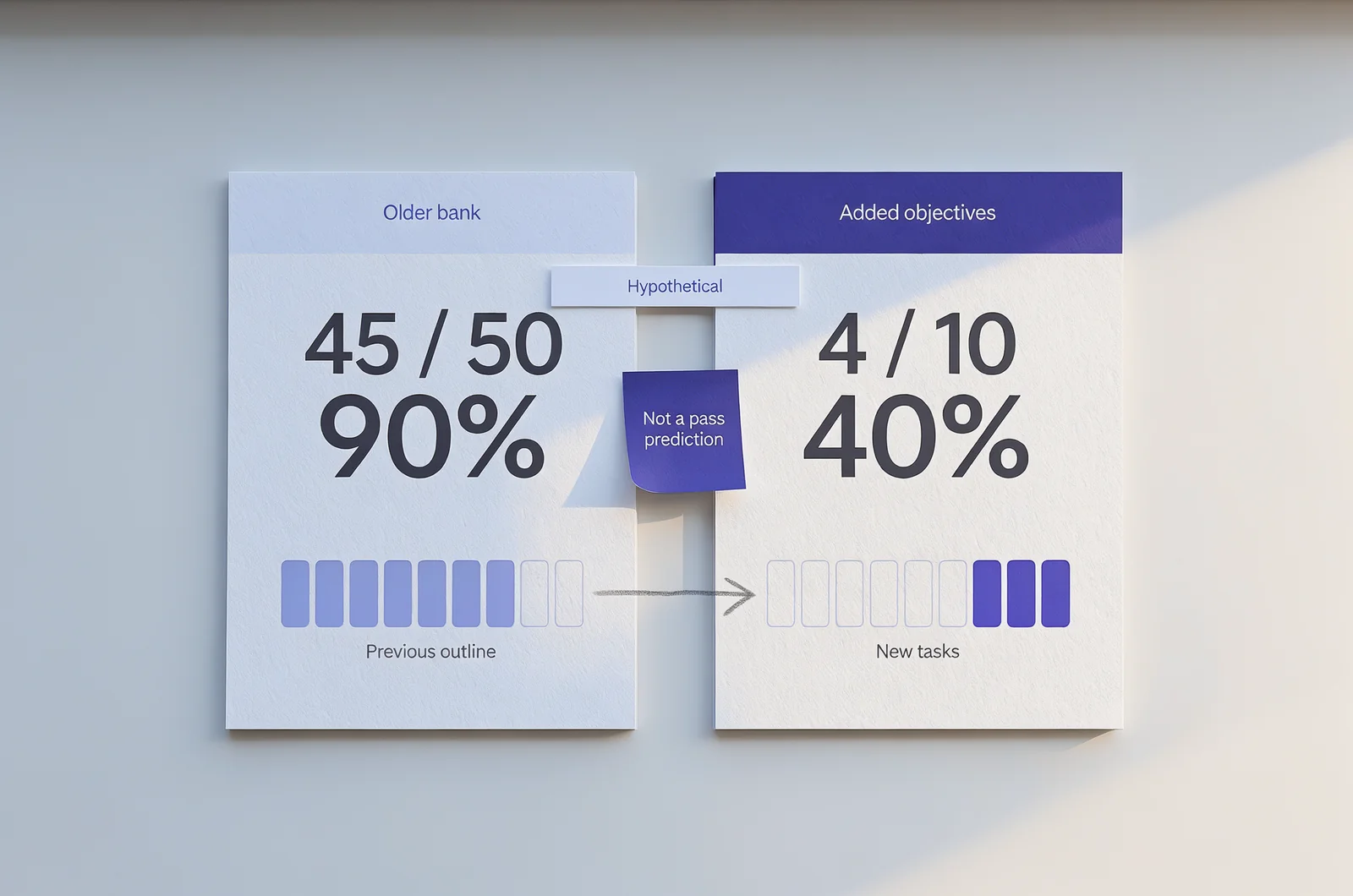
Changed coverage can leave skills untested
Suppose, hypothetically, you answer 45 of 50 questions correctly in an older bank. That produces a 90% result.
You then try ten unfamiliar questions aligned with newly added objectives and answer four correctly. That produces 40% on the smaller set. Neither percentage establishes your chance of passing the revised exam.
The older result describes stronger performance on the material it sampled. The newer result exposes a gap in the added material. Combining them into one percentage would hide that distinction unless you also knew how the questions represented the applicable objectives.
Keep the two results separate. Label the older assessment by its coverage and use the fresh questions to identify what needs attention.
A domain can also retain its name while its task statements change. Check what candidates must actually do within that domain before carrying its old score forward.
Familiar questions can blur the comparison
Repeated questions introduce another uncertainty. If you remember the answer from an earlier attempt, a correct response may tell you little about your ability to solve a changed scenario.
Try explaining the decision before viewing the options. Identify the constraint that makes the answer appropriate and explain why the strongest alternative fails.
I’d treat that explanation as supporting evidence alongside the score. It still needs to address the revised objective.
The practice test accuracy findings are relevant to this distinction between a practice result and the conclusion drawn from it. For your own record, separate first attempts from repeat attempts.
Microsoft, AWS and CompTIA need separate checks
Candidates preparing across these vendors need an exam-specific review. There is no confirmed shared update timeline or cross-vendor score adjustment established here.
Microsoft: compare the applicable skills statements
For a Microsoft exam, compare your preparation coverage with the skills outline that applies to your appointment. Keep the exam code attached to that comparison throughout.
When wording changes, ask whether the task remains equivalent. A terminology change may require a smaller adjustment than a new configuration, troubleshooting or design requirement. The changed wording alone needs interpretation.
For candidates studying that exam, the AZ-800 skills measured overview is a relevant internal starting point. It does not establish an effective date or a newly confirmed revision in this article. Verify those details against the applicable vendor material.
Mark each affected task as covered, partly covered or untested.
AWS: separate exam revisions from preparation updates
For an AWS candidate, the exam guide’s revision and a course’s update date belong in separate records.
A course might change its explanations, demonstrations or supporting material. Those edits alone do not establish that the certification assessment changed. Equally, an unchanged course title tells you little about its coverage of revised tasks.
Compare task statements and any stated domain weights directly. Then check whether your practice questions require decisions within those tasks.
Where a question bank describes its coverage only in broad service names, inspect the scenarios before accepting the alignment. Record the specific decisions you have practised.
CompTIA: check the code before comparing results
For a CompTIA candidate, keep scores attached to the exam code used by the preparation material. A shared certification name does not make results from different codes interchangeable.
The Security+ objective comparison addresses SY0-701 and SY0-601. Its presence here does not establish a new 2026 transition or the current booking status of either code.
If your materials and appointment identify different codes, resolve that mismatch before interpreting another percentage. Compare the objective documents task by task.
Build the timeline around the version you will sit
The useful timeline for your practice score connects the applicable exam revision with the questions you answered. Without confirmed dates, a calendar of vendor announcements would be speculative.
Build your own dated record around these events:
- The vendor publishes the change. Record the announcement date and distinguish it from the date the revision takes effect.
- The revised objectives become applicable. Establish whether your appointment falls within that version’s stated validity period.
- Your preparation material changes. Record the bank’s revision information and any explanation of what was updated.
- You complete a fresh assessment. Save the attempt date, question set, conditions and objective coverage.
These events may occur on different dates. That gap is what matters when interpreting an older score.
An assessment completed after an announcement could still use questions written for the previous outline. An earlier assessment might already cover some retained tasks. Check the content of the attempt alongside its timestamp.
If a material provider states that a bank has been updated, look for enough detail to connect that statement with the applicable objectives. A revision label without a coverage explanation leaves uncertainty.
Before the next timed session, write down which version it is intended to assess. Keep that note with the result so later comparisons use the same basis.
Analysis: establish a fresh baseline after the change
Once you have confirmed that a revision applies, the purpose of reassessment is to measure the changed requirements without losing the useful detail in your earlier work.
Map the changed tasks before taking another full test
Start with the difference between the previous outline and the applicable one. Separate newly added tasks, rewritten tasks, removed material and retained requirements.
For each affected task, record whether you can explain the decision, carry it out where appropriate, and answer an unfamiliar scenario about it. Treat missing assessment coverage as unknown.
A simulator score cannot resolve an objective that its questions never assess. Where coverage is uncertain, record the gap explicitly rather than assigning it a reassuring percentage.
An interactive objective checklist would help here: enter the exam code, applicable outline and bank revision, then flag changed or unmapped tasks. Its useful output would be an untested-objectives list.
Keep learning sessions separate from assessment sessions
After reviewing a changed topic, use practice questions to examine your reasoning. Read explanations and revisit the task while you are still learning.
Then use a fresh session under consistent conditions to assess what you can do independently. Record whether you used notes, paused the timer or saw the questions before.
If you use PlanetCert’s timed simulator, save the attempt conditions alongside the result. Compare sessions that assess the same objective version under similar rules.
The exam simulator analytics topic supports this closer examination of a result. Inspect errors by objective and cause instead of relying on the headline percentage.
Explain score movement before calling it progress
A lower result after an update can have several explanations. The new set may assess unfamiliar tasks, use different scenarios or expose gaps that the old set missed.
A higher result also needs interpretation. Check whether improvement came from stronger reasoning, repeated questions or a different distribution of topics.
I’d compare changed-objective performance first, then inspect the overall result. Retain a short error record that identifies the task, the reason for the mistake and the correction you can explain.
Use the next unfamiliar question to check that correction.
What your next score can justify
Your exam-date decision needs evidence about the revised objectives. A single percentage cannot supply details that the assessment never captured.
Keeping the appointment is easier to justify when you have confirmed the applicable version, assessed the changed tasks and completed practice under the intended conditions. You should also be able to explain decisions across the revised scope without relying on remembered answer positions.
Reconsider the date when an affected objective remains unassessed, the bank’s alignment is unresolved or your errors repeatedly concern the same revised task. Those are specific preparation gaps you can act on.
This article establishes no universal readiness percentage. It also establishes no conversion between a practice result and an official exam result. Avoid treating a simulator percentage as a direct translation of the vendor’s passing standard.
With limited study time, prioritise the uncertainty introduced by the revision. Retesting comfortable, unchanged material may add little to the decision you currently need to make.
For each remaining gap, identify the task, the material needed to address it and how you will assess it afterwards. Fit that work into the time available before your appointment. If it cannot fit, check the applicable appointment-change terms before deciding what to do.
Questions to settle before your next timed attempt
An objective revision raises practical questions about the results you already have. Resolve these before using another attempt to judge readiness.
Does a lower score after an update mean I have lost knowledge?
The score alone cannot establish that. First compare coverage, question familiarity and assessment conditions.
If the newer questions address tasks absent from the older bank, the comparison includes a change in what was assessed. Inspect those tasks separately before drawing a conclusion about your retained knowledge.
Then revisit missed questions from unchanged objectives to see whether the same gaps appear.
Can I keep using questions from the previous outline?
Keep questions that still align with retained objectives and have explanations that remain applicable. Label their coverage so you can distinguish them from questions about changed requirements.
A mixed collection needs a clear map. Otherwise, a strong combined result can conceal objectives that received little attention.
Set aside questions whose relevance or explanation you cannot establish.
Should I wait for another full-length test before deciding?
You can identify missing coverage before completing another full session. Map the changes first, then assess the unresolved tasks.
A fresh timed attempt becomes useful once you know what it covers and which conditions you need to reproduce. If it omits the revised requirements, another full-length percentage leaves the same question unanswered.
Before using the result to support your appointment date, inspect the changed objectives individually and record any that remain untested.
Practice conditions for your next assessment


Discussion
Question Comments
0 comments·0 participantsSign in to leave a comment and access more free questions.