

If you’re wondering how to spot outdated certification study material, start with the relationship between your guide and the exam you intend to sit. A recent publication date helps, but you also need the right exam code, applicable objectives and explanations that hold up. I’d use six resources together: the official exam page, its objective document, a document comparison tool, publisher update records, a coverage spreadsheet and a practice-question review. Each answers a different question. Together, they help you decide whether to keep your guide, fill specific gaps or replace it before spending more evenings on the wrong material.
What your freshness check needs to establish
A useful check separates exam identity, syllabus coverage and technical accuracy. A guide can explain a topic correctly while leaving required objectives uncovered. Equally, an older chapter can remain useful if its subject still belongs in your preparation.
Before judging any resource, write down the exam you plan to book and the date you expect to take it. Then choose the resource that answers your immediate uncertainty.
| Resource | Best use | Main limitation |
|---|---|---|
| Official exam page | Confirming exam identity and applicable dates | Doesn’t establish a guide’s depth |
| Objective or syllabus document | Checking required topic coverage | Doesn’t map itself to your chapters |
| Document comparison tool | Finding differences between document versions | Can confuse formatting changes with content changes |
| Publisher updates and errata | Checking documented revisions and corrections | Depends on the detail provided |
| Coverage spreadsheet | Recording gaps and planning repairs | Requires manual judgement |
| Practice-question review | Checking explanations against selected objectives | A small sample cannot prove full coverage |
Look for traceable evidence throughout: an objective identifier, a chapter reference, a revision entry or a technical explanation you can verify. Keep your check date beside each finding so you know when to revisit it.
Six tools for checking your guide against the exam
These resources belong in the same workflow because they provide different kinds of evidence. Start with exam identity, move into coverage, then inspect the material itself.
The official exam page: confirm the version first
The exam owner’s website is the starting point for deciding which version your material needs to support. For Microsoft, AWS, Cisco or CompTIA preparation, locate the specific exam rather than stopping at a certification overview.
Record the exact code and any version identifier. Look for replacement notices, retirement information and effective dates where available. Match those details to your booking plans and the code printed on your guide.
Keep separate notes for the certification name and the exam code. A familiar certification title alone leaves the version question unanswered.
If you’re preparing for Microsoft, include Microsoft exam format in your review alongside syllabus coverage. Check whether your preparation addresses the assessment you intend to take.
This resource is most useful before buying a guide or booking an exam. Its limitation is scope: confirming the exam identity doesn’t tell you whether a particular book teaches every objective. Save the applicable details, then move to the syllabus.
The vendor’s objective document: check coverage directly
An objective document gives you a reference list for auditing the guide. Look for the exam owner’s syllabus, exam guide, topic list or skills-measured document, using whichever terminology applies.
Work from each objective towards the study material. Find the chapter, lesson or lab that addresses it. Starting with the book’s contents page can make familiar chapters feel comprehensive while missing objectives remain invisible.
For each match, ask whether the material explains the required task at sufficient depth. A passing mention of a service isn’t evidence that the guide prepares you to configure, troubleshoot or choose it.
A Security+ objective comparison provides an exam-specific comparison topic to explore. Confirm which objective set applies to your intended sitting before using either version as your reference.
Choose this resource when you need to identify missing topics or misplaced study effort. Its limitation is the manual mapping involved. Record chapter or lesson references beside individual objectives rather than marking an entire domain complete.
A document comparison tool: expose what changed
A PDF or text comparison tool is useful when you have two versions of an objective document. Its job is to reveal differences for you to inspect.
Compare documents for the same exam family and check their version labels first. Review additions, deletions, changed task verbs and altered domain weightings wherever those appear.
Pay particular attention to verbs. Recognising a technology and implementing it require different preparation. A change in wording may therefore deserve more attention than a newly formatted topic list.
Treat the comparison output as a set of prompts for review. Page breaks, reordered lists and punctuation can produce differences that have little study impact. Where possible, compare extracted text and inspect the original pages for context.
This is the strongest option when you already own an earlier edition and want to assess the size of the revision. It cannot decide whether the author’s explanation meets a changed objective. Read the affected passages and record the resulting study gap.
Publisher update notes and errata: inspect the revision work
Publisher records help you assess whether changes to a guide address the exam requirements you’ve identified. Look for edition notes, errata, supplemental chapters and course revision histories.
Specific entries provide better evidence than a general update badge. Check whether a note identifies the affected lesson, corrected explanation or objective added.
Separate the date an exam change takes effect from the date the publisher revised the material. Those dates answer different questions. A revision published later may still leave some syllabus changes unresolved.
For video preparation, an SAA-C03 course update check is an exam-specific route into this kind of review. Apply the same questions to its stated exam target and lesson coverage.
Use publisher records when deciding whether your existing resource has a practical repair path. Missing revision details leave its status uncertain; they don’t prove the whole guide is wrong. If the notes are vague, ask the publisher which objectives the revision covers.
A coverage spreadsheet: turn uncertainty into a study plan
A spreadsheet is useful once you need to combine findings from several resources. Create columns for objective identifier, required task, material reference, coverage status, corrective resource and date checked.
Use four statuses: covered, partial, missing and unclear. Keep unclear available for passages you haven’t inspected closely enough. Otherwise, uncertain matches can quietly become completed work.
Judge coverage by what the material enables you to do. For a practical objective, a definition alone may leave a substantial gap. Record whether the guide includes an explanation, worked example or relevant exercise.
For a Windows Server preparation plan, organise an AZ-800 skills coverage review around individual skills rather than broad chapter titles.
An interactive version could accept an objective list and chapter references, then flag unmapped objectives for manual review. It should keep uncertain matches visible instead of awarding an automatic freshness score.
This option fits candidates combining a book, course and question bank. Its limitation is the judgement behind each entry. Add a page number, lesson reference or exercise beside every covered status.
A practice-question review: check scope and explanations
Practice questions help you inspect how study material handles selected objectives. Choose questions across several domains, including areas where your coverage sheet shows uncertainty.
Review the explanations as closely as the answers. Check whether each explanation addresses the scenario, explains why alternatives fail and uses terminology consistent with the applicable objective.
Where an answer depends on a product capability, command or limit, verify that detail against the relevant technical documentation. A confident explanation still needs a sound basis.
When reading exam simulator comparisons, give explicit exam targeting and explanation quality more weight than question count alone. Apply the same checks to PlanetCert or any other practice-test provider before relying on a bundle.
This review fits the stage after you’ve mapped the syllabus and need to inspect teaching quality. Its limitation is sampling: a handful of strong answers cannot establish complete coverage. Record which objectives your sample actually examined and which remain unchecked.
Fresh-looking details that still need verification
Several surface details can make study material appear current without resolving whether it fits your exam.
A recent copyright date establishes a publication detail. Check what changed inside the edition and whether those changes address the applicable objectives.
An updated sales page needs the same scrutiny. Compare its claims with the downloadable sample, contents page and revision notes. If those point to different versions, leave the resource’s status unresolved.
Familiar product names also need context. A renamed service or changed interface can make an illustration look old while the underlying concept remains useful. Determine whether the difference affects the task, the correct answer or only the screen layout.
Watch more closely when:
- The resource names a certification but omits the exam code or applicable version.
- A chapter claims coverage without explaining the task described by the objective.
- An answer explanation conflicts with the technical documentation you’re using.
- A practice set has no clear connection to the syllabus you mapped.
- Update notes describe cosmetic edits while identified coverage gaps remain.
Avoid rejecting useful material over a single dated screenshot. Equally, don’t let an attractive dashboard settle a question about syllabus depth. For each concern, record the affected objective and the evidence needed to resolve it.
Decide whether to keep, supplement or replace your guide
The audit should end with a decision about your study materials. Use the findings to choose which resource will anchor your preparation and which passages need additional work.
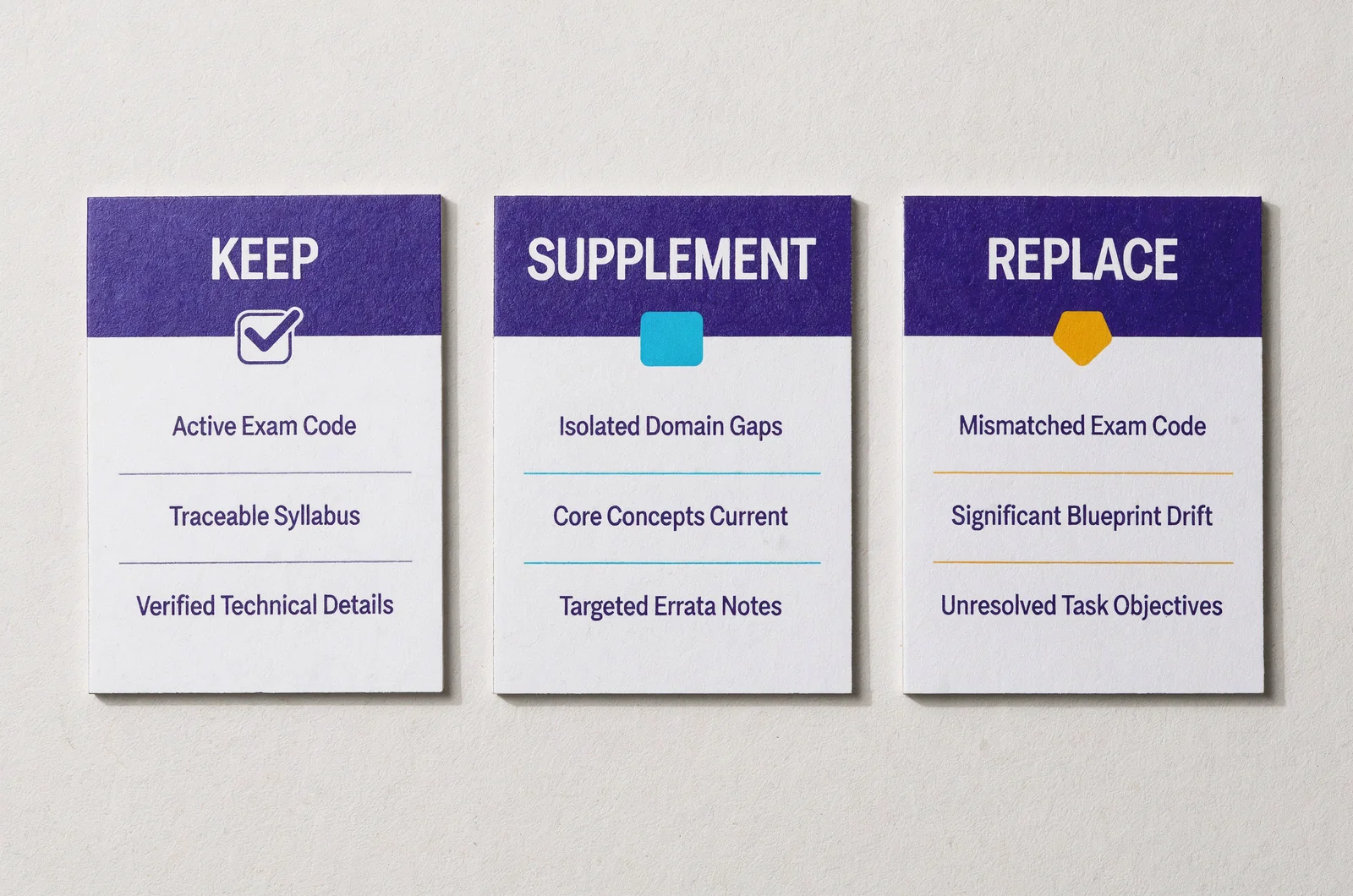
Keep it when the coverage is traceable
Keep the guide as your main resource when it maps convincingly to the applicable objectives and its explanations withstand your checks.
Retain the coverage sheet as part of your study plan. It gives you a record of what you verified and where each topic lives. Add a reminder to recheck exam information before booking or whenever an announced change affects your planned sitting.
Supplement it when the gaps are specific
Supplement the guide when it still provides a useful foundation and you can identify bounded gaps.
Suppose your audit finds two objectives with no adequate chapter coverage. Assign a separate lesson, technical document or lab to each one, then check that resource against the required task.
Keep the repair work in the same spreadsheet. Mark each gap complete only after you’ve studied it and confirmed that the replacement material addresses the objective.
Replace it when uncertainty controls the plan
Replace the guide as your main resource when you cannot establish its intended version, gaps run across several domains or explanations repeatedly fail verification.
You can retain useful chapters as supplementary reading. Give the main role to material whose scope you can map and assess.
Choose the official exam information and objective document as your references. Use publisher records, comparison tools and question reviews to judge the candidate guide against them.
Questions to settle before your next study session
These decisions often arise once you’ve started checking a resource. Resolve them against your intended exam and the evidence in your coverage sheet.
Does an old publication date make a book unusable?
An old date alone doesn’t establish that every chapter is unsuitable. Compare its contents with the applicable objectives and verify technical details where they affect the task.
An older book may remain useful for selected fundamentals. Keep its role explicit: supporting material for mapped topics. Check the remaining objectives before treating it as complete exam preparation.
Is a recently updated course enough proof?
An update date alone leaves the scope of the revision unclear. Inspect the lesson list and revision notes, then examine material related to objectives you need covered.
Check whether the update changed the technical teaching, added missing content or corrected explanations. If the publisher provides no detail, keep those objectives marked unclear until you inspect the lessons yourself.
Can a high practice score confirm that my guide is current?
A score reflects performance on the questions you answered. It doesn’t establish that those questions cover the applicable syllabus.
Keep readiness and freshness checks separate. Map the question bank’s scope, inspect explanations and review objectives that received little attention. Treat a high score as more informative once you understand what the practice set assessed.
When should I repeat the check?
Check the exam target before purchasing material and again before booking. Revisit the affected objectives if an announced change falls within your preparation period.
You don’t need to repeat the entire audit after every study session. Update specific rows when new evidence appears. Keep the exam version, effective date and date checked together in your study record.
Check the resources in your study plan

Discussion
Question Comments
0 comments·0 participantsSign in to leave a comment and access more free questions.