

Comparing official practice tests vs third party simulators means deciding which evidence deserves your trust before you book a certification exam. For CompTIA, Microsoft and AWS candidates, accuracy has several meanings: coverage of the right objectives, realistic reasoning demands, useful explanations and scores that help assess readiness. Those measures need separate scrutiny.
This report provides a framework for that decision. It contains no comparative candidate-outcome dataset, so it cannot establish which category produces higher pass rates or predicts results more accurately. Its central recommendation is practical: verify alignment, inspect explanations and keep performance on unseen questions separate from repeat attempts. I would use those checks before treating any practice percentage as evidence that an exam booking is sensible.
Define the accuracy claim before comparing products
Official and independent practice materials should be assessed against the same clearly stated purpose. A resource can help you learn an objective without reproducing exam conditions. Another can provide timed practice while explaining mistakes poorly.
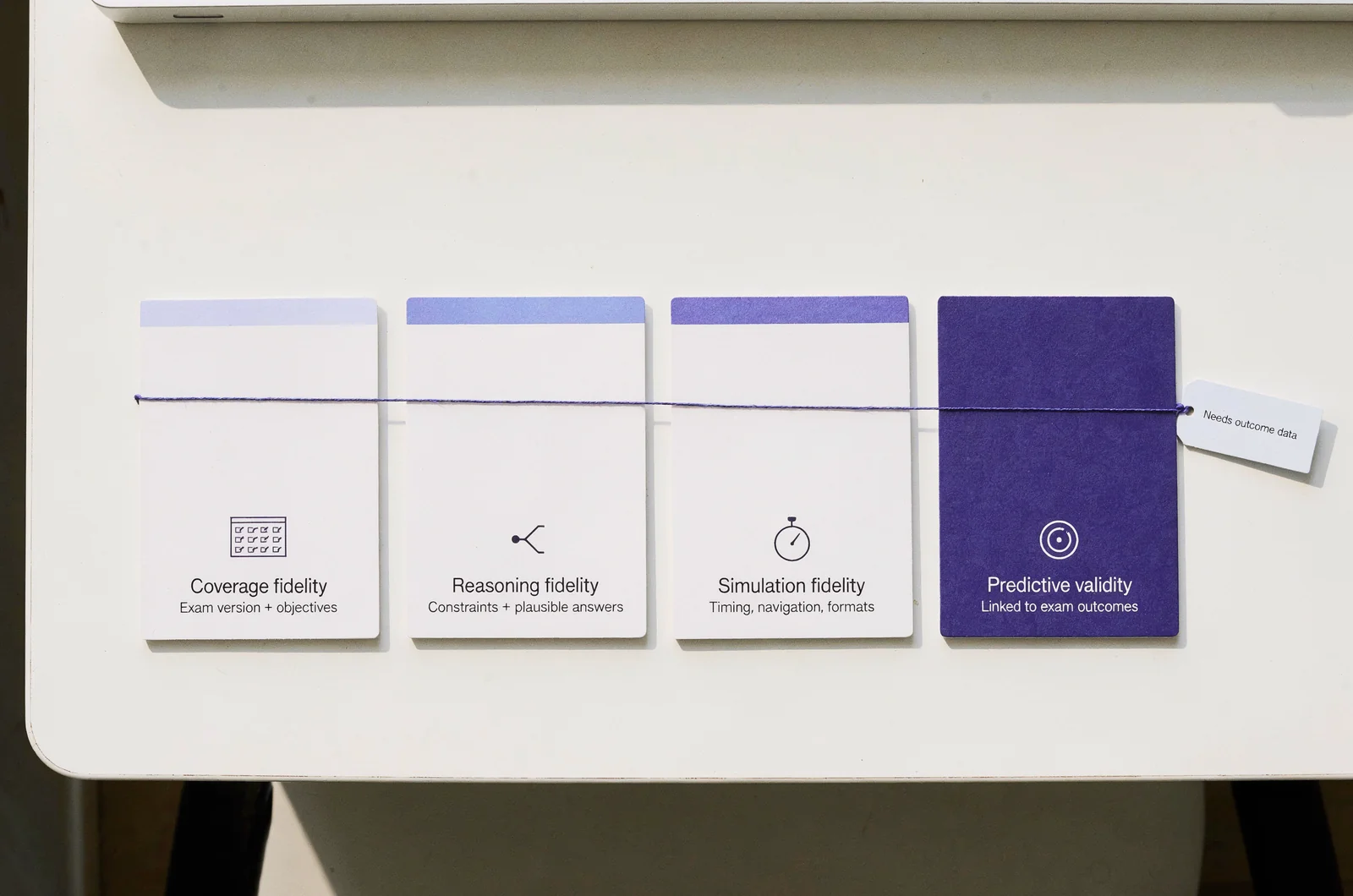
For this comparison, accuracy has four dimensions:
- Coverage fidelity measures whether questions address the intended exam version and its published objectives.
- Reasoning fidelity concerns the decisions a question requires, including how candidates interpret constraints and distinguish plausible answers.
- Simulation fidelity concerns timing, navigation and response formats, where those details are documented.
- Predictive validity concerns whether practice results have a demonstrated relationship with later certification outcomes.
The fourth dimension requires candidate-outcome evidence. A realistic interface, detailed explanation or vendor association cannot establish that relationship on its own.
The scope here covers preparation decisions across CompTIA, Microsoft and AWS certification tracks. It does not assign quality ratings to named providers or claim that one exam family behaves like another.
No candidate-level outcomes, independently audited question samples or provider-specific validation results are analysed here. The recommendations are therefore evaluation criteria. For any proposed purchase, write down which dimension of accuracy you need it to address.
Separate authorship, endorsement and independent development
The official-versus-independent distinction needs clarification before it can guide a purchase. Treat an official label as a claim about a relationship that you should verify.
For evaluation purposes, separate three routes:
| Preparation route | Relationship to verify | Question evidence to inspect | Score evidence to request |
|---|---|---|---|
| Vendor-produced material | The certification vendor publishes the resource | Exam version, objective mapping and sample explanations | Any stated purpose or limits of the score |
| Vendor-endorsed partner material | The endorsement covers the particular product and exam | The partner’s coverage, revision details and sample quality | Validation for that product, if claimed |
| Independent material | The developer describes its own authorship and review process | The same coverage, revision and explanation checks | Outcome evidence behind any readiness claim |
These are categories for checking provenance, not quality rankings. An endorsement for one product should not be assumed to cover every resource sold by the same company.
Separate commercial terms from learning evidence as well. Access duration, refund conditions and question-bank size affect a purchase, but none supplies a measured relationship between practice scores and exam results.
Record who wrote the questions, who reviewed them and which product any endorsement actually covers.
Assess fidelity against the exact exam version
Question fidelity should be judged against the exam you intend to take. Start with its identifier and published objectives before comparing question counts or dashboard scores.
Map coverage before counting questions
Build a simple coverage sheet with one row per objective. Record whether each resource addresses it, how it assesses the skill and whether you have attempted a relevant question.
Where the exam outline publishes domain weights, compare them with the distribution of scored practice items. A question bank can contain many questions while leaving particular objectives lightly assessed.
For example, if your materials carry the SY0-701 identifier, a discussion of Security+ SY0-701 objectives can help organise your review. Confirm the version and applicable objectives against the certification vendor’s documentation before relying on that mapping.
Keep publication dates and exam identifiers together in your notes. A recent website update does not, by itself, explain which questions changed.
Inspect reasoning and response mechanics separately
Read sample questions for the decisions they require. Does the stem provide enough information? Are the alternatives plausible? Does the correct response depend on a stated requirement?
In a hypothetical AWS architecture question, a scenario might specify a recovery requirement and a spending constraint. A useful explanation would connect the selected answer to both requirements and explain why another plausible design fails one.
That is a test of reasoning quality. It makes no claim about confidential examination questions.
For Microsoft preparation, use the Microsoft role-based exam format as a companion topic when identifying format questions to verify. Check the documentation for your particular exam before assuming any response type will appear.
Record content alignment and interface similarity as separate judgements. Give each a short reason, such as an objective reference or a documented navigation behaviour.
Treat practice scores as measurements with limits
A score from either preparation route needs context before it can support an exam-readiness decision. Record what was measured, under which conditions and after how much exposure.
Separate unfamiliar questions from repeat attempts
Keep distinct records for first attempts, study sessions and timed reassessments. Mixing those results makes progress harder to interpret.
Consider a hypothetical candidate who scores 72% on unfamiliar questions, then 90% after reviewing the same set. The second result establishes better performance on that set. It leaves unanswered how the candidate would handle different questions covering those objectives.
To examine transfer, use questions you have not previously reviewed. Explain the answer before opening the rationale, then identify the condition that rules out the strongest alternative.
Exam simulator analytics can provide a useful framework for organising this review. Whatever dashboard you use, retain the attempt date, question exposure, domain breakdown and timing conditions.
Flag correct guesses as well as errors. A correct response with uncertain reasoning still deserves review.
Require more than correlation for a pass prediction
A credible comparison of predictive accuracy would need practice results linked to later exam outcomes for a clearly described candidate group.
At minimum, the report should disclose:
- The exam identifier and version covered.
- Participant numbers, recruitment method and missing outcomes.
- Whether practice scores came from first attempts or repeat sessions.
- The interval between practice and the certification exam.
- Previous experience and other preparation used.
- The prediction method and uncertainty around its results.
A correlation describes how two measurements vary together. It does not establish that a particular practice percentage corresponds to a particular chance of passing.
A pass-probability claim would also need calibration evidence: among candidates assigned similar probabilities, did outcomes match those predictions? Validation on a separate candidate group would help assess whether the relationship extends beyond the original sample.
Without that evidence, keep the conclusion limited to observed practice performance. A percentage alone supplies no conversion to a certification vendor’s scoring scale.
Inspect explanations before paying for more attempts
Explanation quality is worth examining in both official and independent materials because it determines what you can learn from each response.
Choose sample items from different domains, including one you find difficult. After answering, check whether the rationale addresses the requirement in the question, supports the selected answer and deals with plausible alternatives.
A longer explanation is not automatically more useful. Look for a clear chain from the scenario’s constraints to the answer. Documentation references can help you check technical statements, provided they are relevant to the version being studied.
When using PlanetCert practice tests, apply this same standard to the questions and explanations you review. Record whether an explanation resolves your uncertainty and whether you can apply the reasoning to a different scenario.
One useful review exercise is to change a single condition in the question. Ask whether that change would make another answer preferable. If you cannot explain the effect, revisit the underlying objective.
Check how the resource handles ambiguity, too. Before purchasing, look for a way to report a disputed answer and information about how corrections are communicated.
Keep an error log with the objective, your reasoning, the correction and a follow-up task. That task might be a documentation review, a lab exercise or another unfamiliar question. Give every unresolved error a specific follow-up action.
Fit the purchase to your remaining study window
Choosing between preparation routes becomes easier when you connect the purchase to a documented gap in your study plan. Start with the evidence you already have.
Spend on the gap you can name
If you are considering a free AZ-104 practice test, assess its coverage and feedback against your needs before deciding whether another resource adds value.
You might need more unfamiliar questions, clearer explanations or a closer rehearsal of documented exam conditions. These are different requirements.
For timing practice, compare the relevant controls in full-length exam simulators. Check question selection, interruption handling and post-session review where those capabilities matter to your plan.
Calculate cost against the access period you can use. Several overlapping banks create extra work if you never review the explanations.
Protect unfamiliar questions for reassessment
For a proposed two-to-four-week preparation window, divide your work into diagnosis, repair and reassessment. Adjust the time allocated to each stage according to your first-attempt results.
Begin with an unfamiliar set. Map errors and uncertain answers to objectives, then use focused study and practical work to address the gaps.
Keep study activity distinct from assessment. PlanetCert’s flashcards can fit into recall sessions, while its timed simulator can support planned rehearsals. Record those activities separately so repeated exposure remains visible.
Reserve some unfamiliar questions for a later checkpoint. Reproduce the exam conditions that you can verify, then review timing, domain coverage and the reasons behind uncertain answers.
An interactive readiness checklist would suit this process. It could record the exam version, unfamiliar-question results, unresolved objectives and timed completion. Its output would identify evidence still missing before booking.
At the final checkpoint, list the objectives you can explain, the tasks you can perform and the weaknesses that still need work.
Questions to settle before relying on a score
The choice between official and independent preparation often turns on how candidates interpret conflicting results. Resolve those differences at question level before changing your exam date.
What should I do when two resources disagree?
Compare the exact objective, scenario assumptions and technical references. One question may impose a constraint that the other leaves open.
If the disagreement concerns a technical fact, check the relevant vendor documentation. If it concerns an ambiguous stem, record the ambiguity and ask the publisher for clarification.
Keep the disputed item outside your readiness judgement until you can explain which interpretation is supported.
Do I need both preparation routes?
There is no evidence in this report that buying both improves outcomes. I would add a second resource only after identifying a gap the first one leaves unresolved.
That gap might be limited coverage, inadequate explanations or too few unfamiliar questions for reassessment. Apply the same inspection criteria to the additional purchase.
If your existing materials already support the required work, allocate the remaining study time to unresolved objectives.
Which percentage means I am ready?
This report establishes no universal threshold across providers or exam families. Any threshold would need evidence for the relevant test, candidate group and preparation conditions.
Use a readiness record that combines unfamiliar-question performance, objective coverage, timing and explained reasoning. Keep unresolved weaknesses visible beside the overall score.
Where pass predictions remain uncertain
The accuracy question remains open wherever candidate outcomes, question samples or validation details are unavailable. This report cannot estimate score correlation, compare pass rates or identify an empirically superior provider.
Even a future outcome study would need careful interpretation. Candidates who choose different resources may also differ in experience, study time, employer support and previous attempts. Those differences would need consideration before attributing results to a preparation product.
Exam revisions would also limit the period for which findings apply. A result for one version should retain that version label whenever it is reported.
For team purchases, retain product versions, assessment conditions and preparation records alongside outcomes. Obtain appropriate permission before collecting candidate data. Report the number of usable records and missing outcomes with any later comparison.
Check the fit of your exam materials

Discussion
Question Comments
0 comments·0 participantsSign in to leave a comment and access more free questions.