

AD0-E207 sample questions become useful when you can explain why an architecture choice fits a business requirement. Recognising an Adobe Analytics term gives you part of that explanation. You also need to connect measurement goals, implementation constraints and reporting outcomes. I’d approach each practice item as a small design review: identify the requirement, compare the options and justify the decision.
For Adobe Analytics architecture preparation, that means looking beyond the answer letter. This guide explains how to analyse scenarios, assess explanations and turn mistakes into focused revision. Keep one boundary clear: sample sets cannot establish current domain weights, exam format or live test coverage. Confirm those details against Adobe’s exam guide for the exact code you intend to book.
Keep the exam code attached to every study resource
AD0-E207 preparation starts with checking that your materials address the same exam target. Similar titles, shared product terminology and neighbouring exam codes can make resources appear interchangeable.
Record the exam code, credential title and any stated revision date beside each study resource. Then compare its coverage with the corresponding official objectives. Check whether that exam remains available for booking before organising your study schedule around it.
On PlanetCert’s AD0-E207 practice page, keep the code visible as you review individual items. Ask which objective each item helps you practise and whether its explanation depends on a particular implementation approach.
Apply the same discipline if you encounter AD0-E213 practice questions. A different code needs its own scope check. Shared Adobe Analytics terminology does not establish identical objectives or difficulty.
Also separate conceptual usefulness from exam relevance. A well-explained analytics problem might strengthen your reasoning while falling outside your preparation target. Mark it as supplementary and keep your main revision schedule tied to verified objectives.
Give each practice question an objective and a priority
Your AD0-E207 study priorities should come from the official objective breakdown, adjusted for your own gaps. The topic distribution in a small practice set cannot tell you which domains carry the most weight.
Use published weights without inventing precision
Copy domain names and percentages directly from the matching exam guide. If you cannot verify them, leave the weight field blank.
For every practice item, record the objective it appears to address. Some scenarios may touch several areas, but identify the decision the candidate must make. A long implementation story might ultimately ask about requirements analysis rather than configuration.
Keep the mapping specific. An entry such as analytics knowledge tells you little about what to revise. An entry such as choosing a measurement approach under a reporting constraint gives you a useful starting point.
Adjust for weakness and uncertainty
Once you have verified weights, compare them with your results. Give more attention to objectives that combine substantial exam coverage with repeated reasoning errors.
Separate incorrect answers from uncertain correct answers. Guessing correctly leaves a learning gap.
Suppose you consistently identify the reporting goal but struggle to explain how the proposed collection design supports it. Your revision task is the connection between those layers. Repeating terminology flashcards would leave that gap unresolved.
After each session, choose one objective and write the exact decision you still cannot explain.
Read scenario questions in the order decisions happen
An AD0-E207 practice scenario is easier to analyse when you separate the business outcome from the surrounding implementation detail. Product names can attract attention before you have identified the actual problem.
I’d read a scenario in this order:
- Identify the requested outcome, such as comparable regional reporting or a reliable purchase count.
- Mark constraints, including access boundaries, release deadlines and permitted changes.
- Locate the decision verb: recommend, diagnose, validate or prioritise.
- Compare every option against the same outcome and constraints.
- Check whether the question requests one answer or several.
The decision verb matters. A diagnostic question calls for evidence that distinguishes possible causes. A design question asks you to choose an approach. A validation question asks how you would establish that an implementation meets its requirement.
Timing matters too. An option may describe a reasonable later improvement while failing to address the immediate decision.
Avoid adding requirements from your own projects. If the scenario says regional data must remain separate, preserve that condition. If it says nothing about a platform migration, do not assume one is required.
Before choosing an answer, write a short paraphrase: The business needs this result, within these limits, and I must choose this type of action.
Work through an analytics architecture scenario
An original teaching scenario can demonstrate the reasoning involved without claiming to reproduce an Adobe exam item.
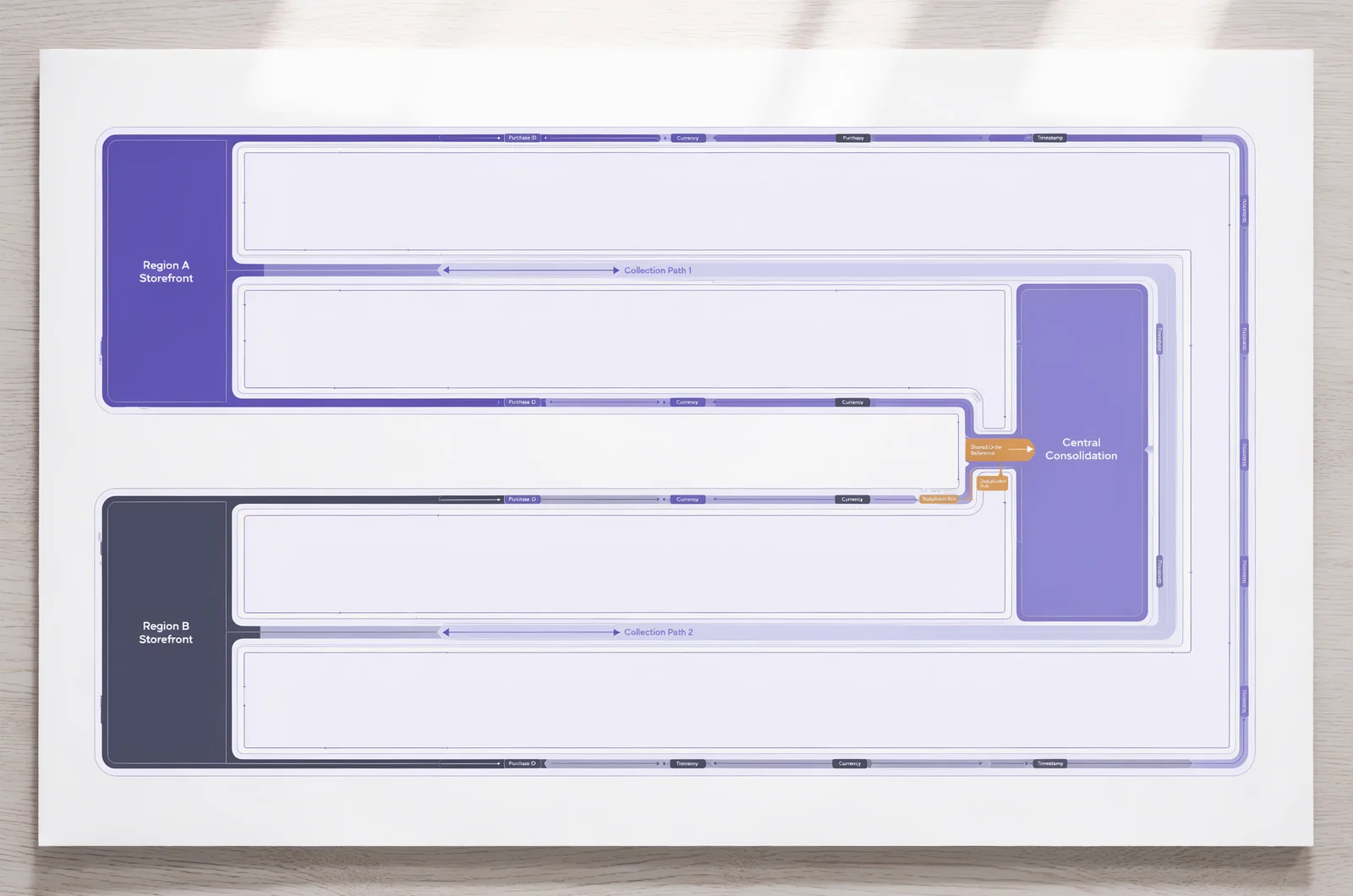
Identify the requirement before choosing a mechanism
Imagine an organisation with two regional websites. Each region needs separate reporting, while a central team compares completed orders.
A shared order reference already exists. Two collection paths can record the same purchase, and the release cannot include a storage or routing change. The design review must address the risk of counting an order twice.
Which recommendation should lead that review?
A. Create a separate reporting dataset for every campaign.
B. Define the uniqueness rule for a completed order, inspect both collection paths and validate counts against transaction records.
C. Rename regional reports so that their titles match.
D. Introduce a daily extract without reviewing the recorded purchase events.
For this hypothetical scenario, B is the strongest starting point. It addresses the stated counting risk and uses evidence the organisation already has.
The other choices leave that risk unresolved. Campaign separation changes reporting organisation. Matching titles changes presentation. A daily extract can carry the same counting problem into another dataset.
Explain what the answer still leaves open
Choosing B does not settle the implementation. The review still needs to establish where duplicate prevention belongs, how failures are handled and how the reporting result will be checked.
That distinction gives you a useful way to assess practice explanations. A sound explanation should identify why the recommendation fits, then respect what the scenario leaves unspecified.
Change one condition and reconsider the answer. Suppose the purchase count is already correct, but regional teams use different definitions of a completed order. The investigation would shift towards metric definitions and comparison rules.
This exercise tests whether you understand the requirement that makes an answer appropriate. Rewrite one condition, then explain whether your original choice still holds.
Trace a requirement through collection and reporting
For Adobe Analytics architecture practice, tracing a requirement through the data lifecycle gives you a way to connect otherwise isolated topics. Use this as a study lens; it is not a substitute for the official domain list.
Translate the business question into a measurable requirement
Start with the decision someone needs to make. A request for customer insight is too broad to assess. A request to compare completed purchases across regions gives you something concrete to examine.
Specify the metric, population and reporting grain. Establish whether the comparison concerns orders, people, visits or another unit.
Also identify who owns the definition. Two technically consistent implementations can still produce an unusable comparison if teams mean different things by the same metric.
In a practice scenario, underline any phrase that establishes the unit being measured.
Follow collection choices into the analysis
Next, ask what must be captured to support that requirement.
In the hypothetical purchase scenario, you would examine whether both paths use the same order reference and completion rule. You would also need a way to distinguish a repeated record from a separate purchase.
Keep assumptions visible. A reporting recommendation that depends on an unavailable identifier has an unresolved dependency. A proposed customer-level analysis needs an appropriate basis for connecting the relevant records.
Write down the data each proposed answer requires before judging its reporting benefit.
Make validation part of the design
Describe how you would assess the resulting output. Possible checks include known test transactions, expected field values and reconciliation against an agreed record.
The appropriate check follows the requirement. A successful collection request alone cannot demonstrate that a regional comparison is meaningful.
For every design answer you select, add one sentence explaining what evidence would show that it worked.
Check whether the explanation teaches a decision
AD0-E207 practice explanations should help you understand the relationship between the requirement and the answer. An answer letter gives you little material for revision.
Look for an explanation that does several useful jobs:
- Names the requirement that determines the answer.
- Shows how the selected option satisfies the stated constraints.
- Explains the specific weakness in each plausible alternative.
- Identifies assumptions or version-dependent behaviour.
- Points you towards the objective or documentation needed to resolve uncertainty.
Treat unsupported certainty cautiously. An explanation that declares an approach universally correct may have skipped a condition that matters.
Equally, a lengthy explanation can contain plenty of terminology without explaining the decision. Reduce it to one sentence: This option fits because… If that sentence is missing, investigate the reasoning before memorising the result.
You can also reverse the exercise. Ask what would need to change for another option to become suitable. This exposes the boundary between two similar approaches.
When an explanation depends on Adobe-specific functionality, check that behaviour against the relevant official documentation. Record the condition under which the answer holds beside your revision note.
Build a revision loop around your wrong answers
AD0-E207 practice becomes easier to act on when every mistake produces a specific follow-up task. A total score alone cannot tell you what to study tomorrow.
Separate knowledge gaps from reading errors
Keep a short error log with the objective, your chosen answer, the stated requirement and the reason your choice failed.
Use categories that describe what happened:
- You did not understand the underlying concept.
- You understood the concept but applied it outside its conditions.
- You missed a constraint in the scenario.
- You answered a different decision from the one requested.
- You lacked enough information to judge the explanation.
If you use PlanetCert’s simulator, review your practice score patterns alongside that log. Two weak sessions can need different remedies: one may reveal missing knowledge, while another reveals repeated reading errors.
A useful interactive objective tracker would let you enter verified domain weights, error categories and review dates. It could sort your revision queue by coverage, uncertainty and recurring mistakes.
Match each gap to a study task
For a conceptual gap, revisit the relevant objective and documentation, then explain the mechanism in your own words.
For a constraint error, practise extracting requirements before looking at the answer options. For an application error, change one condition in a familiar scenario and reassess the recommendation.
Use full-length timed practice after you have confirmed the applicable exam format. Keep diagnostic study sessions available for problems that need slower investigation.
Finish each session with one concrete task for the next session, such as tracing a duplicate purchase through both collection paths.
Questions to resolve before booking AD0-E207
Your AD0-E207 booking decision should combine verified exam details with evidence from your preparation. These questions help separate administrative certainty from study confidence.
Can a sample set establish the exam format?
No. A practice provider’s question count, time limit or answer format does not establish Adobe’s requirements.
Confirm the question count, duration, scoring information and delivery rules for the exact exam you intend to book. Keep those details beside your timed-practice settings.
Does a high practice score establish readiness?
A high score is one input. Check whether you can explain the answers, handle changed conditions and complete unfamiliar scenarios within the applicable time limit.
Repeated exposure can make a set feel easier. Review uncertain correct answers as carefully as wrong ones, and use fresh material where available.
Should you study another Adobe exam first?
Treat that as a preparation decision until the official certification requirements establish any formal dependency.
Another question set may help with a specific gap, but its code alone does not prove that it is a prerequisite. Compare the objectives before adding another syllabus to your workload.
Before scheduling, identify any unresolved gap that could materially affect your preparation: an unverified exam version, an objective you cannot explain or a recurring reasoning error.
Extend your Adobe Analytics study plan


Discussion
Question Comments
0 comments·0 participantsSign in to leave a comment and access more free questions.