
CCNA 200-301 vs Older CCNA Versions: What Changed in the Syllabus
You've got a shelf of CCNA books from 2018. Maybe a friend's old ICND1 notes. A Udemy course that still advertises "CCNA" without a version number. Before you spend eight weeks studying the wrong topics, you need to know: does any of this still apply to the current exam?
Cisco retired the 200-125 composite and the two-exam ICND1/ICND2 path in February 2020. The single exam that replaced them, 200-301, isn't just a rebrand. The syllabus structure, topic weightings, and even the philosophy of what a "CCNA" tests have shifted. Some of your old material is gold. Some of it is dead weight that'll cost you exam day.
This guide walks you through exactly what changed, what stayed, and how to audit your existing resources before you schedule.
Why Cisco Consolidated Everything Into One Exam
Before 2020, Cisco offered three routes to the same CCNA badge:
- Two-exam path: 100-105 ICND1 (CCENT) then 200-105 ICND2
- One-exam path: 200-125 composite
- Specialist bridges: Various refresh exams for expired certs
The problem? Employers didn't care which path you took. The CCENT itself had low recognition outside entry-level job postings. Candidates often got stuck in the ICND1/ICND2 gap, never finishing. Cisco's training revenue was split across too many SKUs.
The 200-301 redesign killed CCENT entirely and collapsed everything into a single 120-minute test. The new exam assumes you can configure, verify, and troubleshoot a small network end-to-end. No more "half a CCNA" stepping stone.
What this means for your old books: Anything labeled ICND1 or ICND2 is now historical context. The knowledge isn't worthless, but the exam structure it prepared you for no longer exists.
Domain-by-Domain: What Moved, What Vanished, What Appeared
The 200-301 exam organises content into six domains. Comparing these against 200-125 and the ICND pair shows the real shifts.
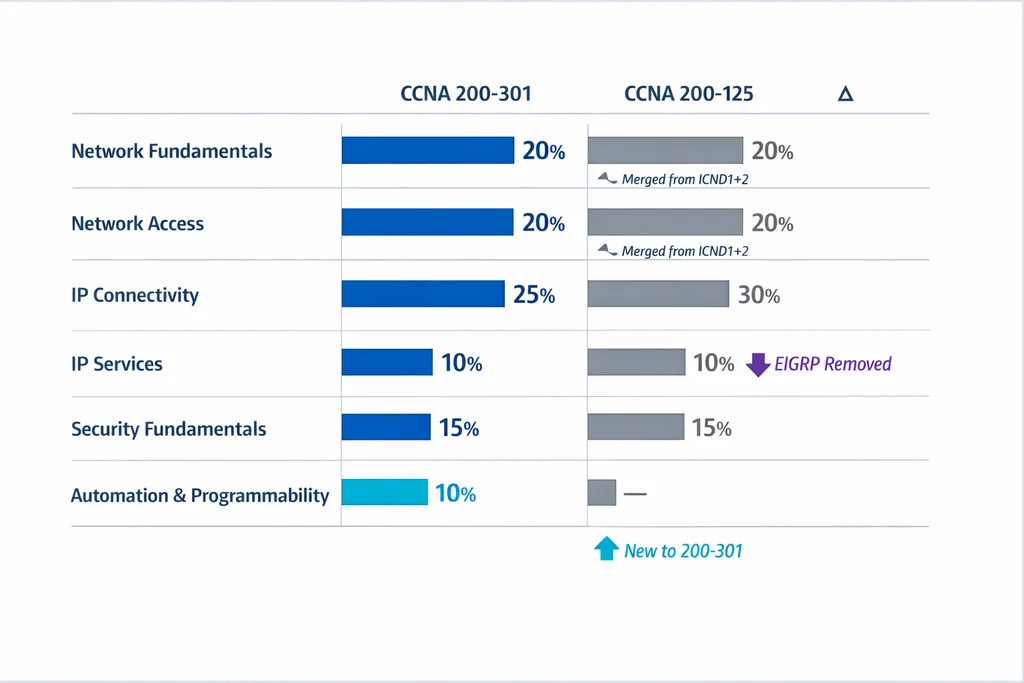
Network Fundamentals (20%)
This domain is largely familiar. IPv4 and IPv6 addressing, subnetting, OSI and TCP/IP models, cabling, and basic topologies all carried over from earlier versions. If you learned subnetting from a 2017 book, the mechanics haven't changed.
The catch: IPv6 weighting increased subtly. Older materials often treated IPv6 as a "bonus chapter." On 200-301, you need working knowledge of address formats, prefix lengths, and basic configuration. Don't skip it.
Dropped: Much of the historical Ethernet evolution (10BASE-T, 100BASE-TX specifics) and deep CSMA/CD theory. Know that collision domains exist; don't memorise timing diagrams.
Network Access (20%)
Layer 2 switching, VLANs, trunking, and EtherChannel remain core. Spanning Tree Protocol (STP) still appears, but with a crucial simplification.
What changed: The old exams drilled PVST+ and Rapid PVST+ in painful detail. 200-301 expects you to understand standard RSTP (802.1w) operation and basic port roles. You don't need to calculate spanning-tree costs manually or compare Cisco-proprietary variants against IEEE standards.
New additions: Wireless LAN controllers and lightweight APs now appear here. Older CCNA materials barely touched wireless beyond "here's an SSID." You now need to understand CAPWAP tunnels, controller-based architectures, and basic WLAN security (WPA2/WPA3, PSK vs. 802.1X). This is one of the biggest content gaps in pre-2020 resources.
Old material check: If your book dedicates a chapter to frame relay or PPPoE configuration, that's legacy WAN technology moved to specialist tracks. Set it aside.
IP Connectivity (25%)
Routing protocols live here. OSPFv2 for IPv4 and OSPFv3 for IPv6 are the stars. EIGRP is gone from CCNA entirely, moved to the CCNP Enterprise track.
Critical delta: Older CCNA materials spent serious time on EIGRP configuration, metric calculation, and troubleshooting. If your book has 40 pages on EIGRP, that's 40 pages of distraction for 200-301. The exam tests OSPF neighbour adjacencies, LSDB concepts, cost manipulation, and basic multi-area configuration. RIP appears only as a "know it exists" footnote.
Also new: Basic routing concepts now explicitly include floating static routes, VRF-lite awareness, and policy-based routing at a conceptual level. Nothing deep, but older ICND1 materials didn't touch these.
IP Services (10%)
This domain consolidates scattered topics from older exams: DHCP, DNS, NAT, NTP, SNMP, syslog, and QoS basics.
What shifted: QoS moved here from a deeper treatment in older CCNP materials. You need to recognise marking (DSCP, CoS), trust boundaries, and basic queuing concepts. Don't expect to configure complex policy maps.
New since 200-125: REST APIs and JSON data formats appear here. The modern CCNA expects you to understand that network devices can be automated, even if you won't write Python scripts on exam day. Know what a REST API call looks like, how JSON structures data, and why controllers use northbound vs. southbound interfaces.
Security Fundamentals (15%)
Security was sprinkled across older exams; now it's a dedicated domain with real weight.
What carried over: ACLs (standard, extended, named), port security, DHCP snooping, and basic device hardening (SSH vs. Telnet, password encryption).
What expanded significantly: VPN concepts, including IPsec site-to-site and remote access purposes. Wireless security (mentioned earlier) ties in here too. You need to understand threat defence at a system level: firewalls, IDS/IPS purposes, and the Cisco security architecture (ISE, Stealthwatch, Umbrella) at a "what does this product do" level.
Old material gap: Pre-2020 CCNA barely mentioned cloud security or DNS-layer protection. Your 2018 book won't have it.
Automation and Programmability (10%)
This is entirely new. Zero carryover from 200-125 or ICND2.
What you need: Understanding of controller-based networking (Cisco DNA Center, SD-WAN at a conceptual level). Ansible, Puppet, and Chef purposes — not configuration, but "which tool does what." YANG data models, NETCONF, and RESTCONF basics. JSON and XML as data formats for automation.
Reality check: You won't write Python on the exam. You might read a short script and identify what it does, or match an automation tool to a use case. But if your study material has zero coverage here, you're missing 10% of the exam by weight.
Auditing Your Old Study Materials: A Practical Checklist
Here's how to evaluate what you've got without starting from scratch.
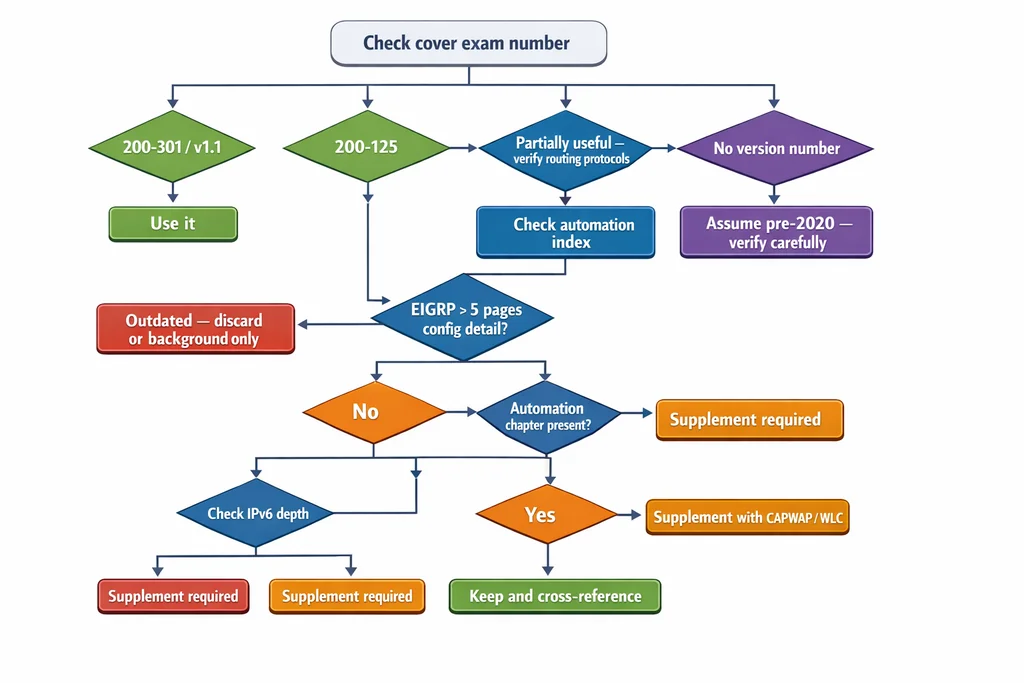
Step 1: Check the exam number on the cover
- 200-301, 200-301 v1.1 (current as of 2024-2025): Current, use it
- 200-125: Partially useful, see below
- 100-105 (ICND1) or 200-105 (ICND2): Structural mismatch, but some topic overlap
- No version number at all: Assume it's pre-2020, verify carefully
Step 2: Flip to the routing protocol chapters If EIGRP gets more than 5 pages of configuration detail, the book is outdated for current CCNA. OSPF should dominate. This is the fastest single check you can do.
Step 3: Look for automation content Search the index for "REST API," "JSON," "Ansible," "NETCONF," or "SD-WAN." Zero hits means a significant gap. The 10% automation domain is entirely missing.
Step 4: Check wireless coverage A single "wireless fundamentals" chapter from 2016 won't cover CAPWAP, controller architectures, or modern WLAN security. You need supplemental material here.
Step 5: Verify security depth Look for dedicated security chapters beyond ACLs and port security. If there's no coverage of VPN types, threat defence concepts, or Cisco security portfolio awareness, you'll need to fill that 15% domain elsewhere.
What you can salvage from 200-125 materials: Subnetting practice, VLAN and trunking labs, basic OSPF configuration, IPv6 addressing, and ACL exercises. These mechanics haven't changed. Just know that the exam context and weightings differ.
What to discard or deprioritise: EIGRP deep dives, frame relay, PPP/PPPoE, deep PVST+ mechanics, and any CCENT-specific exam strategy.
How the Exam Experience Changed
The test itself feels different, not just the topics.
Time and question count: 200-301 allows 120 minutes for roughly 100-120 questions. The old 200-125 was similar in length, but 200-301 includes more scenario-based items and fewer pure memorisation questions. Simlets and testlets (interactive simulations) carry more weight in your final score.
No more testlets split across ICND1/ICND2: The single-exam format means you can't bank a "half cert" and come back later. On the other hand, you don't face the ICND2 cliff where candidates often failed after passing ICND1.
Pricing: As of 2024, the 200-301 exam costs $300 USD. Cisco occasionally runs discount promotions through the Networking Academy, but the exam itself is the only purchase required. No separate ICND fees, no CCENT renewal to track.
Recertification: The three-year cycle remains, but Cisco now offers continuing education credits more broadly. This isn't exam-specific, but it affects your long-term planning if you're comparing total cost of ownership across certification paths.
Building a Hybrid Study Plan From Mixed Resources
If you're working with a 200-125 book plus scattered newer content, here's a practical approach:
Weeks 1-2: Foundation with verification Work through Network Fundamentals and Network Access from your old material, but cross-check each completed chapter against the current 200-301 exam topics list on Cisco's site. Mark any section not on the official list as "skip" or "background only."
Weeks 3-4: Routing with protocol swap Use your old OSPF chapters heavily. Skip or skim EIGRP entirely. Supplement with Cisco's free OSPFv3 for IPv6 overview if your book is IPv4-only.
Weeks 5-6: Security and services Your old material is thinnest here. Budget for a dedicated 200-301 supplement or video course covering the security domain and IP services automation topics. This is where free YouTube content from verified Cisco partners can fill gaps without extra cost.
Weeks 7-8: Automation crash course Even a 4-hour focused course on network automation fundamentals covers the 10% domain adequately. Don't over-invest; conceptual understanding beats configuration fluency at CCNA level.
Practice testing: Once you've mapped your knowledge gaps, run through 200-301 sample questions to validate against the actual exam format. If you started with 200-125 sample questions or ICND2 practice questions from your old study plan, use them for topic review only — the question style and emphasis have shifted.
Common Traps When Mixing Old and New Material
Trap 1: Studying EIGRP "just in case" It's not on the exam. Every hour spent here is stolen from automation or wireless topics that actually appear.
Trap 2: Assuming IPv6 is "extra credit" The exam doesn't treat it as optional. You need to configure and verify IPv6 addressing, interpret OSPFv3 output, and understand dual-stack operation.
Trap 3: Ignoring the automation domain because "I'm not a programmer" The questions test concepts, not coding. You can answer them with zero Python knowledge if you understand what REST APIs, data formats, and controller platforms do.
Trap 4: Using old subnetting speed without checking IPv6 Your IPv4 subnetting drill is still valuable. IPv6 subnetting logic differs (no variable subnet masking in the same way), and prefix-length interpretation needs practice.
What Candidates Still Ask About the Syllabus Shift
Can I pass with only a 200-125 book if I'm experienced? Possible but risky. You'd miss automation entirely, underweight wireless, and potentially overstudy EIGRP. At minimum, supplement with current exam topics and a dedicated automation primer.
Are ICND1/ICND2 books completely worthless? Not completely. ICND1 maps reasonably to Network Fundamentals plus partial Network Access. ICND2 covers some IP Connectivity and IP Services. But the split structure, outdated exam focus, and missing domains make them inefficient primary sources.
Did the 200-301 v1.1 update (2024) change much? Minor refresh. The core domains and percentages stayed identical. v1.1 added slight emphasis on cloud monitoring, enhanced security awareness, and clarified automation expectations. If your material covers 200-301 (any version), you're aligned. If it only covers 200-125, the v1.1 detail is irrelevant — you're already behind.
What's the fastest way to check if a topic is still current? Cisco publishes the official exam topics as a downloadable PDF. Search "200-301 exam topics PDF" and compare any book chapter against that list. It's the single source of truth.
From Audit to Action
You've now got a clear map: keep the subnetting drills, dump the EIGRP deep dive, and budget time for automation and wireless. The CCNA didn't get harder; it got broader. The single-exam format rewards generalists who can configure a switch, spot a security risk, and read a JSON response — not specialists in one routing protocol.
Once you've sorted your materials, the next step is verification against the actual exam style. Browse the relevant exam page and purchase a practice test to close the gap between "I studied" and "I'm ready."
Where to Take Your Prep Next
Sorting your bookshelf is only half the job. The real test is whether your knowledge holds up under exam conditions. These pages extend your prep into timed practice and deeper question review:
browse the relevant exam page and purchase a practice test
Learn more
Discussion
Question Comments
0 comments·0 participantsSign in to leave a comment and access more free questions.