

Cybersecurity Exam Overview: Key Certifications for 2025
Facing the decision to validate your cybersecurity skills can feel daunting with so many new certifications emerging each year. The rise of specialized credentials, like CompTIA Security+, reflects how professional growth depends on aligning your expertise with industry standards and evolving threats. This guide will help you navigate the diverse landscape of cybersecurity exams, highlighting cybersecurity certifications as critical milestones for career development, skill validation, and real-world workplace readiness.
Key Takeaways
| Point | Details |
|---|---|
| Importance of Certifications | Cybersecurity certifications validate technical skills and are essential for career advancement. |
| Exam Formats and Skill Assessments | Certification exams utilize various formats, including practical labs and performance-based scenarios. |
| Evolving Landscape | Certification needs are shifting towards specialization in areas like AI and cloud security. |
| Continuous Learning | Ongoing education and practical experience are crucial for maintaining certification relevance and expertise. |
Defining Cybersecurity Exams and Certifications
Cybersecurity certifications represent formal credentials that validate an individual’s technical skills, knowledge, and professional competence in protecting digital systems and networks. These credentials go far beyond simple test scores - they serve as critical benchmarks for employers seeking qualified cybersecurity professionals.
The landscape of cybersecurity certifications encompasses a diverse range of specialized credentials designed to address different skill levels, career stages, and technological domains. Cybersecurity workforce development programs highlight how certifications align professional capabilities with evolving industry requirements. Organizations like the National Initiative for Cybersecurity Careers and Studies (NICCS) provide comprehensive frameworks that help professionals navigate certification pathways.
Key characteristics of cybersecurity certifications typically include:
- Rigorous examination processes testing technical knowledge
- Specific focus areas like network security, cloud security, or ethical hacking
- Continuing education requirements to maintain credential validity
- Periodic recertification to ensure skills remain current with technological advances
- Validation of practical skills through performance-based assessments
Professional cybersecurity certifications serve multiple critical functions in the technology ecosystem. They demonstrate an individual’s commitment to professional growth, validate technical expertise, and provide standardized mechanisms for employers to assess candidate capabilities. The Canadian Centre for Cyber Security emphasizes that these credentials often correlate directly with enhanced career opportunities and potential salary improvements.
Pro tip: Select certifications strategically by analyzing their alignment with your specific career goals and the current technological landscape.
Leading Certification Types and Vendors for 2025
The cybersecurity certification landscape in 2025 represents a dynamic and rapidly evolving ecosystem of professional credentials designed to address increasingly complex technological challenges. Leading cybersecurity certifications continue to adapt to emerging threats, technological innovations, and workforce development needs.
Key certification vendors and their prominent credentials include:
- ISC2: Certified Information Systems Security Professional (CISSP)
- ISACA: Certified Information Security Manager (CISM)
- EC-Council: Certified Ethical Hacker (CEH)
- GIAC: Various specialized security certifications
- CompTIA: Security+ certification
These certifications are strategically designed to validate technical expertise across different specialization areas, including network security, cloud infrastructure, ethical hacking, risk management, and emerging artificial intelligence technologies. The vendor ecosystem reflects an understanding that cybersecurity professionals require diverse skill sets to protect increasingly complex digital environments.
Here’s a comparison of leading cybersecurity certification vendors and the focus areas of their key credentials:
| Vendor | Key Credential | Primary Focus Area | Typical Career Level |
|---|---|---|---|
| ISC2 | CISSP | Security architecture, risk | Mid to senior |
| ISACA | CISM | Management, governance | Manager, executive |
| EC-Council | CEH | Ethical hacking, penetration | Entry to mid |
| GIAC | GIAC Security Certifications | Specialized domains | Varies by certification |
| CompTIA | Security+ | General security knowledge | Entry-level |
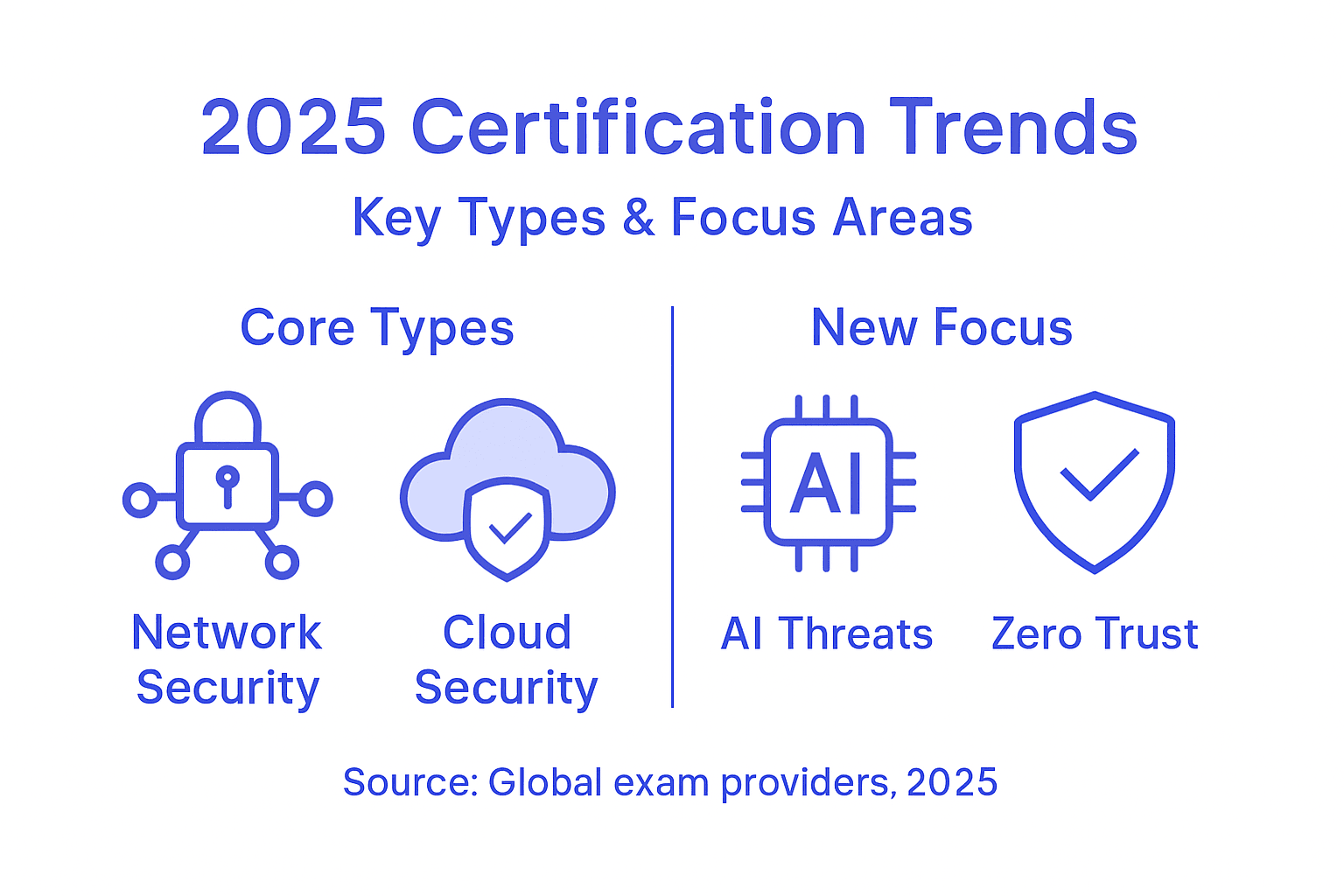
Emerging trends in 2025 demonstrate a significant shift towards specialized certifications that address cutting-edge technological domains. AI-integrated security credentials, cloud security specializations, and advanced threat detection certifications are becoming increasingly prominent. Organizations seek professionals who can demonstrate not just technical proficiency, but also strategic understanding of evolving cyber threat landscapes. For advanced leadership-focused prep, review our CISSP exam guide.
Pro tip: Continuously research and align your certification strategy with current industry technological trends to maximize your professional marketability.
Exam Requirements and Testing Formats Explained
Cybersecurity certification exams in 2025 represent sophisticated assessment mechanisms designed to validate professionals’ technical knowledge, practical skills, and strategic understanding of complex digital security environments. Certification exam question types vary significantly across different credentials, requiring candidates to demonstrate comprehensive cybersecurity competencies through multiple evaluation strategies.
Typical cybersecurity examination formats include:
- Multiple-choice questions testing theoretical knowledge
- Performance-based scenarios simulating real-world security challenges
- Practical lab simulations requiring hands-on technical problem-solving
- Case study assessments evaluating strategic security decision-making
- Interactive cyber range exercises testing live response capabilities
Most professional cybersecurity certifications mandate rigorous prerequisites and structured examination processes. Candidates typically must demonstrate a combination of educational background, professional experience, and ongoing learning commitments. Advanced certifications often require documented work experience, professional references, and periodic recertification to ensure continued expertise in rapidly evolving technological landscapes.

The examination structures reflect the dynamic nature of cybersecurity challenges, moving beyond traditional knowledge testing to assess candidates’ adaptive thinking, technical proficiency, and strategic reasoning. Professional certification bodies increasingly incorporate emerging technologies like artificial intelligence and machine learning into their assessment methodologies, ensuring that certified professionals can navigate complex, unpredictable digital security environments.
The following table summarizes typical cybersecurity exam formats and the skills they assess:
| Exam Format | Typical Skill Assessed | Business Impact |
|---|---|---|
| Multiple-choice questions | Theoretical knowledge | Foundation for job readiness |
| Performance-based scenarios | Practical troubleshooting | Workplace problem-solving skills |
| Lab simulations | Hands-on technical ability | Operational effectiveness |
| Case study assessments | Strategic decision-making | Risk mitigation proficiency |
| Cyber range exercises | Live incident response | Real-time threat containment |
Pro tip: Develop a comprehensive study strategy that combines theoretical learning with practical, hands-on experience to maximize your certification exam success.
Essential Domains and Skills Assessed
Cybersecurity certification exams comprehensively evaluate professionals’ capabilities across multiple critical domains, ensuring a holistic understanding of digital security challenges. Cybersecurity skills framework highlights the multifaceted nature of modern security expertise, demanding profound technical and strategic competencies.
Core domains typically assessed in cybersecurity certifications include:
- Network Security fundamentals and advanced protection strategies
- Threat Detection and Incident Response techniques
- Risk Management and Governance principles
- Cryptography and Authentication mechanisms
- Security Operations and Compliance frameworks
- Cloud and Emerging Technology Security approaches
Professional certifications rigorously test candidates’ ability to understand and implement complex security controls, demonstrating comprehensive knowledge beyond theoretical concepts. The assessment methods simulate real-world scenarios, requiring professionals to exhibit critical thinking, technical problem-solving, and strategic decision-making skills across interconnected technological environments.
Advanced certifications emphasize not just technical proficiency but also strategic understanding of cybersecurity’s broader organizational implications. Candidates must demonstrate skills in analyzing sophisticated threat landscapes, developing robust security architectures, and implementing comprehensive protective measures that align with business objectives and regulatory requirements.
Pro tip: Develop a multidimensional learning approach that combines theoretical knowledge with practical cybersecurity experience to excel in comprehensive certification assessments.
Common Mistakes and Misconceptions to Avoid
Cybersecurity certification candidates frequently encounter misconceptions that can significantly undermine their exam preparation and professional development strategies. Understanding and navigating these potential pitfalls is crucial for successfully advancing one’s cybersecurity career trajectory.
Common mistakes and misconceptions in cybersecurity certification preparation include:
- Overemphasizing Technical Knowledge while neglecting strategic thinking
- Assuming Certifications Guarantee Employment without practical experience
- Relying Solely on Practice Exams without comprehensive understanding
- Underestimating Continuous Learning requirements
- Neglecting Hands-on Practical Skills in favor of theoretical knowledge
- Misunderstanding Certification Scope and Limitations
Many professionals mistakenly view cybersecurity certifications as static achievements rather than dynamic credentials requiring ongoing professional development. Successful candidates recognize that certifications represent starting points for continuous learning, not definitive endpoints in their technological expertise.
Additionally, candidates often misunderstand the comprehensive nature of cybersecurity examinations, believing that memorization alone will suffice. Modern certification assessments demand sophisticated understanding of interconnected technological systems, requiring candidates to demonstrate critical thinking, analytical reasoning, and adaptive problem-solving skills across complex digital environments.
Pro tip: Develop a holistic preparation strategy that balances theoretical study, practical experience, and ongoing technological awareness to maximize certification success.
Expert Tips to Boost Cybersecurity Exam Success
Successful cybersecurity certification preparation demands a strategic, multifaceted approach that goes beyond traditional study methods. Expert exam preparation strategies emphasize the importance of comprehensive and adaptive learning techniques that address both knowledge acquisition and practical skill development.
Critical strategies for cybersecurity exam success include:
- Create a Structured Study Plan
- Diversify Learning Resources
- Practice Active Note-Taking
- Utilize Exam Simulation Tools
- Join Professional Study Communities
- Conduct Regular Self-Assessments
- Focus on Conceptual Understanding
Professional candidates recognize that effective exam preparation transcends simple memorization. The most successful learners develop comprehensive understanding by connecting theoretical concepts with real-world technological scenarios, thereby building adaptive problem-solving capabilities that extend beyond standardized test requirements.
Advanced preparation techniques involve developing a holistic approach to learning that integrates multiple knowledge acquisition methods. This includes combining traditional study materials, interactive online resources, hands-on laboratory experiences, and collaborative learning environments to create a robust and comprehensive understanding of complex cybersecurity concepts.
Pro tip: Design a personalized study strategy that balances theoretical knowledge, practical skills, and continuous technological awareness to maximize your certification exam performance.
Master Your 2025 Cybersecurity Certifications with Confidence
Navigating the evolving landscape of top cybersecurity certifications like CISSP, CISM, CEH, and CompTIA Security+ can feel overwhelming. This article highlights the critical challenge of aligning your exam preparation with rigorous testing formats and emerging technology domains. Key pain points include balancing theoretical knowledge with hands-on skills, understanding complex exam formats, and staying current with industry trends. At PlanetCert.com, we specialize in transforming these challenges into opportunities through our extensive library of verified real exam questions, practice tests, and online simulators tailored specifically for these leading certifications.
Unlock your potential by preparing smarter not harder. Our resources focus on helping you master complex concepts across essential domains such as network security, risk management, and cloud security. Join thousands of professionals who have increased their first-attempt pass rates using our comprehensive study guides and adaptive learning tools. Don’t let exam uncertainty hold you back from the career growth you deserve.

Ready to take control of your cybersecurity career in 2025? Visit PlanetCert.com to access expertly crafted practice exams and up-to-date study materials for critical certifications. Explore Cybersecurity Exam Preparation and start your journey to success today. Your certification achievement is just a few clicks away.
Frequently Asked Questions
What are cybersecurity certifications?
Cybersecurity certifications are formal credentials that validate an individual’s technical skills, knowledge, and professional competence in protecting digital systems and networks. They serve as benchmarks for employers seeking qualified professionals.
What are some leading cybersecurity certifications for 2025?
Leading certifications for 2025 include the Certified Information Systems Security Professional (CISSP) from ISC2, Certified Information Security Manager (CISM) from ISACA, Certified Ethical Hacker (CEH) from EC-Council, and Security+ from CompTIA among others. These credentials cover various specialization areas and align with emerging technological trends.
What types of exam formats are commonly used in cybersecurity certification assessments?
Common exam formats include multiple-choice questions, performance-based scenarios, practical lab simulations, case study assessments, and interactive cyber range exercises. These formats assess theoretical knowledge as well as practical skills.
How can candidates prepare effectively for cybersecurity certification exams?
Candidates can enhance their preparation by creating a structured study plan, diversifying learning resources, practicing active note-taking, utilizing exam simulation tools, and joining professional study communities. Focusing on conceptual understanding alongside hands-on experience is crucial for success.
Recommended

Discussion
Question Comments
0 comments·0 participantsSign in to leave a comment and access more free questions.