

Fortinet NSE Certification Paths Worth Pursuing in 2026
Fortinet's certification programme underwent a structural overhaul in late 2024, and by early 2026 the new hierarchy has settled into a clear, role-based framework. If you're deciding which Fortinet credential to target this year, the choice now maps directly to job function rather than vague "expertise levels." The vendor has retired the old NSE 1–8 numbering for most practical purposes and reorganised around three stacked tiers: associate, professional, and expert, each with specialisations that tie to specific operational roles.
This matters because employers increasingly scan for these exact titles when filtering candidates. A hiring manager looking for a SOC analyst knows to search for FCSS in Security Operations. Someone filling a network architect role looks for FCSS in Network Security. The alignment isn't perfect, but it's far sharper than the previous system, where NSE 4, 5, 6, and 7 all signalled different things depending on when the candidate earned them.
Here's what changed, how the 2026 structure works, and which paths deliver the clearest career signal right now.
What Fortinet Restructured and When
Fortinet announced the tiered reorganisation in October 2024, with full transition guidance published by January 2025. The old NSE 1–8 scale still exists as a historical reference, but active certifications now issue under the new naming convention. If you hold a legacy NSE 4, for instance, it maps forward to the Fortinet Certified Professional (FCP) in Network Security. NSE 7 transitions to Fortinet Certified Solution Specialist (FCSS) in the relevant track.
The key date to know: new exams issued after 1 March 2025 follow the new structure exclusively. Retired exam versions stopped accepting registrations in February 2025. If you see training material referencing NSE 4, NSE 5, and so on, check the publication date. Material from 2024 or earlier may still teach useful FortiOS skills, but the credential names and exam codes have changed.
Fortinet's training portal now lists certifications by job role rather than number. This is the authoritative source for current exam versions, though the company does not always archive old pages cleanly. I've found that searching the training site for specific exam codes—like FCSS-SOC-AN-7.4—returns the current version more reliably than browsing by category.
The Three Tiers and What Each Proves
The 2026 framework has three main tiers below the honorary NSE 8 designation, which remains a separate, lab-based expert credential.
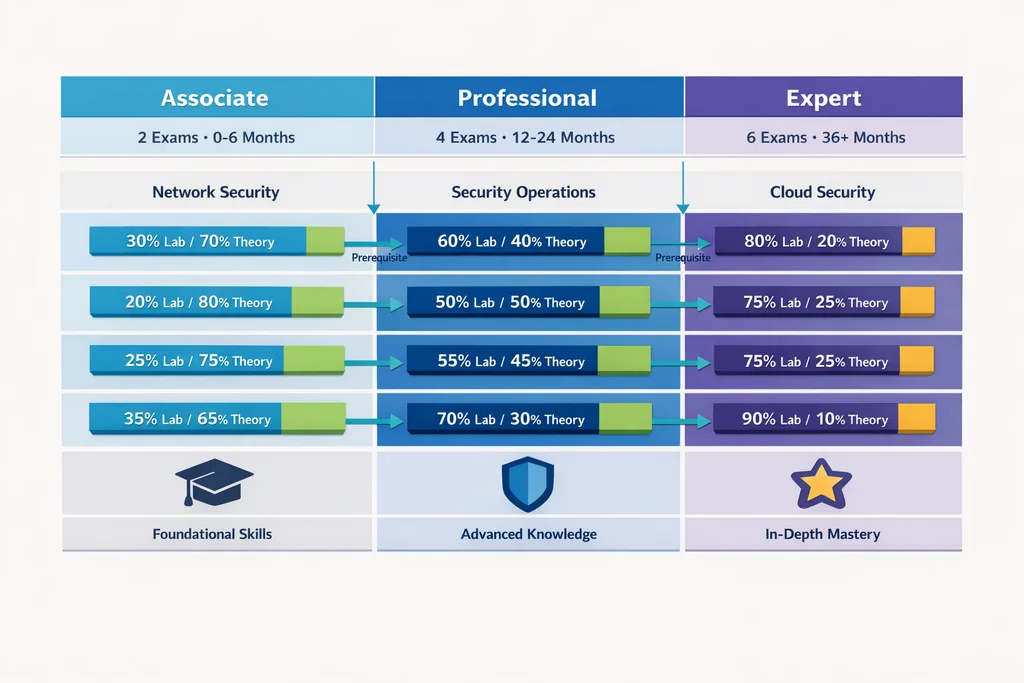
Associate level: Fortinet Certified Associate (FCA)
This replaces the old NSE 1 and NSE 2. It's a single, entry-level credential aimed at sales professionals, new IT staff, and anyone who needs to speak intelligently about Fortinet products without configuring them. The exam is free, self-paced, and available through the training portal. It covers basic cybersecurity concepts, Fortinet product positioning, and the Security Fabric architecture.
For hands-on technical roles, the FCA is too light. But if you're moving into a pre-sales engineer track or need baseline vocabulary before tackling professional-level material, it's a low-friction starting point. Most technical candidates skip it and start at FCP. If you do want to validate your foundation first, NSE 1 sample questions cover the conceptual terrain you'll need before the professional tier.
Professional level: Fortinet Certified Professional (FCP)
This tier replaces NSE 4 and NSE 5. It splits into two main tracks: Network Security and Security Operations. The FCP in Network Security validates day-to-day administration of FortiGate firewalls—policies, VPNs, routing, basic troubleshooting. The FCP in Security Operations covers FortiSIEM, FortiSOAR, and analyst workflows.
These are the credentials that show up most often in job postings for network administrators and SOC analysts with 2–4 years of experience. The exams are proctored, multiple-choice, and cost approximately $200 USD each. Fortinet recommends 6–12 months of hands-on experience, though many candidates pass with intensive lab practice and less on-the-job exposure.
Expert level: Fortinet Certified Solution Specialist (FCSS)
This replaces NSE 7 and covers advanced design and architecture. The 2026 structure offers FCSS specialisations in Network Security, Security Operations, and Cloud Security. Each requires passing a core exam plus a practical assessment that involves configuring and troubleshooting in a live environment.
The FCSS is where Fortinet's path starts to compete directly with Palo Alto's PCNSE. Both signal architect-level competency with that vendor's stack. The PCNSE has broader name recognition in enterprise hiring, but FCSS has closed the gap significantly in Fortinet-heavy environments—service providers, MSSPs, and organisations that standardised on FortiGate for cost reasons.
Mapping Tiers to Job Roles
The restructuring only makes sense if you know which tier matches your target position. Here's how the market reads these credentials in mid-2026.
SOC analyst (Tier 1–2): FCP in Security Operations
Analysts at this level need to interpret alerts, perform initial triage, and escalate correctly. The FCP-SOC covers FortiSIEM query logic, incident response playbooks, and basic SOAR automation. It doesn't replace a broader security foundation—CompTIA Security+ or equivalent knowledge is still assumed—but it signals that you can operate in a Fortinet-centric SOC stack.
For candidates targeting this path, NSE 2 practice questions provide a useful bridge from associate-level vocabulary to professional-level scenarios. The question style shifts from "what does this product do?" to "which dashboard would you check first?"
Network administrator / engineer: FCP in Network Security
This is the workhorse credential. Administrators who manage FortiGate clusters, configure SD-WAN, and maintain site-to-site VPNs need this certification to demonstrate operational competence. The exam covers FortiOS 7.4 features including ZTNA, explicit proxy, and advanced routing.
Many employers treat this as a baseline requirement rather than a differentiator. If you're the person who keeps firewall policies clean and handles change requests, the FCP-NS is expected. Not having it raises questions. Having it merely clears the bar.
Security architect / senior engineer: FCSS in Network Security or Cloud Security
Architects design multi-site deployments, integrate Fortinet into broader security ecosystems, and make vendor-specific versus vendor-neutral tooling decisions. The FCSS requires demonstrating these skills under time pressure in a practical exam.
The Cloud Security track is newer and less proven in the job market, but it's growing quickly as organisations move FortiGate-VM and FortiWeb deployments into AWS and Azure. If your environment is hybrid or cloud-first, this specialisation carries more signal than the on-premises Network Security track.
For architects comparing Fortinet against Palo Alto's PCNSE, the practical exam format is the key difference. PCNSE remains multiple-choice. FCSS requires hands-on configuration. Some employers value this; others don't distinguish. The safe play is to hold one vendor-neutral architect credential (like CISSP-ISSAP or SABSA) plus whichever vendor specialisation your current or target employer uses.
How NSE Stacks Against PCNSE in 2026
The Palo Alto PCNSE has been the reference credential for firewall-specialist roles for years. In 2026, the comparison depends heavily on context.
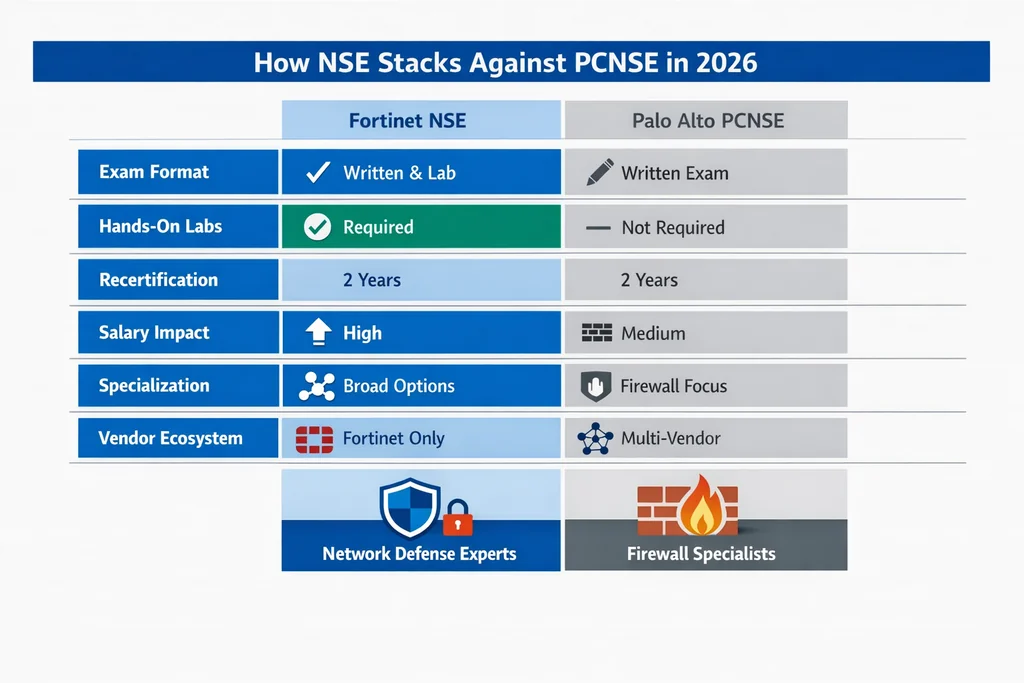
In Fortinet-dominated environments—retail chains, regional healthcare networks, education sectors where cost-per-port matters—FCSS carries equal or greater weight. Hiring managers in these spaces know the Fortinet stack intimately and respect the practical exam format.
In enterprise environments with mixed vendor estates, PCNSE still wins on recognition. Palo Alto's marketing and channel presence at Fortune 500 companies means the credential name travels further. If you're planning to job-hop across industries, PCNSE is the safer investment.
For candidates early in their firewall-specialist career, the choice should follow your current employer's stack, not theoretical market value. You need hands-on access to lab equipment or production environments to pass either exam. Studying abstractly for a vendor you don't touch daily is inefficient and usually fails.
The skills overlap is substantial. Both cover zone-based firewall policy, VPN architecture, threat prevention, and user identity integration. Time spent deep in FortiOS translates partially to PAN-OS, and vice versa. If you're forced to switch vendors later, the conceptual foundation transfers even if command syntax doesn't.
Exam Preparation and What to Budget
Fortinet's training remains unusually accessible compared to Cisco or Palo Alto. The associate-level material is free. Professional and expert courses carry fees, but Fortinet partners often receive discounted or bundled access. Self-study candidates can find official courseware through the training portal, though Fortinet gates some advanced labs behind partner status.
For hands-on practice, the critical resource is FortiGate-VM. Fortinet offers a free evaluation license with reduced throughput limits. It's sufficient for lab topology work. Pair this with the official administration guides for your target FortiOS version—exams specify the version, and features move between releases.
Most candidates need 4–8 weeks of focused study for FCP-level exams, assuming daily lab access. FCSS requires longer, typically 8–12 weeks, because the practical component demands muscle memory with the CLI and GUI. The exam day itself runs 2–3 hours for multiple-choice, with the practical assessment adding another 2 hours in a proctored virtual environment.
If you're building a study plan around work constraints, NSE 3 exam prep material covers the professional-to-expert transition, including scenario-based questions that mirror the FCSS practical format. For network security specialists, network security analyst prep offers targeted practice on the policy and troubleshooting domains that dominate the FCP-NS exam.
What to Watch for the Rest of 2026
Fortinet has signalled two developments worth tracking. First, the Cloud Security track is expanding. Expect additional specialisations around container security and SaaS protection by Q3 2026. These will likely issue as FCSS add-on exams rather than full new certifications.
Second, the NSE 8 lab-based expert credential is being revised. Fortinet has indicated that the current format, which involves a two-day practical examination, will be streamlined. Details remain unpublished as of May 2026, but candidates approaching this level should monitor the training portal for announcements rather than planning around the existing structure.
The broader industry trend toward skills-based assessment continues to favour Fortinet's practical exam approach. While multiple-choice certifications still dominate HR screening, hiring managers in technical interviews increasingly ask for demonstration, not just documentation. FCSS's practical component aligns with this shift better than PCNSE's purely written format.
For SOC analysts specifically, the convergence of XDR and SIEM platforms is blurring vendor boundaries. Fortinet's acquisition strategy and product integration will determine whether FCSS-SOC remains a distinct credential or merges with broader security operations tracks. The XDR analyst certification material reflects this convergence, covering cross-platform detection logic rather than Fortinet-specific tooling alone.
Choosing Your Starting Point
If you're new to Fortinet and targeting a technical role, start with FCP in the track that matches your job function. Don't chase the associate level unless you're in sales or need organisational baseline training. The FCP is where hiring attention actually focuses.
If you're already holding a legacy NSE 4 or NSE 5, check your certification status in the Fortinet portal. These should have auto-mapped to FCP credentials, but the transition created edge cases. Some candidates found their NSE 5 in FortiAnalyzer didn't map cleanly to the new FCP-SOC structure and needed to contact support.
If you're comparing Fortinet against Palo Alto for your next credential investment, default to whichever vendor you can access in production. Certification value follows deployment footprint. A credential you can't maintain through daily use depreciates faster than the exam cost suggests.
For candidates with exam dates in the next 8–12 weeks, FCSS SOC analyst questions and NS admin sample questions provide exam-aligned practice with explanations that map back to official objectives. The timed simulator format helps build the pacing discipline that practical assessments demand.
Learn more → Browse the relevant exam page and purchase a practice test.
Paths That Build on Fortinet Credentials
Fortinet certifications don't exist in isolation. The most effective career builders combine vendor credentials with broader security foundations.
For SOC analysts, pair FCP-SOC with CompTIA CySA+ or Blue Team Level 1. The Fortinet credential proves tool-specific competence. The broader certification validates analytical methodology that transfers across SIEM platforms.
For network security engineers, FCP-NS complements Cisco CCNA or CCNP Security. The routing and switching knowledge from Cisco fills gaps that Fortinet's firewall-focused curriculum leaves open. In hybrid Cisco-Fortinet environments, this combination is common among senior engineers.
For architects, FCSS should sit alongside CISSP or equivalent. Vendor-specific design credentials demonstrate depth in a single stack. The (ISC)² or ISACA credential demonstrates that you understand how that stack fits into enterprise risk management, compliance, and business continuity.
The network security architect exam practice material includes design scenarios that require this cross-domain thinking—calculating failover topology, integrating FortiGate with existing identity providers, and justifying security control selection to non-technical stakeholders.
Questions Candidates Are Actually Asking
Does my old NSE 4 still matter?
Yes, but clarify it on your CV. List it as "FCP in Network Security (legacy NSE 4)" to help both automated parsers and human readers. The skills are current; the label is dated.
Is FCSS recognised outside Fortinet shops?
Moderately. It's stronger than NSE 7 was, but still weaker than PCNSE in mixed-vendor environments. Lead with your vendor-neutral credentials in these contexts.
Can I skip FCP and go straight to FCSS?
Fortinet requires FCP as a prerequisite for FCSS registration. There are no exam-only bypass paths. If you have extensive experience, the FCP should be straightforward, but you still need to sit it.
How long do these certifications last?
FCP and FCSS credentials are valid for two years. Renewal requires passing a current exam in the same or higher tier, or accumulating continuing education credits through Fortinet's training portal. The associate-level FCA does not expire.
Where Fortinet Certification Fits in 2026
The reorganised NSE framework is a genuine improvement. Role-based naming, practical assessments at the expert level, and clearer progression paths make these credentials more legible to employers than the old numbered system.
The limitation remains vendor specificity. Fortinet certifications prove you can operate Fortinet equipment. They don't signal broad security expertise, and they don't transfer cleanly to Palo Alto, Check Point, or Juniper environments. Use them as intended: as depth credentials in Fortinet-heavy roles, not as universal qualifications.
For candidates with exam dates this quarter, the structure is stable enough to commit. No further major reorganisation is expected before 2027. Focus on FortiOS 7.4 material, as this is the current exam baseline, and verify your target exam code against the training portal before purchasing practice tests or scheduling.
More Fortinet Exam Practice

Discussion
Question Comments
0 comments·0 participantsSign in to leave a comment and access more free questions.