
Choosing a DEP-2026 practice test means deciding which resource will help you close knowledge gaps and rehearse under pressure. If you’re fitting revision around work, you need explanations worth studying, relevant questions and enough access to finish your preparation.
There are no documented hands-on provider results behind this roundup. A tested platform winner therefore remains unverified. Instead, I’ve ranked four practice-resource formats by buying priority for someone still closing knowledge gaps, with practical checks for assessing individual platforms. Named providers receive no invented scores, prices or claims about exam coverage.
What an exam-specific shortlist must establish
A useful shortlist starts with a confirmed match between your intended exam and the product being sold. A matching code in a page title is only the first check.
Confirm the awarding body, certification title and applicable exam version. Where the exam owner publishes objectives, compare the provider’s coverage against that document. A year-looking suffix in a code doesn’t establish when questions were written or reviewed.
I’d judge candidates against these criteria before comparing question counts:
- Coverage should be traceable to the applicable objectives, with gaps clearly stated.
- Explanations should justify the selected answer and address plausible alternatives.
- Timed sessions should have settings you can compare with the published exam format.
- Results should help you identify what to revise after each session.
- Access terms should cover your preparation window and any reasonable delay.
Treat each criterion separately. A polished simulator can still contain weak explanations. An excellent question bank might lack the session controls you want for rehearsal.
Also distinguish an unavailable detail from a failed check. If a provider doesn’t show its reporting screen, its reporting remains unknown. Record that uncertainty and request a demonstration before relying on the capability.
Four practice formats, ranked by buying priority
For a candidate who still needs to improve subject knowledge, I’d assess these formats in the following order. These are resource categories, not verified rankings of individual vendors. If your main difficulty is pacing, move the timed simulator to the front.
1. Explained question banks for closing knowledge gaps
Put an explained question bank first when you need to understand why your answers are wrong.
During evaluation, look for questions that require a decision based on the stated conditions. Then examine the explanation. It should connect those conditions to the answer, rather than simply repeat the correct option.
The best fit is a candidate who can name broad weak areas but needs help identifying specific misunderstandings. Topic selection and review controls are worth checking because they determine how easily you can revisit those areas.
The limitation is rehearsal. A bank with immediate feedback may be useful for learning while providing little evidence of performance without help.
Before shortlisting one, inspect explanations for questions you answer correctly as well as those you miss. A correct guess still needs review. Choose this format only when the explanations give you something concrete to study.
2. Timed simulators for practising session control
Prioritise a timed simulator when you understand the material but need to assess pacing, concentration or answer review.
Check whether you can complete a session without seeing explanations midway through it. Examine the timer, submission controls and handling of unanswered questions. Where navigation rules are published for the actual exam, compare them with the simulator’s behaviour.
This format suits candidates approaching a planned exam date who want to rehearse a complete sitting. Its usefulness depends on both the question content and the session controls.
The limitation is diagnostic depth. A final percentage alone gives you little direction for tomorrow’s revision.
Inspect a completed-session report before choosing. Look for a way to review individual responses and distinguish topics that need attention. Use the published exam format to assess the settings; avoid treating a provider’s “realistic” label as proof.
3. Sample question sets for inspecting content quality
Sample sets belong in the comparison because they let you inspect a provider’s writing and explanations before committing to a larger resource.
Use them to assess clarity, consistency and reasoning. Does the stem contain enough information to answer? Are answer choices meaningfully different? Does the explanation resolve the decision presented?
They fit candidates who already have a shortlist and want to assess the content behind the sales page.
Their limitation is scope. A short sample cannot establish complete objective coverage, the quality of every explanation or the variety of a paid bank. It also cannot establish readiness for the actual exam.
Treat samples as an inspection opportunity. Examine several explanations closely, including any answer you dispute. If the reasoning depends on an unstated assumption, record the issue and ask how the provider handles content corrections.
4. Flashcards for focused recall practice
Place flashcards after the main question resource when your remaining gaps involve terms, distinctions or facts you can express clearly.
During comparison, inspect whether cards contain a single useful prompt and an answer you can check. Cards that compress an entire topic into a dense paragraph may be awkward for short revision sessions.
This format fits a candidate who has already identified specific recall gaps through study or practice questions. Check whether you can revisit missed cards or create your own, if those controls matter to your routine.
The limitation is decision-making practice. Reciting a definition doesn’t demonstrate that you can choose between plausible answers under a scenario’s constraints.
Keep flashcards as a supporting purchase criterion. Give greater weight to the main question resource unless recall is the specific problem you need to solve.
Give every candidate the same demo checks
Comparing practice platforms becomes easier when each candidate faces the same checks. Use available samples or demonstrations, and keep a short record of what you could actually verify.
Check reasoning before counting questions
Choose a question whose answer requires more than recognising a term. Write down the condition that determines your choice before reading the explanation.
Then compare your reasoning with the provider’s explanation. Look for an account of why the answer fits and why a tempting alternative fails. A reference can help, but it should support reasoning that is already understandable.
You can score this inspection for your own purposes: clear, incomplete or unresolved. Those labels describe your review of the sample; they aren’t independent ratings of the whole platform.
Record the question’s topic and the specific explanation problem. That gives you a useful basis for comparing candidates.
Inspect what happens after submission
Ask to see the results view, rather than relying entirely on screenshots of the question screen.
Can you identify unanswered items? Can you revisit an explanation? Does any topic breakdown correspond to a meaningful area of study? Check whether a headline score conceals differences between stronger and weaker topics.
The discussion of exam simulator analytics gives context for judging whether a report can guide revision.
Also examine how repeated questions are handled. If you recognise an answer from an earlier attempt, mark that result separately in your own notes. Compare performance on unfamiliar items before treating a higher score as evidence of broader understanding.
Where PlanetCert fits in the comparison
PlanetCert is a later option to inspect once you’ve decided which practice format you need. Its wider service description includes practice tests, a web-based simulator, flashcards and study materials.
That site-wide description does not confirm the exact contents of an exam-specific purchase. Question count, objective coverage, access duration and available session controls still need verification for the particular product.
Use the exam listing to identify what is stated for that product. Keep the listed contents separate from general descriptions elsewhere on the website.
The sample question page is another place to assess the wording and explanations presented for this exam. Apply the same reasoning checks you would use for another candidate.
PlanetCert receives no ranking advantage from being the publisher of this article. Its inclusion establishes an option for inspection, not a verified comparison win. Before making a decision, record which product details are confirmed and which remain unanswered.
Match access terms to your study window
For an exam-specific practice purchase, access duration matters alongside content quality. Compare the total commitment against the time you expect to need.
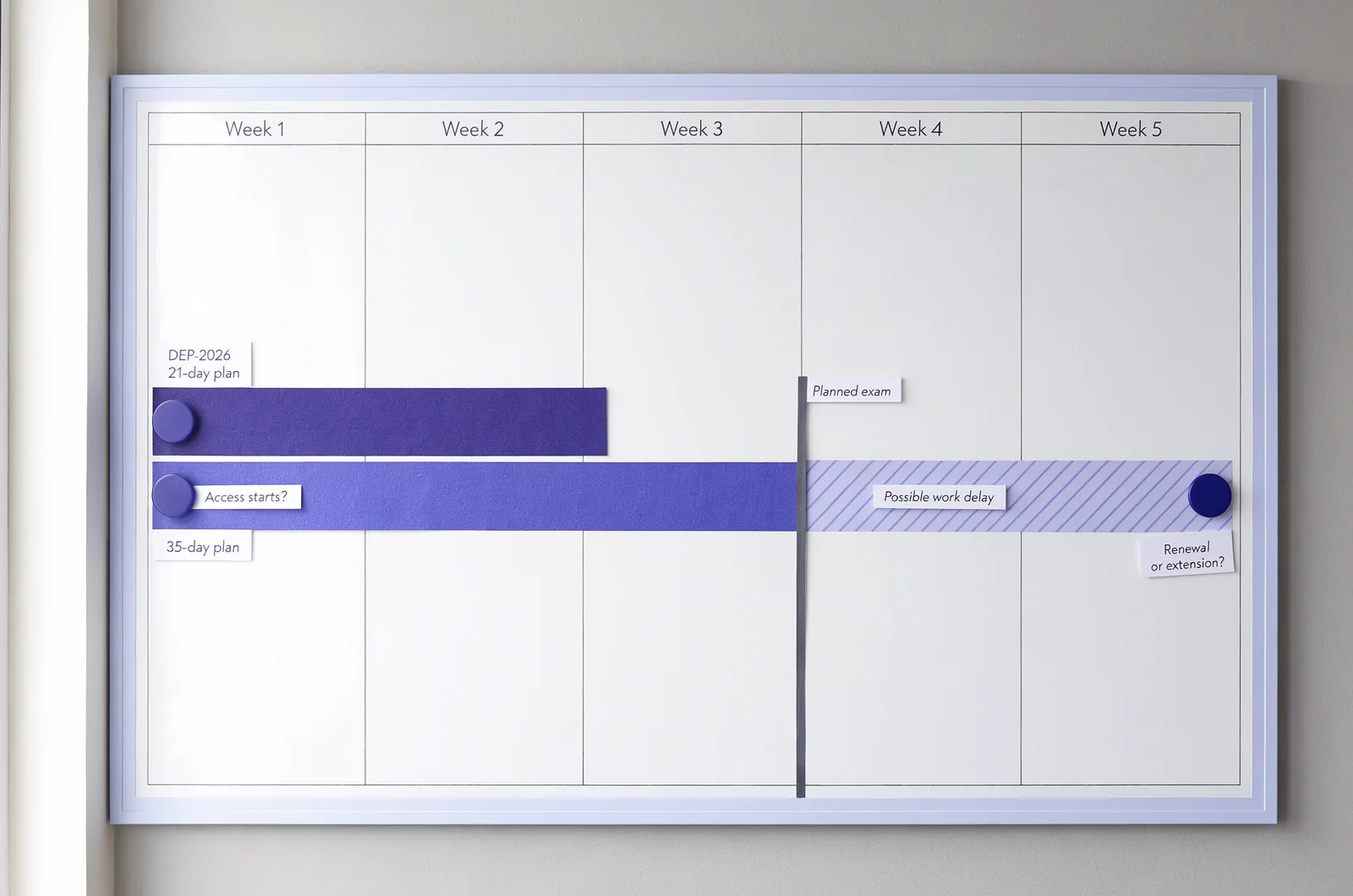
Say you plan three weeks of preparation, but a work deadline could push your exam back by another fortnight. Compare access for both a 21-day schedule and a 35-day schedule. This is a planning example, not a claim about any provider’s terms.
Check when access starts: purchase, activation or another stated event. Confirm whether renewal is automatic and whether extensions require a separate payment. Read any restrictions attached to advertised refund or money-back terms before including them in your decision.
You should also establish whether the displayed price covers the resource you inspected. A demonstration may show controls or content outside the package under consideration.
An access-window calculator would be useful here: enter your study start date, intended exam date and contingency period, then flag products whose stated access ends too early.
For your shortlist, write down the total payable amount, access end date and renewal conditions. Leave unavailable prices blank until you can verify them.
Choose for the gap in your preparation
The right practice format depends on what is stopping you from progressing towards your exam date. Use your current difficulties to set purchase priorities.
When explanations still change your understanding
Prioritise a question bank if reviewing an answer regularly reveals a misunderstanding you couldn’t identify beforehand.
Look for enough explanation detail to help you return to the relevant study material. Assess whether you can organise that review by topic, bookmark items or keep an external error log.
Choose the resource whose sample explanations most clearly resolve your own knowledge gaps.
When correct answers take too long
Prioritise session controls if you can explain your answers but struggle to finish practice within your intended time.
Inspect the timer and any review or navigation controls. Compare them with the applicable published format wherever that information is available.
Your evaluation session should include the complete submission process. Check what happens when time expires and how unfinished responses appear in the report.
When short study sessions are your main constraint
Look at how easily a resource supports stopping, resuming and revisiting unfinished work. Check those actions directly where a demonstration permits it.
Flashcards may suit some brief sessions; focused question sets may suit others. The decision depends on the material you need to practise.
Keep a longer session in your plan if you need to rehearse sustained concentration. Verify that your chosen package supports both the short sessions you can manage and the rehearsal you intend to complete.
Questions to settle before paying
A few unresolved questions can change which exam resource deserves your money. Settle them against the specific product rather than assuming that a provider’s wider reputation answers them.
Can a high practice score prove readiness?
A high score on a repeated set cannot, by itself, establish readiness. You need to consider whether you recognised answers, used explanations during the attempt or completed unfamiliar questions without assistance.
Assess the reasoning behind your responses alongside the result. Can you explain the condition that makes one option preferable? Can you identify why another answer fails?
Keep any provider’s readiness threshold separate from the actual exam’s scoring rules. Apply only scoring information you can verify.
Should you buy the largest question bank?
Question count alone is an insufficient basis for choosing. A larger advertised bank still needs clear explanations, relevant coverage and terms that fit your schedule.
Ask how questions are distributed across the applicable objectives. Check whether the stated total includes repeated variants or material outside your intended exam.
Compare sample quality first, then use verified question count as one part of the decision.
Is one platform enough?
One resource may be sufficient if it supports the learning, review and rehearsal you need. The evidence here does not establish that any particular package does all three for this exam.
Start by identifying your missing capability. If your existing material explains concepts well, a second explanation-heavy bank may duplicate that role.
My recommendation is to choose the smallest combination that addresses your identified gaps. Confirm exam alignment, inspect explanations and verify session controls before paying for additional content.
Timing, access and content freshness


Discussion
Question Comments
0 comments·0 participantsSign in to leave a comment and access more free questions.