

The unlimited access vs single exam purchase decision comes down to which exams you’ll actually study for during the access period. If you have one exam booked and a focused preparation window, I’d start with a single-exam package. A broader library earns its extra cost when several relevant exams fit your calendar. For a team, authorised seats and individual study needs matter just as much as catalogue size.
The useful comparison is the total cost of suitable preparation across your planned dates. A large library has little financial value if the material you need sits unused until access expires.
Match the purchase to your exam calendar
I’d judge each purchase model against four things: confirmed exam coverage, usable access duration, preparation quality and total cost. These three options address different study commitments.
| Purchase model | Best fit | Cost comparison | Main detail to verify |
|---|---|---|---|
| Single-exam package | One defined exam with a near-term deadline | Price for the required package and access period | Exact exam version and expiry date |
| Broad library access | Several planned exams within one access term | Library cost against those specific packages | Inclusion of every intended exam |
| Team licence | Multiple learners with scheduled certification goals | Total licence cost against separate authorised purchases | Seats, assignment rules and learner access |
These are purchase-model recommendations, rather than rankings of named providers. Prices, catalogue contents and licence terms need checking against the specific plan you’re considering.
Start by writing down your next exam and intended test date. Add another exam only if you can assign it realistic study time. That short list gives you something concrete to price.
Best for one booked exam: a single-exam package
A single-exam purchase is my starting recommendation when you have one target, a defined deadline and no scheduled follow-on exam. Its value comes from matching the purchase closely to the work ahead.
Pay for the preparation you can use
For a two-to-four-week preparation window, assess the package against your immediate gaps. You might need explanations, topic practice and timed sessions. A much wider catalogue deserves less weight if those other subjects won’t enter your schedule.
A four-week study plan can help you divide a short window between learning, practice and review. Make that allocation before deciding how much access to buy.
Check whether the package has enough material to revisit weak domains without relying entirely on remembered answers. Also confirm that its access lasts beyond your intended exam date if you need to reschedule.
Accept the narrower scope deliberately
The limitation is the extra purchase required when another exam becomes a firm goal. Separate packages can become more expensive across several exams, depending on their prices.
That possibility alone doesn’t justify buying a library today. A second certification on a wish list has a different budget status from one with study sessions reserved.
There is also a quality exception. If the individual package lacks useful explanations or suitable practice modes, its lower price may leave a gap you must fund elsewhere.
My recommendation is to choose the single-exam option when it covers your target adequately and lasts through your preparation window. Record its expiry date alongside your exam booking.
Best for a planned certification year: broader library access
Broader access becomes worth considering when several exam purchases would otherwise fall within the same usable term. The strongest case is a written study sequence with confirmed coverage.
Put every intended exam beside a date
A cloud engineer planning several credentials should list each exact exam, its preparation window and its likely booking month. A guide to Azure certification paths can help frame the sequence; check current requirements before committing money.
Then match that sequence against the library. Similar certification names are insufficient. You need the relevant exam code, version and preparation content.
Avoid assuming that access starts when serious study begins. Confirm the activation rule, then place the expiry date on your calendar. Time spent finishing another course may consume part of the paid term.
Give optional exploration a separate value
A library can be useful when you want to inspect another subject before committing to it. That flexibility may justify some extra spending, but I’d separate it from expected savings.
Calculate the financial case using exams you genuinely intend to prepare for. Treat exploratory browsing as an additional benefit with its own budget.
The limitation is schedule dependence. Work projects, family commitments or a difficult first exam can push later study beyond the term. A plan that saves money on paper may cost more after an extension.
My recommendation is broader access when the required packages would cost more, the content meets your needs and the study windows fit comfortably. Leave room between exams for revision or rescheduling.
Best for a team programme: access licensed for the learners
For a team buyer, the purchase decision starts with authorised users. A broad catalogue alone tells you little about whether a plan fits several employees.
Compare named learners and assigned exams
Build a simple roster with each person’s target exam, intended study dates and required access. This reveals whether the team has overlapping needs or several unrelated requirements.
Check whether the proposed licence permits those users and how seats are assigned. Ask about reassignment if someone changes role, leaves the programme or postpones study.
Learner progress also deserves attention. If reporting matters to your programme, confirm what managers can actually view. Keep it separate from claims about catalogue breadth.
A team licence deserves its place on the shortlist when it accommodates the planned learners at a sensible total cost. Individual packages remain a valid comparison, particularly for a small group with fixed targets.
Budget around likely participation
Assigned seats and active study are different measures. Estimate use from confirmed participants with protected study time, then compare the complete team cost with separate authorised purchases.
Include administration where it creates a real cost. Someone may need to assign access, answer account questions and review expiry dates.
The limitation is paying for capacity that the programme cannot use. A wider licence can become expensive if the headcount looks ambitious but managers haven’t agreed study time.
My recommendation is to choose the licence structure that fits the confirmed roster. Before paying, obtain clear terms for user numbers, assignment and access duration.
Calculate the break-even point across your study calendar
The extra cost of library access is justified financially only when it beats the cost of suitable alternatives over the same period.
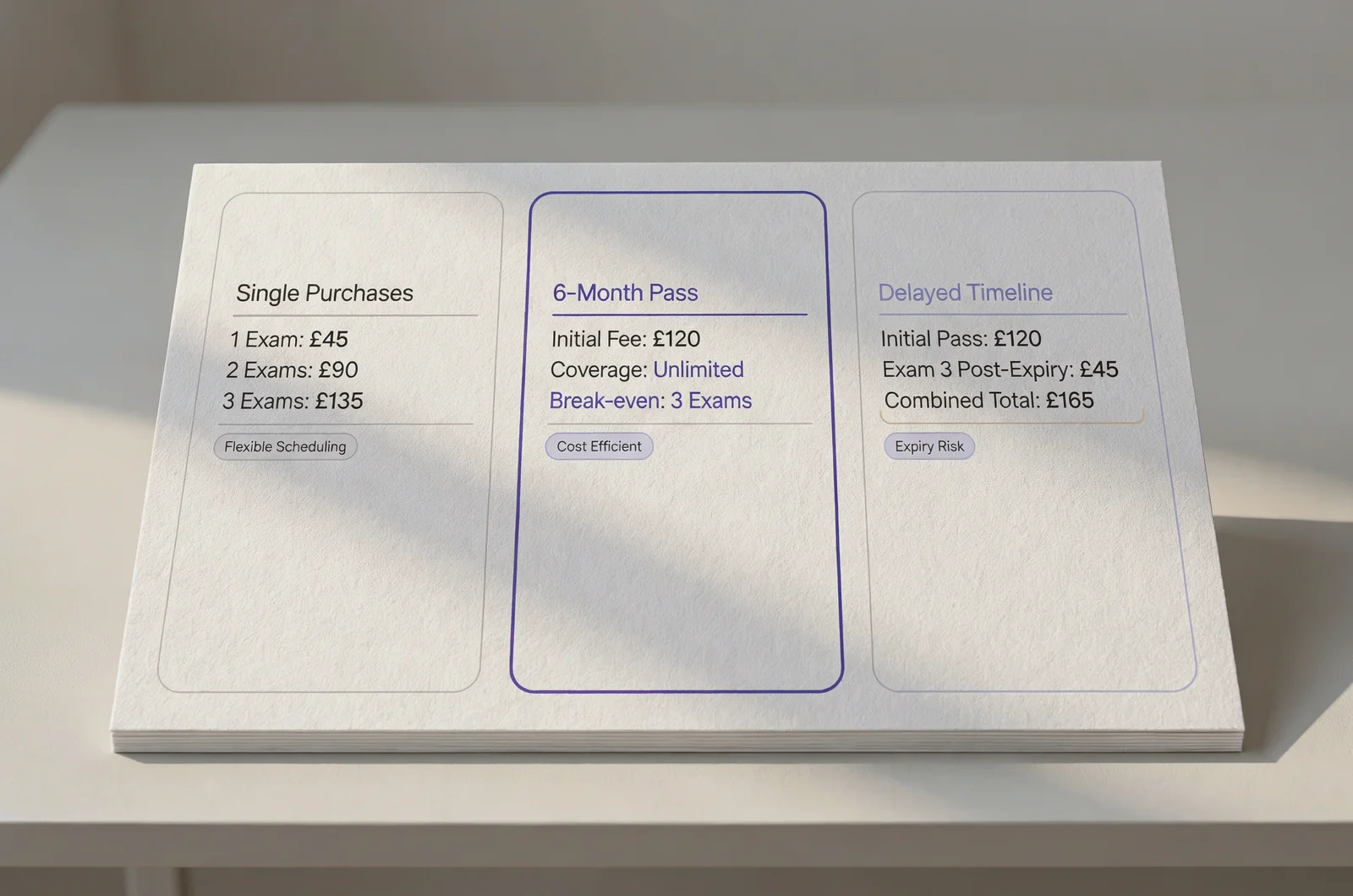
Use comparable totals
For separate purchases, add the prices of the exam packages you expect to need. Include any extensions or supplementary preparation that you already know are necessary.
For broader access, count the initial fee, any commitment or renewal needed to finish, and required material outside the plan. Check whether quoted totals include VAT where applicable.
Keep exam registration, rescheduling and retake budgets separate unless the package explicitly includes them. Preparation access and an exam booking are separate items to verify.
Also compare what each purchase contains. If one includes teaching and another contains practice questions, the prices alone won’t describe equivalent preparation. For an AWS study plan, standalone course comparisons can help you consider the teaching component separately.
A hypothetical six-month comparison
Suppose three suitable single-exam packages cost £45 each, while a six-month library pass costs £120. These are illustrative figures, not provider prices.
Two separate packages cost £90. The pass costs £30 more.
Three separate packages cost £135. If you use all three within the pass period, broader access saves £15.
Now move the third exam’s preparation into month eight. If the pass has expired and you buy that package separately for £45, your total becomes £165. Buying all three individually would have cost £135.
The calendar changed the result even though the package prices stayed identical.
Test the plan against a delay
Repeat your calculation with the second or third exam moved beyond the access term. This shows how dependent the saving is on keeping your schedule.
For recurring access, check the minimum commitment, billing interval and cancellation terms. For a fixed-term pass, check the extension price and what happens at expiry.
A useful break-even calculator would take package prices, access fees, exam dates and licence requirements, then compare totals with and without a study delay.
If the projected saving is small, I’d give more weight to content quality and flexibility. Use the delayed schedule as your final price comparison.
Check preparation quality before paying for breadth
The purchase model matters only after the material meets your exam needs. A cheaper package or larger catalogue cannot compensate for unsuitable content.
Inspect the target exam first
Review samples for the exact exam you intend to take. Assess whether explanations show why the selected answer fits and why plausible alternatives fail.
Check coverage against the applicable objectives. A large question count tells you little about whether your weaker domains receive enough attention.
Look for practice modes that match your study plan. Someone preparing around work may need short topic sessions alongside full-length timed practice. Comparing timed exam simulators can help you identify which capabilities deserve closer inspection.
Treat guaranteed-result claims cautiously in your own budgeting. Base the purchase on the material and terms you can assess.
Ask what the results help you do
A score is more useful when it supports a specific revision decision. Check whether you can identify weak domains, review explanations and distinguish fresh attempts from repeated questions.
Our guide to exam simulator analytics provides another angle for assessing that part of the package.
If PlanetCert is on your shortlist, apply these same checks to the access options you’re considering. Verify the target exam, duration, included tools and licence scope before comparing the price.
I’d also check these purchase details:
- When access begins and ends.
- Whether updates during the term are included.
- Which devices and practice modes are supported.
- Whether cancellation changes remaining access.
- What conditions apply to refunds or any money-back promise.
Save the terms that apply to your purchase. Resolve any uncertainty about your target exam before checkout.
Questions that can change the purchase decision
Access duration, exam changes and uncertain plans can each reverse an otherwise sensible choice.
Does a single-exam purchase mean lifetime access?
Check the stated duration. A one-off payment describes how you pay; the access terms determine how long you can use the material.
Confirm whether the period starts at purchase, activation or another defined point. If your exam might move, include that possibility in the comparison. Record the actual expiry date rather than relying on the package name.
Does broader access include the real certification exam?
Count an exam booking only when the purchase explicitly includes a suitable voucher or registration entitlement.
Check any separate validity dates and conditions. A long preparation period and a shorter voucher window would need to fit the same calendar.
Keep your preparation subtotal and exam-fee subtotal visible as separate budget lines.
What happens if the exam version changes?
Confirm which version the package covers and what update access, if any, applies during your term.
Ask whether a replacement version requires another purchase. Also check your intended booking against the applicable exam information before committing to a long study schedule.
A catalogue entry for a familiar certification name is insufficient evidence of the version you need.
Should I buy a year for one possible second exam?
I’d begin with the confirmed exam and calculate the premium for wider access.
Then give the possible second exam a provisional study window. If you cannot identify time for it, exclude it from projected savings.
Where an upgrade option exists, check its cost and deadline. Compare that route with buying broader access immediately, using the same exam dates.
Is the broader plan worthwhile if it only saves a little?
A small saving can still be useful when the content and access terms fit. But it leaves less room for schedule changes or an additional resource you later need.
Choose the suitable package with the lower realistic total. When the totals are close, use explanation quality, duration and flexibility to decide.
Assess practice options for your target exam


Discussion
Question Comments
0 comments·0 participantsSign in to leave a comment and access more free questions.