

How does AWS score multiple response questions? You must select the complete correct answer set to receive credit. There’s no partial credit for choosing only some correct options. If a question requires two answers, one correct selection and one incorrect selection earn no credit for that item. The practical response is to check the required count, test every option against the scenario, and verify your complete selection before moving on.
What all-or-nothing scoring means for your answer
AWS multiple response scoring makes the whole selection the unit that matters. Knowing one correct answer gets you partway through solving the question, but it doesn’t secure part of the credit.
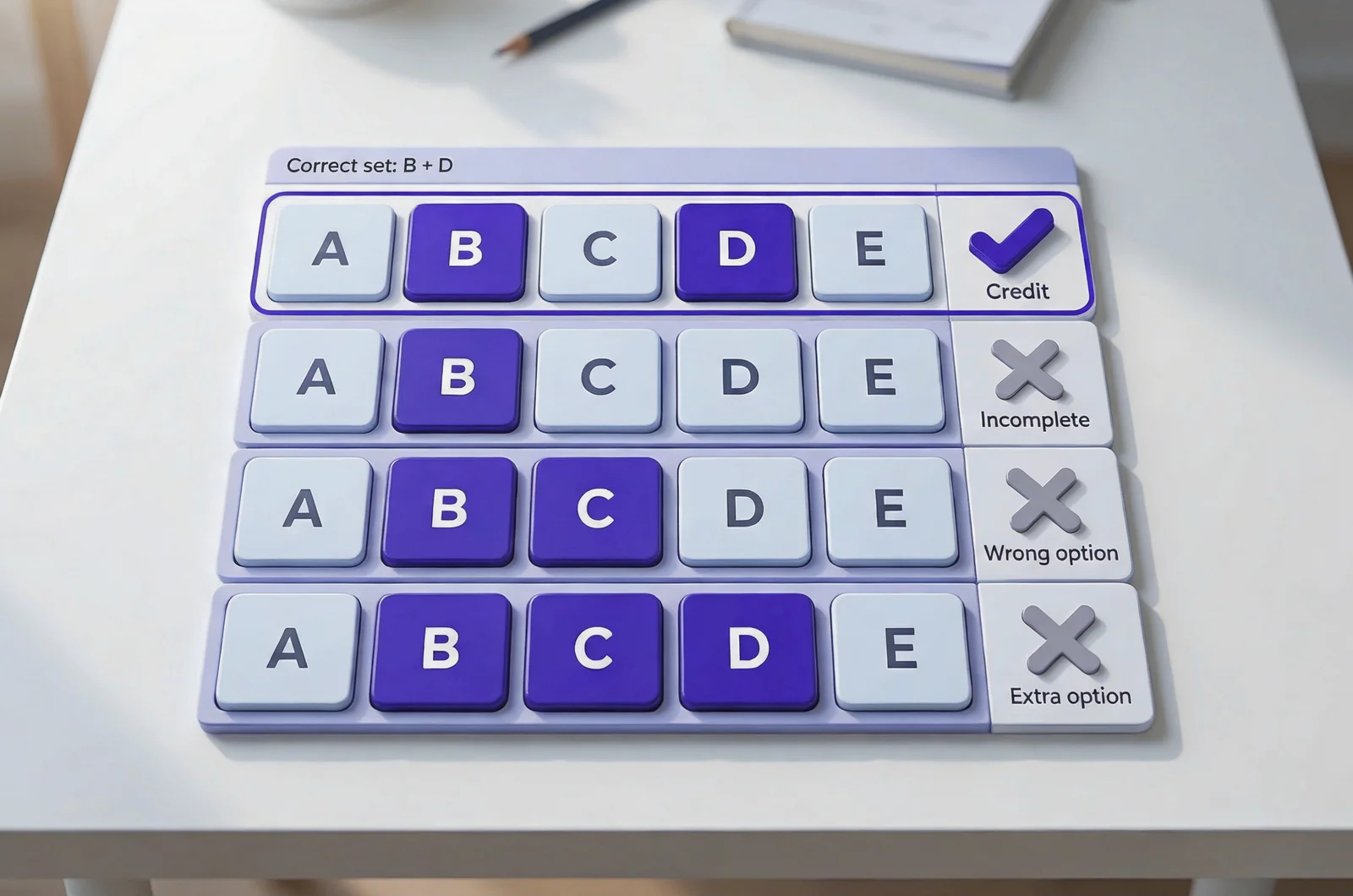
Consider a hypothetical item whose correct answers are B and D:
- Selecting B and D earns credit.
- Selecting B alone leaves the answer incomplete.
- Selecting B and C includes an incorrect option.
- Selecting B, C and D includes an extra incorrect option.
Only the first selection matches the required set.
This changes how you should review your work. Once you find an obvious answer, keep evaluating the remaining options. A familiar service name can make a question feel solved while the second selection still needs careful reasoning.
An incorrect set loses credit for that question; it doesn’t automatically mean you fail the exam. Your overall result depends on performance across the scored content.
During preparation, mark multiple response items using the same complete-set rule. You can record individual correct selections separately to diagnose progress, but your readiness score should count an incomplete set as incorrect.
Read the scaled score without turning it into a percentage
AWS certification results use a scaled score from 100 to 1,000. The passing thresholds for the three certification levels covered here are:
- Foundational: 700.
- Associate: 720.
- Professional: 750.
Check the current guide for your exact exam before using a threshold to plan your preparation.
A scaled score of 720 does not mean you answered exactly 72% of the questions correctly. Scaling means you cannot reliably convert the published passing score into a fixed number of questions you may miss.
The same caution applies to multiple response items. Counting individual correct checkboxes won’t tell you how close you are to passing. Each complete answer set contributes to your performance on the exam; the published threshold doesn’t provide a points-per-checkbox calculation.
Practice percentages remain useful for tracking improvement across comparable, unfamiliar question sets. Keep those percentages separate from predictions about your official result. Guidance on practice test score accuracy can help you judge those limits.
Record your practice percentage, the number of multiple response items answered completely correctly, and the topics behind your errors. Compare those measures across sessions.
Use four checks before submitting a multiple response answer
For an AWS multiple response item, the answering process should protect you against both knowledge gaps and selection errors. I recommend these four checks.
1. Fix the required answer count
Read the instruction that specifies how many answers to choose. Keep that number in mind while evaluating the options.
This sounds basic, but a long scenario can pull your attention towards architecture details before you register the selection requirement. Finding two plausible answers is insufficient when the item asks for three.
Before submitting, count your selected options again. This final count catches accidental omissions and extra selections.
When practising, record answer-count errors separately from technical errors. If you understood the services but selected the wrong number, the correction is a reading habit. Rewatching an entire technical lesson won’t directly address that problem.
Your check is simple: the number selected must match the number requested.
2. Turn the scenario into constraints
Identify what the question requires before deciding which services or actions fit.
Look for requirements involving availability, security, performance, cost or operational effort. Pay attention to qualifiers such as minimum administration or automatic recovery. These can determine which otherwise plausible option is appropriate.
Reduce the scenario to a short mental statement. For example: the solution must survive a server failure and avoid permanent credentials in application code.
Then evaluate answers against that statement. An option may describe a valid technical action while failing the specific requirement.
Before moving on, ask yourself what would make an option wrong in this scenario. If you cannot name the constraints, reread the question before comparing service names.
3. Give every selection its own justification
For each candidate answer, explain how it satisfies a stated requirement. A short reason is enough.
Avoid choosing an option simply because it often appears beside another service in study material. Familiar combinations can be distracting when the question changes a constraint.
Equally, don’t require each selected option to solve the entire scenario alone. Multiple selections may be components of one solution. Each component needs a defensible role in meeting the requirements.
If you can justify one answer confidently but have no clear reason for the second, keep evaluating. The first answer’s strength does not transfer to the other selection.
During untimed practice, say the reason aloud or write it down. Check that your explanation names both the capability and the requirement it meets.
4. Recheck the complete set
Read your selected answers together. Confirm that they collectively meet the scenario and that neither relies on an unstated assumption.
Then revisit the strongest rejected option. Identify the precise reason it fails: perhaps it needs manual intervention, introduces unnecessary administration, or leaves a requirement unmet.
This comparison is especially useful when several choices are technically possible. The deciding detail often sits in the question’s constraints.
Use the final check to catch a contradiction between your selections. Two individually plausible actions may describe incompatible approaches or duplicate one part of the solution while leaving another uncovered.
Finish by checking the required count again. Submit when every selected option has a reason and the complete set addresses the question.
Work through a hypothetical choose-two question
A simplified AWS workload example shows how complete-set reasoning works. The capabilities below are supplied as part of the hypothetical scenario.
Match the options to the stated requirements
Suppose an application has two requirements:
- It must continue serving traffic automatically if one application server fails.
- Its application code must contain no permanent access credentials.
Assume either surviving server has enough capacity for the workload. Choose two actions:
- A. Run several application processes on one server.
- B. Use independent application servers with automatic traffic redirection after a server failure.
- C. Store permanent access credentials directly in the application code.
- D. Use the available temporary-credential mechanism, which requires no permanent credentials in the code.
- E. Keep one application server and document a manual rebuild procedure.
Start with the required count: two.
Next, separate the requirements. One concerns continued service after a server failure. The other concerns credentials in application code. That gives you two tests for the options.
Explain both the selected and rejected answers
B meets the stated availability requirement. The scenario explicitly provides independent servers, enough surviving capacity and automatic traffic redirection.
D meets the credential requirement. Its described mechanism supplies temporary credentials without placing permanent credentials in the application code.
A leaves every application process dependent on the same server. C directly conflicts with the credential requirement. E depends on manual recovery, which fails the automatic-continuity requirement.
The complete answer is B and D.
Selecting B and E would leave the credential requirement unanswered. Selecting D alone would leave the availability requirement unanswered. Adding A to B and D would introduce an incorrect extra selection.
In technical practice questions, service capabilities will require more knowledge than this simplified example. Apply the same discipline: identify the requirement each option meets, then check the complete set.
Train for complete answer sets in timed practice
Your AWS preparation should measure whether you can produce fully correct selections consistently. Build that skill in untimed sessions before adding time pressure.
Review why the whole set was wrong
In a PlanetCert practice test, use the explanations to examine both your selected answers and the alternatives you rejected.
For each missed item, record the specific cause:
- You missed a required answer because you didn’t know a service capability.
- You selected a distractor because it sounded familiar.
- You overlooked a constraint in the scenario.
- You chose the wrong number of options.
- You changed a justified selection without finding new evidence.
These errors need different responses. A capability gap calls for targeted study. A missed qualifier calls for a more deliberate reading check. Repeated answer-count errors call for counting selections before submission.
Use exam simulator analytics to identify recurring topic weaknesses, alongside your own notes about selection errors.
For facts you repeatedly confuse, turn the distinction into a short review prompt. Suitable spaced repetition schedules can help you revisit those distinctions between longer study sessions.
Write the correction as a decision rule you can apply to a new question.
Add timing after your reasoning becomes consistent
Use a timed PlanetCert simulator session to check whether your selection routine holds under pressure. Keep checking the count, constraints and justification for each answer.
Your first timed goal is to preserve the reasoning that worked during untimed practice. Speed should come from recognising requirements and eliminating options more efficiently.
A useful approach to timed practice exams separates learning sessions from pacing sessions. During learning, inspect explanations carefully. During a timed attempt, complete the session before reviewing the answers.
Track full-set accuracy on unfamiliar items. Repeatedly answering remembered questions can inflate confidence without showing whether you can evaluate a fresh scenario.
Also record whether time pressure changed the kind of mistakes you made. If your knowledge stayed steady but omissions increased, practise the final count check until it becomes routine.
Check your practice tool’s marking behaviour
Inspect how your practice material handles incomplete selections. An answer that includes one correct and one incorrect choice should not appear as fully correct.
If a tool displays partial progress for learning purposes, keep that measure separate from your complete-question accuracy.
A useful interactive study aid could compare your selected letters with the correct set and identify missing or extra choices. Its purpose would be to expose selection patterns.
Before trusting a practice percentage, confirm that you understand what the tool counts as a correct question.
Handle uncertainty before you leave a question
AWS multiple response questions can leave you confident about one selection and uncertain about another. Use the evidence in the scenario to make that final decision.
Is one correct selection worth partial credit?
No. The complete selection must be correct to earn credit for a multiple response item.
One correct choice can still tell you something useful during preparation: you understood part of the problem. Record that progress in your review notes, while marking the question itself incorrect.
Does an Associate score of 720 mean I need 72%?
No. The passing threshold is a scaled score, so that calculation doesn’t establish the raw percentage required.
Use practice percentages to compare your own performance across suitable question sets. Avoid planning around an assumed allowance of incorrect answers. Review the topics behind incomplete sets instead.
Should I change an answer during review?
Change it when you identify a concrete reason. You may have missed a qualifier, recalled a relevant capability, or discovered that your selections leave a requirement unmet.
Feeling uneasy is less useful evidence. Before changing an answer, state what you noticed and how it changes the option’s fit.
What should I do with the last uncertain selection?
Compare the remaining candidates against the exact requirement. Identify the assumption each would need, then prefer the option supported by the scenario.
Choose the required number of answers. If review is available, flag the item and return after completing other questions.
On your final pass, confirm the selection count and the reason for each answer.
Check your AWS study materials


Discussion
Question Comments
0 comments·0 participantsSign in to leave a comment and access more free questions.