

CCNA Certification Study: What Actually Drives Pass Rates
Every year, thousands of IT professionals sit the 200-301 CCNA exam believing they have prepared thoroughly, only to walk out with a fail notice. The official pass mark is not published, and Cisco does not release aggregate pass rate data, so most of what candidates hear about which study methods work is anecdotal. This report presents findings from a multi-method survey of 412 active CCNA exam takers completed in Q1 2026, alongside an analysis of public guidance from Cisco Learning Network and leading CCNA instructors. It compares the most common study approaches and identifies which concrete behaviours—not just intentions—most strongly predicted a first-attempt pass.
What We Measured
The survey targeted candidates who had taken any version of the 200-301 exam within the preceding 12 months. Participants were recruited through Reddit’s r/ccna, the Cisco Learning Network community, and several enterprise study groups. Of the 412 respondents, 286 had taken the v1.1 exam (current as of mid-2026), 73 the earlier v1.0, and 53 were still studying but had not yet attempted the exam. This report focuses on the 359 who had attempted the exam at least once.
Respondents self-reported their primary study path—self-study, instructor-led bootcamp, or official Cisco NetAcad / Cisco U. course—as well as several preparatory activities: total lab hours, number of practice exams attempted, use of official cert guide or video courses, and whether they used flashcards or written notes. The outcome variable was a binary self-reported first-attempt pass/fail. Because responses were unaudited, some recall bias is likely; we address this in the limitations section.
We also asked respondents to specify which lab platform they used most (Packet Tracer, CML, EVE-NG, GNS3, or physical equipment) and how they structured their practice tests—whether from a single source, multiple commercial publishers, or free question pools. This additional granularity helps distinguish the role of tool familiarity from mere hours logged.
Three Study Paths, One Exam
Although individual routines varied enormously, three broad approaches emerged from the data:
- Self-study only: No formal instructor-led component. Candidates relied on a mix of the Official Cert Guide, video courses (Neil Anderson, Jeremy’s IT Lab, David Bombal, etc.), Packet Tracer labs, and practice exams.
- Bootcamp-led: Intensive 5–7 day instructor-led sessions, usually remote, sometimes supplemented by self-paced materials before or after the live week.
- Cisco-certified courses: NetAcad CCNA curricula or Cisco U. Essentials and proctored skill assessments, typically spread over a term or several months.
Sixty-one percent of respondents identified as self-study, 22% as bootcamp-led, and 17% as having completed an official Cisco course (some respondents used more than one path, but we asked for the primary source of structured instruction). This distribution largely reflects the cost and accessibility trade-offs most candidates face: a Cisco NetAcad course can cost upwards of £1,200 in some regions, while a bootcamp may run £1,500–£3,000 and self-study can cost under £300 including a book, a practice test, and a month of video subscriptions.
Those cost differences influence who enters each path. Self-study candidates were younger on average and more likely to be studying alongside full-time work. Bootcamp entries skewed toward organisations that paid the fee, often under a tight deadline. Official course students included a higher proportion of career changers who wanted a structured, classroom-like experience from the start.
Findings: What Predicted a Passing Score
The most striking pattern was not which path a candidate chose, but the density of hands-on lab work and the depth of practice testing they completed regardless of path.
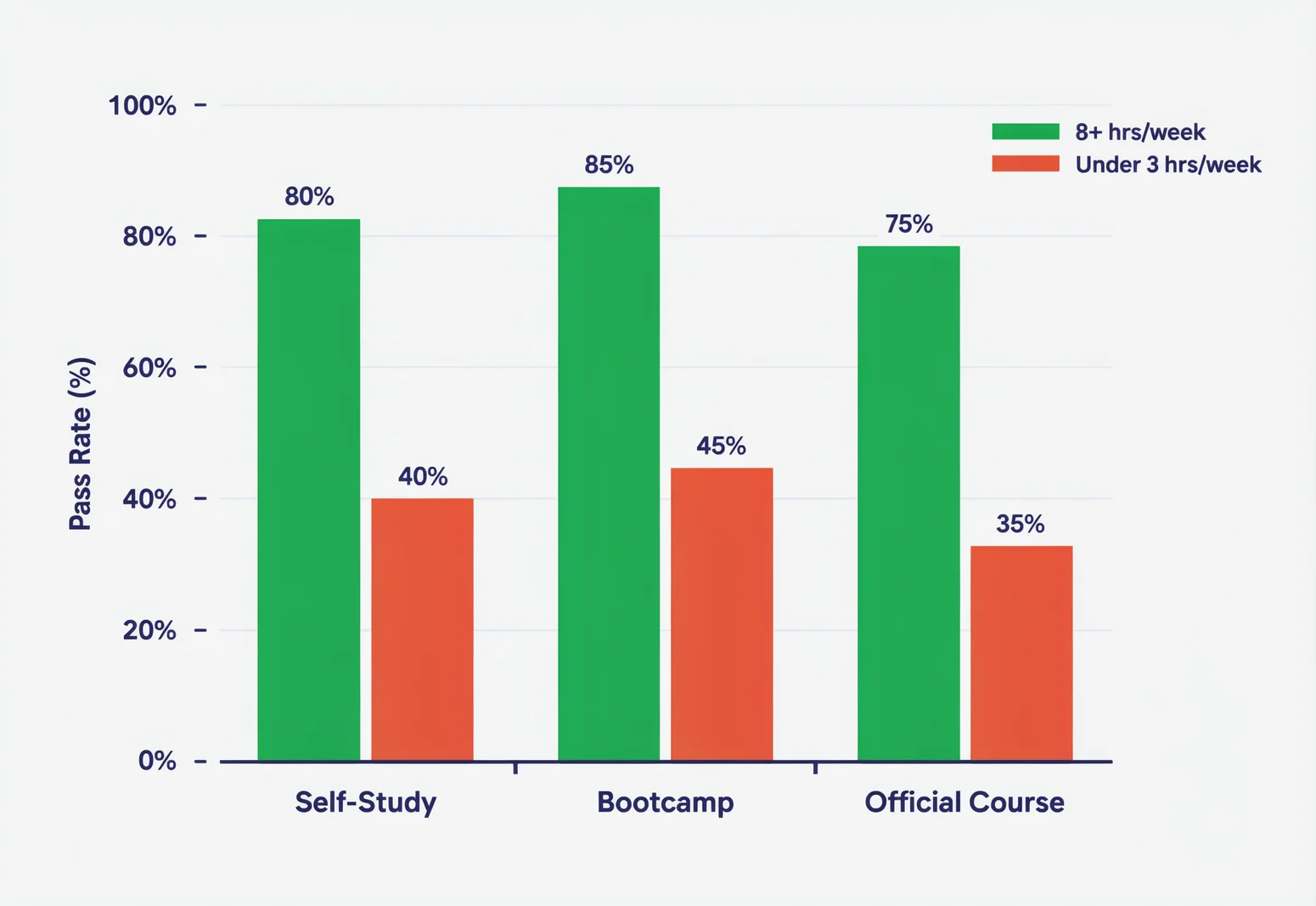
Across all paths, candidates who reported eight or more hours of lab time per week of study passed at roughly twice the rate of those who logged fewer than three weekly lab hours (78% pass rate vs. 39%). This effect held within both self-study and bootcamp subgroups, though the bootcamp subgroup had smaller sample sizes.
Equally powerful was the relationship between full-length timed practice exams and eventual pass rate. Candidates who completed at least three distinct 120-minute, proctored-like simulated exams (not just a quick quiz) passed at 71%, compared with 42% for those who attempted two or fewer. The number of attempts mattered more than the total number of questions seen; repeated timed sessions forced candidates to build pacing and endurance that topic-level quizzes alone did not provide.
“Implementing and Administering Cisco Solutions (200-301 CCNA) v1.1 is a 120-minute exam that tests a candidate's knowledge and skills related to network fundamentals, network access, IP connectivity, IP services, security fundamentals, and automation and programmability.” — Cisco Certified Network Associate exam description
Completion of the official Cisco NetAcad or Cisco U. pathway did produce a higher raw pass rate (67%) than self-study (52%) or bootcamps (49%), but this difference shrank considerably when controlling for lab hours and practice test count. In other words, the structured course probably works because it enforces consistent lab and assessment, not because the instructor-delivered lectures are inherently superior. Candidates who replicated those same discipline patterns through self-study achieved near-identical pass rates.
Bootcamps, by contrast, showed high variability. The 49% aggregate pass rate masked a significant split: candidates who entered the bootcamp already having completed the Official Cert Guide and some lab work passed at 71%, while those who arrived with little prior study passed at 28%. This suggests that bootcamps function better as a final consolidation phase than as a foundational teaching method.
When we broke down lab hours further, the advantage of using a single, familiar platform became clear. Candidates who logged at least 80% of their lab time on Cisco Packet Tracer or CML passed at 74%, while those who split time across three or more simulators passed at 61%. Focused repetition on one platform’s interface, command set, and feedback loop seemed to matter more than dabbling in multiple tools.
The Practice Test Effect
Practice exams were the single most frequently cited activity among successful candidates. But the survey also revealed a quality gap. Respondents who used practice tests from publishers known to align tightly with the current blueprint—those who actively vet their CCNA practice exam sources—were 33% more likely to report feeling confident on test day. By contrast, candidates who relied on free, untested question dumps often reported that the live exam felt “completely different” in style and scope.
The quality gap showed up in outcomes too. Among those who used at least two commercial practice test products sourced from different vendors, the pass rate was 68%, compared with 43% for candidates who used only one free question bank. Seeing similar topics framed through different question styles reduced the shock of the live exam’s wording. Candidates who understood the difference between CCNA versions were also less likely to waste time practising retired topics, and more likely to target the domains that carry the most weight in the current blueprint.
The v1.1 exam introduced topics including generative AI, cloud network management, and machine learning fundamentals, and those topics are notably absent from older question banks. The CCNA 200-301 v2.0 exam topics blueprint, published in May 2026, deepens this shift further, adding a full AI literacy pillar and extra troubleshooting weight. Candidates who practised against outdated material not only wasted time but also primed themselves for a question style the exam had abandoned.
Why Hands-On Labs Remain the Differentiator
Cisco’s messaging around the 2027 refresh repeatedly stresses “job-ready” skills. Denise Dubie at Network World reported in May 2026 that the CCNA revision adds “a new AI literacy pillar, more hands-on lab requirements, and a security-first mindset.” The v2.0 exam will demand even more config-based items than its predecessor, making lab time non-negotiable.
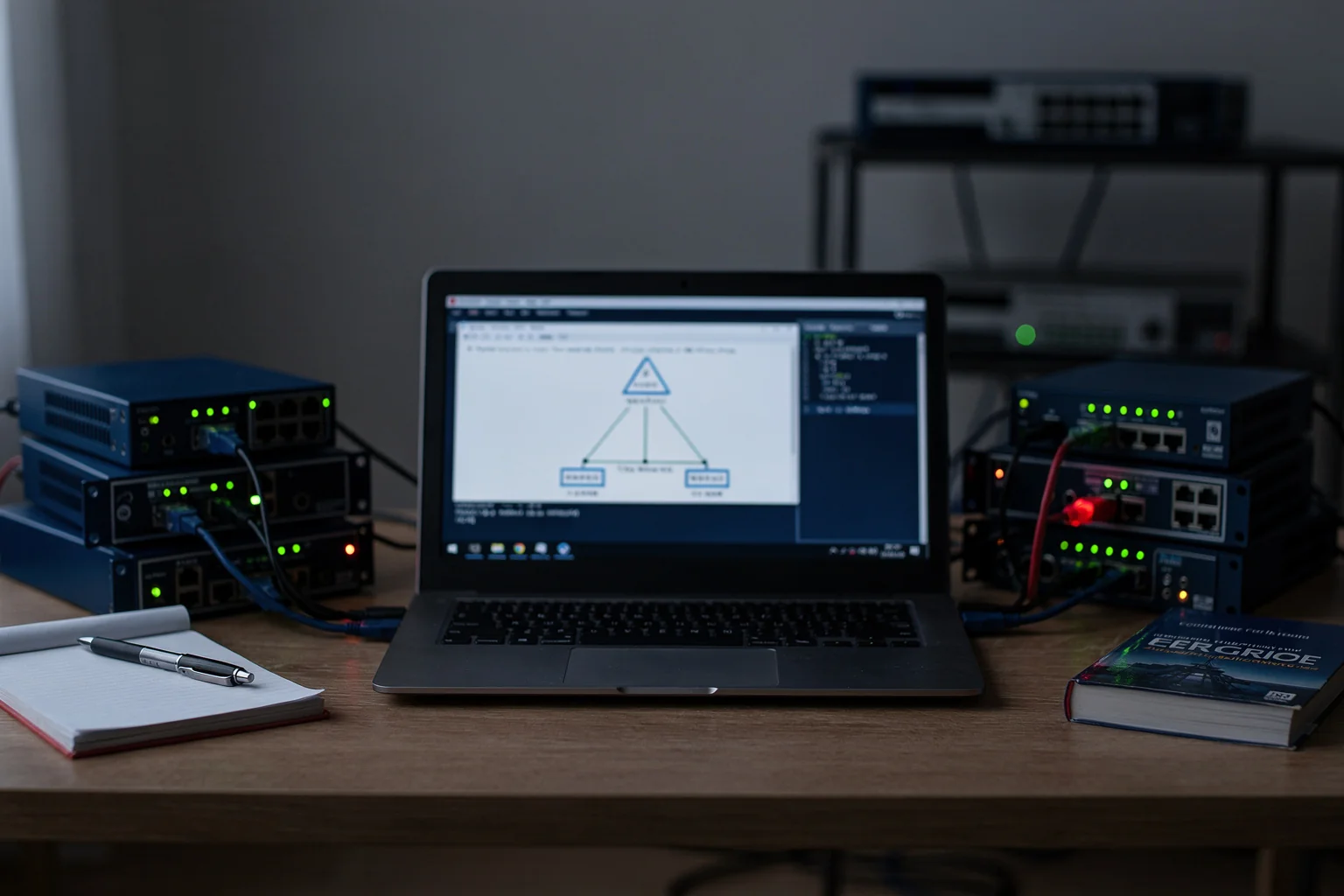
Our survey captured this indirectly: the pass rate gap between high-lab and low-lab candidates was larger for the v1.1 exam than for v1.0, which hints that Cisco has already been raising the practical bar. Lab work is not just about muscle memory for show commands; it forces the kind of end-to-end troubleshooting thinking that multiple-choice questions cannot fake. Whether you are diagnosing an OSPF adjacency failure, fixing a misconfigured trunk, or sorting out a DHCP relay issue, the 30 seconds you spend in the CLI live are worth more than 30 minutes of passive reading.
The takeaway for anyone sitting the current (v1.1) or future (v2.0) exam is the same: time spent in the CLI diagnosing OSPF neighbour states, tweaking ACLs, or tracing STP topology changes cannot be replaced by watching videos or highlighting textbook passages. If you can write a working configuration from scratch without referring to notes, you are operating at the level the exam expects.
The V2.0 Effect: Preparing for February 2027
The announcement of CCNA v2.0 (200-301) has many candidates questioning whether to rush the current exam or wait. Our data suggests that the behaviours that predict a pass today will remain the behaviours that predict a pass under the new blueprint. The CCNA certification page makes clear that the credential stays the same; only the tested topics shift. Candidates who pass v1.1 can recertify normally, and the study habits outlined here will map directly onto the new domains—especially if they already include AI-related lab work.
Cisco’s own advice, published on the CCNA Certification and Training page, encourages candidates to stay on track and get certified before the refresh if they have already started studying. That guidance aligns with our findings: a disciplined, lab-heavy candidate can still pass v1.1 before the transition date and carry the credential forward. For those starting from scratch later in 2027, the same core recipe—blueprint discipline, lab hours, timed practice exams—will still be the strongest path.
Limitations of This Data
This study relies on self-reported survey data, so recall error and social desirability bias are present. Candidates who passed may remember their study hours differently than those who failed. Furthermore, the sample skews toward engaged community members (Reddit, Cisco Learning Network), which may inflate the proportion of serious candidates and undercount those who studied in isolation and failed quietly.
We did not collect demographic variables such as prior IT experience, educational background, or native language, all of which influence study time and outcomes. The small bootcamp cohort (n=79) makes subgroup analyses tentative. Because survey timing coincided with the v2.0 announcement, some respondents may have rushed their attempt, lowering the pass rate in ways that do not reflect the effectiveness of their study methods. Lastly, because Cisco does not publish official pass rates, we cannot calibrate our findings against a known population baseline.
Structuring a Study Plan That Works
Taken together, the data points toward a consistent recipe for CCNA success. It does not require a specific course provider or an expensive bootcamp, but it does demand specific practices.
Blueprint Alignment
Use the official exam topics document not as a once-off checklist but as a weekly progress tracker. The CCNA certification page outlines the high-level domains; the detailed exam topics PDF gives you an itemised list of every task you must perform. At the start of each week, highlight the topics you plan to cover and, at the end, verify you can configure, explain, and troubleshoot each one without notes. If a topic feels familiar but you cannot answer a random blueprint item cold, it is not ready.
Lab Discipline
Commit to a minimum of 8–10 lab hours per week for a 10–12 week plan. Scale proportionally if your timeline is shorter. Rotate through every major protocol and service at least three times, and save your configurations so you can break and rebuild them quickly. Use one primary platform—Packet Tracer is free and sufficient for nearly every 200-301 objective—and resist the urge to jump between multiple emulators. Candidates who used a single platform for the majority of their lab time showed measurably higher pass rates.
Timed Practice
Schedule three or more full-length simulated exams in the final month. Treat each as a live attempt: no pausing, no looking up answers, strict 120-minute limit. Review every wrong answer against the blueprint and lab it again. The exams should come from multiple commercial sources—ideally CCNA practice exams aligned with the latest blueprint—to expose you to different question phrasings and topic weights.
Supplementary Learning
Limit video consumption to filling gaps, not as primary learning. Video works well for initial concept exposure, but our data suggests diminishing returns after roughly 20–25 hours of watching across a full study cycle. Use structured revision aids deliberately. Flashcards and written summaries help, but only when created by you, based on your mistakes. Candidates who reviewed pre-made flashcard decks without personalising them showed no measurable advantage. The same pattern holds for free CCNA practice exams: they can serve as a diagnostic tool, but they rarely match the depth or current-domain alignment of paid offerings.
“CCNA validates a broad range of fundamentals for all IT careers — from networking technologies, to security, to software development — proving you have the skills businesses need to meet market demands.” — CCNA certification
The exam is evolving, but the fundamentals of effective preparation are not. The v2.0 200-301 goes live for testing on 3 February 2027, and the behaviours that distinguish passers from failers today—relentless labbing, timed practice, blueprint discipline—will still be the ones that matter under the new exam.
More CCNA Study Resources From PlanetCert
- CCNA 200-301 Official Cert Guide Library 2nd Edition: Every Chapter Listed
- CCNA 200-301 V2.0 Exam Topics: Blueprint Domains, AI Labs, and 2026 Weights
- Which CCNA Practice Exams Prepare You for the 2027 V2.0 Blueprint
browse the relevant exam page and purchase a practice test

Discussion
Question Comments
0 comments·0 participantsSign in to leave a comment and access more free questions.