

Entry-Level AWS Cloud Practitioner Jobs That Pay Well in 2026
You have the CLF-C02 on your calendar — or maybe you are still deciding whether to book it. Either way, you want to know what happens after you pass. Which doors actually open? What do entry-level AWS Cloud Practitioner jobs pay in 2026, and which roles treat the cert as a real qualifier rather than a nice-to-have?
This article maps the job types that actively recruit at the Cloud Practitioner level, shows verified salary bands from 2026 postings, and connects each role back to the exam prep that gets you through the door. No generic career advice. Just the roles, the numbers, and the study path that matches them.
What the CLF-C02 Actually Proves to Employers
The AWS Certified Cloud Practitioner exam validates foundational knowledge of AWS Cloud concepts, core services, security and compliance, and cloud economics. AWS states that the target candidate has up to six months of exposure to AWS Cloud design, implementation, or operations — or works alongside people who do. That makes it an explicit entry point for early-stage cloud careers and for line-of-business staff who need cloud literacy.
Employers read the cert two ways. For technical roles, it signals you understand the AWS console, billing models, and shared-responsibility security basics without needing hand-holding. For non-technical roles — sales, project coordination, support account management — it proves you can speak credibly to technical teams and customers. Both paths show up in 2026 job data.
The exam itself costs $100, takes 90 minutes, and uses 65 scored questions plus 15 unscored. You need 700 out of 1000 to pass. The current version is CLF-C02, which updated the domain weightings and added modern services like AWS App Runner and expanded sustainability content. If you are scheduling now, verify you are booking CLF-C02, not the retired CLF-C01.
How We Sourced the Salary Data
Salary figures in this article come from three types of 2026 signals: active job postings on major boards, compensation aggregator reports with stated methodologies, and AWS's own early-career program documentation. We cross-referenced ZipRecruiter, Indeed, Glassdoor, Payscale, and Levels.fyi data from January through August 2026.
A few caveats matter. "Entry-level" means different things across employers. Some postings require zero professional IT experience; others want 6–12 months in a related field. Location swings are extreme — a cloud support role in the San Francisco Bay Area can pay 40–60% more than the same title in a secondary US market. We quote ranges where the data is thick enough to trust, and flag single-source figures where appropriate.
With that context, here are the job types that consistently appear in 2026 listings asking for or accepting the AWS Cloud Practitioner credential.
Cloud Support Associate: The Most Common Entry Point
Cloud Support Associate is the role AWS itself hires most aggressively at entry level, and it appears across partner and customer organizations too. In 2026, AWS's own job board lists this as a primary early-career path, with cohort-based training followed by on-the-job specialization.
Typical 2026 salary band: $72,000–$95,000 base in US Tier 2 markets; $95,000–$120,000 in Tier 1 metros like Seattle, San Francisco, New York, and Boston. Total compensation at AWS specifically includes signing bonuses and stock that can push first-year value higher, though stock vests over time.
What you actually do: Triage customer issues through tickets, chat, and phone. Diagnose connectivity, billing, IAM permission, and basic service configuration problems. Escalate to senior engineers when you hit service limits or architectural questions beyond the support scope. Document solutions for the knowledge base.
Why the CLF-C02 fits: You need to understand AWS service boundaries, support plans, and basic troubleshooting workflows. The exam's security and compliance domain maps directly to the IAM and VPC questions customers ask daily. The economics domain helps you explain billing anomalies.
Limitation: Pure support roles can narrow your technical growth if you stay too long. Many associates treat it as a 12–18 month stepping stone toward solutions architecture, DevOps, or specialty engineering.
Junior Cloud Operations Technician: Hands-On Infrastructure
Junior Cloud Operations roles sit between support and engineering. You monitor infrastructure, respond to alerts, execute runbooks, and perform routine maintenance like patching, backup verification, and cost-tag cleanup.
Typical 2026 salary band: $68,000–$88,000 in most US markets; $90,000–$110,000 in top-paying metros. Contract-to-hire positions sometimes start lower but convert with a bump.
What you actually do: Watch CloudWatch dashboards. Respond to PagerDuty alerts for EC2 Auto Scaling events, Lambda errors, or S3 bucket policy changes. Execute documented procedures for certificate rotation, AMI updates, and cost allocation tag audits. Work with senior engineers to automate repetitive tasks.
Why the CLF-C02 fits: The core services domain covers EC2, S3, Lambda, and CloudWatch at exactly the depth operations needs. You will not architect systems, but you need to know what each service does, how it bills, and where to check its health.
Limitation: Employers often want some Linux or Windows server experience alongside the cert. If you are coming from a helpdesk background, this transition is natural. If you are switching careers, you may need to demonstrate lab work or a home project.
Cloud Administrator (Entry Level): The Generalist Track
Cloud Administrator titles appear across mid-size companies, managed service providers, and government contractors. These roles blend user management, resource provisioning, cost monitoring, and light automation.
Typical 2026 salary band: $75,000–$95,000 base, with government and defense-adjacent roles often at the higher end due to clearance requirements. Indeed's 2026 listings show this title frequently paired with "familiarity with AWS, Azure, or ITIL knowledge" as a baseline.
What you actually do: Provision IAM users and groups with least-privilege policies. Monitor AWS Cost Explorer and set up billing alarms. Maintain VPC subnets, security groups, and route tables. Document operational procedures. Occasionally write basic CloudFormation or Terraform under senior guidance.
Why the CLF-C02 fits: This is the broadest match. The exam covers IAM, VPC basics, billing tools, and compliance frameworks — all daily concerns for administrators. Multi-cloud employers value the cert as proof you understand one platform deeply enough to learn a second.
Limitation: "Administrator" means different things at different companies. Some postings are glorified support roles; others expect scripting and infrastructure-as-code within six months. Read job descriptions carefully for Terraform, Python, or PowerShell requirements.
Associate Professional Services Consultant: AWS's Own Fast Track
AWS runs structured early-career programs that combine training, certification, and client-facing work. The Associate Professional Services Consultant track is the most visible, with explicit CLF-C02 and Solutions Architect Associate requirements built into the curriculum.
Typical 2026 salary band: AWS does not publish exact figures, but Glassdoor and Levels.fyi data for early-career Professional Services roles suggest $95,000–$125,000 base plus significant equity. The total first-year compensation often exceeds $130,000 in US headquarters cities.
What you actually do: Complete an accelerated training program — cohort-based, with shadowing of senior consultants. Then work on customer implementations: migrating workloads, configuring well-architected reviews, and building proof-of-concept environments. Prepare for additional certifications aligned to your assigned specialty.
Why the CLF-C02 fits: AWS requires it as a program milestone. You will take it during training, then move toward Solutions Architect Associate. The foundational knowledge lets you participate in customer conversations without slowing down senior team members.
Limitation: These programs are competitive. AWS typically wants a technical degree or demonstrable equivalent, and the application cycle has specific windows. It is not an on-demand hire.
Junior Data Engineer: The Emerging Pipeline Role
Data engineering roles increasingly accept Cloud Practitioner as a starting cert, especially when paired with SQL knowledge and basic Python. The 2026 job market shows more "Data Engineer I" postings mentioning AWS cloud pipelines and DevOps workflows.
Typical 2026 salary band: $80,000–$105,000 base, with higher figures in tech hubs and at companies with heavy analytics investments. One 2026 Indeed posting for a "Data Engineer I — AWS and DevOps Focus" listed $82,000–$85,000 in a midwestern US market.
What you actually do: Ingest data into S3, set up Glue crawlers, build basic ETL pipelines. Monitor data quality and pipeline failures. Work with analysts to expose clean datasets in Athena or Redshift. Maintain infrastructure-as-code for data environments.
Why the CLF-C02 fits: You need to understand S3 storage classes, Glue basics, and IAM permissions for data access. The exam does not cover advanced analytics, but it gives you the vocabulary to learn on the job.
Limitation: This is the most technically demanding entry path on this list. Employers want SQL, Python, and often Spark or dbt experience. The CLF-C02 alone will not qualify you; it is a differentiator among otherwise similar candidates.
Junior DevOps Engineer: When Automation Meets Cloud
Junior Cloud DevOps Engineer roles appear at startups, SaaS companies, and digital agencies. These positions focus on CI/CD pipelines, infrastructure automation, and deployment reliability.
Typical 2026 salary band: $75,000–$100,000 base, with wide variance based on equity offers at startups. Contract roles sometimes bill at $45–$65 per hour.
What you actually do: Maintain GitHub Actions, GitLab CI, or AWS CodePipeline configurations. Deploy infrastructure with CloudFormation or Terraform. Troubleshoot failed builds and environment drift. Document deployment runbooks.
Why the CLF-C02 fits: You need to understand AWS deployment services, IAM roles for CI/CD, and basic networking. The exam's core services and security domains cover this ground.
Limitation: DevOps employers almost always want hands-on tool experience beyond the cert. If you have not used Git, Docker, or a CI/CD platform in a project, the CLF-C02 will not close that gap. Consider building a portfolio project first.
Sales and Business Development: The Non-Technical Path
Not every CLF-C02 holder wants to engineer. AWS-certified sales development representatives, cloud account executives, and partner specialists are common at AWS itself, at consulting partners, and at ISVs building on AWS.
Typical 2026 salary band: $60,000–$85,000 base plus variable compensation that can double total earnings in strong quarters. Entry-level SDR roles often start lower; cloud-specialist account executives earn more.
What you actually do: Prospect and qualify leads. Explain AWS service value to technical and business stakeholders. Coordinate with solutions architects for deep-dive demonstrations. Track pipeline in Salesforce or HubSpot.
Why the CLF-C02 fits: You need to speak credibly about AWS services, pricing models, and security without engineering them yourself. The cert gives you the vocabulary to ask intelligent questions and spot real customer needs.
Limitation: These roles live and die by quota attainment. The cert gets you the interview; relationship skills and business acumen determine success.
How Location Reshapes These Numbers
Geography is the biggest salary variable for entry-level cloud roles. Compensation aggregators tracked through early 2026 show a clear tier structure:
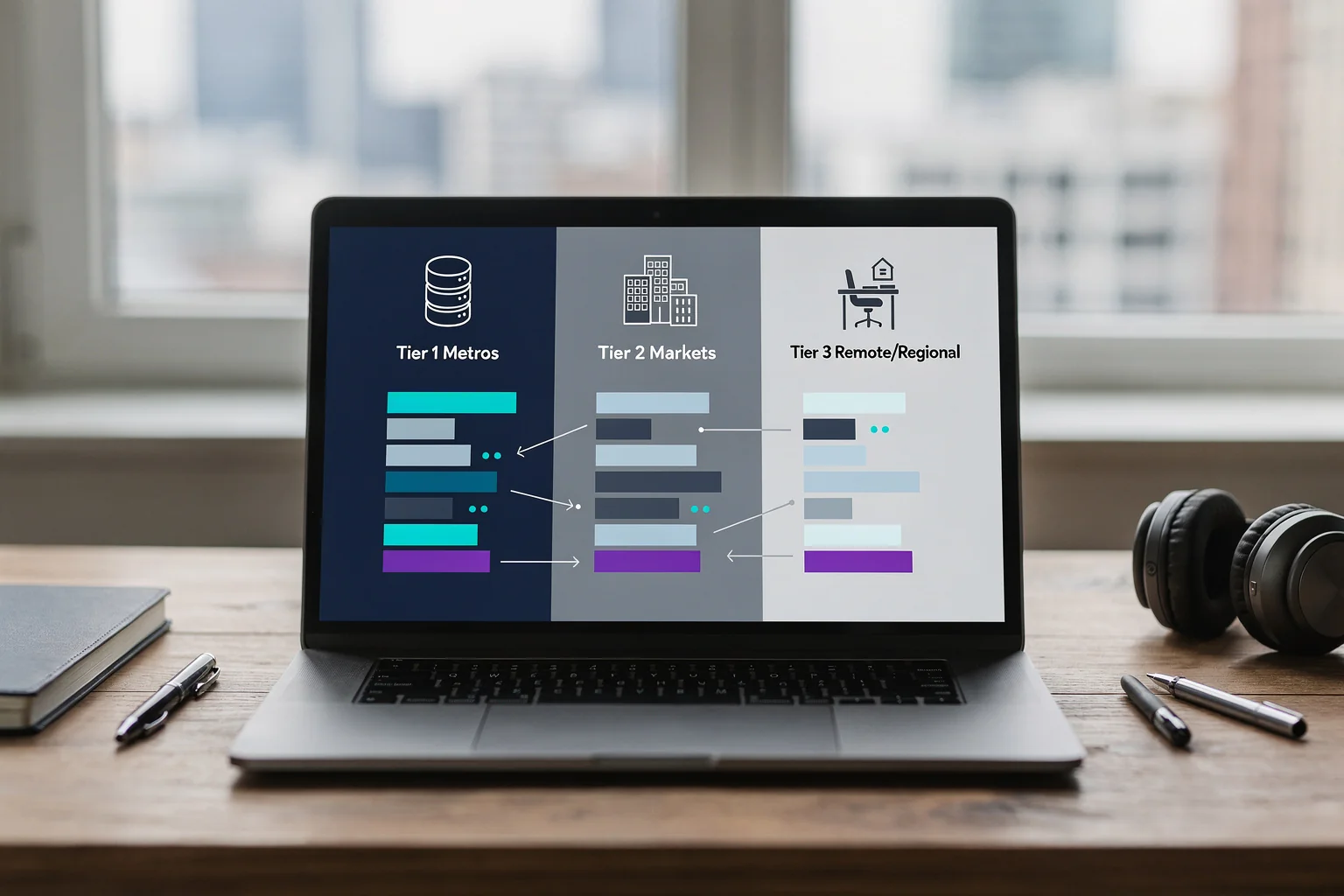
- Tier 1: San Francisco Bay Area, Seattle, New York City, Boston, Washington DC. Base salaries run 25–40% above national medians. Cloud Support Associates at AWS in Seattle or the Bay Area regularly start above $100,000.
- Tier 2: Austin, Denver, Chicago, Atlanta, Los Angeles, Portland. Bases cluster near national averages with some premium for hot markets.
- Tier 3: Secondary and tertiary US markets, most UK regions outside London, and remote-first companies with location-adjusted pay. Bases can run 15–25% below Tier 2.
Remote work has compressed some of these gaps, but location-based pay bands remain standard at large employers. When evaluating offers, compare total compensation — base, bonus, equity, and benefits — not just the headline salary.
The Study Path That Connects Cert to Job
Each role above assumes you pass the CLF-C02 first. The exam covers four domains: Cloud Concepts (24%), Security and Compliance (30%), Core AWS Services (34%), and Cloud Economics and Billing (12%). The 2026 version emphasizes sustainability, modern container services, and updated security best practices.
A practical two-to-four week study plan looks like this:
Week 1: Cover Cloud Concepts and Security. Read the official exam guide. Build flashcards for shared responsibility, IAM policies, and compliance programs. Run your first short practice test to baseline your knowledge.
Week 2: Deep-dive Core Services. Focus on EC2, S3, Lambda, RDS, VPC, and CloudWatch — the services that appear in virtually every job description above. Use the CLF-C02 essential services shortlist to avoid over-studying edge services.
Week 3: Economics, billing, and full-length simulation. Practice Cost Explorer scenarios, support plan comparisons, and pricing calculator exercises. Run timed simulator sessions to build stamina for the 90-minute exam.
Week 4: Gap closure and final readiness. Revisit missed questions, review the 2026 Cloud Practitioner exam changes for any late updates, and take a final practice test under exam conditions.
The exam costs $100, and retakes cost the same. Most candidates who follow structured prep pass on the first attempt. Those who underestimate the security domain or skip hands-on console time often need a second sitting.
From First Role to Second: Typical Progression
Entry-level cloud roles are not endpoints. The 2026 data shows clear mobility paths:
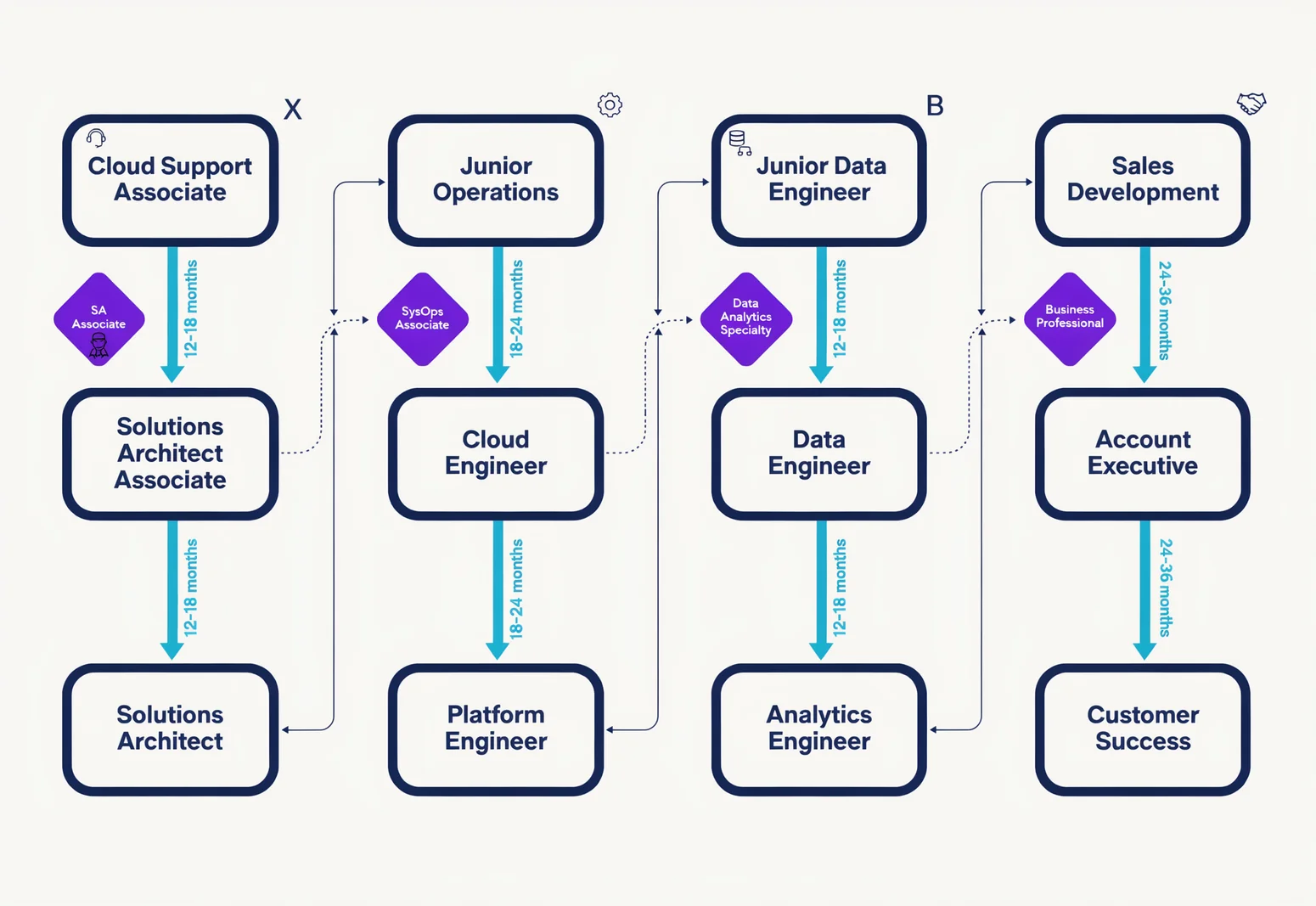
- Cloud Support Associate → Solutions Architect Associate → Solutions Architect: 18–36 months. The SA Associate cert is the standard next step.
- Junior Operations → Cloud Engineer → Platform Engineer: 24–48 months. Add Terraform, Kubernetes, and observability depth.
- Junior Data Engineer → Data Engineer → Analytics Engineer: 24–36 months. Build SQL, Python, and modern data stack skills.
- Sales Development → Account Executive → Customer Success: 12–36 months. Quota attainment and relationship management drive advancement.
The CLF-C02 is the foundation, not the ceiling. Pair it with hands-on projects, a second certification, or specialized tooling skills to accelerate progression. For a detailed view of how pay evolves, see the Cloud Practitioner salary comparison between entry-level and one-year post-certification earnings.
Questions Candidates Ask Before Applying
Does the CLF-C02 alone guarantee a job?
No. It qualifies you for interviews at the roles above, but employers still evaluate communication skills, problem-solving approach, and cultural fit. Technical roles want project or lab experience; customer-facing roles want evidence of relationship skills.
How long after passing should I start applying?
Immediately. Job postings do not require a minimum certification age. Some candidates schedule interviews while studying, using the exam date as a concrete milestone in conversations.
Do I need a computer science degree?
Not for most entry-level cloud roles. AWS's own early-career programs accept diverse backgrounds, and many employers prioritize certifications and demonstrated skills over formal degrees. Specialized roles like data engineering may prefer quantitative coursework.
Is remote work realistic at entry level?
Increasingly yes, though some employers want initial on-site training. AWS, many consulting partners, and SaaS companies hire remote-first. Location-adjusted pay is common.
Should I pursue Solutions Architect Associate before job hunting?
It depends on your timeline and target role. If you want Cloud Support or Operations, the CLF-C02 is sufficient. If you are targeting architecture or consulting roles, the SA Associate significantly strengthens your profile. Many working professionals earn the CLF-C02, start a role, then study for the SA Associate with employer support.
Where Cloud Certification Is Heading in 2026
The certification landscape is shifting. AWS updated three associate and professional exams in 2026 to reflect evolving cloud roles, with machine learning engineering and advanced architecture seeing the most significant changes. The CLF-C02 itself is stable, but candidates should verify they are studying current materials — not retired CLF-C01 content.
Industry analysis of 63 active certification exams shows AWS, Azure, and GCP still dominate the market, but AI-specific credentials from NVIDIA, Anthropic, and IBM are growing rapidly. For early-career professionals, the foundational cloud cert remains the most versatile starting point, but plan to add specialization within 12–18 months to stay competitive.
References
- Cloud Practitioner 02 — The AWS Certified Cloud Practitioner (CLF-C02) exam is intended for individuals who can effectively demonstrate overall knowledge of the AWS Cloud, independent of a specific job
- 900 Entry Level Aws Cloud — Entry Level Aws Cloud Practitioner Jobs, Employment | Indeed ... ## entry level aws cloud practitioner jobs ... We didn't find any results for this search. ... ## 2026
More Paths to Explore


Discussion
Question Comments
0 comments·0 participantsSign in to leave a comment and access more free questions.