

Your entry level AWS cloud engineer salary expectation needs a location, a currency and a genuinely junior job description. Without a dated source covering those details, a precise starting-pay figure would be a guess. I’d build your target from comparable advertised vacancies, then assess where your relevant IT experience, certification preparation and practical AWS skills fit within their salary bands.
That distinction matters when you’re deciding whether to fund an exam or accept your first cloud role. A certification can support your application, but it doesn’t establish a guaranteed salary. Here’s how to arrive at a figure you can defend.
How can you establish a realistic starting salary?
Start with advertised annual base pay for junior roles you could reasonably apply for. Keep the country, employment type and level of responsibility consistent.
A useful comparison group might include junior cloud engineer, cloud operations associate and cloud support engineer vacancies. Read the duties before including each position. A support role centred on ticket escalation provides a different comparison from a position requiring independent infrastructure design.
For each suitable vacancy, record:
- The advertised base-pay range and currency.
- The work location and any attendance requirement.
- The experience described as essential.
- The AWS responsibilities you would handle.
- Any separate bonus, shift allowance or on-call payment.
Keep a record of when you checked the advert. Remove duplicate agency listings so one vacancy doesn’t distort your sample.
Once you have several comparable roles, look for overlapping bands. That overlap gives you a more useful negotiating reference than the highest figure you found. Keep unusually high or low adverts separate until you understand what explains them.
An advertised range still doesn’t tell you where an employer would place your application. Ask whether its lower end covers candidates needing substantial training, and what evidence would support appointment higher in the band. Record that answer alongside the salary.
How does location affect your salary expectation?
Location determines which salary market you should compare against. Keep figures in their original currencies until you understand the employment arrangement.
For a UK application, assess annual gross base pay in pounds and compare roles with similar attendance requirements. A salary attached to an overseas vacancy needs its own context. Currency conversion alone cannot establish whether the positions have comparable purchasing power, benefits or employment conditions.
Remote work needs another check. Ask which country the employer can hire in and whether its salary band depends on your location. A vacancy visible online may have restrictions that make its headline salary irrelevant to your application.
Commuting also affects the value of an offer. Work out your expected annual travel expense and the time required to attend the office. Use those figures when comparing otherwise similar positions.
You can keep two separate numbers: the market range supported by comparable vacancies, and the minimum salary that makes a particular arrangement workable for you. Your personal minimum is useful for deciding whether to continue an application. It doesn’t establish the employer’s market rate.
When discussing expectations, specify the currency, annual base salary and location. That keeps a seemingly straightforward salary conversation from mixing incompatible figures.
Does Cloud Practitioner or Solutions Architect Associate change your pay?
Neither credential establishes a fixed starting salary or an automatic pay increase. Choose your certification around the knowledge you need and the requirements of suitable vacancies.
There’s no verified salary premium to quote here for one credential over the other. Treat any claimed increase cautiously unless its evidence separates experience, geography and job responsibilities.
When does Cloud Practitioner preparation make sense?
AWS Certified Cloud Practitioner preparation can be a sensible starting point if you need to organise your understanding of cloud concepts before deeper technical study.
For an engineering application, connect that learning to practical explanations. Be ready to discuss an access requirement, a cost concern or a reason for choosing one approach over another.
If you already work in IT support, use relevant examples from your existing responsibilities. Explain the troubleshooting you performed, the limits of your access and when you escalated a problem. Keep your contribution precise.
When should you consider Solutions Architect Associate?
Consider AWS Certified Solutions Architect – Associate preparation when the roles you want require more architectural reasoning and you have enough practical grounding to apply it.
Use study scenarios to practise explaining availability, access, recovery and cost trade-offs. Then demonstrate your reasoning through a small project you can discuss clearly.
Before choosing either route, separate vacancy requirements into essential and desirable credentials. Check whether practical experience can satisfy an equivalent requirement. Apply against the written criteria, and ask the recruiter about ambiguous wording before paying for another exam.
What can hands-on AWS work add to your salary case?
Practical work gives you evidence to discuss when an employer assesses your readiness for junior engineering responsibilities. Its value depends on what you can explain and reproduce.
A useful project can be small. Build an environment, define its access permissions, document its components and introduce a fault you can diagnose. Keep enough detail to explain what happened without relying on screenshots alone.
Prepare to answer questions such as:
- What requirement shaped your design?
- Which permissions did each component need?
- How did you investigate the failure?
- What would you change before someone relied on it?
- How did you remove resources after the exercise?
Be clear about the setting. A personal lab demonstrates different experience from maintaining a service used by customers. Describe supervision, scale and limitations accurately.
If you have previous support, networking or systems experience, connect it to the advertised duties. A documented troubleshooting example may be more useful than a long list of services you have briefly explored.
For salary discussions, identify the tasks you could perform with initial guidance and those requiring further training. Ask how that readiness relates to the employer’s band. Let the employer explain its assessment rather than assigning your project an invented monetary value.
Which published salary figures need closer scrutiny?
Check any figure that leaves out experience level, geography, collection date or the definition of compensation. Those omissions can make a precise-looking number unsuitable for a first-role decision.
A cloud engineer average may cover responsibilities beyond the junior vacancy you’re considering. A certification-holder salary figure may include people who had substantial professional experience before taking their exam. Neither figure establishes what a new candidate should expect.
Before using a survey or salary page, ask:
- Does it isolate junior candidates or combine experience levels?
- Is the figure base salary, total compensation or contract income?
- Which country and currency does it cover?
- When were the underlying figures collected?
- Does it explain how its sample was assembled?
Apply the same checks to AWS and Azure salary comparisons. A difference between two groups doesn’t establish how much an individual would earn by changing certification paths.
Keep publication dates separate from collection dates. A recently updated page can still contain older figures.
You don’t need to discard every broad benchmark. Use it as background, then return to comparable vacancies when choosing an application target. Label your own estimate with the location, experience level and date you checked it.
How can you tell whether demand matches your experience?
Look for repeated requirements across vacancies you could actually perform. Search-result totals alone won’t tell you whether employers need candidates at your stage.
Build a short requirements list from suitable adverts. Record where employers ask for troubleshooting, networking, scripting, infrastructure changes, documentation or customer communication. Then attach an example from your work or study to each requirement you meet.
This exercise helps distinguish a missing skill from a missing credential. If you can explain concepts but struggle to investigate failures, another exam may leave the same application gap. If you already perform relevant technical work, your priority may be presenting that experience clearly.
Search adjacent titles as well as junior cloud engineer. The discussion of entry-level AWS roles can help broaden your search vocabulary. Assess each vacancy’s actual duties before treating its salary as comparable.
Ask how the team supports junior staff. Who reviews changes? Who handles escalation? What would you own during your first months?
A role requiring independent decisions from the outset needs a different readiness assessment from one with supervised work. Use the answers to refine both your application list and the salary evidence you collect.
How should you compare two actual junior-role offers?
Compare guaranteed base pay first, then examine allowances, working hours, training and the responsibilities attached to each offer. Keep uncertain payments separate from guaranteed income.
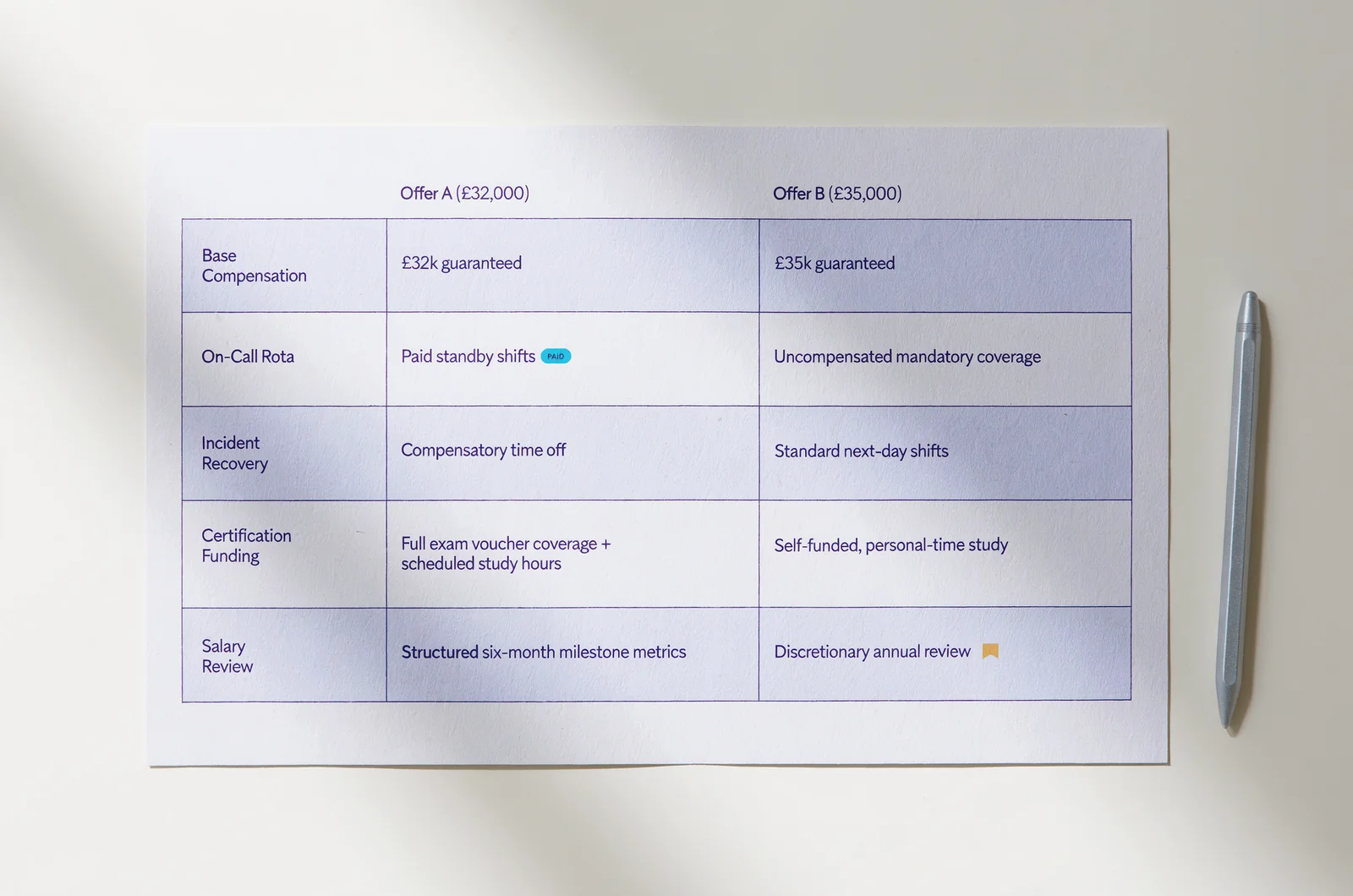
Consider a hypothetical choice between a £32,000 base salary with separately paid on-call work and a £35,000 base salary with on-call duties included. These invented amounts illustrate comparison only.
The guaranteed base-pay difference is £3,000 annually before tax. You still need the first employer’s payment terms and the expected on-call commitment at both companies. Without those details, you cannot compare the full arrangements.
Ask each employer about:
- The frequency of shifts or on-call cover.
- Payment terms and any time off after incidents.
- The training available during working hours.
- Exam funding and any repayment conditions.
- The timing and criteria for salary reviews.
Treat a discretionary bonus as uncertain. Keep a possible future pay rise out of your guaranteed-pay calculation until its terms are agreed.
For a first engineering position, also ask who will review your technical work. Access to useful supervision deserves consideration alongside salary, especially if the role introduces responsibilities you haven’t handled before.
Request the written terms before choosing between offers. Resolve unclear allowances or repayment clauses while you can still compare the options.
Where do practice exams fit into the salary decision?
Practice exams belong in your preparation plan. They can help you assess exam readiness, while your salary discussion still needs evidence of relevant work and practical capability.
Use a diagnostic attempt to identify subjects that need attention. Study the explanations, revisit the underlying concept and complete a related exercise where practical. Save timed rehearsal for assessing pacing and decision-making under exam conditions.
A PlanetCert practice test can structure that rehearsal. After reviewing an incorrect answer, write down why your choice failed and what would change the decision. A familiar answer letter gives you little to discuss in a technical interview.
PlanetCert flashcards can support recall between longer study sessions. Pair them with an explanation in your own words, especially for topics you keep confusing.
If you need a different teaching format, compare Solutions Architect Associate courses against the gaps you have identified. Check their stated coverage and update information before committing more study time.
Set a separate readiness check for applications: can you explain a design choice, investigate a fault and describe your own contribution? Use your remaining preparation time against whichever requirement you cannot yet demonstrate.
What salary target should you take into an interview?
Take a researched range supported by comparable vacancies, together with a clear explanation of your relevant skills. Keep your minimum acceptable figure private unless discussing it serves your negotiation.
Prepare a short record with the location, advertised bands, matching responsibilities and dates checked. Remove positions that require substantially different experience. This gives your target a traceable basis.
Then map your evidence to the vacancy. You might explain your existing support responsibilities, show a documented project and describe the technical work you could undertake with supervision. Avoid assigning a cash value to each certificate or lab.
Ask the recruiter for the budgeted range early enough to assess whether the process makes sense. If the employer requests your expectation first, specify annual base pay and clarify how allowances are handled.
A useful interactive offer worksheet would let you enter base pay, guaranteed allowances, attendance costs and expected hours. It should display uncertain bonuses separately and leave promotion assumptions out of guaranteed income.
If an offer is below your target, ask what determines placement within the band and whether a review can be tied to agreed responsibilities. Get any review arrangement in writing. Finish the comparison with confirmed terms rather than an assumed future increase.
How can you check your AWS exam readiness?


Discussion
Question Comments
0 comments·0 participantsSign in to leave a comment and access more free questions.