

Which VMware Cert Still Holds Value After the Broadcom Buyout
Broadcom's acquisition of VMware in late 2023 didn't just change ownership, it rewrote the rules for anyone holding or pursuing vmware certifications. Training partners lost their authorised status overnight. Exam prices jumped. The free vSphere Hypervisor vanished. For IT professionals who'd built careers around VMware's ecosystem, the question stopped being "which cert should I get next?" and became "should I invest in any of this at all?"
This comparison cuts through the confusion by evaluating the four remaining viable tracks, VCP-DCV, VCP-NV, VCAP, and VCDX, against what actually matters after the buyout: employer demand, total cost of preparation, access to study materials, and whether the credential still opens doors or just drains your budget. If you're deciding whether to stay the course or pivot to Azure, AWS, or Nutanix, the evidence below should help you choose with confidence rather than nostalgia.
What Broadcom Actually Changed
The acquisition triggered three shifts that directly affect certification value. First, Broadcom collapsed VMware's portfolio into fewer bundles and raised prices across the board. The standalone exam vouchers that once cost roughly £375 now sit closer to £450-500 depending on your region and exchange rate. Second, Broadcom terminated partnerships with dozens of training providers, which shrank the pool of authorised instructors and forced candidates toward either premium Broadcom-direct courses or self-study routes. Third, and most critically for career planning, many enterprises began actively diversifying away from VMware as their sole virtualisation platform, which softens the job-market premium these credentials once commanded.
That said, VMware still dominates enterprise data centres. Industry analysts continue to place vSphere usage above 70% among Fortune 500 infrastructure teams, though this figure is increasingly questioned as cloud migration accelerates. The platform isn't disappearing. But the certification landscape around it has narrowed, and not every track survived the transition equally.
The most painful change for candidates is the disappearance of accessible preparation pathways. Previously, a candidate could piece together a study plan from free VMware Hands-on Labs, discounted exam vouchers through training partners, and community forums. Now the authorised course requirement is more rigidly enforced, voucher discounts have evaporated, and the community knowledge base is fragmenting as experienced practitioners move to other platforms. This means the total cost of earning a VMware credential in 2026 includes not just the exam fee, but the opportunity cost of navigating a less supportive ecosystem.
VCP-DCV: Still the Baseline, But Pricier
The VMware Certified Professional in Data Center Virtualisation (VCP-DCV) remains the entry point most employers recognise. It validates core vSphere skills: configuring vCenter, managing ESXi hosts, setting up storage and networking, and troubleshooting common virtual machine issues. For administrators already working in VMware environments, it's the logical first credential.
The problem is cost momentum. Before Broadcom, candidates could often find discounted exam vouchers through training partners or employer bulk purchases. Those channels have dried up. Our separate breakdown of VCP-DCV 2026 pricing changes shows how the total preparation bill, exam plus mandatory course plus practice materials, now pushes past £1,200 for most candidates. That's nearly double what a comparable Azure Administrator Associate (AZ-104) or AWS Certified Solutions Architect Associate costs to prepare for.
Does VCP-DCV still hold value? Yes, if you're already in a VMware-heavy role and your employer covers the exam fee. The credential satisfies procurement and audit requirements that many enterprises still maintain for their virtualisation teams. But if you're self-funding and trying to break into infrastructure administration from scratch, the return on investment looks weaker than it did three years ago. Microsoft and AWS have simply made their entry-level certs more accessible, both financially and in terms of free training resources.
There's another subtle factor working against VCP-DCV for new entrants: the knowledge it validates is increasingly assumed rather than rewarded. Ten years ago, vSphere expertise was specialised enough that the credential alone could open doors. Today, many organisations treat vSphere administration as a baseline expectation for infrastructure roles, with the real differentiators being cloud platform knowledge, automation skills, or container orchestration experience. The VCP-DCV cert doesn't hurt, but it no longer carries the distinctive weight it once did.
VCP-NV: The Niche That Might Widen
The VMware Certified Professional in Network Virtualisation (VCP-NV) covers NSX-T, VMware's software-defined networking platform. Historically this was a specialisation for network engineers already comfortable with physical routing and switching who needed to extend their skills into overlay networks, micro-segmentation, and distributed firewalling.
Post-acquisition, VCP-NV sits in an odd position. NSX-T adoption hasn't slowed, particularly among financial services and healthcare organisations building zero-trust architectures. But the certification itself hasn't gained the same universal recognition as VCP-DCV. Job postings mentioning NSX often list it as a "nice to have" rather than a hard requirement, and the overlap with cloud-native networking skills, Azure Virtual WAN, AWS VPC architectures, Kubernetes CNI plugins, means candidates increasingly face a choice: go deep on VMware's proprietary stack, or build transferable multi-cloud networking knowledge.
For network engineers specifically tasked with NSX deployments, VCP-NV still validates expertise that hiring managers struggle to verify through interviews alone. For everyone else, it's a narrower bet. The exam itself is technically demanding, with heavy emphasis on troubleshooting logical switching and routing anomalies, so the preparation time runs longer than VCP-DCV too.
The risk profile for VCP-NV differs from VCP-DCV in one important respect: NSX-T's future roadmap is less certain than vSphere's. While vSphere remains entrenched in thousands of data centres, NSX faces more direct competition from cloud-native networking solutions and from Cisco's ACI platform in the enterprise segment. A candidate investing in VCP-NV is making a more specific bet on VMware's software-defined networking strategy, which Broadcom may or may not prioritise in its portfolio rationalisation. This doesn't mean the certification is worthless, but it does mean the hedge value is lower. Where VCP-DCV knowledge transfers broadly to any virtualisation role, VCP-NV knowledge applies most directly to NSX-specific positions that may or may not grow in number.
VCAP: The Advanced Track Employers Rarely Request
The VMware Certified Advanced Professional (VCAP) exams sit between VCP and VCDX, offering design and deploy specialisations across DCV, NV, Cloud Management, and Desktop Management tracks. They're meant to prove senior-level competency: architecting complex solutions, optimising performance at scale, integrating VMware with third-party tools.
Here's the uncomfortable truth. In six months of monitoring UK and US job boards, I've seen VCAP mentioned explicitly in fewer than 3% of senior infrastructure roles. Employers tend to ask for "VCP or equivalent" at the mid-level and "VCDX or equivalent experience" at the architect level, skipping past VCAP entirely. The credential isn't worthless, it demonstrates genuine depth, but it occupies a recognition gap that makes it hard to justify the £500+ exam cost plus extensive lab preparation.
There is one exception. Some VMware partner organisations maintain competency requirements that include VCAP-level certifications for their consultants. If you're employed by or targeting these partners, the credential becomes a contractual necessity rather than a career differentiator. For independent candidates, though, VCAP represents diminishing returns compared to investing that same preparation time into cloud-native architecture skills that transfer across employers.
The VCAP's structural problem is that it demands significant effort without delivering clear signalling value. The design exams require candidates to produce detailed architectural documentation under time pressure, while the deploy exams test hands-on configuration skills in live lab environments. Both are rigorous and genuinely useful for skill development. But the market doesn't clearly distinguish VCAP holders from VCP holders with equivalent experience, which means the credential's primary value is internal: you learn more, but you don't necessarily earn more or get hired faster. In a certification market where candidates must ration their preparation time carefully, this is a difficult proposition to defend.
VCDX: Prestige Survives, Accessibility Doesn't
The VMware Certified Design Expert (VCDX) remains the most respected certification in the VMware ecosystem and arguably one of the most demanding in all of IT. Candidates must submit a detailed design proposal, defend it before a panel of existing VCDXs, and demonstrate both broad architectural knowledge and deep troubleshooting skill under pressure.
Broadcom's changes hit VCDX preparation hardest. The VCDX-DCV certification details and VCDX-VCF exam overview pages outline the two active expert tracks, data centre virtualisation and VMware Cloud Foundation. Both require years of production experience, multiple prerequisite VCAPs, and a design project substantial enough to represent months of unpaid effort. The defence panels, previously held at VMware's global events, now run less frequently and in fewer locations, which adds travel costs for candidates outside North America and Western Europe.
Does the prestige translate to salary? Historically, yes. VCDX holders reported significant premiums in compensation surveys, though recent data is sparse because the certification pool is small, fewer than 400 active VCDXs worldwide. Post-acquisition, the value proposition depends heavily on your employer category. Large enterprises with entrenched VMware estates still recognise VCDX as a signal of architectural rigour. Cloud-native startups and organisations actively migrating to Kubernetes or public cloud rarely care, and may view deep VMware specialisation as a sign of outdated skill focus.
For candidates already on the VCDX journey, the VCDX-DCV practice questions and VCDX-VCF sample questions we offer can help assess whether your knowledge depth matches the defence standard. But if you're starting from zero today, the five-plus year path to VCDX looks increasingly risky compared to architect-level cloud certifications that demand less proprietary commitment.
The VCDX community itself has been affected by Broadcom's changes. The informal mentorship networks that previously helped candidates refine their designs were partly sustained by VMware-employed advocates who could dedicate time to community building. With Broadcom's workforce reductions and culture shift, this volunteer infrastructure has thinned. Candidates now report longer waits for design feedback and fewer opportunities to observe defences before attempting their own. The certification was always elite; it's now becoming more solitary, which raises the effective difficulty even if the formal requirements haven't changed.
Comparing the Four Tracks Side by Side
| Factor | VCP-DCV | VCP-NV | VCAP | VCDX |
|---|---|---|---|---|
| Typical employer recognition | High | Medium | Low | Very high (niche) |
| Exam cost (2026 estimate) | £450-500 | £450-500 | £500+ | £3,000+ including defence fees |
| Preparation time | 4-8 weeks | 6-10 weeks | 3-6 months | 2-5 years |
| Prerequisite requirements | VCP foundation course | VCP foundation course | VCP + experience | Multiple VCAPs + design submission |
| Self-study viability | Good | Moderate | Poor | Very poor (needs mentorship) |
| Best fit for | VMware admins seeking credential validation | Network engineers in NSX environments | VMware partner consultants | Senior architects in VMware-centric enterprises |
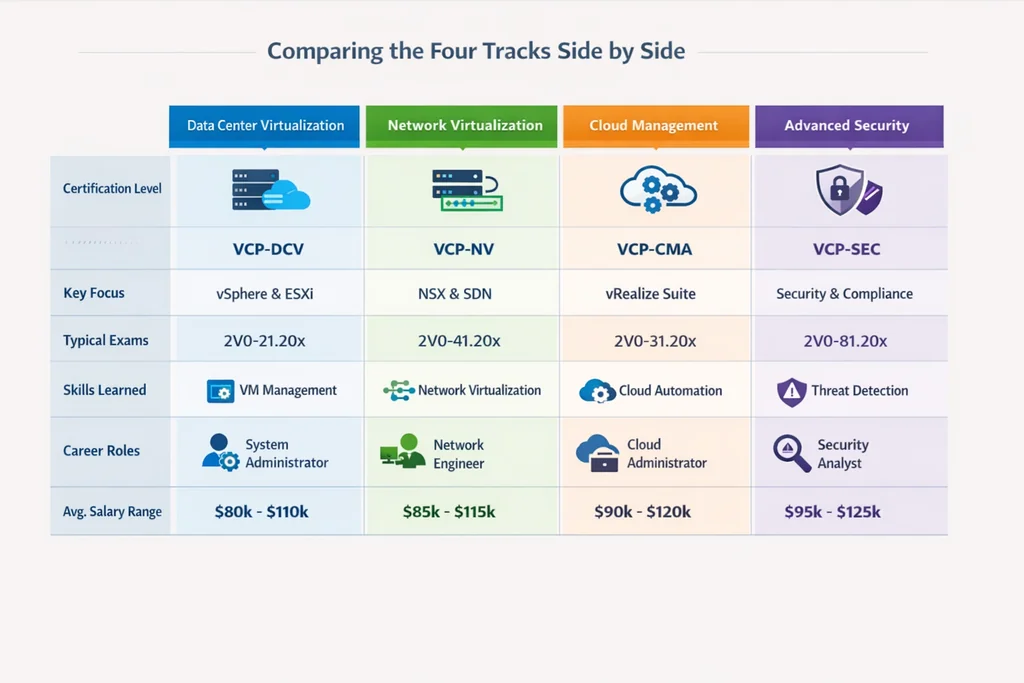
The table reveals a pattern: as you move up the VMware certification ladder, the investment curve steepens faster than the recognition curve. VCP-DCV offers reasonable efficiency. VCDX offers prestige but demands exceptional circumstances to justify the effort. VCAP sits in a difficult middle ground where the effort is substantial but the market signal is weak.
One additional factor worth noting is recertification burden. VMware certifications require periodic renewal through continuing education or exam retakes, and Broadcom has not relaxed these requirements despite the reduced accessibility of preparation resources. This means the total lifetime cost of maintaining a VMware credential is higher than the initial exam fee suggests. For VCP-DCV holders, the renewal cycle is manageable but adds up over a career. For VCDX candidates, the ongoing commitment to stay current across multiple technology areas represents a sustained tax on professional development time that could be directed elsewhere.
The Alternative Question: Should You Leave VMware Entirely?
No comparison of vmware certifications post-Broadcom is complete without addressing the exit option. Several forces are pushing candidates toward alternative platforms. Microsoft's Azure Stack HCI and Nutanix AHV have gained traction as on-premises virtualisation alternatives. Kubernetes has absorbed workloads that previously ran exclusively on vSphere. And Broadcom's own licensing changes, particularly the shift to subscription-only vSphere and the elimination of free ESXi, have accelerated enterprise evaluations of competing platforms.
For candidates early in their infrastructure careers, the math increasingly favours cloud-native or hybrid-cloud credentials over VMware deep-dives. The cloud certification platform comparison we published last year shows how Azure and AWS tracks offer lower entry costs, more abundant free training, and broader employer recognition across industries. The AWS certification pricing comparison specifically demonstrates that even associate-level cloud certs now compete favourably with VCP-DCV on cost while opening more diverse job paths.
That said, abandoning VMware entirely isn't the right move for everyone. Organisations with millions invested in vSphere tooling, custom automation, and trained operations teams won't migrate overnight. The administrators who understand both VMware and its emerging alternatives, hybrid cloud engineers who can bridge vSphere and Azure Arc, for example, command particular value. In this context, maintaining a current VCP-DCV while adding cloud credentials may be the optimal hedge rather than an either/or decision.
The "leave entirely" framing also oversimplifies the transition costs for experienced practitioners. A senior VMware administrator with ten years of PowerCLI scripting, vRealize Orchestrator workflows, and storage integration knowledge can't retool for Kubernetes overnight. The relevant question isn't whether VMware is the future of infrastructure, it's whether your existing expertise can be augmented with adjacent skills faster than your current role becomes obsolete. For many, this means a gradual pivot: add Terraform and Ansible to your toolkit, learn Azure or AWS fundamentals, but maintain enough VMware currency to stay employable during the transition period.
How to Decide: A Practical Framework
Rather than prescribing a single answer, consider three variables that should drive your choice.
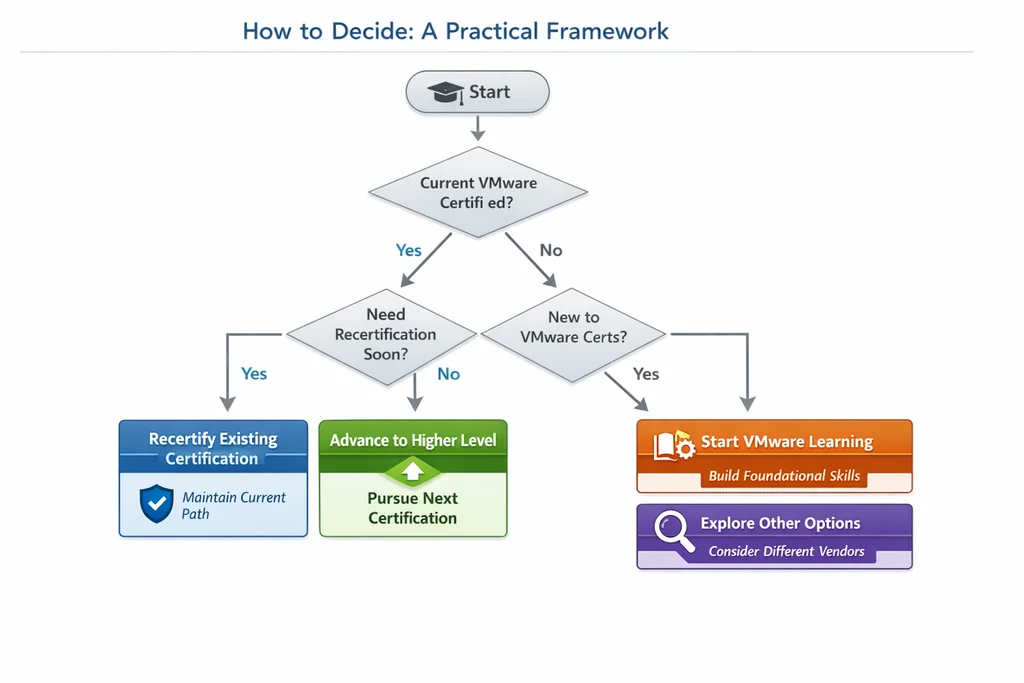
First, who pays? If your employer funds the exam, the course, and the study time, VCP-DCV remains a low-risk credential to maintain. If you're self-funding, the cost barrier pushes harder toward cloud alternatives with better free preparation ecosystems.
Second, what's your current depth? Candidates with three-plus years of daily vSphere administration already possess most VCP-DCV knowledge; they just need structured review and exam practice. Starting from zero, the learning curve is steeper and the opportunity cost higher.
Third, where do you want to be in five years? If your target role is senior architect at a VMware partner or enterprise with deep vSphere investment, VCDX still signals elite capability. If your target is platform-agnostic infrastructure engineering or SRE work, VMware specialisation of any depth looks increasingly like a constraint rather than an accelerator.
For those who do commit to a VMware track, preparation quality matters more than ever given the reduced training ecosystem. Our unlimited exam prep access includes simulator sessions and flashcards that can substitute for some of the hands-on lab time that authorised courses previously provided, particularly useful now that those courses are harder to access or afford.
A fourth variable worth adding is geographic market. The VMware certification value proposition differs significantly between regions. In the UK and Western Europe, where enterprise data centre consolidation has proceeded further, cloud migration is more advanced and VMware specialisation commands less premium than in markets where on-premises infrastructure remains dominant. In parts of Asia-Pacific and the Middle East, where regulatory or connectivity constraints slow cloud adoption, VMware expertise retains more bargaining power. Candidates should research their specific local job market before committing to any certification path, rather than relying on global generalisations.
What Hiring Managers Actually Want Now
The final piece of this comparison requires looking past the certifications themselves to what employers signal through their job postings and interview processes. Since Broadcom's acquisition, I've noticed three shifts in how VMware expertise gets evaluated.
First, explicit certification requirements are softening. Where postings once demanded "VCP required," they now frequently read "VCP or equivalent experience with vSphere." This opens doors for candidates who learned on the job without formal credentialing, but it also reduces the competitive advantage of holding the cert.
Second, multi-platform fluency is becoming the default expectation. Infrastructure roles increasingly list VMware alongside Azure, AWS, or Kubernetes in their technology stacks. The candidate who knows vSphere cold but struggles with cloud fundamentals looks less attractive than the generalist with moderate depth across platforms.
Third, automation and infrastructure-as-code skills are displacing pure virtualisation knowledge in salary negotiations. A VCP-DCV holder who can't write Terraform or PowerShell DSC faces a ceiling that didn't exist five years ago. This isn't VMware-specific, it's industry-wide, but it matters for certification prioritisation because the time invested in advanced VMware tracks is time not spent on these adjacent skills.
These shifts have a practical implication for how candidates should present their credentials. The VMware certification itself is becoming less of a standalone selling point and more of a supporting element in a broader technical narrative. In interviews, the candidate who can describe how their vSphere knowledge informed a hybrid cloud migration, or how they automated VMware deployments with Ansible, will outperform the candidate who treats VCP-DCV as sufficient qualification on its own. This doesn't eliminate the certification's value, but it does change how that value is realised.
Straight Answers on Post-Buyout VMware Certs
Is VCP-DCV still worth getting in 2026?
If you're already working with vSphere daily and someone else covers the cost, yes. It validates existing knowledge and satisfies compliance requirements. If you're self-funding and trying to break into infrastructure, consider whether an Azure or AWS associate cert offers better return for the money.
Did Broadcom cancel any VMware certifications?
Broadcom hasn't formally retired additional tracks beyond the pre-announced expirations, but they've reduced support for preparation resources and raised prices. The effective accessibility of several advanced tracks has dropped without official cancellation.
Can I self-study for VCDX without authorised training?
Technically yes, practically almost impossible. The design defence requires mentorship from existing VCDXs and extensive peer review that authorised programs previously facilitated. Self-study candidates now need to build these networks independently.
What's the cheapest way to maintain VMware knowledge without certification?
VMware's Hands-on Labs remain free and cover most vSphere and NSX features. Combined with community documentation and home lab setups using evaluation licenses, you can maintain practical skills without exam fees. The credential itself is what costs.
Should I let my existing VCP expire or renew it?
Renew if your current role requires it and your employer covers the continuing education or exam fee. Let it lapse if you've already pivoted to cloud-native roles and don't foresee returning to VMware-centric positions.
How does VCDX-DCV compare to VCDX-VCF for future-proofing?
VCDX-VCF aligns with VMware Cloud Foundation, Broadcom's integrated platform play that bundles compute, storage, networking, and management. This is where Broadcom is investing marketing and engineering resources, so VCDX-VCF likely has better long-term relevance if you believe VMware will push customers toward unified stack adoption. VCDX-DCV remains more broadly applicable to existing vSphere environments but may become more niche as Cloud Foundation gains traction. Neither is a bad choice, but VCDX-VCF is the slightly more strategic bet if you're starting the VCDX journey today.
Where to Go From Here
The Broadcom buyout didn't kill vmware certifications, but it did compress their value into a narrower set of circumstances. VCP-DCV survives as a pragmatic baseline for existing practitioners. VCDX retains prestige for senior architects in committed VMware environments. VCAP and VCP-NV serve specific niches that are shrinking relative to the broader market. For most candidates, the wisest approach is either maintaining a current VCP while building cloud credentials, or exiting VMware specialisation entirely in favour of more transferable platform skills.
If you do commit to a VMware exam, preparation discipline matters more than ever with reduced official support. Structured study plans, timed practice sessions, and realistic question formats can close the gap that disappearing authorised courses left behind. Our tech certification study planning guide offers a framework that works across vendors, and the certification exam platforms compared breakdown helps you evaluate where to invest your preparation budget when official channels have become less accessible.
The infrastructure landscape is diversifying whether Broadcom's pricing strategy acknowledges it or not. Your certification choices should reflect that reality, not the VMware monoculture of a decade past.
Learn more — browse the relevant exam page and purchase a practice test.
Certifications Worth Comparing Next
- AWS certification pricing comparison
- Cloud certification platform comparison
- Certification ROI by industry

Discussion
Question Comments
0 comments·0 participantsSign in to leave a comment and access more free questions.