

Boson vs Pocket Prep: Which CISSP Simulator Builds Real Stamina?
A side-by-side look at question fidelity, explanation depth, and exam-day stamina for candidates targeting the 2024 CISSP content outline.
A cissp practice exam isn't just a quiz—it's a stress test for your judgment under pressure. The real CISSP exam runs up to 3 hours with 125-175 adaptive questions, and plenty of candidates who know the material cold still falter because their prep never simulated that cognitive load. Pick the wrong simulator and you'll walk in confident on content but fragile on stamina.
This guide compares Boson ExSim-Max and Pocket Prep, the two platforms most frequently cited in CISSP study communities. Rather than crown a single winner, we'll map how each tool fits different preparation phases, learning styles, and budget constraints. You'll see where each excels, where each falls short, and how to combine them—or supplement with alternatives—to hit exam day with both knowledge and endurance locked in.
Topic Map
CISSP prep has three interconnected layers: content mastery, exam mechanics, and psychological readiness. Most candidates over-index on the first and ignore the others. A quality simulator needs to address all three.
We'll organize this comparison around four pillars. First, question fidelity—whether practice items mirror the 2024 exam outline in scope, difficulty, and cognitive demand. Second, explanation depth—how thoroughly wrong answers get unpacked so you actually learn rather than memorize. Third, platform design—whether the interface and scheduling tools sustain momentum across a 6-12 week study cycle. Fourth, stamina building—how well the simulator prepares you for the adaptive exam's unpredictable length and pressure.
Each pillar matters differently depending on your starting point. A security veteran with a decade of architecture experience needs different reinforcement than a career-switcher with three years of general IT. The comparison below accounts for both.
What Is CISSP Exam Simulation?
CISSP exam simulation replicates the Certified Information Systems Security Professional test experience through timed, scored question sets that approximate the real exam's format, content distribution, and adaptive logic. The CISSP Detailed Content Outline with Weights 2024 defines eight domains ranging from Security and Risk Management (16%) to Software Development Security (10%). Effective simulation must distribute questions proportionally while testing at the "adaptive" cognitive level—analysis, evaluation, and synthesis rather than simple recall.
The exam's computer-adaptive testing (CAT) format adds real complexity. Unlike fixed-length tests, the CISSP adjusts question difficulty based on your performance, potentially ending at 125 questions or extending to 175. Your simulator must train you for this uncertainty: you can't game the system by counting questions remaining, and mental fatigue becomes a genuine failure mode. Good simulation builds what sports psychologists call "stress inoculation"—familiarity with pressure that prevents panic.
Historically, CISSP prep relied on book-based questions and informal study groups. Dedicated simulation platforms emerged as the exam evolved toward adaptive testing and cybersecurity credentials professionalized. Today, simulation is nearly universal among successful candidates, but platform quality varies enormously.
Core Concepts
Before evaluating specific tools, four concepts determine simulator effectiveness.
Cognitive Level Matching. The CISSP tests at Bloom's Taxonomy levels 3-5: application, analysis, and evaluation. "What is the CIA triad?" is level 1; a cloud migration scenario asking which control framework best balances compliance with agility is level 4. Many practice banks fill levels 1-2 because they're cheaper to write. Effective simulation needs level 3-5 density.
Domain Weight Fidelity. The 2024 content outline specifies precise domain percentages. A simulator with 900 questions but skewed toward Security Operations (13%) at the expense of Security Architecture and Engineering (13%) or Communication and Network Security (13%) creates false confidence. You need proportional exposure, not just volume.
Explanation Rigor. Wrong answers teach more than right ones—if the explanation is thorough. Quality explanations identify why the distractor tempts, what principle it violates, and what scenario would make it correct. Surface-level notes ("B is wrong because encryption provides confidentiality, not integrity") waste your review time.
Stamina Architecture. The CAT format means you may face 175 questions with no fixed endpoint. Simulators defaulting to 50-question quizzes build knowledge but not endurance. Full-length practice exams of 125-175 questions, preferably with adaptive difficulty simulation, are essential for final-phase preparation.
How It Works
Boson ExSim-Max and Pocket Prep operate on fundamentally different pedagogical models, though both deliver CISSP question banks.
Boson structures its offering around six full-length practice exams totaling 900 questions. Each exam is designed as a complete simulation: timed, scored, and formatted to mirror the CISSP experience. The platform emphasizes "exam mode"—a locked, linear progression with no pauses, no hints, and no immediate feedback until completion. This mirrors actual test conditions precisely. After completion, you enter "study mode" with detailed explanations for every answer option, references to specific domains and subtopics, and performance analytics broken down by domain.
Pocket Prep takes a microlearning approach. Its mobile-first platform delivers daily question quotas, customizable quick sessions (10, 25, or 50 questions), and gamified streak tracking. The question bank is larger—typically 700-800 items with regular additions—but organized for distributed practice rather than marathon simulation. Explanations are concise, optimized for mobile consumption, and include community discussion threads where users debate answer rationale. The platform excels at filling idle moments: commutes, lunch breaks, waiting rooms.
The critical difference is temporal architecture. Boson trains you for the 3-hour block; Pocket Prep trains you for the 12-week accumulation. Neither is sufficient alone for most candidates, which is why study forums frequently recommend pairing them—Pocket Prep for daily maintenance, Boson for weekend stress tests.
Both platforms draw on the CISSP Detailed Content Outline for question scope, but implementation differs. Boson's questions tend toward longer scenarios with multiple variables; Pocket Prep favors tighter stems with clearer distractor patterns. These reflect different theories of what makes practice "authentic."
Main Layer 1: Question Fidelity and Exam Alignment
Question fidelity is the hardest attribute to evaluate before purchase and the most important for exam success. It encompasses three sub-dimensions: content accuracy, cognitive level, and surface validity.
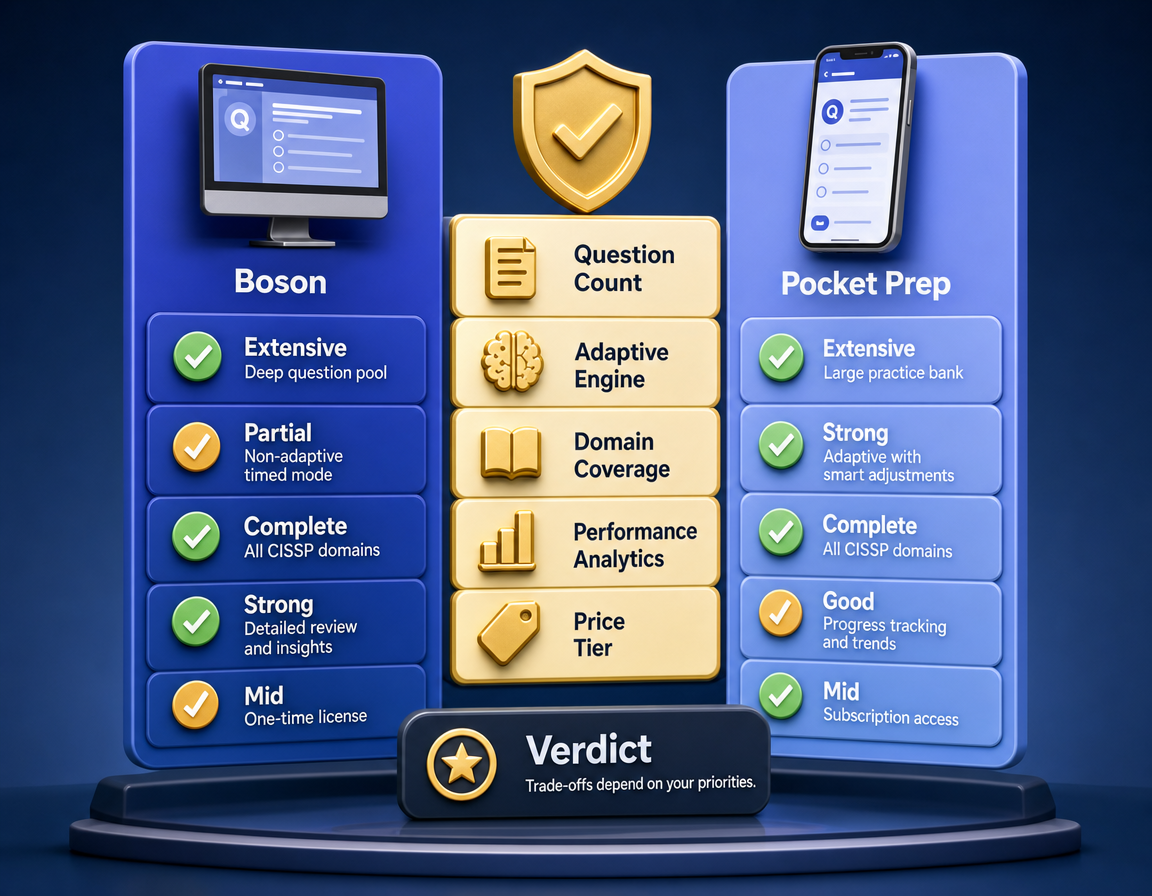
Content Accuracy. Both Boson and Pocket Prep claim alignment with the current CISSP exam outline, but verification methods differ. Boson publishes sample questions with detailed domain mappings; Pocket Prep offers a free trial with limited questions. Independent analysis suggests Boson's domain distribution tracks official weights more closely—particularly noticeable in Domain 1 (Security and Risk Management at 16%) and Domain 8 (Software Development Security at 10%), where many competitors underweight governance and overweight technical controls. Pocket Prep's larger bank allows finer granularity but requires user vigilance to ensure balanced coverage.
Cognitive Level. This is where the platforms diverge most significantly. Boson questions routinely present 150-200 word scenarios requiring synthesis across multiple domains. A typical item might describe a healthcare organization's cloud migration, ask you to identify the primary risk, then require selecting controls that address confidentiality, integrity, and availability in that specific context. These mirror the ISC2 self-study resources emphasis on "think like a manager" reasoning.
Pocket Prep questions run shorter, typically 50-100 word stems, with more explicit signal words. This isn't necessarily inferior—it builds pattern recognition for question archetypes—but it underprepares candidates for the reading load and ambiguity of the actual exam. Users who score 85%+ on Pocket Prep sometimes report shock at the CISSP's verbosity and indirect questioning.
Surface Validity. This refers to whether the question feels like the exam: formatting, interface, timing pressure. Boson's exam mode replicates the Pearson VUE interface with reasonable fidelity, including the lack of question numbering (a CAT feature that disorients unprepared candidates). Pocket Prep's mobile interface is polished but distinct from the desktop-based exam experience. For candidates with test anxiety, Boson's familiarity-building may be therapeutic; for others, Pocket Prep's lower-stakes presentation reduces avoidance.
A practical evaluation protocol: attempt Boson's free sample and Pocket Prep's trial questions, then compare to the official ISC2 practice quiz. The cognitive distance between each platform and the official sample predicts your exam-day comfort.
Main Layer 2: Explanation Depth and Learning Architecture
Explanations transform practice from assessment into education. The best platforms teach you to think, not just to answer.
Boson's explanations are extensive: 200-400 words per question, with explicit reasoning for why each distractor is wrong and under what modified conditions it would be right. This "distractor archaeology" builds metacognitive awareness—you start recognizing how ISC2 constructs tempting wrong answers. Explanations reference specific domain objectives, enabling targeted review. The platform also provides "exam score reports" showing performance by domain and subtopic, with recommendations for supplementary study.
The tradeoff is time. A 175-question exam with thorough review can consume 6-8 hours. Candidates with limited study windows may find this unsustainable, particularly in early preparation when domain knowledge gaps are large and every question triggers extensive review.
Pocket Prep explanations are tighter: 75-150 words, focused on the correct answer with brief wrong-answer notes. The innovation is community layering—each question has a discussion thread where users debate rationale, share mnemonics, and identify errata. This crowdsourcing catches errors faster than publisher revision cycles and builds study community. However, discussion quality varies enormously; popular questions attract informed debate, while obscure items may have misleading top comments.
For learning efficiency, Boson suits candidates with solid domain foundations who need to refine judgment. Pocket Prep suits broader knowledge building, particularly for candidates early in their CISSP journey or those with isolated weak domains. The optimal sequence often runs Pocket Prep for initial exposure, Boson for consolidation, then both for final review.
Main Layer 3: Platform Design and Study Momentum
Sustained study over 8-12 weeks requires more than good content—it requires a system that reduces friction and builds habit.
Boson's desktop-first design assumes dedicated study sessions. The interface is functional but dated; navigation requires more clicks than modern users expect. There's no mobile app, no offline mode, and no progress gamification. For candidates with consistent evening or weekend study blocks, this is acceptable. For those fitting preparation around unpredictable schedules—on-call rotations, travel, family obligations—the friction cost is real.
Pocket Prep is built for fragmentation. The mobile app syncs across devices, downloads questions for offline use, and sends push notifications for daily goals. Streak counters, achievement badges, and leaderboards exploit proven behavioral psychology for habit formation. The "Question of the Day" feature alone sustains engagement for many users who would otherwise skip study days.
The risk is trivialization. When practice becomes too convenient, it can feel like entertainment rather than preparation. The 10-question "quick session" builds familiarity but not the sustained concentration the exam demands. Candidates who rely exclusively on Pocket Prep sometimes report mental fatigue at question 80 of the real exam—precisely when CAT systems may still be calibrating their final score.
A hybrid workflow addresses both needs: Pocket Prep for minimum viable daily practice (maintaining momentum), Boson for weekly deep sessions (building endurance). The key is intentional scheduling, not defaulting to whichever platform feels easier in the moment.
Maturity Path
CISSP simulator needs evolve through three preparation phases. Matching platform to phase prevents both under-preparation and wasted investment.
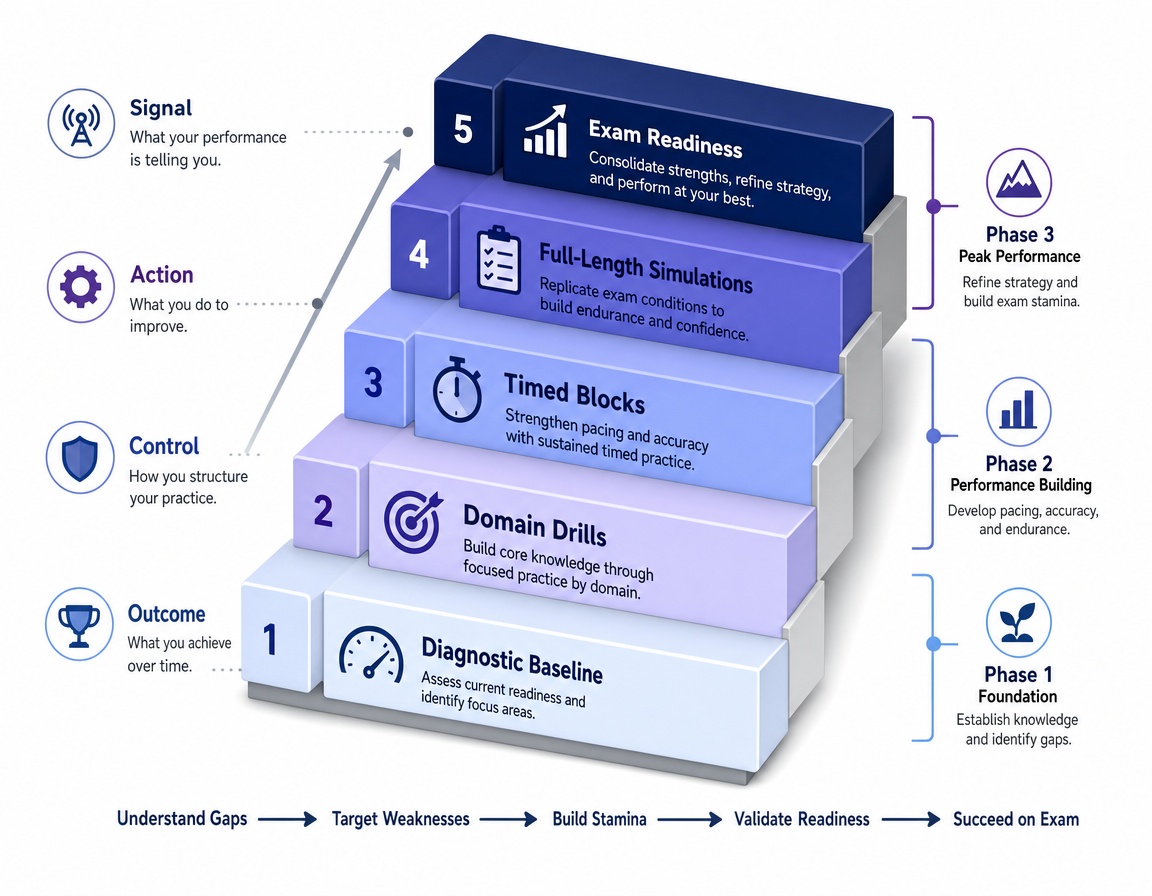
Phase 1: Foundation (Weeks 1-4). You're building domain knowledge, likely through the official study guide, video courses, or bootcamps. Your simulator use should be light and diagnostic: 10-25 questions daily to identify weak domains, with thorough explanation review. Pocket Prep excels here—its bite-sized format fits alongside primary learning without overwhelming. Target 60-70% accuracy; lower scores indicate content gaps, not simulator inadequacy.
Phase 2: Consolidation (Weeks 5-8). You shift from learning to applying. Full domain quizzes (50-100 questions) reveal whether knowledge integrates across topics. Boson becomes valuable now; its scenario-based questions force cross-domain thinking. Start with untimed study mode, then introduce timing pressure. Target 75-80% accuracy with improving speed.
Phase 3: Simulation (Weeks 9-12). This is stamina building. Full-length exams under strict exam conditions: 3-hour blocks, no interruptions, no reference materials. Boson's exam mode is purpose-built for this. You should complete at least 3-4 full simulations, with detailed performance analysis after each. Target 80%+ consistently, but prioritize endurance—finishing strong at question 175 matters more than early accuracy.
Advanced candidates with strong security backgrounds may compress phases; career-switchers may need extended foundation work. The maturity path is descriptive, not prescriptive—adjust based on diagnostic performance, not calendar optimism.
Real-World Scenarios
Scenario 1: The On-Call Engineer. Marcus works SOC rotation with unpredictable hours. He tried Boson first but found 3-hour blocks impossible to schedule. Switching to Pocket Prep for daily 15-minute sessions maintained his study streak through a brutal on-call month. In his final two weeks, he took three Boson full-length exams on days off. He passed at 125 questions, attributing his mental freshness to the distributed practice base.
Scenario 2: The Career Switcher. Priya moved from project management to cybersecurity with minimal technical background. She found Boson questions impenetrable initially—every explanation assumed familiarity she lacked. Six weeks of Pocket Prep built her vocabulary and pattern recognition. She then added Boson for final simulation, finding the scenarios now readable rather than overwhelming. Her domain scores showed steady improvement: 52% → 71% → 83% across three Boson exams.
Scenario 3: The Retake Candidate. David failed his first CISSP attempt at question 150, exhausted and rushed through final domains. His preparation had been heavy on reading, light on simulation. For his retake, he used Boson exclusively, completing five full exams with strict timing. He tracked his question-pace degradation: steady through 100 questions, then 15% slower from 100-150, then erratic. Targeted practice on sustained concentration—reading long technical passages without speed loss—addressed his specific failure mode. He passed on his second attempt.
Common Mistakes to Avoid
Mistake 1: Equating Question Volume with Preparation Depth. A candidate who completes 2,000 Pocket Prep questions without full-length simulation may have excellent domain knowledge but catastrophic stamina. The CAT format punishes this specifically—late-exam fatigue causes careless errors on questions you'd answer correctly fresh. Schedule simulation volume, not just question volume.
Mistake 2: Overvaluing Percentage Scores. Boson's questions are deliberately harder than the exam; scores of 65-70% often correlate with passing performance. Conversely, Pocket Prep's accessible questions may produce inflated confidence. Use scores for trend analysis and domain comparison, not absolute prediction. The official CISSP study tools emphasize understanding over memorization for good reason.
Mistake 3: Neglecting Weak Domain Redistribution. Both platforms default to mixed-domain quizzes, which feels efficient but protects weak areas from focused attention. If your Domain 5 (Identity and Access Management) scores lag, you need deliberate overpractice there—not just more general questions. Use platform analytics to identify and target gaps, not to confirm strengths.
Mistake 4: Ignoring Explanation Quality in Platform Selection. Many candidates choose based on price, interface, or forum recommendations without evaluating whether explanations match their learning style. If you need extensive reasoning to absorb why an answer is wrong, Boson's depth justifies its cost. If you prefer concise correction with community validation, Pocket Prep fits better. Trial both before committing.
Mistake 5: Timing the First Full Simulation Too Late. Candidates often delay full-length practice until they feel "ready," then discover stamina gaps with no time to address them. Your first Boson exam should occur by week 6—early enough to adapt your training, late enough that domain knowledge supports meaningful performance.
How PlanetCert Helps
PlanetCert's CISSP sample questions and full practice exams complement both Boson and Pocket Prep with a different emphasis: mobile-optimized simulation that preserves exam-length fidelity. Where Pocket Prep fragments and Boson anchors to desktop sessions, PlanetCert's simulator runs full-length adaptive exams on any device—building stamina without requiring dedicated computer time.
For candidates who travel frequently or study across multiple devices, this flexibility removes a common friction point. The explanation architecture sits between Boson's depth and Pocket Prep's brevity: sufficiently detailed for standalone learning, sufficiently concise for review efficiency. The ISC practice test catalog includes CISSP concentration exams (ISSAP, ISSEP, ISSMP) for candidates planning post-CISSP specialization, enabling longitudinal platform use rather than single-exam abandonment.
The broader vendor catalog supports multi-certification candidates—common in cybersecurity career paths where CISSP pairs with CCSP, CISM, or vendor-specific cloud security credentials. Consistent simulation architecture across exams reduces relearning cost.
For candidates evaluating their readiness before purchasing any platform, PlanetCert's free sample questions provide diagnostic value: attempt them under informal conditions, then compare your confidence and accuracy to the experience on Boson or Pocket Prep trials. The gap between platforms reveals your preparation priorities.
What to Read Next
The CISSP preparation cluster extends beyond simulator selection into study methodology, exam logistics, and career integration. Three articles provide natural progression from this comparison.
First, our guide on online CISSP practice exam timing, scoring, and prep tips translates simulator selection into actionable scheduling—how to sequence full-length exams, interpret score trends, and adjust your final-week approach based on diagnostic performance.
Second, for candidates considering cloud security specialization, the CCSP practice test comparison applies similar evaluation frameworks to the Certified Cloud Security Professional credential, which shares Domain 1-7 overlap with CISSP but tests at greater depth in cloud-specific controls.
Third, the broader certification exam platforms comparison situates CISSP-specific tools within the full market landscape, including platforms for CompTIA, Cisco, and AWS credentials that may complement your career path.

Discussion
Question Comments
0 comments·0 participantsSign in to leave a comment and access more free questions.