

Choosing Between PRINCE2 and PMP for Your Career Path
Project management credentials can open doors, but picking the wrong one for your market wastes months of study and hundreds of dollars. PRINCE2 and PMP both carry global recognition, yet they serve different employers, teach different frameworks, and deliver different salary outcomes depending on where you work. This comparison breaks down what each certification actually covers, what it costs to earn, and which path aligns with your location and career goals.
What PMP Actually Covers
The Project Management Professional (PMP) certification from PMI tests your grasp of the Project Management Body of Knowledge, now in its eighth edition released in 2025. The exam spans 230 minutes with 180 questions mixing multiple choice, multiple response, and drag-and-drop formats. It evaluates your ability to manage people, process, and business environment across predictive, agile, and hybrid approaches.
PMI requires documented experience before you sit: 36 months leading projects if you hold a four-year degree, or 60 months with a high school diploma. You also need 35 hours of formal project management education. This barrier filters out entry-level candidates, which partly explains why PMP carries weight with employers seeking proven practitioners.
The PMBOK Guide organizes knowledge around twelve project management principles and eight performance domains. You will study topics like stakeholder engagement, team performance, planning, project work, delivery, measurement, and uncertainty. The eighth edition added stronger emphasis on agile and hybrid models, reflecting how teams actually work in 2026.
For exam preparation, many candidates spend 8-12 weeks with a mix of coursework, self-study, and practice exams. The PMP exam page at PlanetCert offers a full practice test environment that mirrors the timed, adaptive feel of the real assessment.
What PRINCE2 Actually Covers
PRINCE2 (PRojects IN Controlled Environments) is a structured methodology rather than a broad knowledge framework. PeopleCert administers the certification, which comes in two levels: Foundation and Practitioner. The Foundation exam lasts 60 minutes with 60 multiple-choice questions, while Practitioner gives you 150 minutes with 68 questions testing objective-style scenarios.
The methodology centers on seven principles, seven themes, and seven processes. Principles include continued business justification, learn from experience, defined roles and responsibilities, manage by stages, manage by exception, focus on products, and tailor to suit the project environment. Themes cover business case, organization, quality, plans, risk, change, and progress. Processes run from starting a project through directing, initiating, controlling, managing product delivery, managing stage boundaries, and closing.
PRINCE2 Foundation has no prerequisites. Anyone can sit the exam after completing an accredited training course or self-study program. Practitioner requires that you first pass Foundation, or hold an approved alternative certification like PMP, CAPM, or IPMA levels. This lower entry barrier makes PRINCE2 accessible to career switchers and junior team members.
The PRINCE2 Foundation practice test and PRINCE2 Practitioner practice test both provide scenario-based questions that match the exam's emphasis on applying methodology to specific project situations.
Regional Demand and Employer Recognition
Where you plan to work matters more than many candidates realize. PMP dominates the North American market and holds strong presence across Asia-Pacific and the Middle East. Job postings for senior project managers in the United States routinely list PMP as preferred or required. The certification also aligns with federal contracting requirements and appears frequently in healthcare, construction, and technology sectors.
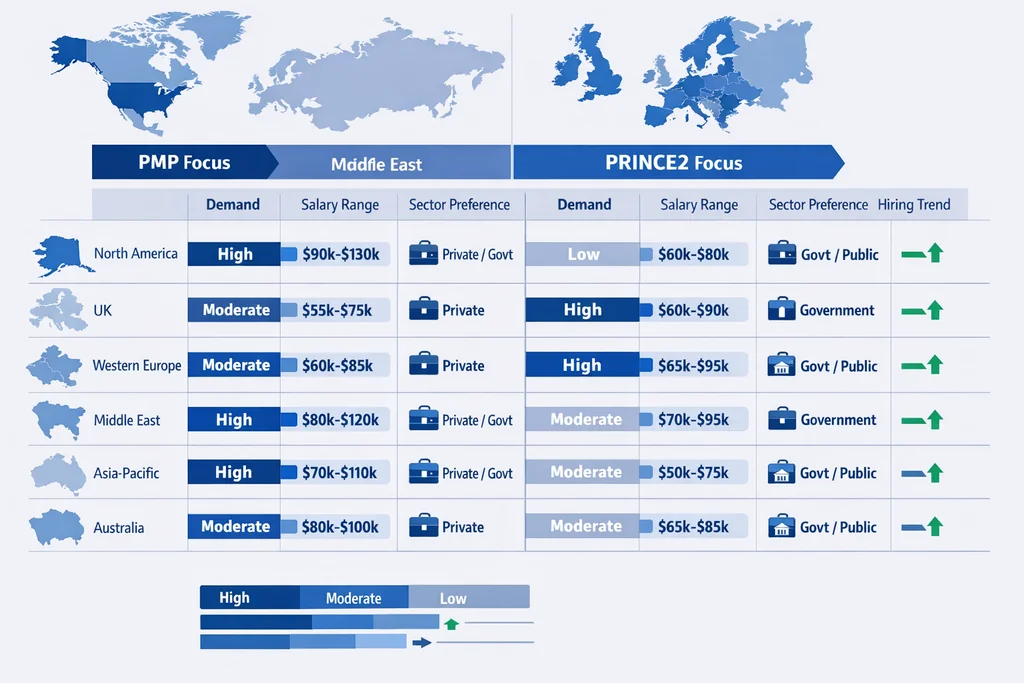
PRINCE2 remains the standard in the United Kingdom and sees heavy use across European Union member states, Australia, and parts of Africa. UK government projects require PRINCE2 by policy. Multinational organizations with British roots or European headquarters often specify PRINCE2 Practitioner in job descriptions.
Some professionals hold both credentials to stay mobile. A project manager at a global consulting firm might need PMP for the New York office and PRINCE2 for the London branch. If your career plan includes international rotation, earning both over time removes friction.
Salary data reflects this regional split. PMP holders in the United States average roughly $125,000 annually according to 2026 market reports, while PRINCE2 Practitioner salaries in the UK cluster around £57,500. These figures shift with experience level, industry, and specific role, so treat them as directional rather than guaranteed.
Exam Cost and Total Investment
PMP carries higher direct and indirect costs. The exam fee runs $555 for non-PMI members or $405 for members. Membership itself costs $129 annually plus a $10 application fee. Add 35 hours of education, which ranges from $300 for basic online courses to $2,000+ for live bootcamps, plus study materials and practice exams. Total investment often reaches $1,500-$3,000 before you pass.
PRINCE2 Foundation exam costs roughly $365 through accredited providers, with Practitioner around $485. Training packages vary widely: self-study courses start near $500, while classroom programs can exceed $2,000. Because Foundation has no experience requirement, you avoid the documentation and audit steps that slow down PMP applications.
Both certifications need renewal. PMP requires 60 professional development units every three years, which means ongoing time and sometimes money for courses, volunteering, or project work. PRINCE2 Practitioner expires after three years unless you resit the exam or collect enough Continuing Professional Development points through AXELOS or PeopleCert channels.
Study Approach and Exam Difficulty
PMP demands broader preparation. You must synthesize knowledge across predictive, agile, and hybrid lifecycles while answering questions that test situational judgment. Many candidates report that half the challenge is unlearning overly rigid approaches and embracing PMI's flexible, context-dependent mindset. The exam also includes three scheduled breaks, which helps stamina but extends your test day.
PRINCE2 exams test methodology fluency more than judgment. Foundation checks that you know the terms, roles, and process flow. Practitioner presents project scenarios and asks you to apply PRINCE2 correctly: which document gets updated, who makes which decision, what exception route applies. The logic is learnable and consistent, which appeals to candidates who prefer structured study over ambiguous case analysis.
Study timelines differ accordingly. PMP candidates with full-time jobs often need 100-150 hours across 8-12 weeks. PRINCE2 Foundation can absorb 30-40 hours over two weeks for motivated learners. Practitioner adds another 40-60 hours depending on how recently you passed Foundation.
For either path, timed practice exams matter. The PMP sample questions and PRINCE2 Foundation sample questions let you diagnose weak areas before the real test. PlanetCert's simulator tracks your pace and accuracy across topic domains, so you know whether to revisit risk management or stakeholder engagement.
Which Certification Suits Your Situation
Your decision hinges on three factors: location, career stage, and employer type.
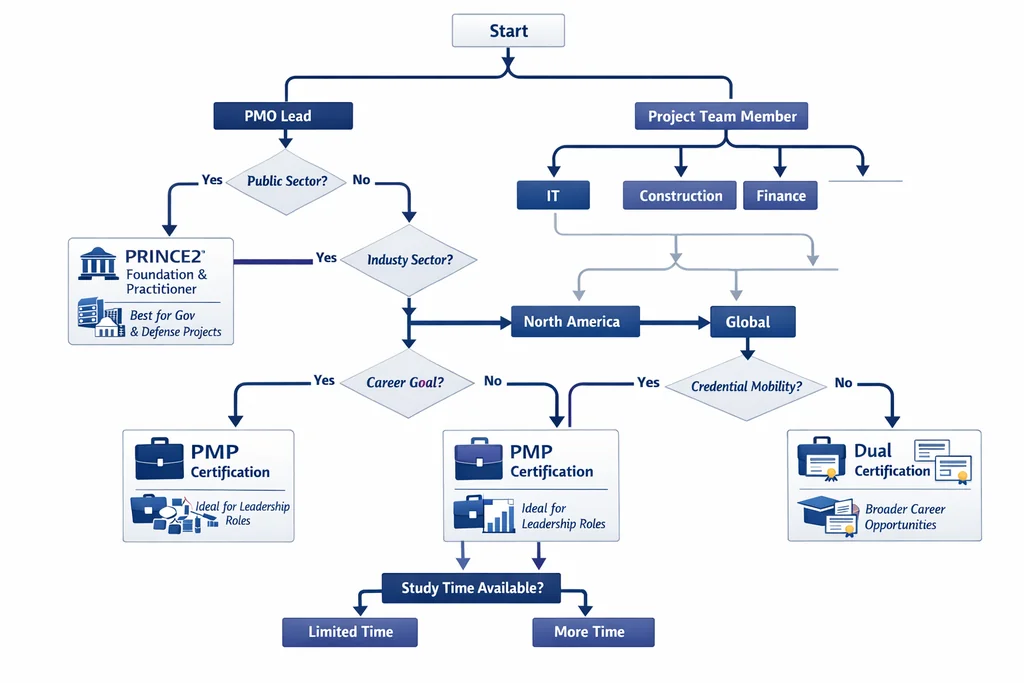
Choose PMP if you work or plan to work in North America, if you target senior project or program management roles, if your employer or clients require PMI credentials, or if you want a certification that signals broad, adaptable knowledge across methodologies. PMP also makes sense if you already meet the experience requirements and want to capitalize on that investment.
Choose PRINCE2 if you work in the UK, Europe, or Commonwealth markets, if you prefer a prescriptive methodology with clear processes, if you are early in your career and lack the experience for PMP, or if your organization mandates PRINCE2 for project governance. The Foundation entry point lets you build credibility quickly without waiting years to qualify.
Consider both if you operate globally, if your employer reimburses certification costs, or if you want to pivot between markets. Earning PRINCE2 Foundation and Practitioner first gives you a credential within weeks, then you can accumulate project hours toward PMP while working.
How to Structure Your Study Plan
Regardless of which path you choose, treat exam preparation as a project with defined scope, schedule, and resources. Block 60-90 minute study sessions four to five days per week. Start with official materials: the PMBOK Guide for PMP, or the official PRINCE2 manual from PeopleCert for that track. Supplement with accredited training if your budget allows, since structured courses expose gaps that self-study misses.
Practice exams should enter your routine by week three, not the final weekend. They serve two purposes: building stamina for the timed environment and revealing which knowledge areas need reinforcement. Aim for consistent scores above 75% before scheduling the real exam. If you plateau below that threshold, revisit the underlying material rather than taking more practice tests.
For PRINCE2 candidates, focus on process flow and document relationships. Know which theme feeds which process, who holds the project manager role versus executive, and how exception handling works. For PMP candidates, practice interpreting scenario questions where multiple answers seem partially correct. PMI rewards the most appropriate choice, not the perfect one.
Real-World Scenarios: Three Professionals, Three Paths
Maria, a business analyst in Manchester, wants to move into project management within six months. She lacks the 36 months of leading projects that PMI requires, so PMP is out of reach for now. She enrolls in a PRINCE2 Foundation course, passes in three weeks, and immediately adds the credential to her internal profile. Her manager assigns her to a small project as deputy project manager, giving her the lead experience she will need for PMP later.
James, a construction project coordinator in Dallas, has led site teams for four years. His employer requires PMP for senior project manager promotions and reimburses exam costs. He submits his application, documents his hours, and schedules the exam for ten weeks out. He uses PlanetCert's PMP practice tests to drill earned value management and risk response strategies, passing on his first attempt with above-target scores in three domains.
Priya, a consultant at a global technology firm, splits time between Singapore and London client sites. She earns PMP first to solidify her standing with North American accounts, then adds PRINCE2 Practitioner to satisfy European procurement requirements. Her dual credentials appear on proposal boilerplates, and she bills at a higher rate on projects where the client specifies methodology certification. The second exam takes less preparation because her PMP study already covered stakeholder and risk concepts that overlap with PRINCE2 themes.
Common Mistakes to Avoid
Candidates often stumble on predictable errors. One is choosing based on prestige rather than market fit. PMP sounds more senior, but it will not help you if your target employers in Germany or Australia specify PRINCE2. Another mistake is underestimating the application overhead. PMI's experience documentation takes hours to compile, and a random audit adds weeks. Start that paperwork early rather than treating it as a formality.
Some learners over-invest in training and under-invest in practice exams. A $2,000 bootcamp feels productive, but without repeated timed testing, you may freeze on exam day. Conversely, self-studiers sometimes skip accredited courses entirely and miss methodology nuances that appear on the test. Balance structured learning with self-assessment.
Finally, do not schedule the real exam until your practice scores stabilize in the passing range. Anxiety pushes candidates to book early, but a failed attempt costs money and morale. Use your practice test trend line, not your calendar urgency, as the trigger to schedule.
FAQ
Can I hold both PMP and PRINCE2 certifications?
Yes. Many project managers hold both. PMP demonstrates broad knowledge and experience, while PRINCE2 shows methodology fluency. They complement each other rather than compete, and some employers value the combined credential for global roles.
Does PRINCE2 Foundation alone help my resume?
Foundation proves you understand PRINCE2 terminology and structure, but Practitioner is what employers typically require for project management roles. Treat Foundation as a stepping stone, not a destination, unless you need quick credibility for a support or coordination position.
How long does PMP application audit take?
PMI audits a percentage of applications randomly. If selected, you have 90 days to submit verification documents. The audit itself typically processes within 5-7 business days after you submit complete materials. Build this buffer into your exam scheduling.
Is PMP harder than PRINCE2 Practitioner?
Difficulty depends on your background. PMP covers more domains and tests judgment in ambiguous situations. PRINCE2 Practitioner tests precise application of a specific methodology. Candidates with deep experience often find PMP more intuitive; those who prefer clear rules often find PRINCE2 easier to master.
Do these certifications expire?
PMP expires after three years without 60 PDUs. PRINCE2 Practitioner expires after three years without resitting the exam or earning sufficient CPD points. Foundation does not expire, though staying current with methodology updates helps your credibility.
Can I use PMP to skip PRINCE2 Foundation?
Yes. PMP holders can sit the PRINCE2 Practitioner exam directly without passing Foundation first. This exemption recognizes that PMP covers equivalent knowledge. Check current PeopleCert rules before registering, as policies can update.
Which certification do employers prefer for IT projects?
In the United States, PMP appears more frequently in IT job postings. In the UK and Europe, PRINCE2 dominates. For agile-heavy technology teams, neither may be the primary ask; employers might prefer Scrum certifications instead. Research ten job postings in your target market to confirm actual demand.
Learn more — browse the relevant exam page and purchase a practice test to start your preparation with realistic, timed questions.
Further Reading
- Top 12 IT Certifications for Career Growth in 2026
- Study Planning Guide for Tech Certification Exams
- Common Certification Exam Questions Answered
References
- How PRINCE2 can compliment PMBOK® — PMBOK® is the recognized (de facto) standard of project management knowledge. In the UK and Europe, the PRINCE2® project management methodology is looked to as the methodology of

Discussion
Question Comments
0 comments·0 participantsSign in to leave a comment and access more free questions.