

CompTIA A+ vs Network+: Which Certification Should You Get First?
If you're starting a career in IT, choosing between CompTIA A+ and Network+ depends on your experience and goals.
- CompTIA A+ is ideal for beginners and covers IT basics like hardware, operating systems, and troubleshooting. It's perfect for help desk or support roles.
- CompTIA Network+ focuses on networking concepts like infrastructure, protocols, and security. It's better suited for roles like network administrator or systems engineer.
Key Differences:
- A+ requires 2 exams ($506–$530 total), while Network+ is a single exam ($358–$399).
- A+ is entry-level, while Network+ assumes some IT knowledge and is intermediate.
- A+ aligns with roles averaging $64,000/year, while Network+ leads to jobs paying $72,000–$96,800/year.
Quick Comparison Table:
| Feature | CompTIA A+ | CompTIA Network+ |
|---|---|---|
| Exams | 2 (Core 1 & Core 2) | 1 |
| Cost | $506–$530 | $358–$399 |
| Difficulty | Beginner | Intermediate |
| Study Time | 3–4 months | 2–3 months |
| Focus | IT basics, troubleshooting | Networking concepts |
| Job Roles | Help Desk, IT Support | Network Admin, Systems Eng. |
| Salary Range | ~$64,000/year | $72,000–$96,800/year |
Start with A+ if you're new to IT, as it builds a solid base for future certifications. If you already have IT experience or knowledge, consider starting with Network+ for higher-paying, network-focused roles.
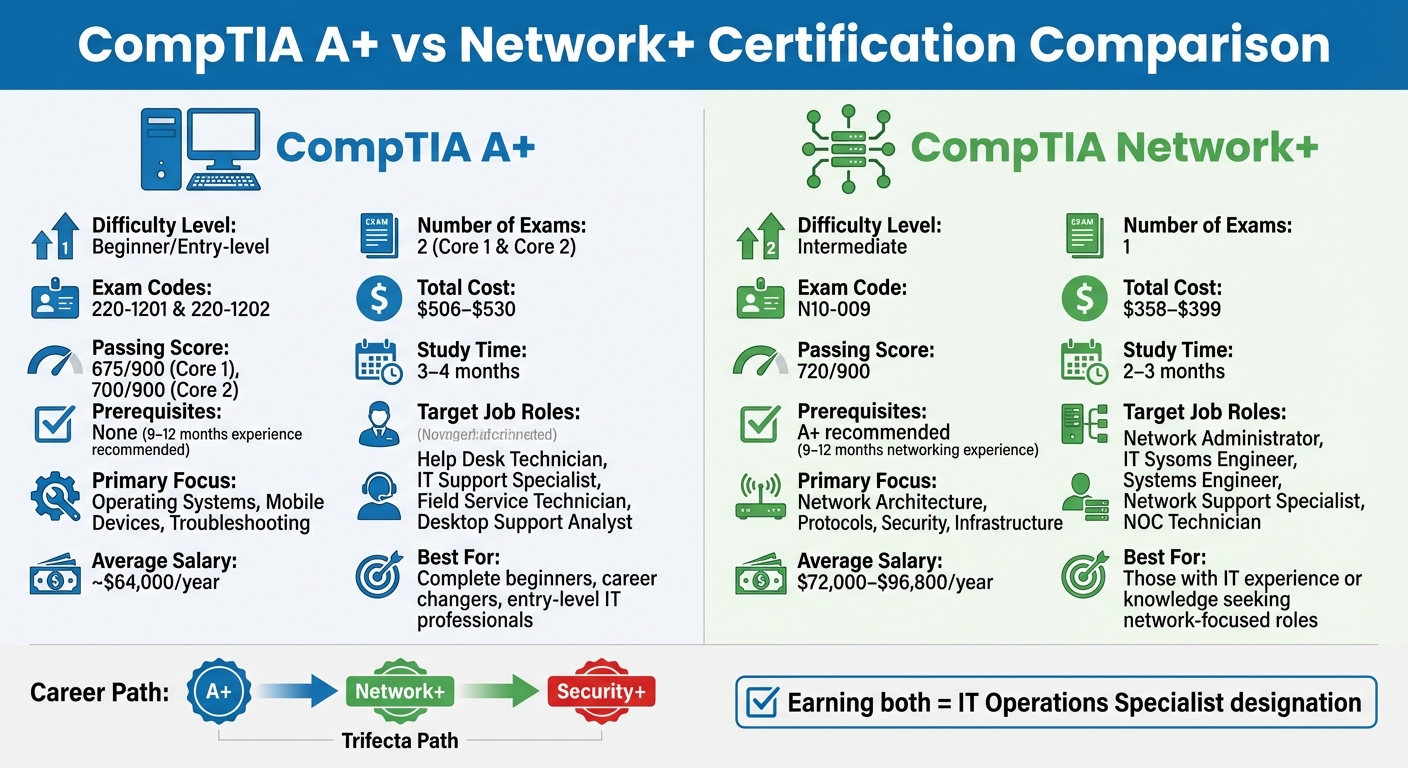
CompTIA A+ vs Network+ Certification Comparison Chart
A+ vs Network+: Which Certification Should You Get First?
CompTIA A+ vs Network+: Side-by-Side Comparison

The CompTIA A+ and Network+ certifications cater to different aspects of IT expertise. A+ serves as a foundation, covering a wide range of IT basics, including hardware, operating systems, mobile devices, and troubleshooting across various platforms. On the other hand, Network+ dives deeper into networking, focusing on device connectivity, communication, and security within network infrastructures. This difference extends to the structure of their respective exams.
The A+ certification requires two separate exams (Core 1 and Core 2), while Network+ is assessed through a single comprehensive exam. This means the A+ typically involves more preparation time and higher costs. For instance, candidates usually spend 3–4 months studying for A+, compared to 2–3 months for Network+.
The difficulty also varies. For A+, the passing scores are 675/900 for Core 1 and 700/900 for Core 2. Network+, however, has a higher passing score of 720/900 and includes more abstract topics like subnetting, the OSI model, and network architecture. These distinctions create unique challenges for candidates, as highlighted by industry professionals.
According to an IT Director from a major hospital system: "We don't hire anyone for tier-1 support without A+ or equivalent experience. It proves they speak the basic language of IT".
A Cloud Infrastructure Manager added: "Network+ gives candidates the vocabulary and conceptual framework we need. They understand why networks fail, not just that they're down".
Comparison Table
| Feature | CompTIA A+ | CompTIA Network+ |
|---|---|---|
| Exam Codes | 220-1201 (Core 1) & 220-1202 (Core 2) | N10-009 |
| Number of Exams | 2 | 1 |
| Total Cost | $506–$530 | $358–$399 |
| Passing Score | 675/900 (Core 1), 700/900 (Core 2) | 720/900 |
| Difficulty Level | Beginner / Entry-level | Intermediate |
| Study Time | 3–4 months | 2–3 months |
| Primary Focus | Hardware, OS, Mobile, Troubleshooting | Network Architecture, Protocols, Security |
| Prerequisites | None (9–12 months experience recommended) | A+ recommended (9–12 months networking experience) |
| Target Job Roles | Help Desk, Field Technician, IT Support | Network Admin, Systems Engineer, Network Analyst |
| Average Salary (US) | ~$64,000 | $72,000–$96,800 |
Next, we’ll explore the core skills each certification develops and help identify the right fit for different career paths.
CompTIA A+ Certification Overview
The CompTIA A+ certification is the perfect starting point for anyone looking to launch a career in IT. It establishes the essential skills needed for entry-level roles and covers a broad range of technologies, ensuring your expertise isn’t tied to a single vendor. This flexibility makes it a great foundation for various IT career paths, from help desk support to cybersecurity.
To earn the certification, you’ll need to pass two 90-question exams: Core 1 (220-1201) and Core 2 (220-1202). Each exam is 90 minutes long and includes multiple-choice, drag-and-drop, and performance-based questions that replicate real-world scenarios. Note that both exams must be from the same series - currently V15, which launched on March 25, 2025.
CompTIA suggests having 9 to 12 months of hands-on experience before taking the exams. The certification tests your ability to handle hardware, network, malware, and operating system issues. As CompTIA puts it:
"CompTIA A+ is not just about PC repair. CompTIA A+ candidates are better prepared to troubleshoot and problem-solve a wider variety of issues, ranging from networking and operating systems to mobile devices and security".
Here’s a closer look at the skills covered in each exam.
Skills and Topics Covered
Core 1 focuses on hardware and infrastructure. You’ll learn to install and configure components like RAM, CPUs, storage devices, and motherboards. It also covers setting up mobile devices, understanding networking protocols, wireless technologies, and SOHO network configurations, as well as troubleshooting hardware and networking issues. The exam domains are weighted as follows:
- 25% hardware
- 23% networking
- 13% mobile devices
- 11% virtualization/cloud
- 28% troubleshooting
Core 2 shifts to software and security. It tests your knowledge of operating systems (Windows, macOS, Linux, Chrome OS, and mobile OS), command-line tools, encryption, and access controls. You’ll also need to demonstrate skills in software troubleshooting and operational procedures, such as documentation, backup and recovery, and professional communication. The domain breakdown includes:
- 28% operating systems
- 28% security
- 23% software troubleshooting
- 21% operational procedures
Recent updates reflect the evolving needs of modern workplaces. These include a stronger focus on remote and hybrid work support, such as remote troubleshooting, SaaS applications, IoT security, data management, and basic scripting.
Best Candidates for A+
The A+ certification is a great fit for career changers, recent graduates, and entry-level IT professionals. It’s especially useful for roles like Help Desk Technician, IT Support Specialist, Field Service Technician, Desktop Support Analyst, or Tier I Support Specialist. In the U.S., these positions typically offer annual salaries between $45,000 and $64,000.
Additionally, the certification is DoD 8140 approved, making it a gateway to government and defense-related roles. These include Technical Support Specialist, System Administrator, and Cyber Defense Infrastructure Support Specialist. The demand for cybersecurity skills is high - between September 2023 and August 2024, there were over 457,000 job openings requiring these skills, a demand that aligns with the foundational knowledge provided by A+.
For those aiming to specialize in cybersecurity, A+ is an excellent starting point. As CompTIA explains:
"Building a cybersecurity career is a lot like building a house. You can't just skip to roof construction. First, you need to lay a foundation... The best way to build core foundational skills is via CompTIA A+ certification".
Interestingly, candidates with an A+ certification are 23% more likely to pass the advanced Network+ exam on their first try.
sbb-itb-b03e171
CompTIA Network+ Certification Overview
CompTIA Network+ zeroes in on the essentials of designing, configuring, managing, and troubleshooting both wired and wireless networks. While the CompTIA A+ certification covers a broader spectrum of IT fundamentals, Network+ is all about networking, making it the go-to option for those looking to specialize in this area.
The most recent version of the exam, N10-009, launched on June 20, 2024. It includes up to 90 questions, which must be completed in 90 minutes. These questions come in multiple-choice and performance-based formats, the latter simulating practical, real-world networking tasks. To pass, candidates need a score of 720 on a scale of 100–900. Although there are no official prerequisites, CompTIA advises having the A+ certification and 9 to 12 months of hands-on experience in a junior network support role. Much like A+, this certification can be a key milestone in your IT career, especially if networking is your focus.
One of the standout features of Network+ is its vendor-neutral approach, equipping you with skills that are applicable across various platforms. As CompTIA puts it:
"CompTIA Network+ is the premier certification for validating your knowledge of essential networking tools and concepts".
Skills and Topics Covered
The Network+ exam evaluates a wide range of networking skills, broken down into these core areas:
-
Network Troubleshooting (24%)
This section emphasizes the six-step troubleshooting process: identifying the problem, forming a theory, testing the theory, implementing a solution, verifying functionality, and documenting the resolution. -
Networking Concepts (23%)
Covers foundational topics such as the OSI model, cloud service models (SaaS, IaaS, PaaS), IP addressing and subnetting (including VLSM and CIDR), and key ports and protocols. -
Network Implementation (20%)
Focuses on routing protocols like BGP and OSPF, switching technologies including VLANs and STP, and wireless encryption methods. -
Network Operations (19%)
Encompasses network monitoring tools like SNMP, disaster recovery strategies, documentation, and life-cycle management. -
Network Security (14%)
Highlights techniques for hardening network security, implementing zero-trust architecture, and mitigating common threats such as DDoS attacks and ARP poisoning.
The N10-009 version also incorporates emerging technologies like Software Defined Wide Area Networking (SD-WAN), Infrastructure as Code (IaC), VxLAN, and advanced zero-trust principles.
Best Candidates for Network+
This certification is a great fit for IT professionals aiming for roles like network administrator, systems engineer, network support specialist, or NOC technician. It’s particularly useful for those ready to transition from general IT support to more focused network infrastructure roles.
In the U.S., Network+ professionals earn an average salary of about $77,078, with some roles reaching up to $90,000. For example, network support specialists typically earn a median salary of $68,000, while systems engineers can earn as much as $130,000 annually. Job growth in these fields is projected at 9% from 2023 to 2028.
Network+ also serves as a foundational step for those pursuing cybersecurity roles, as it provides the networking expertise needed for certifications like CompTIA Security+. The exam voucher costs $369, while bundled packages that include retakes and study materials range from $475 to $999.
This certification lays the groundwork for exploring advanced IT paths and aligning your credentials with your career ambitions.
Which Certification Should You Get First?
Deciding where to start in IT largely depends on your experience and career goals. If you're brand new to IT or transitioning from another field, A+ is the logical first step. It introduces the essential terminology and hands-on skills that will make future learning much easier.
On the other hand, if you already have 9–12 months of IT experience, a computer science degree, or a solid understanding of concepts like IP addressing and the OSI model, you might be ready to jump straight into Network+. However, skipping A+ could leave you with gaps that might surface during technical interviews for entry-level jobs.
Let’s take a closer look at how these certifications align with different career goals.
Choosing Based on Your Career Goals
Your career aspirations should shape your decision. Choose A+ if you're aiming for help desk or support roles where troubleshooting and hardware/software management are key. These roles are often the first step into IT, with salaries typically around $64,000 annually.
Choose Network+ if you’re setting your sights on roles like network administrator, junior network engineer, or systems administrator from the start. These positions focus on network infrastructure and come with higher starting salaries, typically ranging from $72,000 to $96,800. In cities like New York or San Francisco, experienced Network+ professionals can earn between $110,000 and $130,000+ annually. A Cloud Infrastructure Manager highlights the value of Network+:
"Network+ gives candidates the vocabulary and conceptual framework we need. They understand why networks fail, not just that they're down".
Common Certification Paths
Once you've chosen your starting point, many professionals follow a structured path to build their expertise. A well-known route is the "Trifecta" sequence: A+ → Network+ → Security+. This progression creates a strong foundation for general IT and cybersecurity roles. Once you've passed Network+, use a CompTIA Security+ practice exam to gauge your readiness for the final step. CompTIA even rewards this path with stackable designations - earning both A+ and Network+ grants you the "IT Operations Specialist" title automatically.
Other paths include moving from Network+ directly to Security+ and CySA+ for cybersecurity operations or following A+ with Network+ and then Cloud+ for cloud-focused roles. These routes allow you to specialize while steadily advancing your career.
Conclusion
The earlier sections highlighted the key distinctions and career opportunities tied to both certifications. Deciding between CompTIA A+ and Network+ depends largely on your experience level and career aspirations. For those new to IT or transitioning from another field, A+ lays the groundwork with essential terminology and practical skills, making it an ideal entry point for help desk and support roles. If you already have some IT experience (9–12 months) or a background in computer science, Network+ could be your stepping stone to roles like network administrator or junior network engineer.
Statistics suggest that starting with A+ helps establish a strong base for long-term career progression. For many, the A+ → Network+ → Security+ path is the tried-and-true route. This sequence equips you with a well-rounded skill set that employers highly value. Plus, completing both A+ and Network+ earns you the "IT Operations Specialist" designation automatically.
To prepare effectively, aim for at least an 85% score on CompTIA A+ practice exams before taking the official test. Remember, your first certification is just the beginning. Pair it with hands-on experience to fast-track your IT career. As your skills evolve, these certifications will serve as a springboard to more advanced opportunities in the field.
FAQs
Do I need A+ before Network+?
You don’t have to get the CompTIA A+ certification before going for Network+. There aren’t any strict requirements, but having A+ or similar knowledge can help you feel more prepared. The A+ certification focuses on hardware, troubleshooting, and IT support basics, which can make understanding networking concepts a bit smoother. That said, if you already know the fundamentals of computer systems and networking, you can jump straight into Network+ without any issues.
Which certification helps me get hired faster?
The CompTIA A+ certification is a popular starting point for those looking to break into IT roles like help desk technician or IT support specialist. Employers appreciate this certification because it demonstrates core knowledge in areas like hardware, troubleshooting, and operating systems. With its wide-ranging focus and no need for prior experience, it’s an excellent option for anyone aiming to enter the IT workforce quickly.
What should I study first if I struggle with subnetting?
If you're finding subnetting tricky, consider starting with the CompTIA A+ certification. This certification focuses on essential IT skills, including the basics of networking such as subnetting, IP addressing, and troubleshooting. It’s a great way to build a strong foundation before tackling the more advanced networking concepts covered in Network+.
Related Blog Posts

Discussion
Question Comments
0 comments·0 participantsSign in to leave a comment and access more free questions.