

If you’re wondering why sample questions feel easier than exam day, compare the conditions around each attempt. Familiar wording, repeated answers and unlimited thinking time can make practice comfortable. Fresh scenarios, competing requirements and a running clock demand a different performance. To close that gap, you need practice that separates what you understand from what you recognise. The steps below help you diagnose the difference, adjust your sessions and check whether your progress holds when the questions change.
Spot what your sample score is measuring
An easy practice session can mean you understand the material. It can also mean the session gave you help that your assessment won’t provide.
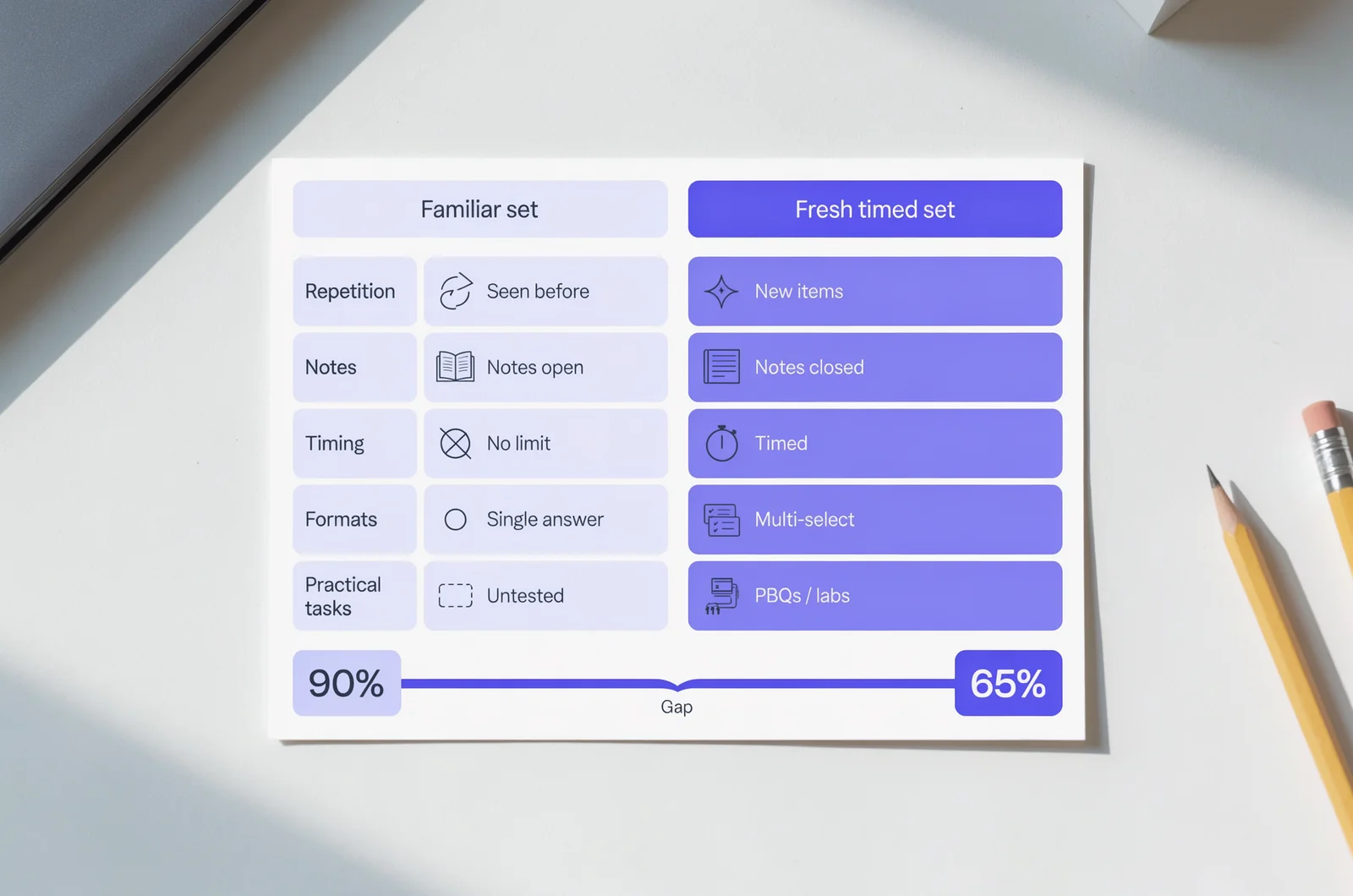
Check whether these conditions apply:
- You recognise the question and remember which option was correct before working through the problem.
- The wording points straight to a definition, with few details to interpret.
- You pause to consult notes or read explanations between answers.
- Every item asks for one answer, so you haven’t practised evaluating several selections.
- Your preparation covers written questions but leaves practical tasks, PBQs or labs untested where your exam requires them.
These are different gaps, so they need different adjustments. A clock won’t fix missing knowledge. A larger question bank won’t automatically teach you to configure something.
Consider a hypothetical result: you score 90% on a familiar set, then 65% on unseen questions covering similar objectives. The difference doesn’t establish your likely exam score. It tells you to investigate how much the familiar wording helped.
Keep repeat attempts separate when tracking practice test scores. Record whether each set was fresh, timed and completed without help. Those details make the percentage easier to interpret.
1. Match practice to your booked exam
Your practice should reflect the assessment you intend to sit. Start with the exact exam code and the objectives associated with your booking.
Have the exam details, objective list and recent practice results beside you. Check the permitted time, question formats, navigation rules and any practical components. Avoid transferring assumptions from another certification, even within the same vendor’s programme.
Make a short coverage list in your notes. For each objective, record what you’ve actually done: answered fresh questions, explained the concept, interpreted a scenario or completed a relevant task.
Be precise. “Reviewed networking” gives you little direction. “Explained the route selection in three unfamiliar diagrams” describes something you can check.
I’d also separate learning sessions from readiness checks. During learning, use notes and explanations freely. During a readiness check, decide the rules beforehand and follow them throughout.
If you use PlanetCert’s simulator, keep results from study sessions separate from timed attempts. Otherwise, an assisted answer can disappear into a percentage that looks more independent than it was.
You’ve finished this step when you can identify both the content and the conditions your next practice session needs to cover. Put any unverified format detail on a list to confirm before the full rehearsal.
2. Test yourself on questions you haven’t seen
Fresh questions help you check whether you can apply an idea without recognising its presentation.
Reserve some legitimate practice material for later assessment. Choose questions aligned with your objectives and supported by explanations. Reject material advertised as copied live exam content.
Keep familiar sets for revision. When you revisit one, cover the options first and explain the answer in your own words. Then examine why each alternative fails under the stated conditions.
For an unseen set, record your confidence before viewing the explanation. A simple distinction between confident, uncertain and guessed is enough.
Review correct guesses alongside wrong answers. A lucky selection leaves a gap that the percentage hides. Equally, a wrong answer reached through sensible reasoning may reveal one specific misconception rather than a whole weak domain.
You can also create a variation of a familiar question. Change a requirement, remove an assumption or ask what evidence would alter the answer. Treat your version as a learning exercise; don’t use it as an independently validated score.
The check is whether your reasoning survives a change in wording. After reviewing an item, explain the principle without naming an answer letter. If all you remember is “option C”, return to the objective and work through a different example.
3. Add the clock and remove study aids
Timed practice shows whether you can complete the work within the conditions you’ve confirmed for your exam.
Start with a manageable block rather than forcing a full rehearsal into a busy evening. Set the time allowance before you begin. Close notes, silence notifications and leave explanations until the block ends.
Use the timing information for your specific assessment. A simple minutes-per-question calculation can provide a rough checkpoint, but it won’t account for every item’s demands. Leave room for longer scenarios and practical work where applicable.
Follow the confirmed navigation rules too. If returning to an answer is restricted, your rehearsal needs that restriction. If review is available, practise using it within the time allowance.
Keep timed practice exams separate from untimed learning. Each session should have a clear purpose.
Afterwards, check where the time went. Did you repeatedly reread long stems? Spend too long between two plausible options? Rush the final questions? These patterns suggest different repairs.
For example, repeated rereading calls for practice extracting requirements. Long debates between options call for explaining the deciding constraint.
If the block goes badly, review the cause before adding more pressure. Repeat a comparable block after targeted study. Check whether both completion and reasoning improve, rather than celebrating a faster attempt with more guesses.
4. Practise the decisions your samples leave out
Short questions can leave parts of your preparation untouched. Add exercises that require you to produce an answer, interpret evidence or manage competing requirements.
Work through tasks without answer choices
For CompTIA preparation, turn a relevant troubleshooting objective into a task. Describe the symptoms, identify what you would inspect and explain how you would confirm the result.
If your confirmed exam format includes performance-based questions, practise the required actions as well as the surrounding theory. Match the exercise to the published scope.
For Cisco preparation, use an unfamiliar network diagram. Predict the traffic path, identify the information you need and explain how you would verify your answer. Where configuration work fits the objectives, carry it out in an appropriate practice environment.
Check the result against the task’s success conditions. Recognising a command among four options gives you different evidence from choosing and using it yourself.
Resolve scenarios with competing constraints
For AWS study, practise finding the requirement that decides between plausible choices. A hypothetical scenario might prioritise cost, availability or reduced administration. Identify which condition controls the answer before evaluating the options.
The approach to AWS scenario-based questions is to make that requirement explicit.
For multiple-response practice, assess every option independently and follow the requested number of selections. Explain what supports each inclusion and exclusion. Use the practice provider’s stated scoring rules when interpreting the result.
For Microsoft preparation, extract requirements from a longer scenario before answering. Check the Microsoft exam format for the assessment you’re preparing for, then confirm the details against current vendor information.
You’ve completed this step when you can explain your decision without relying on the wording of a familiar answer.
5. Turn explanations into a repair plan
Review should change what you do in the next session. Reading an explanation and immediately recognising it leaves that work unfinished.
Record the cause of each uncertain answer
For every wrong, guessed or uncertain answer, write the objective and the reason for the difficulty.
Perhaps you lacked a fact, misunderstood a relationship, missed a constraint or ran out of time. Choose the description that points to a repair.
Keep each entry short. For a hypothetical routing mistake, you might write: “I applied the wrong route-selection rule; compare overlapping routes and explain the result.”
If you use PlanetCert’s question explanations, turn each reviewed item into a prompt you can answer later without seeing the original options. Keep prompts focused on the objective.
Retest the same idea in a different form
Choose an exercise that tests the repaired gap. That might be a short lab, a fresh scenario or a spoken explanation followed by a check against your study material.
Leave a gap before retesting so the explanation is no longer immediately in front of you. Then change the presentation.
Exam simulator analytics can help you decide where to investigate, but inspect individual answers before diagnosing a whole domain.
A useful evening session might contain ten minutes of review, twenty minutes on the weakest objective and a short fresh question block. Adjust that schedule to your available time. Finish by recording whether the original error reappeared.
6. Check readiness across more than one session
Your adjusted routine needs a final check under consistent conditions. Compare several fresh attempts rather than relying on one strong result.
Use sets with suitable objective coverage and the formats you’ve confirmed. Keep notes closed, apply the intended time allowance and record interruptions. Avoid blending an interrupted session into your main readiness record.
I’d look for these signs before treating a score as reassuring:
- You can explain correct answers and reject plausible alternatives.
- Fresh questions produce reasonably consistent results.
- Previously weak objectives hold up when presented differently.
- You complete relevant practical tasks without step-by-step prompts.
- Your pacing leaves enough attention for the final items.
There’s no universal practice percentage that guarantees a pass. A provider’s threshold belongs to its own assessment and scoring method.
A useful interactive readiness checklist could flag a high score when the attempt included repeated questions, exceeded its time allowance or omitted a required format.
If the evidence is mixed, choose the smallest useful repair. A repeated misunderstanding needs focused study. A pacing problem needs another timed block after you address its cause.
Before scheduling another full rehearsal, write what it will test. “Check whether I can finish unfamiliar scenarios within the allowance” gives the session a purpose. Compare the result with the previous attempt on that same basis.
When practice scores leave you unsure
Uneven results need interpretation before you change your exam plan. Use the conditions behind each score to decide what deserves attention.
Does a lower fresh score mean I’m getting worse?
Compare the sets before drawing that conclusion. A fresh attempt may remove the recognition that helped earlier results. Different coverage can also expose objectives the familiar set barely touched.
Inspect the errors. If they cluster around one objective, repair that area and test it with new material.
Should I stop using sample questions?
Keep using them for focused learning and checking whether you understand an explanation. Give fresh questions and realistic rehearsals a separate place in your routine.
When a set becomes familiar, change the task: justify the answer, reject each alternative or explain how a different requirement would change the result.
What if the clock makes me freeze?
Begin with a short timed block after you understand the topic. Notice whether you struggle with knowledge, interpretation or committing to an answer. Increase the session length as you become more comfortable with the routine.
If timing repeatedly disrupts performance, address that pattern before relying on a full-length score. Use your next session to practise one specific response, such as identifying the deciding requirement before comparing options.
Strengthen recall and plan your final week


Discussion
Question Comments
0 comments·0 participantsSign in to leave a comment and access more free questions.