

The Microsoft certification retake policy waiting period is 24 hours after your first failed attempt, then 14 days between later attempts at the same exam. These are minimum gaps for standard certification exams. Your next appointment also depends on eligibility and available slots. Before booking, identify which attempt comes next, confirm the current requirements for your exact exam, and decide whether you need more preparation time.
How long must you wait after each failed attempt?
After your first failure, allow at least 24 hours before taking the same exam again. If you fail a second time, allow at least 14 days before your third attempt. The longer gap also applies between subsequent attempts, subject to any attempt limits.
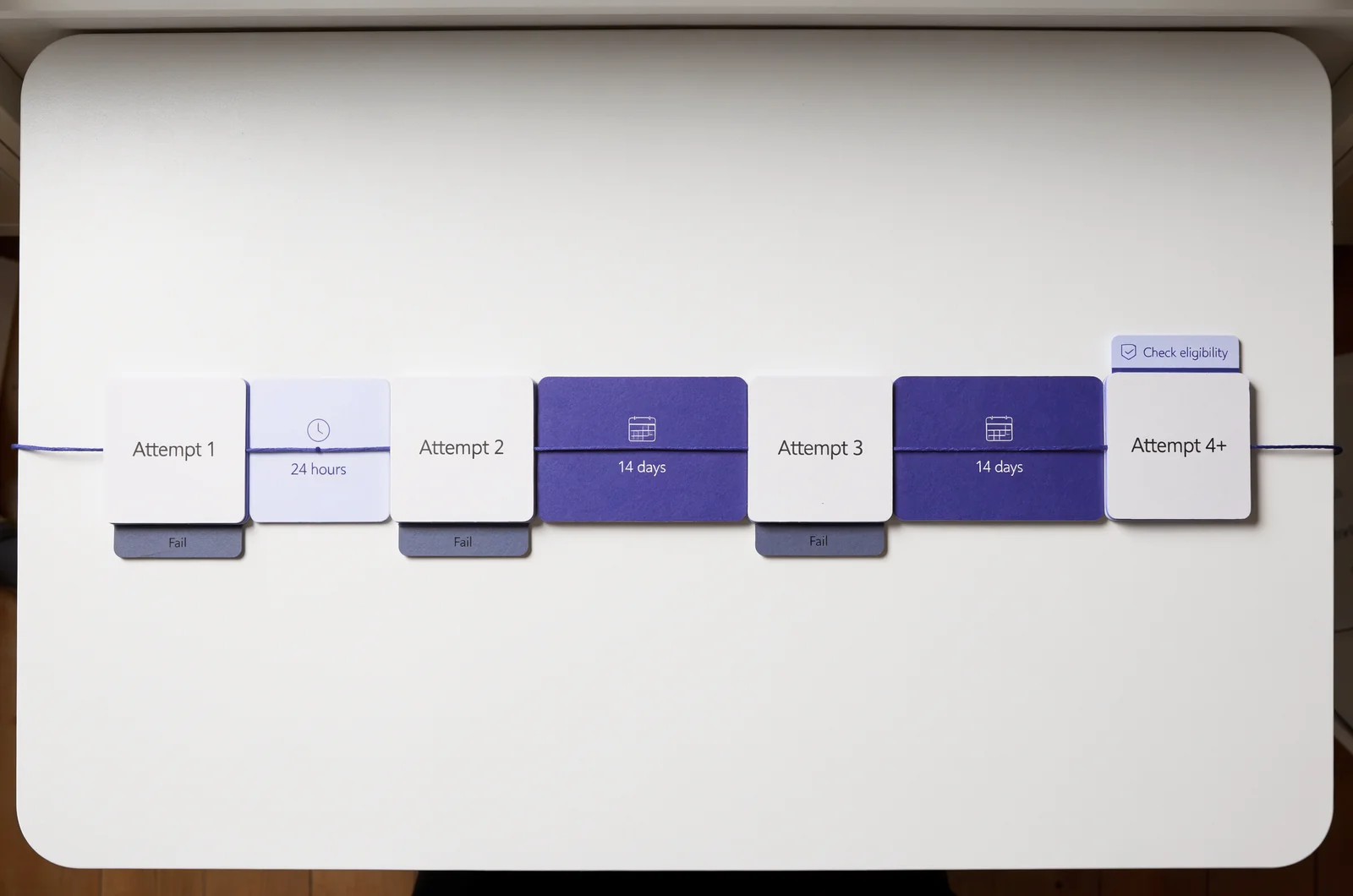
The sequence is:
- First failed attempt: wait at least 24 hours before attempt two.
- Second failed attempt: wait at least 14 days before attempt three.
- Further failed attempts: allow the applicable 14-day gap and check your remaining eligibility.
The distinction matters if you have already retaken an exam. The 24-hour interval does not restart after each failure.
Count attempts for the specific exam you want to retake. Keep its exam code beside your results so you can distinguish that history from other Microsoft exams.
These timings should not be carried across to every assessment associated with Microsoft. Certification exams, renewal assessments and other credential assessments may have different requirements. Confirm which assessment you are booking.
If you are also reconsidering your certification goal, the Microsoft Azure certification path can help you place an exam within a broader study route. Check the requirements for the exact exam code before choosing your next appointment.
Does the waiting period start when your exam finishes?
For planning, work forward from the failed attempt rather than treating the next calendar day as automatic permission to retake. The precise timestamp used to release your eligibility needs confirmation in your exam account.
Suppose, as a hypothetical example, your first failed attempt finishes at 16:00 on Monday. A full 24 hours takes you to 16:00 on Tuesday. Tuesday morning would still be inside that interval.
The same arithmetic applies to a 14-day gap. Two weeks must pass; counting the exam date as a completed waiting day can put your calculation ahead of the elapsed time.
This example explains the interval. It does not establish the exact timestamp Microsoft's scheduling systems use for your record. If your result appears later, or your booking screen shows a different eligible date, resolve that difference before paying.
Time zones also deserve attention. An appointment displayed in another zone can appear to fall on a different date. Check the time zone on both the failed appointment and the proposed retake.
A useful retake-date calculator would accept the failed-attempt date, time, time zone and attempt number, then show a provisional earliest date. Check any calculated result against the eligibility shown in your exam account.
Do online-proctored exams follow the same retake timing?
Taking a standard Microsoft certification exam through online proctoring does not shorten the normal retake gap. Plan around 24 hours after the first failure and 14 days between later attempts.
Moving from an online appointment to a test centre should not be treated as a way to reset your attempt history. Your preparation and scheduling decisions should follow the exam you failed.
Delivery still matters when you diagnose the result. Separate knowledge gaps from problems with the testing environment:
- Did interruptions or technical difficulties affect concentration?
- Did the room setup make it difficult to settle?
- Did you lose time because you were unfamiliar with the interface?
- Would a different testing environment help you work more comfortably?
Those questions can influence your next appointment. They do not establish an exception to the waiting period.
If an online session was interrupted, check how the attempt was recorded before applying the normal failed-exam timeline. Keep the appointment confirmation and any incident reference.
Avoid assuming that a disconnected session was automatically cancelled or excluded from your history. Ask the responsible support team to confirm its status and the arrangements available for that specific appointment.
Can you book a retake before the waiting period ends?
Your earliest permitted exam date and the date you can reserve an appointment are separate questions. The waiting period establishes the minimum interval before another attempt. It does not, by itself, explain when every booking screen will accept a reservation.
Use your exam account to check what is available. If it allows you to select a future appointment, confirm that the appointment itself falls after your eligibility date.
A practical booking sequence is:
- Check the result and exam code for your previous attempt.
- Confirm the waiting period that applies to your attempt number.
- Review the eligible appointments shown in your account.
- Check your study schedule and payment conditions.
- Verify the date and time zone before completing the reservation.
An available slot is only one part of that decision. You also need enough time to address the problems behind the failed attempt.
If a convenient slot appears immediately after the minimum gap, compare it with your actual preparation needs. A later appointment may give you time to complete a lab, review a weak domain or finish a fresh timed session.
What should you check about fees, vouchers and attempt limits?
Check the payment conditions and remaining eligibility before treating a retake date as settled. A waiting period does not tell you whether another attempt is included in your original purchase.
Review the terms attached to your booking or voucher. In particular, establish:
- Whether another exam payment is required.
- Whether a purchased package includes a retake.
- Whether the voucher has an expiry date.
- Whether the benefit applies to your exact exam.
- Whether an attempt limit affects your booking.
Avoid assuming that a discount, employer payment or training package includes another attempt. Look for explicit terms covering the retake.
Keep the payment deadline separate from the waiting period. A voucher expiry can constrain your options, but you should not assume it overrides an eligibility restriction. If those dates conflict, ask the issuer or booking support what options apply.
The minimum gap also does not mean you have unlimited attempts. Check the current attempt-limit rules for your exam before arranging another sitting, particularly after repeated failures.
I’d keep a short record containing the exam code, previous attempt dates, next eligible date and payment conditions. That makes it easier to explain a discrepancy to support. Save the relevant confirmation alongside the record before making another payment.
How should you use the first 24 hours after a failure?
Use the first day to identify what needs to change. Retaking as soon as you become eligible only makes sense if you can address the main cause of the failure within that time.
Start with your score report and the exam's current skills outline. Note the domains that need attention, then distinguish content gaps from pacing problems.
Useful review notes describe skills you need to practise. For example, you might need to compare access-control options more confidently or complete a configuration task without consulting instructions. Avoid trying to reconstruct protected exam questions.
For an AZ-104 retake, the discussion of common AZ-104 exam mistakes can help you organise that diagnosis. Select the issues that match your own preparation and result.
If you use PlanetCert's flashcards, focus them on distinctions you repeatedly confuse. Pair each card with an explanation in your own words. Recognition alone can hide a weak understanding.
Protect some recovery time as well. A late-night review followed by an early retake can leave little room to assess whether anything has improved.
Before choosing the next available appointment, complete one focused check of the weak area. Explain the decision, perform the task where practical, and review any remaining errors.
What can you improve during a 14-day waiting period?
A 14-day gap gives you room to diagnose weak areas, practise the underlying skills and check whether those changes hold under time pressure. Build the schedule around your result and available study time.
What should you do during the first week?
Begin by matching your weak domains to the current exam objectives. Check that your material still covers the relevant scope. These outdated study guide checks can help you review its suitability.
Choose a manageable amount of work for each session. For a working professional, a focused task after work may be more practical than an ambitious evening syllabus.
For each weak objective:
- Review the concept in suitable learning material.
- Complete a relevant hands-on task where practical.
- Answer a small set of legitimate practice questions.
- Record why your incorrect answers were wrong.
Write down the reasoning behind correct answers too. A correct guess still leaves work to do.
By the end of the week, aim to explain the weak topics without relying on familiar answer wording.
What should you change in the second week?
Move from isolated topic work towards mixed, timed practice. This checks whether you can select the right approach when several domains appear together.
With a timed session in PlanetCert's exam simulator, review the explanations after finishing. Keep the timed attempt separate from the learning session so the result reflects your unaided decisions.
Use exam simulator analytics to look for patterns across sessions. Repeated errors in one domain deserve different attention from mistakes clustered near the end of a test.
For AZ-900 preparation, these free AZ-900 practice tests provide another starting point for selecting practice material. Check its scope against the exam you have booked.
Leave time after each session to repair the errors it exposes. Schedule your final review early enough to revisit an unresolved topic before exam day.
How do you know you're ready for another attempt?
You are better placed to retake when you can show what has improved since the failed attempt. The end of the waiting period is an eligibility milestone; readiness needs separate evidence.
Look for changes such as:
- You can explain previously weak objectives without reading notes.
- You can complete relevant tasks with fewer prompts.
- You can distinguish plausible answers using the scenario's requirements.
- You can finish fresh practice within the available time.
- You can explain why your earlier reasoning led to mistakes.
Treat repeated scores on the same question set cautiously. Familiarity can make answers easier to recognise without testing whether you can apply the concept elsewhere.
A practice result also cannot guarantee an exam outcome. Question selection, difficulty and scoring may differ. Use practice to locate weaknesses and assess your reasoning.
If time management caused difficulty, check whether your new approach works throughout a timed session. Getting the opening questions right does not resolve a pattern of rushing near the end.
I’d base the retake date on the smallest unresolved problem that could still affect performance. That might be one weak domain, an unfamiliar task type or a pacing habit.
Choose an appointment that leaves enough time to practise that problem and check the result again.
What if your result or retake eligibility looks wrong?
If your recorded result or eligible date looks inconsistent, resolve the record before arranging another attempt. A calculation cannot settle an account-specific discrepancy.
Gather the exam code, appointment date, displayed result and any relevant confirmation messages. If the problem followed a technical incident, include its reference number.
Ask a precise question. For example: “My account shows this attempt status and this eligible date. Can you confirm which waiting period applies?” This gives support a specific issue to investigate.
Do not assume that an interrupted exam, missing result or disputed outcome will receive the same treatment as a completed failed attempt. Ask how the appointment is classified and what you can do next.
If an employer deadline, voucher expiry or planned study break affects your options, include those dates in the enquiry. Keep studying while the administrative issue is resolved.
Before finalising the new appointment, check that the confirmed exam code, eligible date and booking conditions match your account.
Which resources can help you prepare for the retake?


Discussion
Question Comments
0 comments·0 participantsSign in to leave a comment and access more free questions.