

If you searched for “how does Microsoft exam adaptive scoring work”, you’re probably trying to interpret a practice percentage or an unfamiliar score report. Microsoft technical certification exams use scaled scoring with a passing score of 700. They do not use the answer-by-answer adaptive model that the phrase suggests, and 700 does not mean 70% correct.
I’d begin with Microsoft Learn’s scoring guidance, then use its exam experience material, exam-specific study guides and Practice Assessments. Each answers a different question. Together, they help you separate scoring rules from question formats and choose what to revise before your booked exam.
What a 700 passing score actually tells you
A Microsoft technical certification result tells you whether your performance meets the passing standard. Understanding that result requires separating question selection from score reporting.
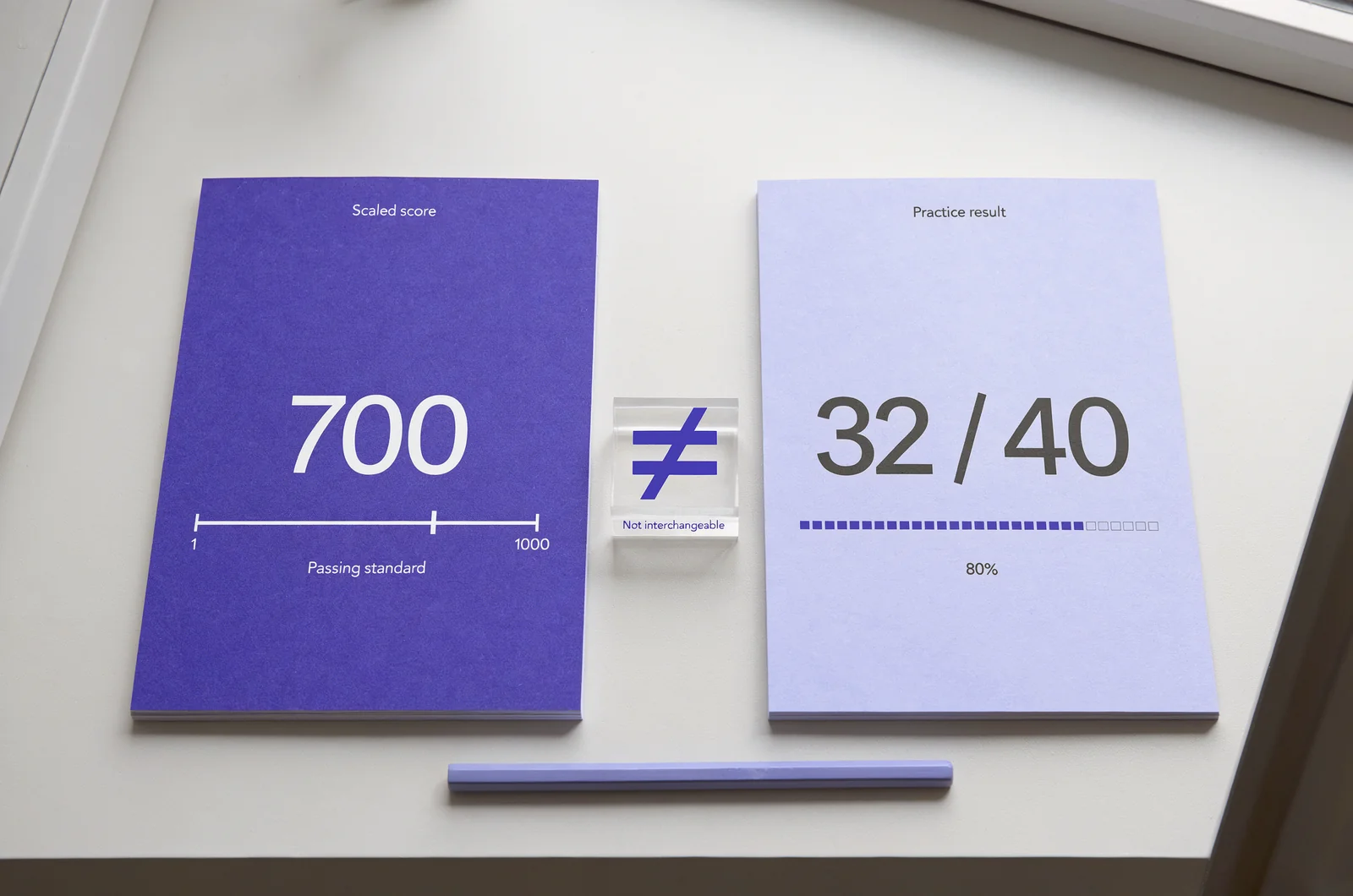
Scaled scoring and adaptive question selection
Computer-adaptive testing changes question selection in response to earlier answers. Scaled scoring expresses performance on a reporting scale. These are separate assessment mechanisms.
A difficult question appearing after an easy one does not establish that the exam has adapted to your performance. Neither does a sudden change of subject.
During your exam, treat question difficulty as a demand on your knowledge. Trying to infer a hidden ability estimate from the sequence gives you no dependable basis for changing your answers or pacing.
Why 700 does not mean 70%
The 700 threshold is a scaled passing score. It does not give you a universal percentage of questions you must answer correctly.
Suppose a hypothetical practice quiz contains 40 equally weighted questions and you answer 32 correctly. Your result is 80% on that quiz. It does not establish that you would receive 800 on a Microsoft exam.
The quiz and certification exam have different questions and scoring arrangements. A percentage alone cannot bridge that gap.
The same limitation applies after an unsuccessful attempt. The distance between your result and 700 does not tell you exactly how many additional questions you needed to answer correctly. Use the report to identify revision priorities.
The free Microsoft resources to read in order
For Microsoft scoring questions, I prioritise authority, relevance to your exact exam and a clear explanation of limitations. These four resources have different jobs, so the reading order follows the problem each can solve.
Check the exam code and any applicable update notice before using exam-specific material.
| Free resource | Most useful for | Main limitation |
|---|---|---|
| Microsoft Learn scoring guidance | Understanding scaled results and score reports | Cannot turn your practice percentage into an exam score |
| Exam experience guidance and sandbox | Understanding question screens and navigation | Does not establish readiness to pass |
| Your exam’s study guide | Planning revision around assessed skills | Does not reveal individual question values |
| Microsoft Learn Practice Assessments | Checking understanding and reviewing explanations | Results cannot guarantee a certification outcome |
Microsoft Learn’s scoring and score-report guidance
Microsoft Learn’s exam scoring and score-report guidance is the first resource I’d use to interpret the passing standard. It addresses the meaning of the result more directly than a practice provider’s percentage display.
It is particularly useful when you have received a score and want to understand what the number can tell you. Read the explanation of scaled scoring alongside the guidance on interpreting performance by skill area.
Its limitation is precision at the individual-question level. A score report does not give you enough information to reconstruct every scoring decision or calculate a dependable raw percentage.
Keep your questions narrow while reading: what does the overall result establish, what does the domain feedback show, and what remains unknown?
For a candidate holding a disappointing result, this is the strongest starting point. Write down the skill areas needing attention before deciding how much revision time each deserves.
Microsoft’s exam experience guidance and sandbox
Microsoft’s exam experience material and sandbox help you understand the delivery interface. That makes them useful when unfamiliar screens are contributing to scoring anxiety.
Question formats, section boundaries and navigation rules affect how you approach the exam. They do not, by themselves, reveal an adaptive scoring mechanism.
Use the sandbox to become familiar with the controls and presentation. Then check the instructions that apply to your exam and to each section you encounter. Pay particular attention to any restrictions on returning to previous questions.
The Microsoft exam format explainer provides broader context for these structural questions.
The sandbox’s limitation is its purpose: familiarity with the interface does not demonstrate subject knowledge. Work through it until the controls feel understandable, then return to the assessed skills. Keep a separate note of any navigation instruction you need to remember on exam day.
The study guide for your exact exam
Your Microsoft exam’s study guide is the resource to use when scoring questions turn into revision decisions. Its skills outline connects preparation to the work the exam assesses.
Use the exact exam code. A guide for a neighbouring certification may overlap technically while giving you the wrong preparation priorities.
Check the skills measured, the published domain ranges and any stated effective date for changes. Those details help you judge whether your notes and practice material still cover the relevant objectives.
For a specific example, the PL-300 passing score discussion connects the threshold with that exam’s format.
The study guide’s limitation is that domain coverage does not disclose a value for every question. You cannot use its percentage ranges to calculate the precise benefit of answering one item correctly.
I’d use it to build a revision map: list the objectives, identify weak tasks and attach a learning activity to each gap.
Microsoft Learn Practice Assessments
Where one is available for your exam, a free Microsoft Learn Practice Assessment can help you check understanding and review explanations.
This is the most useful resource in the group when you need to move from reading about scoring to examining your own answers. Work through the reasoning behind mistakes, including questions you answered correctly through guessing.
Its limitation is the temptation to treat a practice result as a certification forecast. An official practice assessment still has its own questions and reporting approach. Its percentage does not establish your future scaled score.
Repeated attempts also need careful interpretation. Recognising a familiar answer gives you different evidence from solving an unfamiliar problem.
The comparison of official versus third-party practice tests can help you assess how different resources fit your preparation.
Use the assessment to produce a repair list. For each weak objective, record what you misunderstood and what you need to explain or perform without assistance.
How weighting, unscored items and partial credit fit together
Microsoft scoring discussions become clearer when you separate content coverage, score contribution and the instructions for an individual question.
Domain percentages guide your revision
The domain ranges in an exam’s skills outline describe the planned distribution of assessed content. They help you decide how much attention a subject deserves during preparation.
They do not mean that every question from a larger domain automatically carries more marks than a question from a smaller one. Nor do they turn a domain performance bar into an exact percentage correct.
Use coverage and weakness together. Give substantial revision time to a heavily represented area you struggle with, while keeping every assessed domain in your plan.
Avoid multiplying domain bars by published coverage ranges to manufacture an overall score.
Unscored questions still deserve a normal attempt
An exam may include unscored items used to evaluate questions. Their presence makes simple calculations based on the total number of questions unreliable.
You cannot reliably identify such an item from unusual wording, difficulty or subject matter. An unfamiliar question can still concern an assessed objective.
Give each question a reasonable attempt under the instructions. Spending time deciding whether an item counts creates another task without dependable evidence.
The practical implication is straightforward: plan your time around the questions presented. Do not reserve effort only for questions that feel familiar or resemble those in your practice material.
Partial credit depends on the question
Multipart questions can create uncertainty about whether a partly correct response earns any credit. The applicable instructions matter.
Some items may allow partial credit, but you should not assume every question format follows the same arrangement. Selecting one correct option does not automatically establish how the whole response will be marked.
Read the full prompt, including instructions about how many answers to select and any explanation of scoring. During revision, review each component of a multipart answer.
If a practice system awards partial credit, check its explanation. That practice rule alone does not establish how a superficially similar certification item is scored.
Use practice scores to choose your next study session
Your Microsoft practice results are most useful when they help you select a specific revision task. Keep the result connected to the questions behind it.
Build evidence from unfamiliar questions
Record more than the headline percentage. Note which objectives caused mistakes, where you guessed and whether you could explain the answer without seeing the options.
Distinguish an incorrect answer caused by missing knowledge from one caused by overlooking a requirement. Those problems need different repairs.
For a knowledge gap, revisit the relevant learning material and apply it to a fresh scenario. For a reading error, practise identifying the constraints before choosing an answer.
A high result after several attempts with the same questions deserves cautious interpretation. Recognition can make the score less informative about how you handle unfamiliar material.
The guide to practice test score accuracy discusses the relationship between preparation results and the real exam.
Keep a short revision log with the objective, the error and the evidence that you have corrected it. Review that log before starting another full practice session.
Rehearse timing after repairing specific gaps
Untimed work gives you space to inspect explanations and investigate unfamiliar concepts. Timed practice helps you rehearse pacing and sustained decision-making.
Use both deliberately. If you repeatedly miss a particular task, another full timed attempt may tell you less than focused study followed by fresh questions on that objective.
Once you can explain the material, rehearse a complete session using the relevant exam’s published timing and instructions. Review where time went as well as which answers were incorrect.
The guide to timed practice exams explains how to combine these modes.
PlanetCert can fit here as a later option for timed rehearsal and explanation review. Evaluate its practice results by the objectives covered and the reasoning you can reproduce.
A useful interactive readiness checklist would pair each objective with a fresh-question result, an explanation you can give unaided and a practical task. It should flag gaps without converting percentages into a supposed Microsoft score.
Questions candidates ask about Microsoft results
These distinctions help you use Microsoft score information without giving it more precision than it supports.
Can I calculate exactly how many answers I need?
You cannot derive a dependable number from the 700 threshold alone. A calculation based on a percentage of the displayed question count leaves out the exam’s scoring arrangements.
Prepare across the published objectives and follow each item’s instructions. Avoid building a test-day strategy around an assumed allowance of incorrect answers.
Does a harder question mean I answered the previous one correctly?
A harder question does not provide dependable feedback on your previous response. Difficulty also depends on your experience: a familiar administrative task may feel easier than a short conceptual question.
Read the current item on its own terms. Use your knowledge and the stated requirements to choose an answer.
Is 70% on a practice test enough to book?
A practice percentage alone cannot establish readiness. Consider the freshness of the questions, coverage of the objectives and whether you understand the explanations.
I’d look for consistent reasoning across unfamiliar scenarios before treating a result as encouraging. Check weak domains individually, especially where the overall percentage hides repeated errors.
Can I average the domain bars on my score report?
Domain bars are diagnostic feedback, and an arithmetic average does not reconstruct the overall scaled result. Treating each bar as an equally weighted percentage introduces assumptions the report does not establish.
Use the bars alongside the current skills outline. Pick a weak area, identify its assessed tasks and test your understanding again after revision.
Which resource should I open first?
Start with Microsoft Learn’s scoring guidance if the number itself is confusing. Choose the exam experience material if your uncertainty concerns screens or navigation.
For revision priorities, open the study guide for your exact exam code. Then use an available Practice Assessment to identify specific misunderstandings and record what needs repair.
Plan your Microsoft practice and retake preparation

Discussion
Question Comments
0 comments·0 participantsSign in to leave a comment and access more free questions.