

Pass DevOps Pro Without Memorizing 200 Services
The DOP-C02 exam covers dozens of services, but passing depends on recognizing architectural patterns and automation trade-offs, not rote recall.
The AWS DevOps Engineer Professional exam has a reputation for being one of the toughest certifications in cloud computing. I've watched plenty of candidates open the AWS Certified DevOps Engineer exam guide, see that sprawling list of in-scope services, and immediately assume success means memorizing every API and configuration option. That assumption costs people time, money, and confidence. Here's the reality: the exam rewards pattern recognition, trade-off analysis, and genuinely understanding how AWS services integrate into continuous delivery pipelines. This guide shows you how to study efficiently by zeroing in on the mechanisms that actually appear on the test.
Quick Summary
| Focus | Details |
|---|---|
| Best for | Readers trying to solve aws devops engineer pro study |
| What you'll learn | A practical explanation of the highest-value next steps |
| What this covers | Table of Contents • Topic Map • What Is AWS DevOps Engineer Professional Certification? |
| Reader outcome | A scannable answer path plus deeper sections on Table of Contents |
Table of Contents
- Topic Map
- Core Concepts
- Key Terms
- How It Works
- Main Layers
- Maturity Path
- Real-World Scenarios
- Common Mistakes
- What to Read Next
Topic Map
The DOP-C02 exam organizes into five content domains, but these collapse into four interconnected areas of expertise that build on each other. Understanding how they connect prevents the common trap of studying services in isolation.
First, SDLC Automation sits at the center because it defines how code moves from commit to production. This domain pulls in CodePipeline, CodeBuild, CodeDeploy, and third-party tools, but the exam rarely asks about any single service in isolation. Instead, it tests how you orchestrate them.
Second, Configuration Management and Infrastructure as Code provides the foundation that makes automation repeatable and auditable. CloudFormation, Terraform, Systems Manager, and AWS Config work together here, and questions often pit template-based approaches against imperative scripting.
Third, Resilient Cloud Solutions and Monitoring and Logging operate as the operational feedback loop. You cannot build reliable systems without observability, and you cannot troubleshoot what you cannot see. These domains appear separately in the exam guide but function as two sides of the same coin in practice.
Finally, Security and Compliance threads through every other area. IAM policies, encryption, and network controls appear in questions across all domains rather than as standalone topics.
| Topic Layer | What It Controls | Related Subtopic |
|---|---|---|
| SDLC Automation | Code deployment velocity and safety | CI/CD pipeline design, rollback strategies, artifact management |
| Configuration Management & IaC | Infrastructure consistency and drift prevention | CloudFormation, Systems Manager, AWS Config, compliance as code |
| Resilient Cloud Solutions | System availability and fault tolerance | Auto Scaling, multi-AZ architectures, disaster recovery patterns |
| Monitoring & Logging | Operational visibility and incident response | CloudWatch, X-Ray, centralized logging, alarm design |
| Security & Compliance | Access control and data protection | IAM policies, encryption at rest and in transit, network ACLs |
What Is AWS DevOps Engineer Professional Certification?
The AWS Certified DevOps Engineer – Professional (DOP-C02) validates that you can provision, operate, and manage distributed application systems on AWS at scale. It sits at the professional tier, meaning AWS expects two or more years of active experience before you sit for the exam.
This certification emerged from AWS's recognition that cloud operations had shifted from manual configuration to automated, code-driven workflows. Where the SysOps Administrator Associate focuses on operating existing systems, the DevOps Engineer Professional demands that you design those systems for automated deployment, monitoring, and recovery from the start.
What makes this exam particularly challenging is its scenario density. You'll face 75 questions across 180 minutes, and most present complex multi-service situations requiring you to select the best architectural approach. The exam doesn't ask you to recite S3 storage classes or list EC2 instance families. It asks you to choose between deployment strategies when a blue/green rollout fails, or to identify which combination of CloudWatch alarms and Systems Manager automation documents would remediate a known failure pattern.
This matters now because organizations increasingly expect their senior cloud engineers to own the full lifecycle. The person who writes Terraform modules often owns the pipeline that deploys them and the runbooks that respond to their failures. The DOP-C02 exam reflects that convergence.
Core Concepts
Before diving into service specifics, you need fluency in five ideas that appear repeatedly across exam scenarios. These concepts function as lenses for interpreting questions rather than facts to memorize.
Automation over manual intervention. Every well-designed question has a correct answer that eliminates human toil. If you see an option involving an engineer SSHing into instances to fix something, that's almost certainly wrong. The exam rewards systems that self-heal, self-scale, and self-report.
Immutable infrastructure. The exam favors patterns where you replace resources rather than mutate them. Blue/green deployments, container image updates, and CloudFormation stack replacements all embody this principle. When you see a question about patching or updating, ask whether the correct approach creates new resources and shifts traffic rather than modifying existing ones.
Observability as a first-class concern. You cannot operate what you cannot measure, and the exam treats monitoring, logging, and tracing as integral to every solution. A deployment pipeline without automated rollback triggers based on CloudWatch alarms is incomplete. An Auto Scaling group without health checks and notifications is fragile.
Least privilege and defense in depth. Security questions rarely appear as standalone topics. Instead, they embed in scenarios about pipeline permissions, cross-account access, or network segmentation. The correct answer almost always involves narrowing IAM scopes, encrypting data, or adding network controls rather than opening access for convenience.
Trade-off analysis. Many questions present multiple valid approaches and ask you to select the best one given specific constraints. Cost, complexity, recovery time objective, and team expertise all factor into these decisions. The exam expects you to reason through these tensions, not apply a single best practice universally.
Key Terms
| Term | Plain-English Meaning | Why It Matters |
|---|---|---|
| Blue/green deployment | Running two identical environments and switching traffic between them | Enables zero-downtime releases with instant rollback capability |
| Canary release | Routing a small percentage of traffic to a new version before full rollout | Limits blast radius when deployments introduce regressions |
| Infrastructure as Code (IaC) | Defining infrastructure through version-controlled templates rather than manual configuration | Ensures consistency, auditability, and repeatable deployments |
| Immutable artifact | A deployable package that never changes after creation | Guarantees that what you tested is exactly what reaches production |
| Drift detection | Identifying when actual infrastructure state diverges from template definitions | Critical for maintaining compliance and preventing configuration entropy |
| Rollback trigger | An automated condition that reverses a deployment based on failure signals | Reduces mean time to recovery and limits customer impact |
| Cross-account pipeline | A CI/CD workflow that deploys resources across multiple AWS accounts | Supports security isolation between development, staging, and production |
| Event-driven architecture | Systems that respond to state changes rather than running on schedules | Enables responsive scaling, cost optimization, and loose coupling |
How It Works
The DOP-C02 exam operates as a scenario-based assessment of your ability to integrate AWS services into coherent DevOps systems. Understanding its mechanics helps you study more effectively and manage your time during the test.
The exam presents 75 questions, either multiple choice or multiple response, across 180 minutes. Each question maps to one of five content domains with specific weightings: SDLC Automation (22%), Configuration Management and IaC (17%), Resilient Cloud Solutions (15%), Monitoring and Logging (15%), and Security and Compliance (14%). The remaining 17% covers additional topics including incident and event response and high availability and business continuity.
What distinguishes professional-level AWS exams from associate exams is question complexity. Associate exams often test whether you know what a service does. Professional exams test whether you can select the right combination of services given constraints, diagnose failures in integrated systems, and optimize existing architectures.
Consider how a typical pipeline question unfolds. You might see a scenario describing a three-tier application deployed through CodePipeline with CloudFormation, where deployments occasionally fail due to database schema mismatches. The question asks you to identify the most effective solution. The correct answer likely involves adding a pre-deployment validation step, perhaps using CodeBuild to run database migration tests against a staging environment, rather than simply retrying the deployment or manually coordinating schema changes.
The Technologies and Concepts page from AWS documentation lists the specific capabilities tested, including application deployment strategies, automation patterns, cost optimization techniques, and rollback procedures. These are not abstract categories. They translate directly into question types you'll encounter.
For service coverage, the dop 02 in scope services documentation organizes eligible services by function. The Developer Tools category alone includes CodePipeline, CodeBuild, CodeDeploy, CodeArtifact, CodeStar, and related services. But memorizing this list helps less than understanding how these services interact in typical pipeline architectures.
Main Layer 1: SDLC Automation and Deployment Patterns
The largest content domain on the exam, SDLC Automation, demands deep familiarity with how code progresses from repository to running production workload. This is where many candidates overstudy individual services and understudy integration patterns.
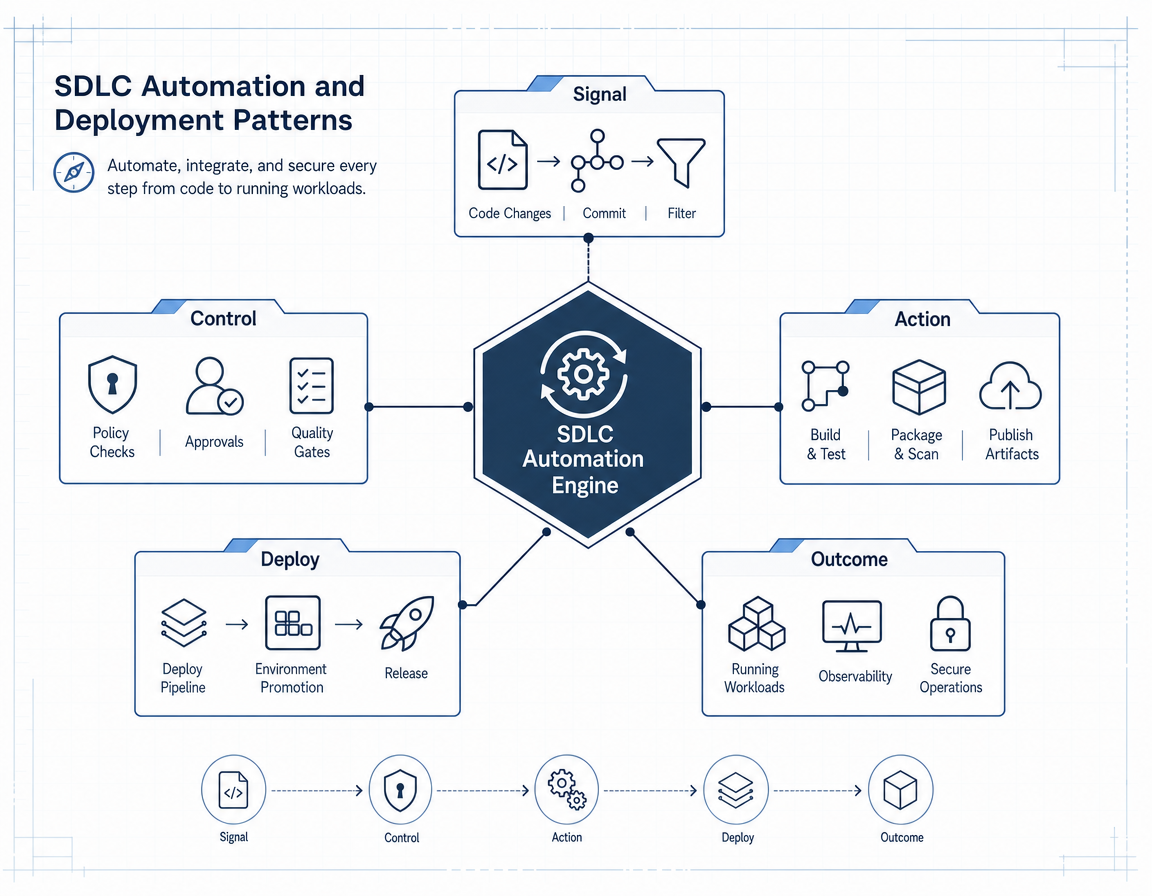
Pipeline architecture fundamentals. A well-designed AWS CI/CD pipeline typically flows from CodeCommit or a third-party repository into CodePipeline, which orchestrates build, test, and deployment stages. CodeBuild handles compilation and unit testing. CodeDeploy manages the actual deployment to compute targets. CodeArtifact stores dependencies and output packages. Understanding this flow matters more than knowing any single service's API surface.
The exam frequently tests deployment strategy selection. CodeDeploy supports several approaches, each with distinct trade-offs. In-place deployments update existing instances, requiring downtime but minimizing infrastructure cost. Blue/green deployments provision a parallel environment and switch traffic, enabling instant rollback but doubling resource requirements during deployment. Canary deployments route small percentages of traffic to validate new versions before full cutover, balancing risk and resource efficiency.
Your task on the exam is matching strategy to constraints. A financial services application with strict recovery time objectives probably warrants blue/green deployment despite higher cost. An internal tool with tolerant users might accept in-place updates. A customer-facing web application with unpredictable traffic patterns likely needs canary releases with automated CloudWatch alarm-based rollback triggers.
Artifact management and versioning. The exam tests whether you understand that build artifacts should be immutable and versioned. Once CodeBuild produces a deployment package, that exact package should progress through staging and production. Rebuilding at each stage introduces variability that defeats the purpose of pipeline testing. CodeArtifact and S3 with versioning enable this pattern, and questions often present scenarios where teams rebuild artifacts per environment, introducing subtle bugs that only appear in production.
Third-party integration. AWS doesn't expect pure AWS homogeneity. The exam includes questions about integrating GitHub, Jenkins, GitLab CI, and other tools into AWS-native pipelines. The key pattern is using CodePipeline as the orchestration layer while delegating build or source actions to external providers through supported integrations.
Main Layer 2-4: Configuration Management, Resilience, and Observability
These three layers function as the operational foundation that makes SDLC automation trustworthy. Without consistent infrastructure, reliable runtime behavior, and comprehensive visibility, even the most sophisticated pipeline delivers little value.
Configuration Management and IaC. CloudFormation remains the primary IaC service tested, though the exam acknowledges Terraform and other tools in hybrid scenarios. The critical concepts here include stack sets for multi-account deployment, drift detection for maintaining template compliance, and nested stacks for managing complex dependencies. Systems Manager complements CloudFormation by handling operational tasks that templates don't address well, such as patching schedules, parameter storage in Parameter Store, and automation documents for remediation workflows.
A common exam pattern presents a team managing infrastructure across development, staging, and production accounts. The correct solution typically involves CloudFormation stack sets deployed from a central tooling account, with StackSet constraints preventing production modifications from lower environments. IAM cross-account roles and service-linked roles feature heavily in these scenarios.
Resilient Cloud Solutions. This domain tests your ability to design systems that recover automatically from failures. Auto Scaling groups with health checks, multi-AZ deployments, and Route 53 health-based routing all appear regularly. The exam emphasizes distinguishing between high availability and disaster recovery. An application deployed across three availability zones achieves high availability against single-AZ failures. True disaster recovery requires cross-region replication and documented recovery procedures with tested recovery time objectives.
Elastic Load Balancing health checks, Auto Scaling termination policies, and ECS service auto-scaling represent specific mechanisms the exam expects you to configure correctly. Questions often present failing applications and ask you to identify which resilience mechanism is misconfigured or missing.
Monitoring and Logging. CloudWatch sits at the center of AWS observability, but the exam tests integration across multiple services. CloudWatch Logs for centralized logging, CloudWatch Metrics for operational dashboards, CloudWatch Alarms for automated responses, and CloudWatch Events (now part of EventBridge) for triggering automated workflows all appear. X-Ray adds distributed tracing for microservices architectures.
The exam frequently tests log aggregation patterns. A typical scenario involves applications running across EC2, ECS, and Lambda, with requirements for centralized analysis and alerting. The correct approach usually involves CloudWatch Logs insights for querying, metric filters for alarm generation, and potentially OpenSearch for complex analytics, with Kinesis Firehose handling high-volume streaming.
Maturity Path
Your preparation approach should evolve based on your current experience level. The exam assumes professional-tier expertise, but candidates arrive with varying backgrounds.
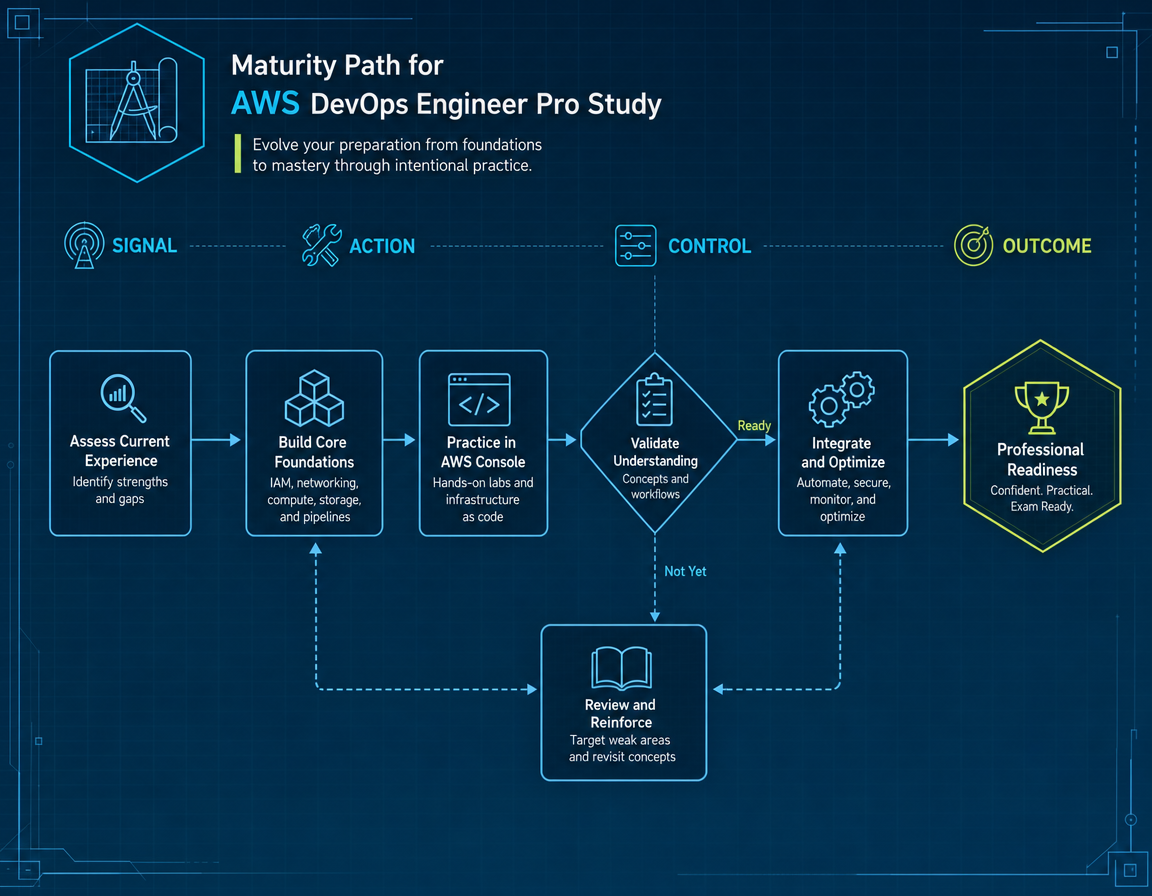
Beginner: Building foundational patterns. If you've passed the AWS Certified Developer or SysOps Administrator Associate exams but lack extensive production experience, start by implementing the core patterns manually. Build a CodePipeline that deploys a CloudFormation stack. Configure blue/green deployment with CodeDeploy to an Auto Scaling group. Set up CloudWatch alarms that trigger Systems Manager automation documents. The tactile experience of making these integrations work provides context that reading alone cannot.
At this stage, your study should emphasize breadth over depth. You need to know what each major service does, how services connect, and what problems each integration pattern solves. Practice exams become valuable for calibrating your understanding against actual question complexity. PlanetCert's flashcards can help reinforce service capabilities during this phase, letting you build quick recall without getting lost in documentation.
Intermediate: Optimizing and troubleshooting. With some production experience, shift focus to optimization and failure modes. Study how pipeline execution parallelism works, when to use CodeBuild batch builds versus separate projects, and how CloudFormation stack policies prevent dangerous updates. Practice identifying the root cause in scenario questions where multiple services could theoretically be at fault.
This is where targeted practice tests with detailed explanations become particularly valuable. You need feedback on why wrong answers are wrong, not just confirmation that right answers are right. The importance of real exam questions in certification preparation becomes clear at this stage, as they reveal the specific reasoning patterns the exam rewards. PlanetCert's practice tests include explanations that trace through this reasoning, helping you recognize the patterns faster.
Advanced: Architectural reasoning under constraints. Experienced DevOps engineers should focus on the trade-off analysis that distinguishes professional-level questions. Study cost optimization techniques for pipelines, such as using EC2 Spot instances for CodeBuild or S3 lifecycle policies for artifact retention. Understand when to recommend managed services versus self-managed alternatives. Practice explaining your reasoning for each choice in terms the exam's scoring methodology would recognize.
Real-World Scenarios
The pipeline that outpaced its monitoring. Maria's team had built an impressive CI/CD pipeline deploying microservices to ECS through CodePipeline. Deployment frequency increased from weekly to multiple times daily. But when a bad release caused intermittent latency spikes, they discovered their CloudWatch alarms only checked endpoint availability, not response time percentiles. The exam tests whether you would add CloudWatch Logs Insights queries, X-Ray service maps, and latency-based alarms with automatic rollback triggers before increasing deployment velocity.
The multi-account governance challenge. After acquiring another company, James needed to enforce consistent tagging and encryption standards across fifty AWS accounts. Manual auditing was impossible. The solution involved AWS Config rules deployed through CloudFormation StackSets, with Systems Manager Automation documents remediating non-compliant resources and SNS notifications alerting the security team. The exam presents similar scenarios testing your ability to select the right combination of governance services.
The failed rollback that wasn't tested. Priya's team used blue/green deployments for their customer API, but their first production rollback attempt failed because the Route 53 health check that controlled traffic shifting had been configured with overly aggressive thresholds. The green environment was marked unhealthy before it could stabilize, trapping traffic on the failing blue environment. The exam tests whether you understand proper health check configuration, including request intervals, failure thresholds, and the role of CloudWatch alarms in automated rollback decisions.
Common Mistakes to Avoid
Studying services in isolation. Opening the AWS documentation and reading about each service alphabetically feels productive but fails to build the integration understanding the exam tests. Instead, study by scenario: "How would I build a pipeline for a containerized microservice?" Then identify which services you need and how they connect.
Neglecting hands-on practice. The DOP-C02 exam scenarios describe situations that resonate differently when you've encountered similar challenges. If you've never configured a CodeDeploy deployment group or debugged a CloudFormation stack rollback, the abstract knowledge may not transfer to exam questions. Build at least one complete pipeline end-to-end.
Overlooking the exam guide's weightings. SDLC Automation represents 22% of scored content, nearly double some other domains. Yet many candidates distribute study time evenly across all topics. Focus your deepest preparation on pipeline design, deployment strategies, and automation patterns, then ensure solid competence in other areas.
Ignoring the business context in questions. Professional-level questions include constraints about cost, compliance, and team structure. An answer that's technically elegant but violates a stated budget constraint or requires expertise the team lacks is wrong. Read scenarios completely, noting all constraints, before evaluating options.
Relying solely on video courses without practice testing. Video content builds foundational knowledge effectively but rarely develops the rapid pattern recognition that timed exams require. Incorporate practice tests early and regularly, using them to identify weak areas rather than just confirming strengths.
How PlanetCert Helps
Preparing for the DOP-C02 exam demands more than understanding concepts in theory. You need repeated exposure to the specific question styles, scenario complexities, and service integration patterns that appear on the actual test. PlanetCert's practice test platform provides exam-style questions with detailed explanations that trace through the reasoning behind each correct answer and why distractors fail.
The platform's simulator replicates the timed pressure of the real exam, helping you develop pacing strategies for complex multi-part scenarios. Flashcards reinforce service capabilities and integration patterns for quick recall during the test. For candidates balancing preparation with full-time work, the mobile-friendly interface enables study during commutes and breaks, making consistent progress feasible even with demanding schedules.
If you're ready to validate your readiness, browse the relevant exam page and purchase a practice test.
Reader Questions
How much hands-on AWS experience do I really need for this exam?
AWS recommends two or more years, but quality matters more than duration. If you've designed, built, and operated complete CI/CD pipelines on AWS, including handling failures and optimizations, you may be ready with less calendar time. If your experience is limited to following tutorials without independent troubleshooting, you likely need more practice regardless of tenure.
Should I take the SysOps Administrator Associate before attempting DevOps Engineer Professional?
The associate certification provides valuable foundation, particularly for monitoring, logging, and basic automation. However, direct progression is possible if you have substantial professional experience. The DevOps Professional exam assumes you can design systems, not just operate them, so ensure your experience includes architectural decisions.
How do I handle questions where multiple answers seem partially correct?
This is the hallmark of professional-level exams. Look for the constraint that eliminates alternatives: a stated cost limit, a compliance requirement, a team skill set limitation, or a recovery time objective. The correct answer satisfies all constraints optimally, not just most of them.
What to Read Next
Your certification journey extends beyond any single exam. These related resources support continued growth in cloud operations and certification strategy.
If you're early in your AWS certification path, the study planning guide for tech certification exams offers frameworks for structuring preparation around work and life constraints. For understanding how practice questions build exam readiness, the discussion of real exam questions and certification success explains why quality practice materials matter more than volume.
Those considering broader cloud security credentials might explore the CCSP practice test comparison to understand how different certification programs structure their professional-level assessments. And if you're evaluating study platforms, the best certification exam platforms comparison provides criteria for selecting resources that match your learning style and schedule.
Final Synthesis
The AWS DevOps Engineer Professional exam rewards systems thinking over service memorization. The five content domains collapse into a coherent picture: automate software delivery through pipelines, define infrastructure as version-controlled templates, ensure resilience through health-aware architectures, and maintain observability through integrated logging and metrics. Security weaves through every layer rather than standing apart.
Your preparation succeeds when you can look at a scenario question, identify the underlying pattern being tested, and reason through service selection based on stated constraints. The topic map of SDLC automation, configuration management, resilience, and observability provides your mental model. The maturity path guides your progression from implementing individual patterns to optimizing complex systems. And the common mistakes highlight where candidates most often divert effort from what actually matters.
Related Blog Posts
- Role of real exam questions — Understand how practice questions develop the pattern recognition skills this exam demands
- 7 key types of certification exams for IT success — Contextualize where the AWS DevOps Professional fits in broader career planning
- What is CCNA certification — Compare network-focused certification paths with cloud DevOps credentials for career trajectory decisions

Discussion
Question Comments
0 comments·0 participantsSign in to leave a comment and access more free questions.