

For IT professionals comparing self study with guides vs video courses, the practical question is which approach will prepare you to answer unfamiliar questions and apply concepts under exam conditions. A pass-rate percentage could help, but only if the underlying comparison accounts for experience, exam version, study time and additional practice.
This report contains no verified comparative candidate survey or delayed-recall dataset. It therefore cannot establish a numerical pass-rate or retention advantage for either medium. Its purpose is to explain what credible comparative data would need to show, assess the practical uses of each format, and outline checks you can apply before your exam.
I recommend choosing a primary resource around your knowledge gaps and available study time, then checking progress through closed-resource explanations, unfamiliar questions and practical tasks. The scope here is independent IT certification preparation using written guides, recorded courses or a combination.
What pass-rate data would need to prove
Comparing guides with video courses requires a clear definition of success and a fair account of how candidates prepared. Without those details, a headline percentage gives you little basis for choosing a resource.
Define the candidate group and outcome
A useful first-attempt pass rate has a straightforward calculation:
First-attempt pass rate = first-attempt passes ÷ candidates who took their first attempt × 100.
The denominator needs attention. Ask whether the calculation includes every eligible exam taker, only course completers, or only people who answered a follow-up survey. Each describes a different group.
Also check how results were recorded. A candidate’s self-reported result and a verified exam outcome should be identified separately. Missing responses need to remain visible.
For a comparison relevant to your decision, look for the same certification and exam version, a stated reporting period, and clear rules about previous attempts. Treat results from different exams as separate findings unless the analysis explains how they were combined.
Account for preparation beyond the main resource
The label “video learner” leaves several questions unanswered. Did that person also use a textbook, complete labs, attend employer training or practise with question sets? The same questions apply to a guide-led candidate.
Prior experience matters to the interpretation too. A network administrator revising familiar routing concepts and a career switcher encountering them for the first time have different starting points.
A credible comparison should record:
- Relevant work experience and baseline knowledge.
- Time spent studying, including practical work.
- Additional resources and instructor support.
- Resource completion and alignment with exam objectives.
Even a well-described survey would establish an association within its candidate group. A claim that one medium caused better results would require stronger controls over how candidates entered each group and what they did afterwards.
Before accepting a provider’s pass-rate claim, ask for its population, denominator, reporting period and preparation criteria.
Where each study format earns its place
Guides and videos give you different ways to work through material. The following comparison is planning guidance; it contains no measured performance rankings.
| Study approach | Useful task | Learning check | Planning risk |
|---|---|---|---|
| Guide-led | Compare definitions, constraints and configuration details | Explain distinctions with the book closed | Reading advances without independent recall checks |
| Video-led | Observe a demonstrated procedure and its sequence | Reproduce the task without playback | Watching continues without a separate attempt |
| Combined | Use a second explanation for a specific gap | Answer a fresh question or complete the task independently | Duplicate coverage consumes the study budget |
Use guides for precise comparisons
A written guide lets you revisit a paragraph, inspect a diagram and compare nearby explanations at your own pace. I would use it when the task involves distinguishing similar concepts or checking a precise constraint.
For a routing topic, write down why one route would be selected over another. Then check your reasoning against the explanation. For permissions, describe the access a configuration should permit before reviewing the worked example.
Check currency before committing to a long reading plan. Match the edition and topic coverage to the objectives for your booked exam. The outdated study guide checks provide a separate resource for that assessment.
Use video to inspect a process
A recorded demonstration can show command order, interface changes and the relationship between an action and its result. Choose a segment that addresses the task you cannot yet perform.
Pause at a meaningful step, predict what should happen, and attempt the procedure independently where you have a suitable practice environment. Record the point at which you needed help.
When comparing paid courses, inspect the syllabus, sample teaching and objective coverage. For an AWS-focused example, the Udemy SAA course comparison addresses that resource-selection decision. Confirm alignment with your intended exam before adopting any course as your main resource.
Measure recall after the material is closed
Retention checks should ask what you can explain or do after studying with either format. Completion percentages alone cannot answer that question.
Separate immediate performance from later recall
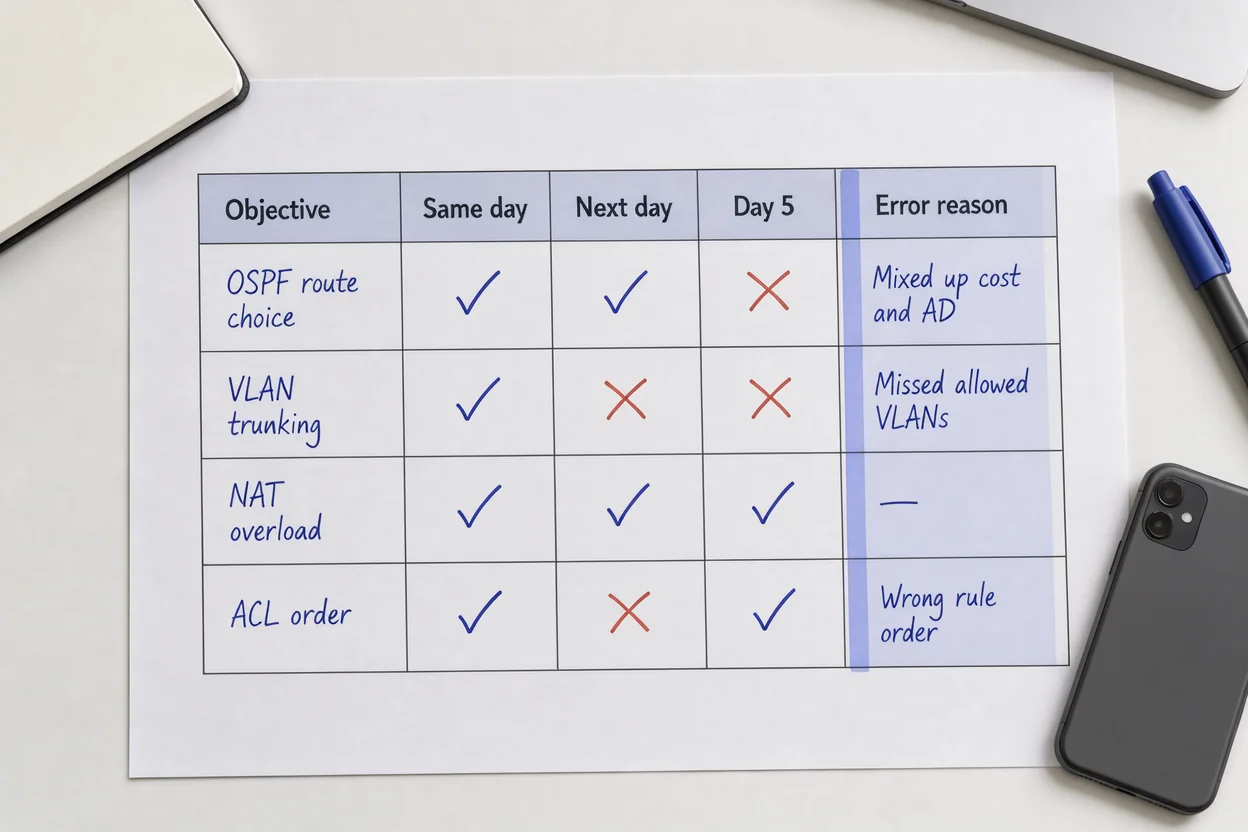
An immediate check asks whether you can work with material straight after a chapter or lesson. A delayed check asks what remains accessible after time has passed.
For a practical study routine, try a short check the following day and another several days later. These are suggested review intervals, not evidence of an optimal schedule for every learner.
Use a mixture of tasks:
- Explain a concept without opening your notes.
- Answer an unfamiliar scenario question.
- Carry out a relevant procedure without following a demonstration.
- Explain why a plausible alternative answer fails the scenario’s requirements.
Keep the task tied to an objective. “Understand networking” is too broad to assess consistently. “Explain the route selected in this scenario” gives you a specific answer to inspect.
Record errors with enough detail to act
If you use PlanetCert practice tests, commit to an answer before consulting its explanation. Write down the reasoning that led to your choice, then compare it with the explanation.
Classify the gap: missing knowledge, confusion between alternatives, difficulty applying a concept, or a missed condition in the question. Choose the next study action from that record.
A terminology gap may justify a focused reading passage. Trouble following a procedure may justify a demonstration followed by another independent attempt. For a separate discussion of interpreting performance records, see exam simulator analytics.
If you calculate a personal recall percentage, state what counted as correct and keep the scoring rule consistent. Record the delay and whether each question was new. Keep short explanations beside the number so you can see exactly what needs another attempt.
Compare your own results without overstating them
A small personal comparison can help you choose between guides and video before you invest the rest of your study window. Treat it as a resource-selection exercise with explicit limits.
Keep the study conditions comparable
Choose two objectives with similar familiarity and manageable scope. Attempt a brief baseline task for each before studying. Record any prior experience that might affect the comparison.
As an illustrative setup, allocate 30 minutes to a guide-based session and 30 minutes to a video-based session. Give both sessions the same allowance for independent practice. Include pauses, rewinds and note-making in the time budget.
Check each topic immediately afterwards and again after 48 hours. Use different questions that require comparable reasoning. For a procedure, change a relevant input or condition while keeping the underlying task similar.
Record the outcome, elapsed time and help required. A topic answered correctly only after reopening the resource needs a different entry from one explained independently.
Use the result to adjust one decision
Two topics cannot establish a universal medium preference. Their difficulty may differ, and the selected author or instructor may explain one topic more clearly. Your baseline knowledge may also be uneven.
Use the result to decide what to try for the next weak objective. If the comparison remains unclear, repeat it with another pair before replacing your main resource.
A useful interactive study log could accept the objective, format, study minutes, delayed result and assistance used, then flag objectives that need another independent check.
Keep spending decisions separate from confidence ratings. Record what each resource costs and whether access lasts through your planned exam date. Change one part of the study plan at a time so you can interpret the next result.
Build a four-week plan around the exam objectives
A combined study plan needs a defined job for each resource. Four weeks is an illustrative schedule; extend it when your baseline assessment shows gaps that the available hours cannot cover.
Week one: map coverage and establish a baseline
List the objectives for your intended exam and record the version you plan to sit. Compare that list with your guide’s contents or course syllabus.
Mark each objective according to what you can currently explain or perform. Use a short diagnostic to identify topics that deserve closer inspection. Keep guessed answers visible, even when the guess was correct.
Choose one primary resource for the week. Reserve the alternative format for a named problem, such as an unclear explanation or a procedure you cannot reproduce.
Build the timetable around sessions you can realistically protect after work. For a concrete scheduling example, the four-week PCEP-30-02 study plan provides an exam-specific companion.
Weeks two and three: close gaps and revisit them
Work through objectives in manageable groups. After each study session, complete a closed-resource task and record the next review date.
When an explanation fails to resolve a gap, identify what is missing before switching format. You might need a worked example, a diagram or a demonstration of state changes. Select the smallest useful replacement segment.
Then repeat the independent task. Keep the second resource only if it helps you address the recorded problem within your time budget.
Include questions from earlier objectives alongside recent material. Keep familiar and unseen questions separate in your records, and reserve some fresh material for later checks.
Week four: rehearse timing and inspect unresolved gaps
Move some practice into sessions with a defined time limit. Use a rehearsal length appropriate to your exam and record where you needed to rush or revisit a question.
If you use PlanetCert’s exam simulator, treat the timed session as a rehearsal with specific observations to capture. Its result should sit beside your objective log, explanations and practical work.
The guide to full-length timed simulators provides a companion discussion of that preparation stage.
Review incorrect answers and correct guesses. For each unresolved objective, choose a concrete task to complete before the next rehearsal. Avoid converting one practice percentage directly into a predicted probability of passing the live exam.
Questions to settle before changing resources
The choice between guides and courses often becomes urgent when progress feels slow. These decisions should follow the gaps in your record and the time remaining before the exam.
Do I need to buy both formats?
Start with one resource that covers your objectives and that you can use consistently. Add another when you can name the problem it should solve.
If you can explain a topic, answer fresh questions and perform the relevant task independently, buying another explanation may have little practical purpose for that objective. Keep the budget available for gaps you have actually recorded.
Access needs also belong in the decision. Inspect sample pages, captions, transcripts, playback controls or downloadable material as relevant to your circumstances. Check the particular resource before purchasing; those provisions vary.
Should I switch if my scores stop improving?
Inspect the errors first. A plateau leaves several possible actions: revisit missing content, practise applying it, slow down to read conditions, or attempt a task independently.
Switch format when the current explanation leaves a specific obstacle unresolved. Set a bounded trial for the replacement, then repeat the learning check.
If fatigue makes evening reading impractical, test a shorter video segment with a written recall task afterwards. If playback consumes the session, test a focused reading passage followed by the same kind of check.
Keep the format that supports demonstrable progress within your available hours. For your next session, name one weak objective, select one explanation and write down the independent task you will attempt afterwards.
Check practice quality, access costs and exam errors


Discussion
Question Comments
0 comments·0 participantsSign in to leave a comment and access more free questions.